- The paper demonstrates that heat transport in an InAs nanowire adheres to one-dimensional electron-phonon coupling with an exponent n ≈ 2.6.
- It employs quantum dot thermometry with localized Joule heating to precisely measure spatial temperature gradients and minimal thermal leakage.
- The findings challenge the Wiedemann-Franz law due to superconductivity-induced deviations, offering insights for cryogenic electronics and quantum device design.
Heat Conduction and Energy Relaxation in InAs Nanowires: Approaching the Clean 1D Limit
Introduction
The paper "Heat Conduction and Energy Relaxation in an InAs Nanowire Approaching the Clean One-Dimensional Limit" (2603.29358) presents a quantitative investigation of mesoscopic heat transport and energy relaxation in a semiconductor nanowire system. Employing an epitaxially grown InAs nanowire with in-situ quantum dot thermometry and localized Joule heating, the study analyzes both electronic and phonon-mediated heat flow via a one-dimensional transport model. The work targets the regime where the nanowire dimensions, phonon spectra, and electronic mean free path converge to the clean 1D limit, providing a platform for fundamental studies in quantum thermodynamics, low-temperature electronics, and nanoscale heat management.
Experimental Architecture
The hybrid device consists of a 70 nm diameter wurtzite InAs nanowire, with a well-defined quantum dot (QD) formed by InP barriers (Figure 1). Superconducting contacts are spaced 250 nm apart, allowing precise control over localized Joule heating. The QD, placed 1.3 μm from the wire end, serves as a primary thermometer by resolving thermal broadening in Coulomb blockade transport. The device configuration leverages the extremely low thermal conductance of the superconducting contacts at cryogenic temperatures, ensuring that heat transport occurs almost exclusively within the nanowire. Electronic transport characterization confirms Coulomb diamonds with a charging energy of Ec=4 meV and minimal orbital splitting, indicating dominant Coulomb blockade physics.
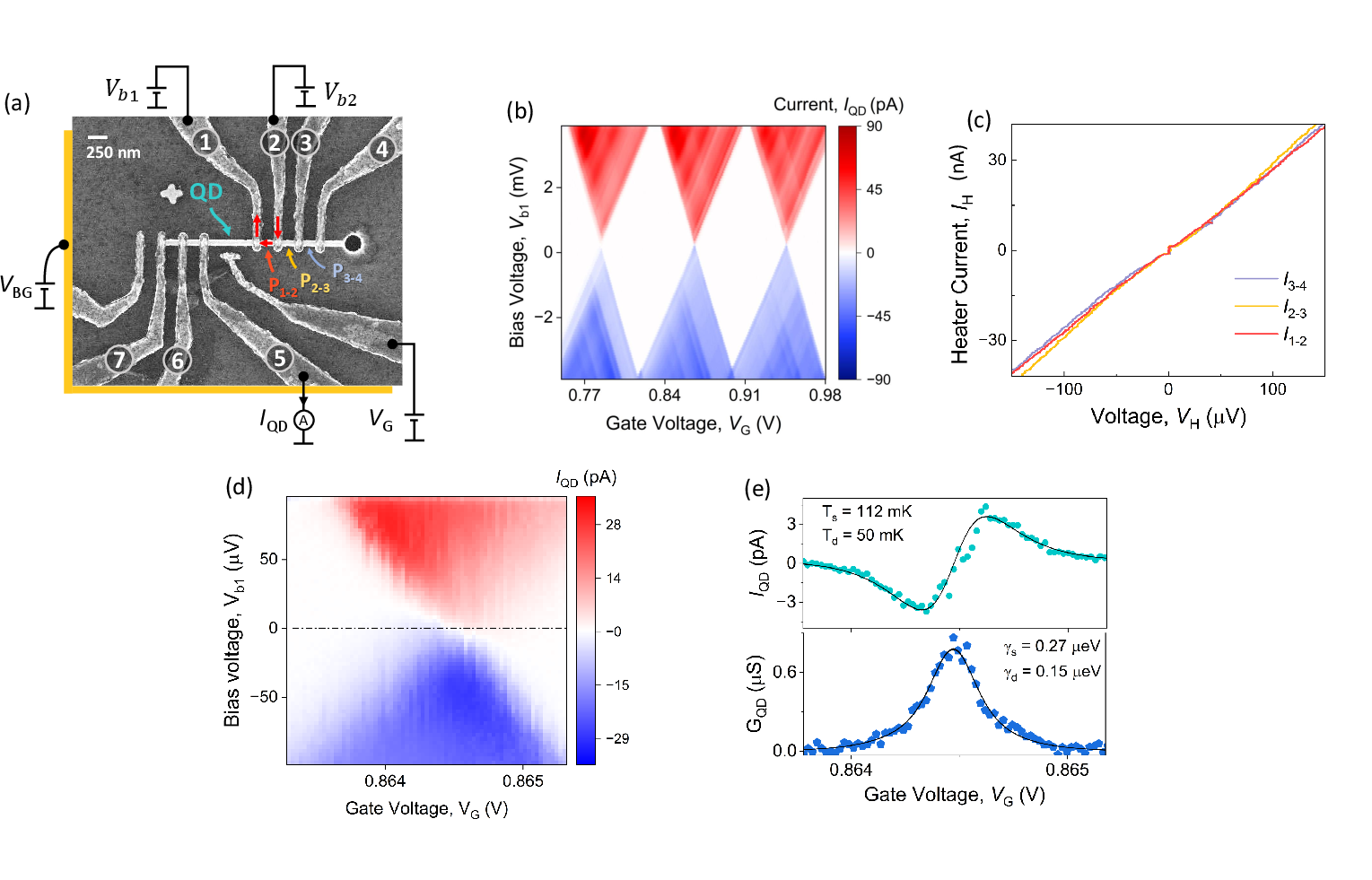
Figure 1: Scanning electron micrograph of the semiconductor-superconductor hybrid device, detailed QD location and contacts, and characteristic transport signatures.
Results: Thermometry and Heat Transport Modeling
Local electronic temperatures are accessed via QD thermometry, with fits based on Landauer-Büttiker formalism in the thermally broadened limit. Controlled Joule heating between specific contacts produces spatial temperature gradients, with measured source and drain temperatures (Ts, Td) reflecting steady-state heat flow and energy relaxation. Data reveal that heating power near the QD yields maximal temperature response, confirming the presence of longitudinal gradients.
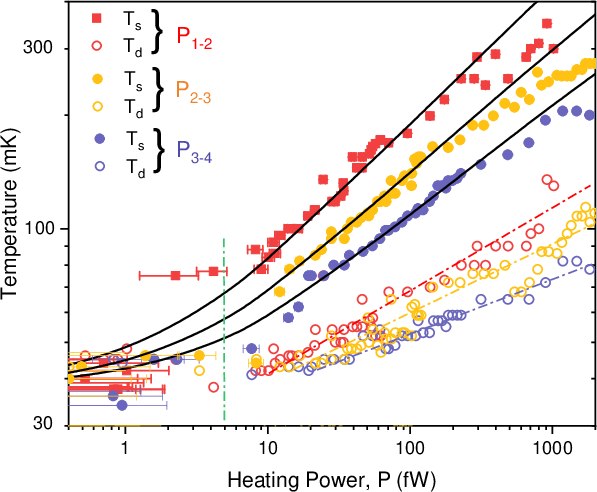
Figure 2: Source and drain temperature response to heating in distinct wire segments, fit with the one-dimensional heat-flow model.
Analysis utilizes a 1D heat transport equation combining electronic diffusion and generalized electron-phonon cooling (P∝Tn), with three principal fit parameters: electron-phonon coupling constant (Σ), power-law exponent (n), and Lorentz number renormalization (ξ). Experimental fits yield n=2.6±0.2, Σ=(2±0.2)×109 W/m3KTs0, and a substantial reduction in Lorentz factor (Ts1), indicating significant deviation from Wiedemann-Franz law—likely due to proximity-induced superconductivity in the nanowire.
Mechanisms of Energy Relaxation and Thermal Conductance
The extracted exponent (Ts2) closely matches the Ts3 scaling expected for clean one-dimensional electron-phonon coupling, supporting a regime distinct from disorder-dominated or higher-dimensional systems. Calculated electronic and phonon thermal conductances reveal Ts4 exceeds Ts5 for wire segments below the characteristic equilibration length (Ts6). This length, defined as Ts7 nm at 100 mK, demarcates the crossover from electronic diffusion-dominated to phonon-mediated cooling.
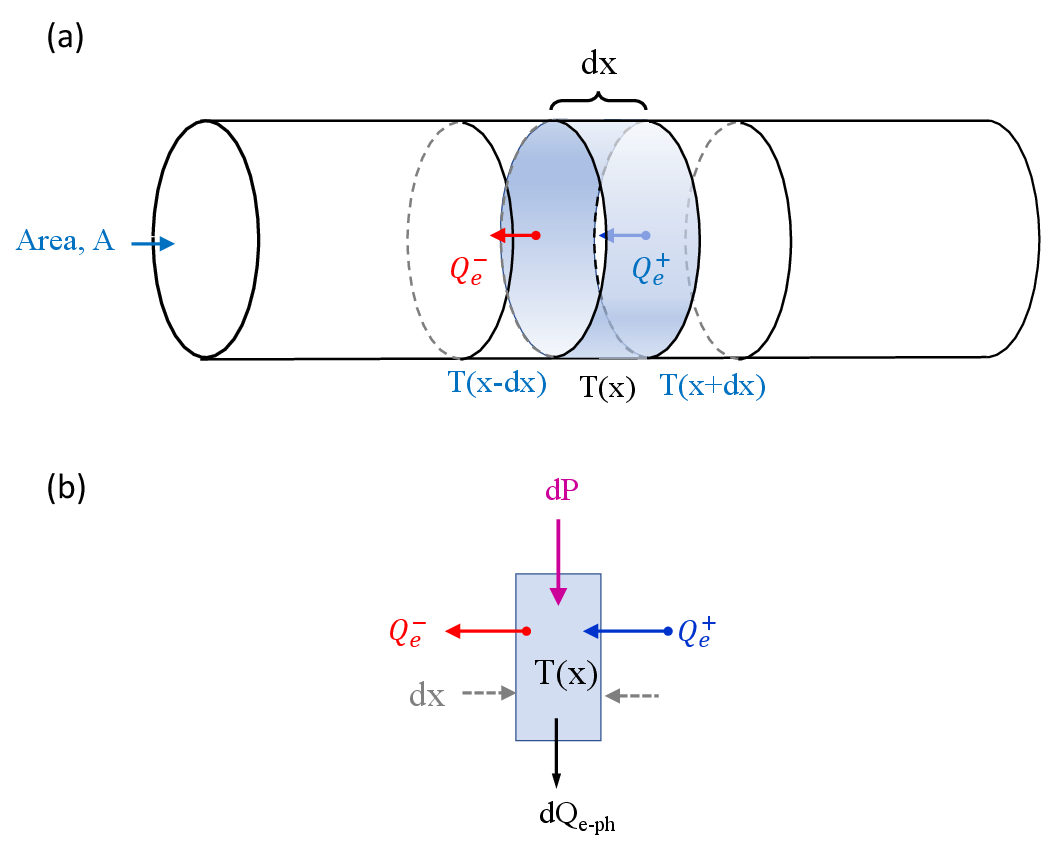
Figure 3: Schematic of one-dimensional NW thermal model and heat balance in elementary wire volumes.
Quantum dot thermometry was evaluated for invasive heat leakage. The QD acts as a minimally invasive local thermometer, with sub-1% heat leak relative to total nanowire heat transport, and a thermal conductance Ts8 only Ts9 of the ballistic quantum limit. The Lorentz number in the QD is considerably enhanced, attributed to energy filtering effects in the Coulomb blockade regime.
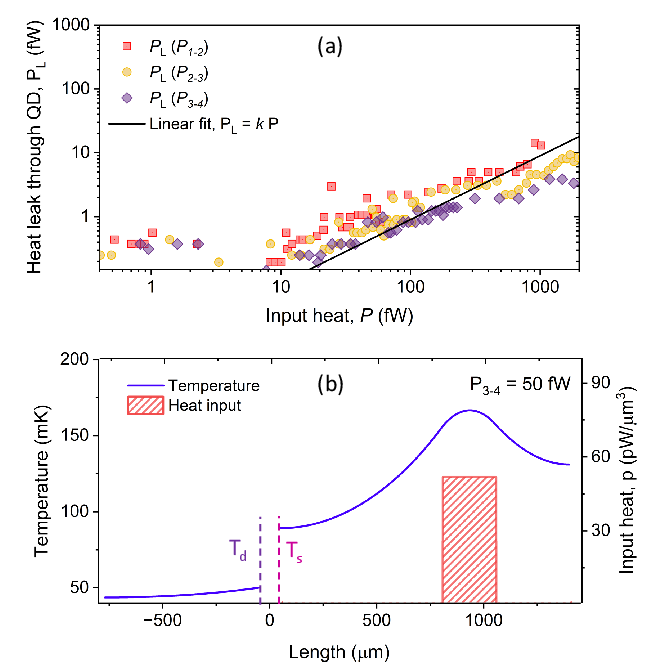
Figure 4: Quantification of heat flow through the QD and computed temperature profile along the nanowire.
Implications for Nanoscale Thermodynamics
Experimental quantification of heat flow in a clean 1D nanowire provides detailed parameters for energy relaxation relevant to quantum devices. The measured exponent and characteristic length facilitate predictive design of nanowire systems where thermal management, thermoelectric efficiency, and quantum decoherence are impacted by electron-phonon coupling. The breakdown of the Wiedemann-Franz law and identification of minimal thermal leakage in QD thermometry offer new understanding for devices integrating superconducting contacts and quantum dot arrays.
The results extend the framework for studying heat transport and relaxation in low-dimensional nanostructures, with practical implications for high-performance cryogenic electronics, quantum computing, and thermoelectric energy conversion. The approaches and findings are applicable to nanowire architectures with variable length scales, contact configurations, and material systems, offering generalizable design rules.
Future Directions
Additional studies may probe the crossover between clean and disordered regimes, influence of surface/interface scattering, and electron-phonon coupling modulation by gating or environmental factors. Further integration of quantum dot heat engines, noise thermometry, and calorimetric platforms could leverage the minimal invasiveness and sensitivity of the QD thermometer demonstrated in this work.
Scaling experiments at lower temperatures, higher bias, or with substrate engineering can systematically elucidate fundamental quantum limits of thermal transport. Comparative studies in other semiconductor materials or hybrid systems will expand the theoretical landscape and technological utility.
Conclusion
This paper delineates heat conduction and energy dissipation in a clean one-dimensional InAs nanowire, quantitatively described by electron-phonon coupling exponent Td0, a characteristic relaxation length Td1, and deviations from Wiedemann-Franz law attributed to superconducting proximity effects. The minimally invasive quantum dot thermometer enables precise local measurements and sets a new benchmark for non-galvanic electronic thermometry. The results provide rigorous benchmarks and parameters for thermal engineering and quantum device applications in semiconductor nanowire systems.