- The paper introduces a novel funding model where cryptocurrency tokens are minted only after spectroscopic confirmation of galaxies.
- It utilizes a hybrid token supply mechanism with strict detection criteria and transparent governance to ensure funding integrity.
- The framework enhances economic scalability and public engagement by directly linking scientific progress to funding rewards.
Introduction and Motivation
The manuscript provides an extensive proposal for a novel funding paradigm in extragalactic astronomy predicated on the deployment of a cryptocurrency ("GAL") directly linked to spectroscopically confirmed galaxies. This structure addresses endemic vulnerabilities in traditional funding (government allocations, philanthropy, institutional short-termism) by embedding monetary reward into the empirical advancement of astronomical knowledge. Each token is cryptographically associated with a unique galaxy, minted only upon robust spectroscopic confirmation, and administered by a not-for-profit entity. Notably, the proposed system is engineered to be transparent, immutable, and verifiable, leveraging existing survey infrastructures and public astronomical databases.

Figure 1: Symbolic representation of the proposed GAL cryptocurrency as referenced in the design specification.
Tokenomics and Verification Mechanism
At the algorithmic level, GAL embodies a supply model interpolating between complete elasticity (fiat money) and the algorithmic determinism characteristic of fixed-supply cryptocurrencies. The total monetary base is capped by the ultimately observable galactic population (current lower bound ∼1012), but growth is strictly conditioned on the production of new high-confidence data. The design precludes arbitrary expansion, relying on irreducible scientific effort for minting new coins. Each token is unique (non-fungible), mapped to a galaxy catalog entry, but nominally identical in value to discourage secondary speculation.
Critical to system integrity are unambiguous selection criteria for galaxy identification. The architecture relies on segmentation algorithms (e.g., SExtractor [1996A&AS..117..393B]) with robust post-processing thresholds (minimum 5σ detection), mandating spatial isolation (≥100 kpc separation) and requiring spectroscopic confirmation to disambiguate from foreground contaminants such as brown dwarfs (Tu et al., 28 Jan 2025). This dual-requirement mitigates spurious coin proliferation and maintains alignment with the principles of reproducibility and open validation. Governance extensions support additional domain-specific currencies for multi-wavelength or rare-source incentivization, increasing architectural flexibility.
Economic and Sociotechnical Implications
The system reconfigures incentive alignment in observational astronomy, shifting from legacy metrics (publication counts, impact factor pursuit) towards directly rewarding empirical discovery. By design, it privileges deep, high-resolution, and wide-area surveys, new instrumentation, and improvements in data-processing pipelines. Minting rewards are returned predominantly to the originating research consortia, creating a feedback loop for infrastructure investment. The projected effect is an exponential acceleration in the spectroscopic census of observable galaxies.
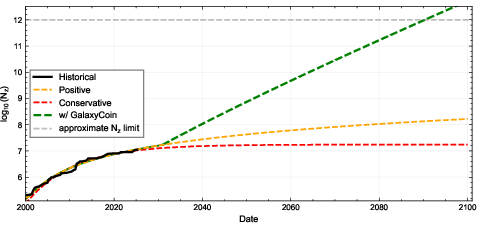
Figure 2: Modeled rate of spectroscopically confirmed galaxy identification with (blue curve) and without (black curve) GAL-based incentives, juxtaposed with historical data from NASA/IPAC Extragalactic Database. The model suggests practical closure on the observable galaxy census within ∼100 years under galvanized incentive dynamics.
The monetary design provides a unique hybrid: supply expansion is a direct function of cumulative scientific progress and remains publicly auditable, refuting opacity and deficit-driven manipulation in both central banking and conventional cryptocurrencies. Existing limitations of fungibility are expected to be negligible for practical commerce, except for a small tail of tokens coincident with high-profile or rare galaxies. Notably, the face value of each coin is fixed across tokens, explicitly to avoid cosmological model-dependence and mitigate inflationary/deflationary risk with changing cosmological parameters [2019NatAs...3..891V, (Roper et al., 2023)].
From a public engagement perspective, this system enables direct lay participation in the scientific enterprise, converting the otherwise abstract process of cataloging galaxies into ownership of uniquely mapped digital assets. This transformation potentially broadens science communication, augmenting public literacy and fostering new models for distributed science funding.
Numerical Projections and Theoretical Boundaries
The current supply of spectroscopically confirmed galaxies is approximately 107. If the GAL ecosystem were to subsume the total current global money supply (M3 ∼1014), each GAL token would accrue a notional value of ∼£107. With future economic growth and eventual catalog completion (∼1012 galaxies), each token would stabilize around a floor value of ∼£103, assuming proportional economic expansion. This scaling ensures long-term viability and preserves economic meaning throughout the rollout.
The GAL protocol accommodates possible future scaling through parallel currency models:
- Wavelength-specific tokens for facilitating multi-band observational follow-up (Pacifici et al., 2022, Conroy, 2013).
- Rewards for rare, scientifically exceptional galaxies via proportional or bespoke tokens (Wilkins et al., 2024, Lovell et al., 31 Mar 2025).
- Extensions to planetary, stellar, and even speculative domains (e.g., exoplanets, habitable zones, or exotic objects (Roper et al., 2022)) further broadening the impact surface.
Limitations and Extensions
Although the architecture robustly incentivizes extragalactic observational confirmation, it does not natively address incentivization for non-galactic research domains or derived scientific outputs (e.g., theoretical modeling, instrument design) outside the direct mapping to observational tokenization. Incentive imbalance may bias resource allocation toward initial detection over subsequent characterization. However, the framework’s extensibility allows rapid adaptation for these contingencies through collateralized token families and research output-linked smart contracts.
Conclusion
The proposed cryptocurrency model links the expansion of monetary instruments to the irreversible advancement of cosmological knowledge, aligning scientific, economic, and public engagement objectives within a transparent decentralized infrastructure. By utilizing the intrinsic properties of galaxies as anchors of digital scarcity, the system offers an operational blueprint for scalable, non-arbitrary, empirically justified funding structures in fundamental science.
If realized, this approach would instantiate a direct feedback loop between discovery velocity and financial inflow, fundamentally altering the organizational economics of large-scale observational astronomy. Extensions to other domains are straightforward, opening a new vector for participatory, trustless science funding and governance.
References: The technical summary is based on "An innovative alternative to traditional funding streams for extragalactic astronomy" (2603.29340) and employs contextual citations throughout for domain-specific claims.