- The paper demonstrates that the low-mass stellar–halo mass relation exhibits an upturn at M_h ~ 10^10 h⁻¹ M☉, indicating rising star formation efficiency.
- It employs a PAC cross-correlation technique with DESI and DECaLS photometry to achieve a complete mapping of the galaxy stellar mass function down to ~10^6 M☉.
- The study provides robust halo mass constraints and examines reionization and assembly bias effects, offering key insights into dark matter and feedback models.
Mapping the Galaxy–Halo Connection into the 106 M⊙ Frontier with DESI and PAC
Introduction and Motivation
The galaxy–halo connection at the low stellar mass regime provides crucial tests for both cosmological models of structure formation and baryonic feedback physics. Progress has historically been impeded by the severe incompleteness in spectroscopic observations and the possibility that the well-known Local Void undercuts inference of global trends from local dwarf populations. This paper leverages the Photometric objects Around Cosmic webs (PAC) method and Year 1 DESI BGS together with DECaLS photometry to execute a detailed analysis of the galaxy–halo connection down to M∗≈106.4 M⊙, achieving a definitive mapping of the stellar–halo mass relation (SHMR) and the galaxy stellar mass function (GSMF) in the low-mass domain under controlled selection and completeness.
Datasets and the PAC Methodology
DESI's spectroscopic BGS sample, with its broad and deep sky coverage, is matched with DECaLS grz imaging, delivering multi-band photometry of high completeness to r∼22.5 across >5,000 deg2 in the DESI footprint. The PAC methodology operates by cross-correlating spectroscopic and photometric selections, projecting photometric properties along the redshift axis of spectra, and constructing a data vector n(rp) — the excess projected surface density of photometric galaxies around spectroscopic tracers — as a function of both photometric and spectroscopic stellar mass bins.
The work applies rigorous completeness thresholding (Figure 1) to restrict n measurements to fully complete regimes in both datasets, resulting in 349 n measurements covering M∗=106.3−1011.9 M⊙ (photometric) and M∗=108.3−1011.7 M⊙ (spectroscopic), with radial bins spanning M∗≈106.4 M⊙0–M∗≈106.4 M⊙1.
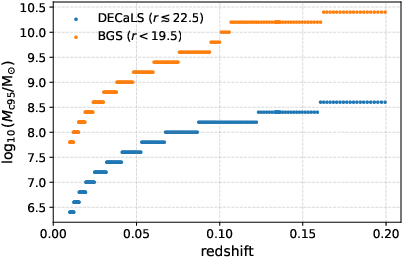
Figure 1: The 95% completeness stellar mass limits M∗≈106.4 M⊙2 for DECaLS and BGS samples as a function of redshift.
Signal-to-noise and covariances across the M∗≈106.4 M⊙3 grid are quantified (Figure 2–Figure 3), with robust compression and shrinkage techniques applied to the jackknife-derived covariance to enable feasible inference in a high-dimensional space.
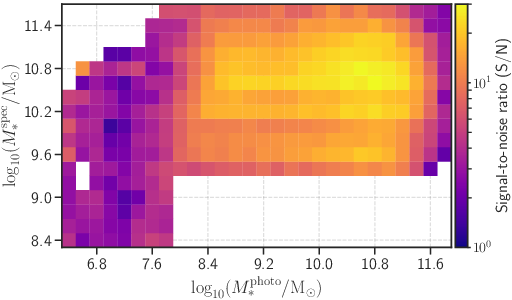
Figure 2: Total signal-to-noise ratio of each M∗≈106.4 M⊙4 measurement in bins of M∗≈106.4 M⊙5 and M∗≈106.4 M⊙6.
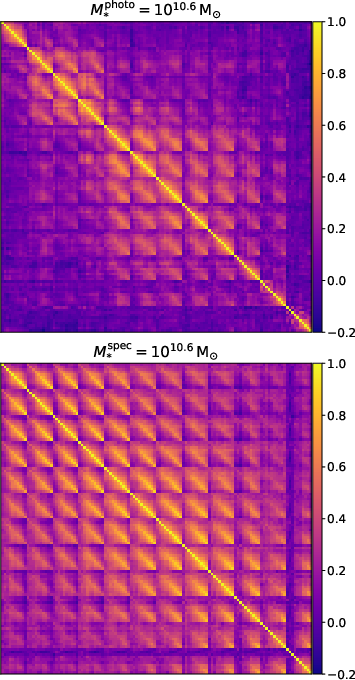
Figure 4: Normalized covariance matrices of M∗≈106.4 M⊙7 measurements for samples with M∗≈106.4 M⊙8 and M∗≈106.4 M⊙9 fixed at r∼22.50.
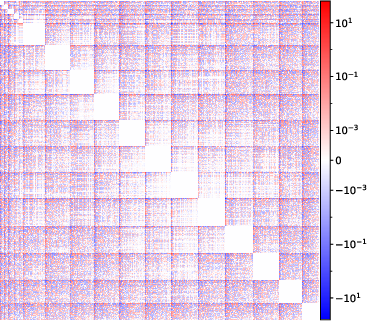
Figure 3: Estimated covariance matrix of the normalized r∼22.51 data vector in the compressed PCA space.
SHMR Inference with SHAM Modeling
The core modeling employs a subhalo abundance matching (SHAM) strategy coupled with high-resolution r∼22.52-body simulations from the Jiutian suite (mass resolution to r∼22.53), extended by careful orphan correction to avoid artificial subhalo disruption. PAC measurements are matched to model prediction using pre-tabulated correlation functions for halo–halo, halo–subhalo, and subhalo–subhalo pairs.
The SHMR is treated with both non-parametric (monotonic) and parametric models for centrals and satellites, with lognormal scatter. The fiducial model adopts constant scatter, but variants allow for mass-dependent scatter and incorporate reionization-induced suppression of halo occupation via models for the halo occupation fraction (HOF).
Main Numerical Results and Physical Implications
SHMR Features and Central/Satellite Demarcation
A key result is the clear upturn in the mean central SHMR at r∼22.54 (Figure 5), which persists across all tested models for scatter and assembly bias. This upturn indicates rising star formation efficiency (SFE) in lower-mass halos, potentially contradicting the usual assumption of monotonically decreasing SFE toward the low-mass end.
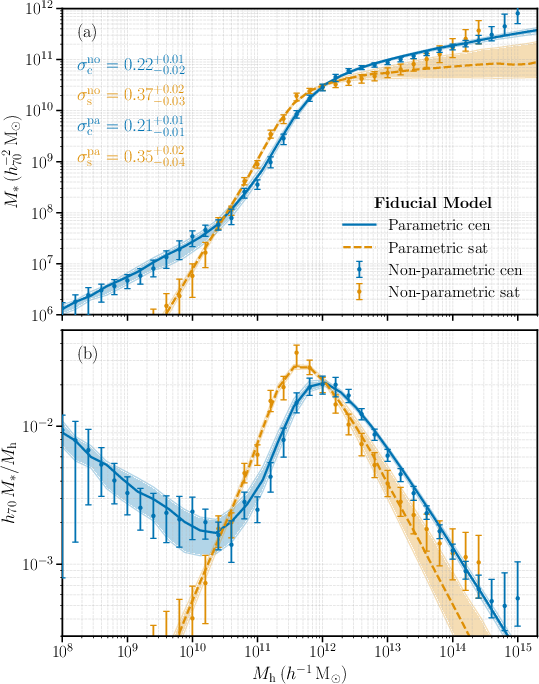
Figure 5: Mean stellar–halo mass relations (top) and stellar-to-halo mass ratios (bottom) for central (blue) and satellite (orange) galaxies from non-parametric and parametric SHMR models. Error bars and shaded regions reflect MAP and r∼22.55 intervals.
Sharp demarcation is found between centrals and satellites, especially evident at intermediate and low masses, establishing the necessity to model these populations independently.
Model Fit Quality
The reduced r∼22.56 distribution across all bins (Figure 6) demonstrates satisfactory model performance given the covariance structure. Non-parametric and parametric models yield mutually consistent SHMRs and GSMFs.
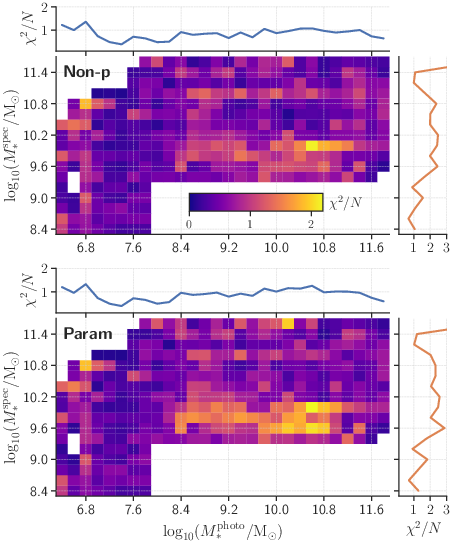
Figure 6: Reduced r∼22.57 values for the non-parametric (top) and parametric (bottom) model fits to each r∼22.58 measurement and per r∼22.59/>5,0000 bin.
SHMR Scatter and Degeneracy
Allowing mass-dependent lognormal scatter increases the error envelopes for both the SHMR and the GSMF but does not erase the upturn at the low-mass end, confirming its robustness (Figure 7).
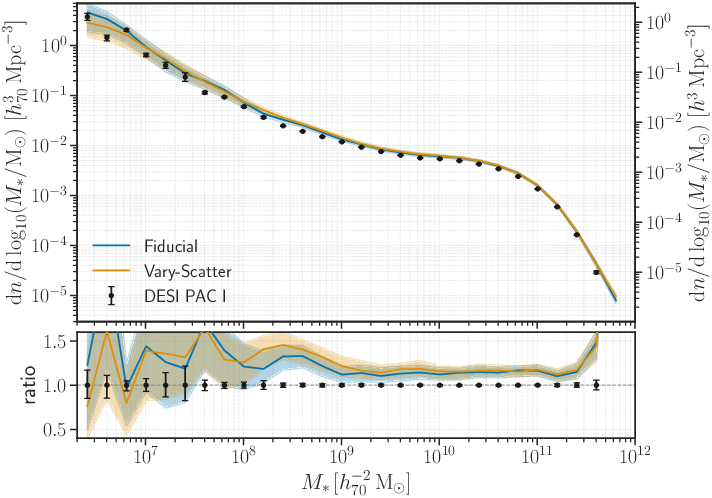
Figure 7: GSMFs from fiducial and mass-dependent-scatter non-parametric SHAM models, compared to previous results.
Reionization and HOF
Accounting for reionization via HOF based on H I and H>5,0001 cooling prescriptions reveals that, without invoking strong assembly bias, current models under-predict observed dwarf abundances at >5,0002 unless H>5,0003 cooling is efficient and/or the assembly bias is maximal — but even then, tension persists (Figures 14–17).
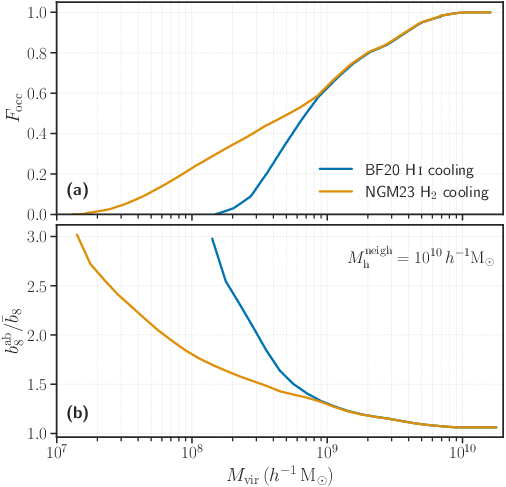
Figure 8: (a) Halo occupation fraction at >5,0004 from several gas cooling models.
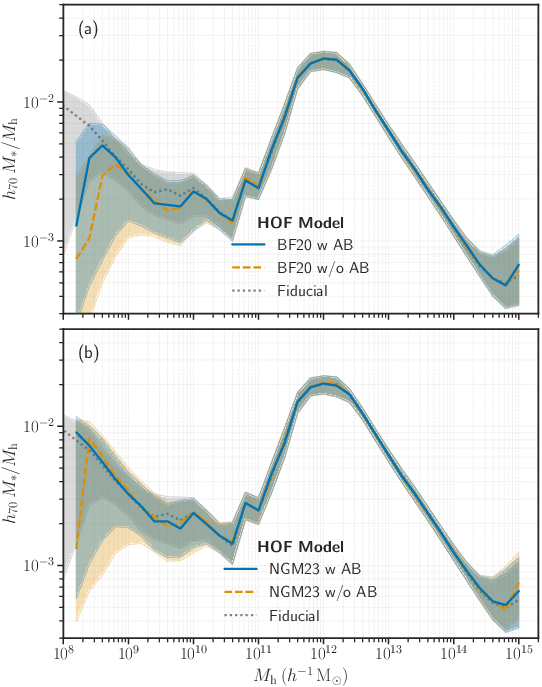
Figure 9: Mean central SHMRs derived under different HOF prescriptions, showing robustness of the low-mass upturn.
Assembly Bias and Cosmological Systematics
Explicit modeling of maximal assembly bias (forcing >5,0005->5,0006 correlation at fixed halo mass) shifts the >5,0007 (and therefore the inferred GSMF) upward by only >5,0008 at most. This is insufficient to explain the >5,0009 excess in GSMF (relative to independent 20 approaches) that remains under a Planck18 cosmology. Instead, a 21 reduction in 22 (e.g., shifting to a WMAP9-like cosmology) decreases the tension, and modeling at slightly different 23 can remove it entirely, indicating strong sensitivity to assumed cosmology and measurement redshift (Figures 20–24).
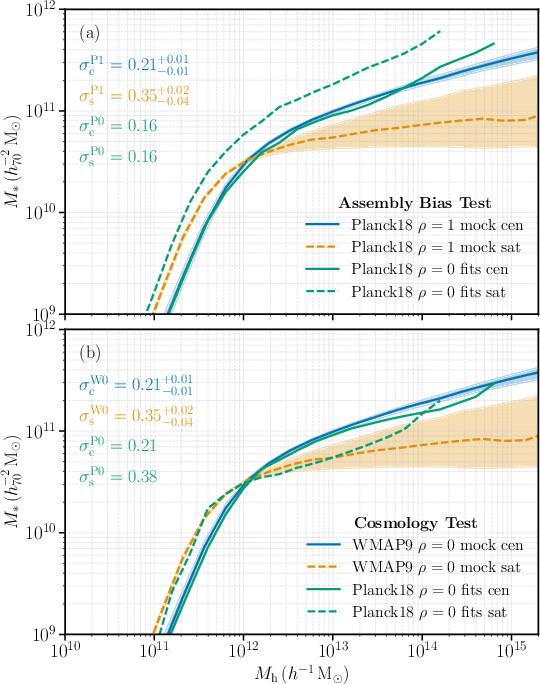
Figure 10: Tests of galaxy assembly bias and cosmology on SHMR inference using mocks.
Robust Minimum Halo Mass Constraints
By applying a cutoff in the minimum halo mass and comparing the increase in 24, the study infers strict 25 and 26 upper bounds of 27 and 28 on the smallest halos required by data, tightening constraints on dark matter models that predict a suppression of small halo abundance.
Red Dwarf Dominance and Quenching Hypothesis
Analysis of central and satellite fractions in the GSMF, compared with color demographics, supports the assertion that at the low-mass end (29), the population is dominated by red centrals. The paper proposes a scenario in which pre-reionization SFE is higher than predicted by standard models, and post-reionization feedback then quenches these systems, yielding the observed red, massive dwarfs.
Implications, Theoretical and Observational
- Feedback and Reionization Physics: The inferred upturn in central SHMR and GSMF structure at the low-mass end provides constraints on star formation, photoionization feedback, cooling (H I vs. Hn(rp)0), and assembly bias processes in cosmological galaxy formation scenarios.
- Dark Matter Models: The lower bounds on minimum halo mass derived from PAC deliver direct, cosmology-aware constraints on alternatives to cold dark matter (e.g., warm or self-interacting DM) aiming to suppress structure on subgalactic scales.
- Methodological Rigor: The PAC technique, with controlled completeness and cross-validation against n(rp)1 and group-catalog analyses, is shown to deliver robust, model-independent constraints that are only weakly sensitive to assumed halo bias modeling at these masses.
- Cosmic Variance: The paper highlights the relevance of environmental effects (e.g., the Local Void) and their impact on the completeness and universality of low-mass galaxy inferences.
- Towards Deeper Surveys and Machine Learning: The methodology is extendable to next-generation surveys (LSST, Euclid, Roman) and is amenable to further enhancement by machine learning approaches for high-dimensional modeling, role of secondary halo properties, and non-Gaussian systematics in future AI-based inference frameworks.
Conclusion
This work comprehensively establishes the galaxy–halo connection into the n(rp)2 regime using DESI and DECaLS through a systematic PAC methodology. It robustly detects an upturn in the SHMR at n(rp)3 for centrals, constrains the GSMF and quenching demographics of dwarf galaxies, and derives strong lower bounds on halo mass. These results sharpen the observational test space for dark matter, reionization, and star-formation physics, motivating both refined baryonic models and future deep imaging surveys. Further progress will depend on deep multi-band photometry, direct lensing measurements, and statistical/machine learning frameworks that can exploit the complex, high-dimensional datasets now accessible for the faintest galaxies.

