- The paper demonstrates that semantics-aware backdoor attacks in federated learning can achieve high attack success rates while preserving benign accuracy.
- It employs content-consistent triggers and aggregation-aware malicious objectives to evade robust defenses like MultiKrum and FilterFL.
- Experimental results reveal significant ASR improvements (up to 98.4%) with minimal impact on clean accuracy, underscoring a critical security threat.
Semantics-Aware Backdoor Attacks in Federated Learning
Introduction
"Beyond Corner Patches: Semantics-Aware Backdoor Attack in Federated Learning" (2603.29328) addresses a persistent weakness in federated learning (FL) security research: the reliance on synthetic, out-of-distribution triggers (e.g., corner patches or arbitrary overlays) for backdoor attacks. The paper demonstrates that backdoor threats persist—even under realistic, semantically meaningful, and distribution-consistent triggers—and explicitly shows that robustness claims based on such synthetic attacks are unreliable. The authors introduce a semantics-aware backdoor framework, leveraging content-consistent triggers (e.g., sunglasses on faces) and aggregation-aware malicious objectives, evaluated across heterogeneous FL setups and multiple robust aggregation rules.
Attack Methodology
The proposed attack operates under a standard synchronous FL protocol, with clients partitioned into benign and malicious subsets. Malicious clients engineer semantically-aligned image triggers rather than artificial overlays, using instruction-based editing methods to create visually plausible modifications. The trigger is designed to remain within the natural image distribution, ensuring stealth and practicality.
The malicious objective combines:
- Clean and triggered cross-entropy losses: Ensures benign accuracy and drives targeted misclassification when the trigger is present.
- Feature-separation loss: Enforces margin-based separation between clean and triggered sample representations at the penultimate layer, maximizing attack reliability while preserving utility.
- Parameter regularization: Constrains deviations from global parameters, minimizing aggregation-based anomaly detection risks.
- Neurotoxin-style gradient masking: Attenuates updates on high-importance parameters for clean tasks, hiding backdoor effects in low-importance subspaces.
Malicious clients maintain three data partitions: paired clean/triggered samples, clean-only, and trigger-only images—allowing optimization with the composite loss for maximal attack strength and stealth.
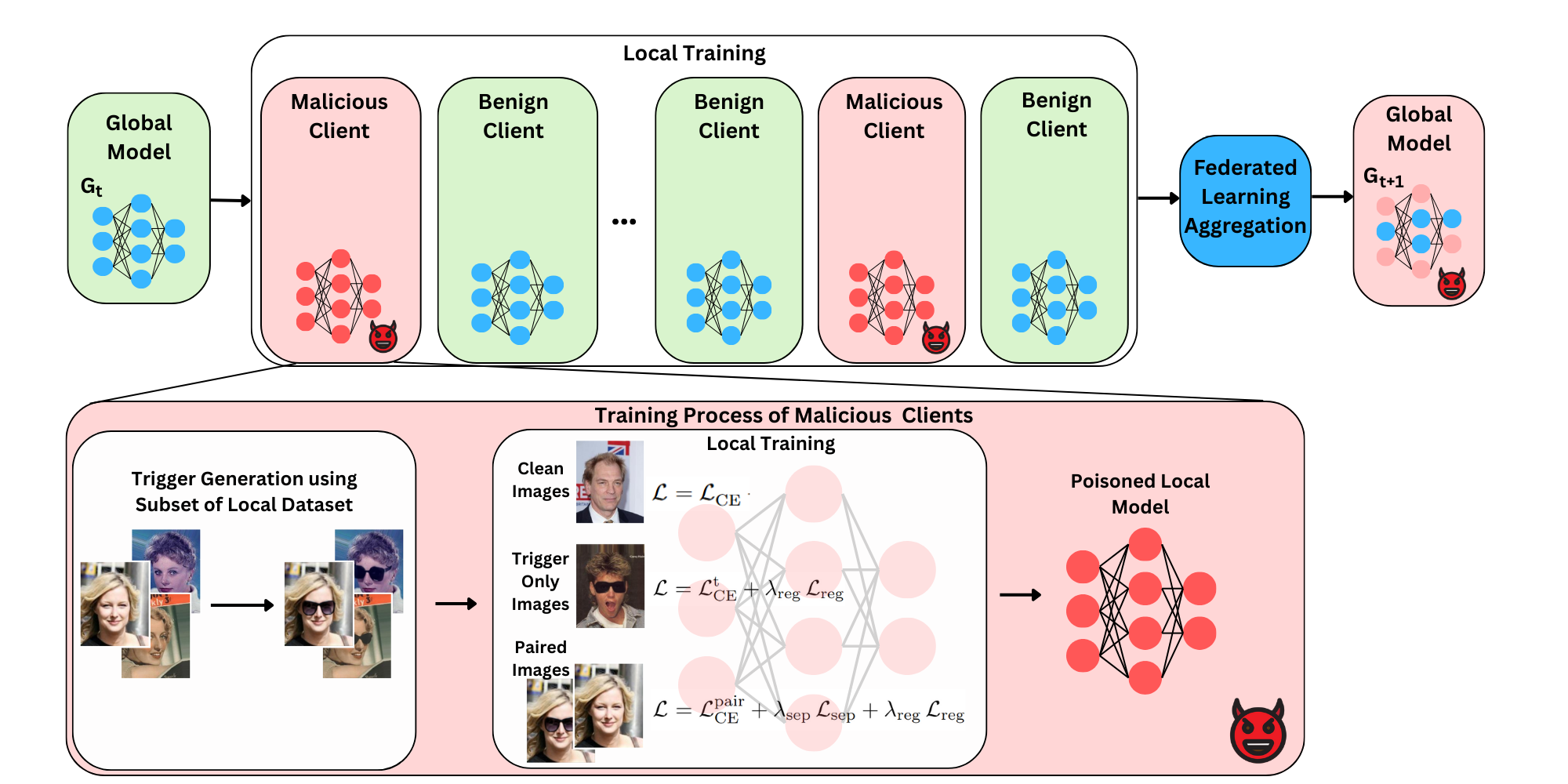
Figure 1: Block diagram of the semantics-aware backdoor attack pipeline showing aggregation of poisoned updates and the joint optimization objective executed by malicious clients.
The attack is instantiated for CelebA hair-color classification and GTSRB traffic-sign recognition, utilizing realistically modified attributes (e.g., sunglasses, blue cap overlays), and evaluated under FedAvg, MultiKrum, Trimmed Mean, FLAME, FilterFL, and other robust aggregation protocols.
Experimental Evaluation
Datasets
- CelebA: Four-class hair-color classification with semantic triggers generated by adding sunglasses to faces. Triggered samples are remapped to a fixed target class, and evaluations are performed on disjoint training and testing splits with both ResNet-18 and VGG-16 architectures.
- GTSRB: Multi-class traffic-sign classification with semantic triggers involving overlaying a blue cap above stop signs, aiming for misclassification into a priority class.










Figure 2: Clean CelebA face samples prior to the application of semantic triggers.
Figure 3: Triggered CelebA samples after semantic modifications (e.g., addition of sunglasses for attack instantiation).
Numerical Results
Across all settings, semantics-aware backdoor attacks deliver high attack success rates (ASR) while preserving benign accuracy. Notably:
- ResNet-18, CelebA, MultiKrum: ASR rises from 52.1% (baseline) to 84.5% (semantics-aware), with only modest clean accuracy reduction. Similarly, FilterFL yields ASR gains from 62.1% (baseline) to 87.8%.
- VGG-16, CelebA, MultiKrum: Clean accuracy and ASR see significant improvement (from 79.1% to 94.5% ASR, holding accuracy near the benign-only baseline).
- VGG-16, GTSRB, MultiKrum: ASR jumps from 63.4% (baseline) to 98.4% (semantics-aware), emphasizing the attack's persistence under robust aggregation.
The attack preserves benign utility, and under standard aggregation (FedAvg), achieves near-native clean accuracy with ASR close to 80-100% depending on dataset and architecture. Under robust aggregation, the advantage of semantics-aware triggers is especially pronounced.
Representation-Level and Parameter Space Analysis
UMAP visualizations illustrate a pronounced shift in representation space for triggered samples with the proposed attack: triggered inputs are clustered tightly with the target-class embeddings, unlike the dispersed baseline, evidencing stronger semantic alignment at the feature level.
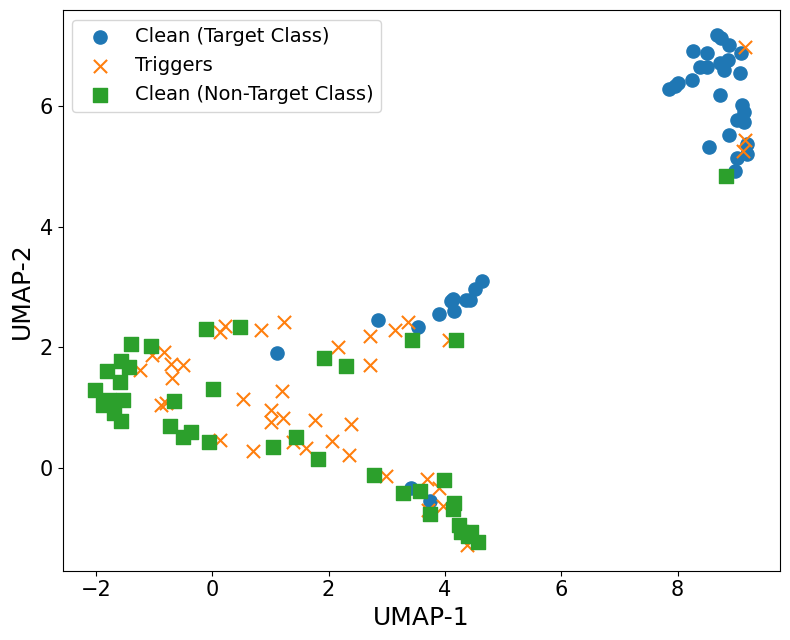
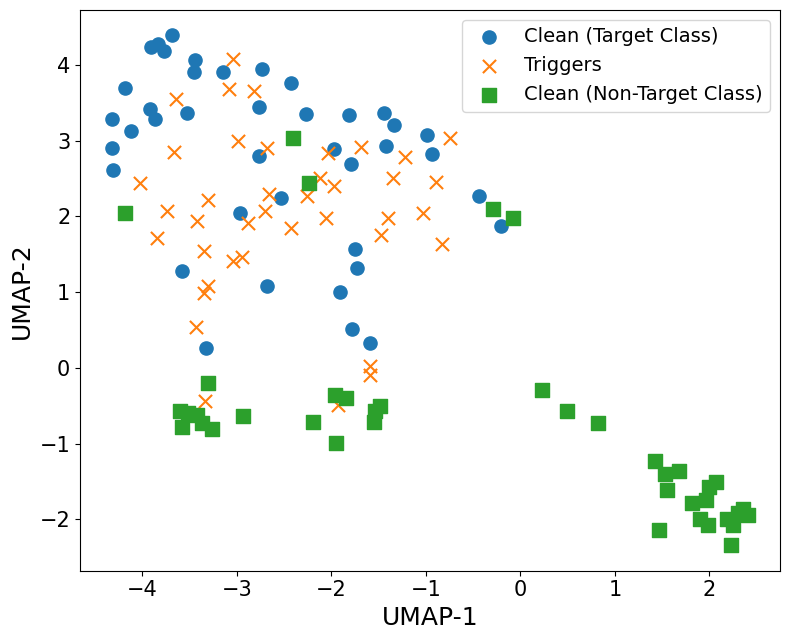
Figure 4: UMAP projection of penultimate-layer activations in ResNet-18 under baseline backdoor training.
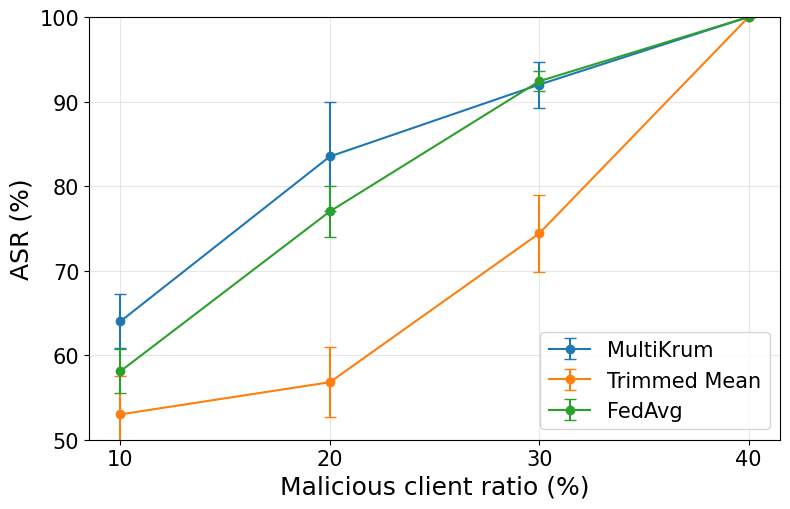
Figure 5: UMAP projection showing tightly-clustered triggered samples aligning with the semantic target in the SABLE attack.
Training-time overhead for malicious clients is higher than for benign, but the difference becomes negligible in heterogeneous FL populations, limiting practical defensibility through timing analysis.
Aggregation Robustness and Defense Evasion
The paper's results robustly contradict the assumption that filtering or robust aggregation suffices against adaptive backdoors—especially those using in-distribution, visually plausible triggers. Even strong defenses like MultiKrum, Trimmed Mean, FilterFL, and FLAME are penetrated by the semantics-aware attack, particularly as the fraction of malicious clients increases. ASR scales monotonically with attacker participation, and robust aggregation defenses lose efficacy rapidly beyond 20–40% malicious ratio.
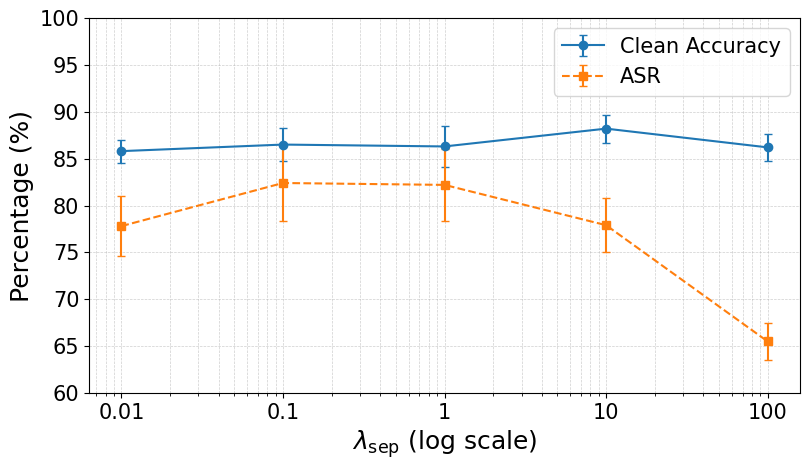
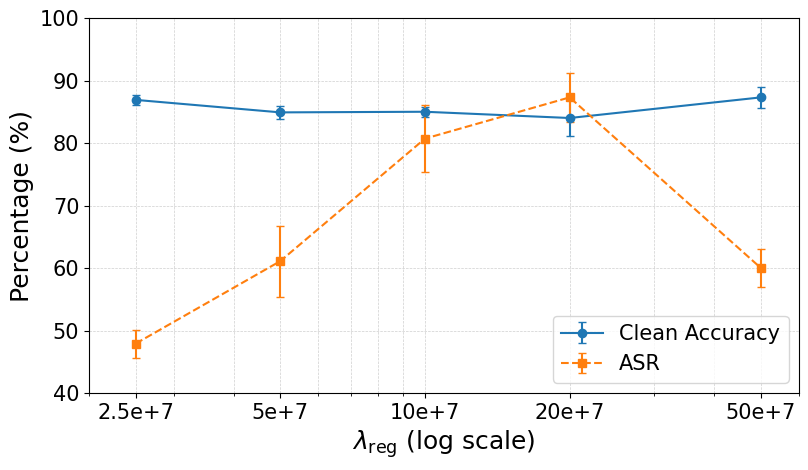
Figure 6: ASR trends for FedAvg, MultiKrum, and Trimmed Mean as malicious client ratio increases—demonstrating defenses' collapse at higher attack participation.
Sensitivity analysis demonstrates that moderate weights for feature-separation and regularization optimize the clean accuracy–ASR trade-off, with attack efficacy robust to tuning.
Practical and Theoretical Implications
The study establishes that semantics-aligned, aggregation-aware backdoor attacks can bypass both standard and state-of-the-art robust aggregation schemes, raising significant concerns about the real-world resilience of deployed FL systems. It invalidates the common practice of benchmark defense evaluation with out-of-distribution, synthetic triggers. Defenses must now contend not only with statistical outlier detection, but also with fine-grained semantic and representation-level shifts.
Theoretical implications include the necessity for defense analytics that reason both about semantic trigger locality and feature-space clustering, as well as aggregation algorithms with enhanced representation-awareness. Practical risk assessment for FL must include consideration for in-distribution, physically plausible triggers.
Future Directions
Advancements will require:
- Device-efficient semantic trigger pipelines: For attacks (and defense testing) in resource-constrained environments.
- Representation-level defense mechanisms: Beyond traditional L2 or coordinate-wise anomaly filters, including clustering or attribution analysis.
- Analytical frameworks for semantics-based attacks and aggregation defense interplay: Formalizing necessary and sufficient conditions for robustness and developing semantic decay metrics.
- Evaluation across modalities: Including language, audio, and multimodal tasks, and physical-world instantiations (e.g., wearable accessories, signage).
Conclusion
This work rigorously demonstrates the potency of semantics-aware backdoor attacks in FL under practical aggregation schemes, highlighting the inadequacy of defenses built and tested on synthetic triggers (2603.29328). The attack design—combining content-consistent triggers, feature-separation, and aggregation-aligned parameter regularization—shows high ASR under even robust defense protocols, with preservation of benign accuracy. Future FL security must fundamentally reconsider threat models, and invest in defense approaches that recognize semantic and representation-level vulnerabilities at scale.

