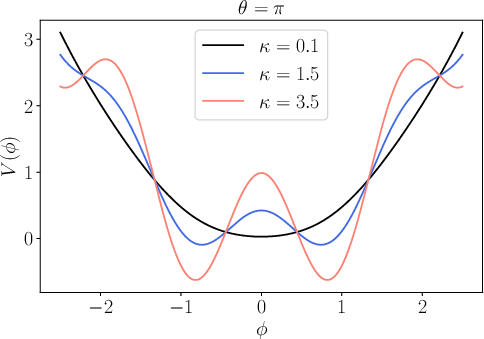
- The paper presents a detailed analysis of how entanglement observables capture the θ-dependent vacuum structure in the Schwinger model using lattice simulations.
- It demonstrates that entanglement entropy peaks sharply at θ = π and a critical m/g ratio, revealing underlying CP symmetry and phase transition characteristics.
- The study establishes a correspondence between the modular Hamiltonian and the LBW ansatz, providing a framework for simulating topological effects in gauge theories.
Entanglement Signatures of Competing Vacuum Structures in the Schwinger Model with θ Term
Introduction
The interplay of topology and quantum fluctuations in gauge theories gives rise to a complex vacuum structure, exemplified in the presence of a θ angle. In (1+1)-dimensional QED—the Schwinger model—the θ term induces a multi-branched energy structure and CP-violating phenomena. This work uses large-scale tensor network and exact diagonalization methods on a chirally rotated lattice Hamiltonian to elucidate how entanglement observables, specifically entanglement entropy (EE) and entanglement spectrum (ES), probe the θ-dependent vacuum structure of the massive Schwinger model across varied mass-to-coupling ratios.
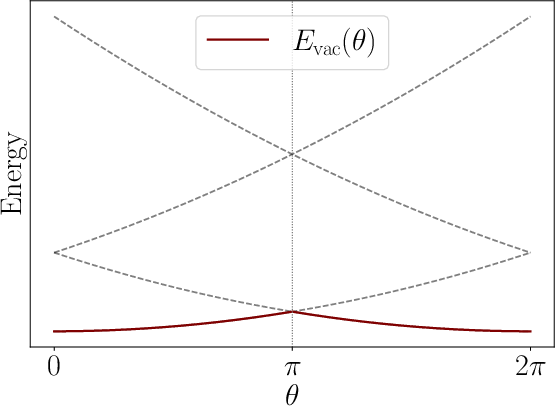
Figure 1: Vacuum energy branches En(θ)∝(θ+2πn)2 in the Schwinger model, showing the physical vacuum as the lower envelope.
Theoretical Framework and Lattice Implementation
The study employs a chirally rotated Hamiltonian for the massive Schwinger model:
The implementation includes:
- Staggered fermions to mitigate doubling.
- Open boundary conditions with a non-trivial treatment of Gauss's law.
- A symmetry-restoring counterterm to recover discrete chiral symmetry at finite lattice spacing.
This setup facilitates direct computation of bipartite entanglement properties and comparison to continuum results.
Numerical Results: θ5 Dependence and Criticality
Ground-State Energy and Local Observables
Across small to intermediate θ6, the ground-state energy exhibits smooth periodic dependence on θ7, closely matching continuum chiral perturbation theory at small θ8. For increasing mass, a distinct nonanalytic behavior emerges at θ9, consistent with a transition toward first-order criticality.
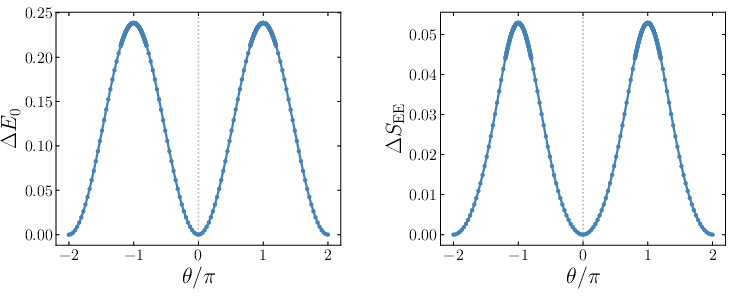
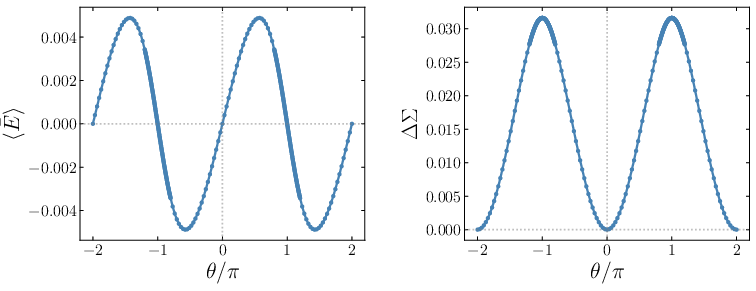
Figure 3: Ground-state energy, entanglement entropy, electric field, and chiral condensate versus (1+1)0 for (1+1)1: all observables vary smoothly, with entanglement entropy peaking at (1+1)2.
As (1+1)3 increases:
- The energy shows a nonanalytic slope at (1+1)4.
- The electric field exhibits a discontinuous jump, reflecting the switch between competing electric field orientations.
- The chiral condensate displays sharp features indicating vacuum reorganization near criticality.
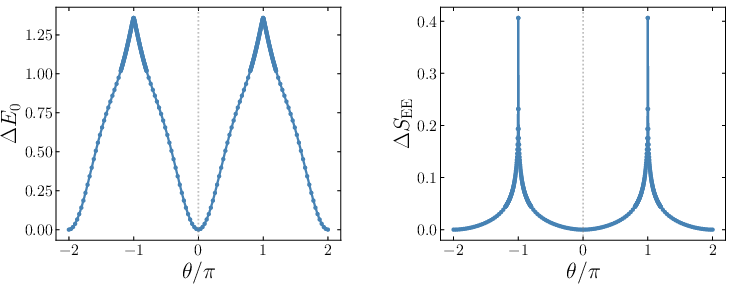
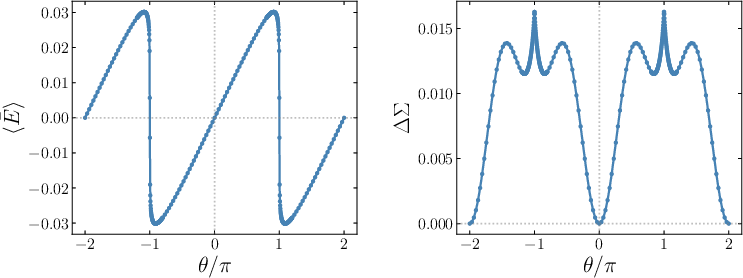
Figure 4: For (1+1)5, nonanalyticity in energy and sharp entropy peak emerge at (1+1)6, indicating proximity to the critical region.
Entanglement Entropy and Entanglement Spectrum
A robust, (1+1)7-dependent enhancement of the entanglement entropy (1+1)8 is observed near (1+1)9 for all θ0. This peak becomes singularly sharp at a critical mass ratio θ1, signifying maximal quantum fluctuations due to near-degenerate vacua.
Analysis of the entanglement spectrum reveals:
- For small θ2, eigenvalues change smoothly, and the entanglement gap remains open across θ3.
- Near the critical mass, the lowest Schmidt eigenvalues nearly coalesce at θ4, indicating strong mixing between CP-conjugate vacuum sectors and an entanglement gap closing.
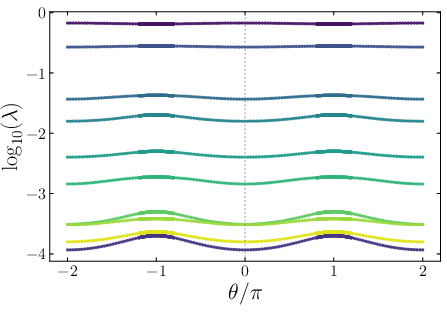
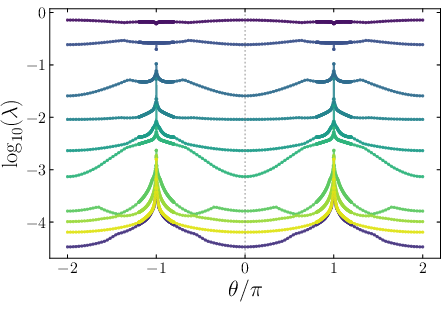
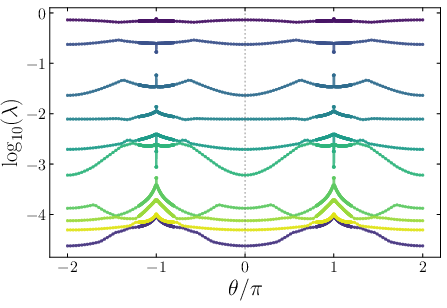
Figure 5: Schmidt eigenvalues of the half-chain reduced density matrix across θ5 for representative masses: the entanglement gap narrows dramatically at criticality (θ6) and θ7.
Spatially resolved observables further corroborate that the nonlocal entanglement response detects features—the CP-competing flux sector mixing—not directly apparent in local quantities.
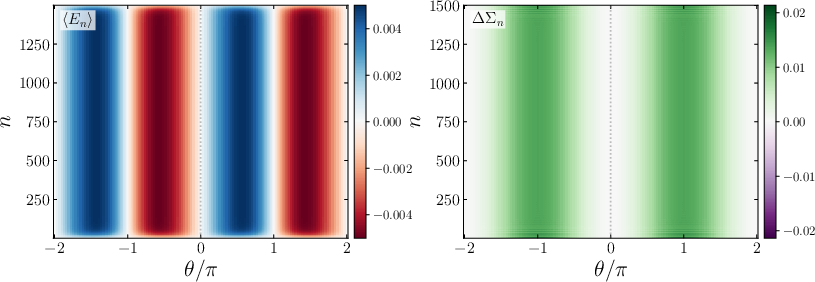
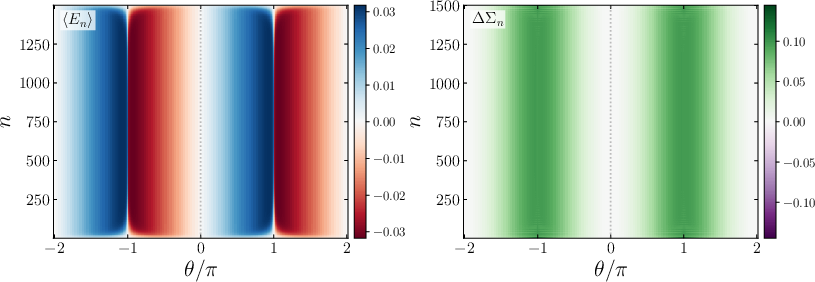
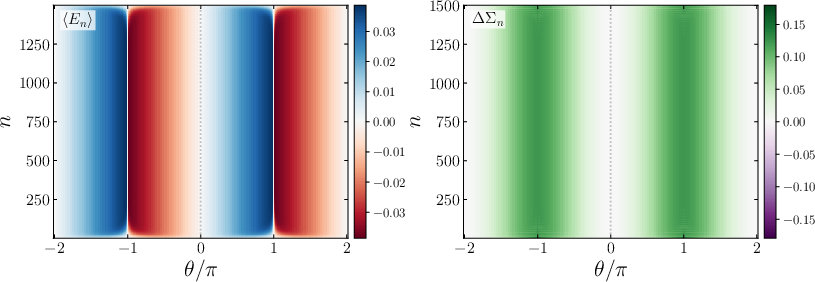
Figure 6: The spatially resolved electric field and chiral condensate display distinct signatures at criticality, reflecting the underlying entanglement-driven vacuum competition.
Mass Dependence and Divergent Correlations
By varying θ8 at fixed θ9, a sharp peak in θ0 is identified at negative θ1 in the chirally rotated Hamiltonian, corresponding to the conventional critical point at θ2. Local observables (condensate, energy) evolve smoothly, in contrast to the nonlocal entanglement measures.
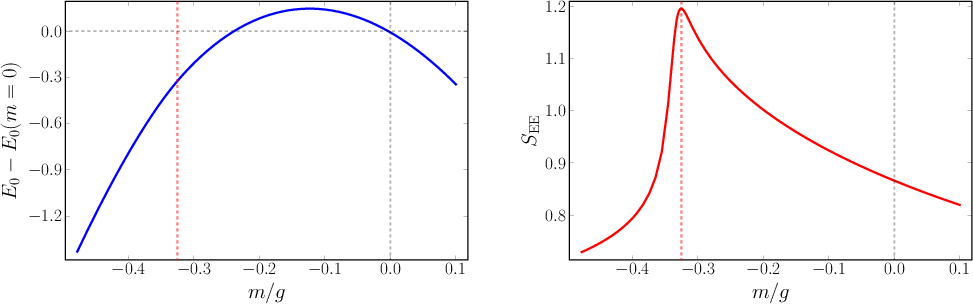
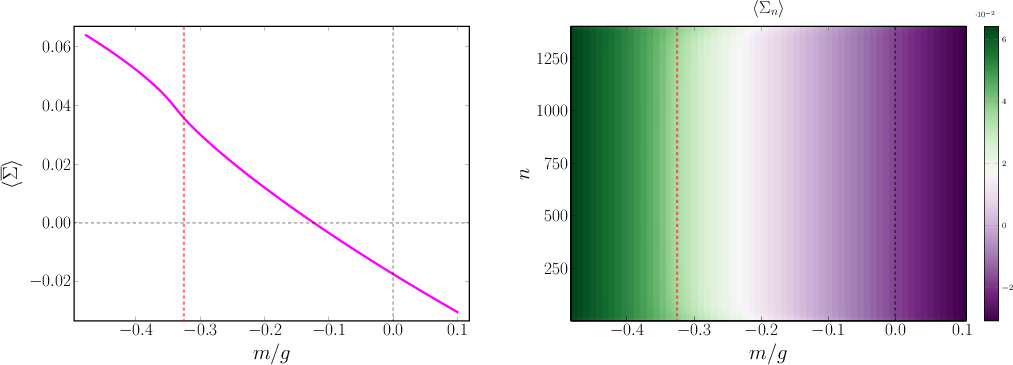
Figure 7: Entanglement entropy and local observables versus θ3 (negative values mapping to θ4): entanglement entropy peaks near the critical ratio, absent in local probes.
The entanglement spectrum also shows pronounced narrowing at this mass ratio, supporting a picture of enhanced quantum superposition between degenerate branches.
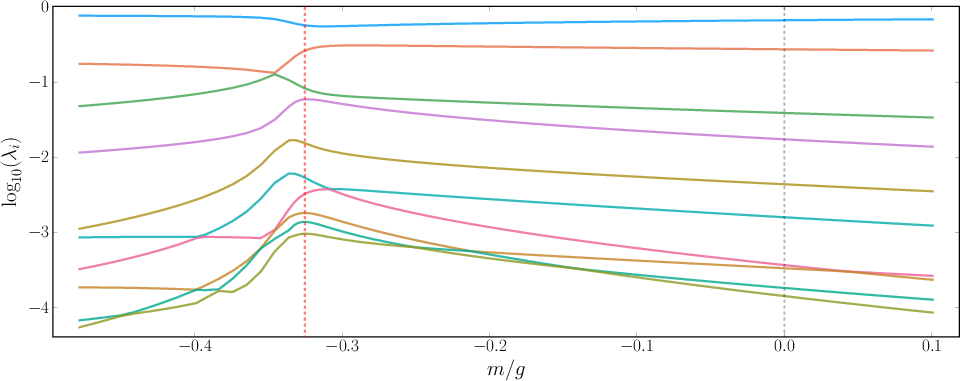
Figure 8: The leading Schmidt eigenvalues approach near-degeneracy at the entanglement entropy maximum in θ5 space, marking the critical region.
Correlation Length and Topological Susceptibility
The critical region is characterized by a diverging correlation length, extracted from various two-point functions. Both exponential fits and second-moment estimators give consistent results: the correlation length θ6 exhibits a narrow divergence in the same θ7 region as the entanglement signature.
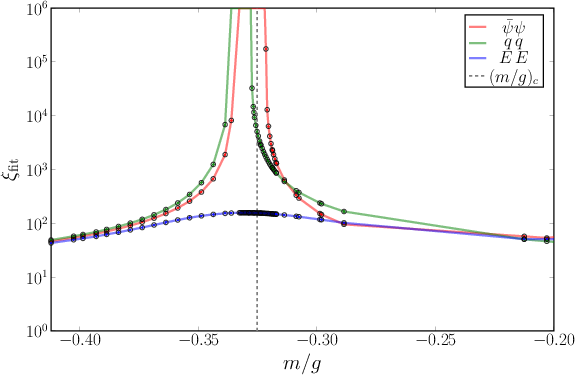
Figure 9: Correlation length θ8 as a function of θ9; divergence aligns with the peak in entanglement entropy at criticality.
Topological susceptibility En(θ)∝(θ+2πn)20, computed from the curvature of the vacuum energy with respect to En(θ)∝(θ+2πn)21, further encodes the vacuum's sensitivity to topological fluctuations and exhibits sharp structure in this region.
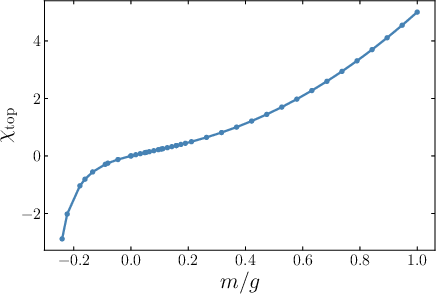
Figure 10: Topological susceptibility as a function of En(θ)∝(θ+2πn)22; a significant alteration occurs approaching the critical point.
Emergent Bisognano–Wichmann Structure and Modular Hamiltonians
The work establishes a quantitative and operator-level correspondence between the entanglement Hamiltonian (modular Hamiltonian) and a lattice Bisognano–Wichmann (LBW) construction. The LBW ansatz, employing a spatial weighting of local Hamiltonian terms, demonstrates high fidelity to the exact modular Hamiltonian spectral and eigenvector structure in the low-energy (infrared) sector.
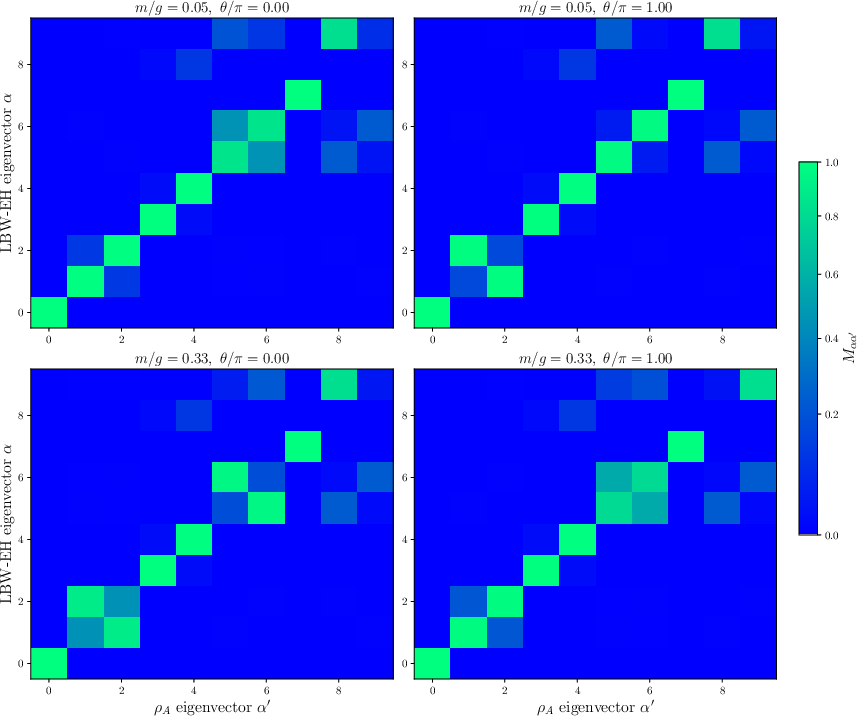
Figure 11: Overlap matrix between LBW and exact modular Hamiltonian eigenvectors; diagonal structure indicates precise matching in the infrared.
This justifies interpreting the ES as a spatially filtered image of the physical many-body spectrum and links entanglement gap closing to physical excitation softening.
Implications and Outlook
This analysis elucidates how nonlocal entanglement measures reveal underlying topological and vacuum structure in gauge theories beyond conventional local order parameters:
- Entanglement entropy and spectrum function as sensitive, experimentally relevant probes of criticality and vacuum superposition driven by topology.
- The chirally rotated lattice framework ensures faithful continuum limit physics, vital for emergent topological phenomena.
- The BW correspondence opens pathways for direct simulation of entanglement Hamiltonians in quantum computing and quantum simulation platforms, bypassing the need for full state tomography.
Potential future developments include:
- Generalization to higher-dimensional and non-Abelian gauge theories where topological sectors and entanglement structure are even richer.
- Application to real-time dynamics and out-of-equilibrium processes, exploiting the diagnostic power of entanglement in detecting transitions and nonperturbative effects.
- Deepening connections with quantum simulation and many-body condensed matter systems, including topological insulators and quantum wires, where entanglement-based diagnostics may be operationally accessed via charge fluctuation statistics.
Conclusion
The chirally rotated lattice Schwinger model with a En(θ)∝(θ+2πn)23 term provides a controlled setting to link entanglement observables with vacuum structure, phase transitions, and topological effects. The results affirm that entanglement entropy and spectrum—especially their behavior near En(θ)∝(θ+2πn)24 and the critical mass-to-coupling ratio—encode nontrivial, physically accessible information about quantum vacuum competition, criticality, and topological susceptibility, beyond what is visible in local correlators. The established operator-level correspondence between the modular Hamiltonian and the Bisognano–Wichmann ansatz further supports the use of entanglement approaches as fundamental probes in strongly correlated quantum matter and gauge field theories.