- The paper develops a statistical mechanics model coupling emotional contagion with hazard exposure via bipartite and social networks.
- Mean-field analysis and Bayesian inference on COVID-19 Twitter data reveal that social amplification dominates emotional responses in over 80% of U.S. states.
- Phase diagram and Sobol index analyses indicate that direct hazard reduction is far more effective than modifying network connectivity for mitigating collective stress.
Social Amplification and Its Dominance in Collective Hazard Response
Model Framework: Coupling Hazard Exposure with Networked Emotional Contagion
The study develops a statistical mechanics-inspired model to formalize how individual emotional states, modulated by both direct hazard exposure and social contagion, culminate in collective behavioral regimes. Emotional states yi are coupled to both individual hazard exposure xj (via a bipartite network Axy) and peer emotional states (via a social network Ayy). The local Hamiltonian describes the total "energy" governing the emotional state of each agent by the convex combination of: (i) an empathy term and an asymmetry term (parameterized by α and c); and (ii) alignment to hazard exposure, weighted by 1−α.
The chief parameters controlling emergent macroscopic behavior are the relative strength of social versus hazard-induced emotional excitation (α), the sign and magnitude of emotional asymmetry or "negativity bias" (c), network connectivities (⟨k⟩), and the average damage rate xj0. Mean-field analysis yields a free energy density xj1 for the collective stress prevalence xj2, providing a direct mapping between microscopic coupling structure and system-level emotional regimes, with explicit analytic phase boundaries delineating proportional versus amplified collective responses.
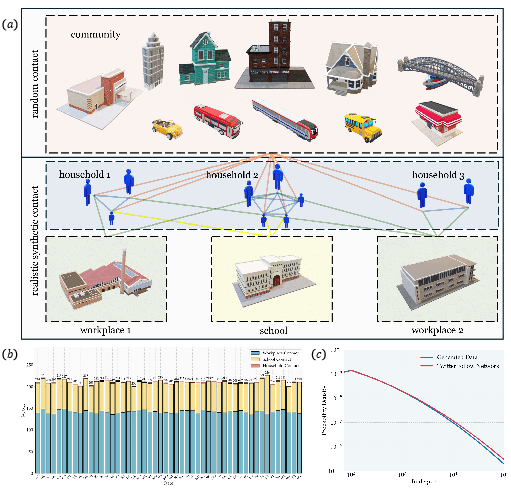
Figure 2: Multi-layer contact network architecture employed to encode social and hazard-exposure interactions underlying population emotional dynamics.
Phase diagram analysis reveals that for xj3 ("negativity bias"), increasing either social interaction strength or network connectivity shifts the system toward an amplification regime: stress prevalence xj4 becomes superlinear in damage rate xj5 and can exhibit nonconvexity, multistability, and "tipping." Conversely, xj6 ("positivity bias") causes social interaction to attenuate stress, resulting in higher resilience and proportionality.
Empirical analysis is grounded in U.S. state-level time series of COVID-19 prevalence, mobility, economic indicators, and social stress signals extracted from approximately 180k–230k COVID-relevant tweets via supervised fine-tuning of BERTweet, outperforming prompt-based GPT-5.2 classification by a margin of over 12% (validation accuracy 76% versus ~62%).
The model leverages Bayesian inference under a mean-field approximation to estimate the joint posterior over xj7 for each state, explicitly propagating both epistemic and aleatoric uncertainty (via multinomial confusion modeling).
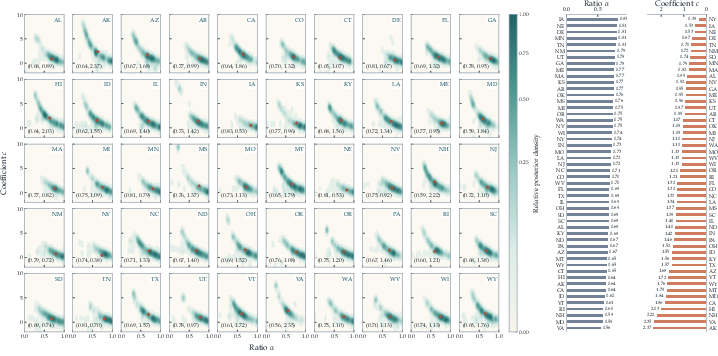
Figure 3: State-level posterior densities over xj8 (social amplification weight) and xj9 (emotional asymmetry), highlighting widespread dominance of social influence (Axy0 in all states) and significant negativity bias (Axy1 in all states).
The central quantitative finding is that in over 80% of U.S. states, collective emotional responses to COVID-19 were dominated by social amplification rather than direct hazard prevalence, as indicated by Axy2 for all states, and values exceeding Axy3 for several (e.g., DE, IA, MN, NE). Furthermore, all states exhibited Axy4, i.e., negativity bias is a universal property of collective emotional dynamics in this context. Bayesian posteriors also reveal an inverse correlation between Axy5 and Axy6, consistent with redundancy in the amplification mechanism.
Phase Behavior and Regime Boundaries
The model's free energy admits a critical threshold in the composite "amplification" parameter Axy7, above which the response function Axy8 transitions from convex (proportional regime) to nonconvex (amplification regime) with onset of emotional polarization. Analytic and simulation results consistently show that, for realistic U.S. social/sentiment network connectivities, the COVID-19 regime resides well within the dominant social amplification phase.
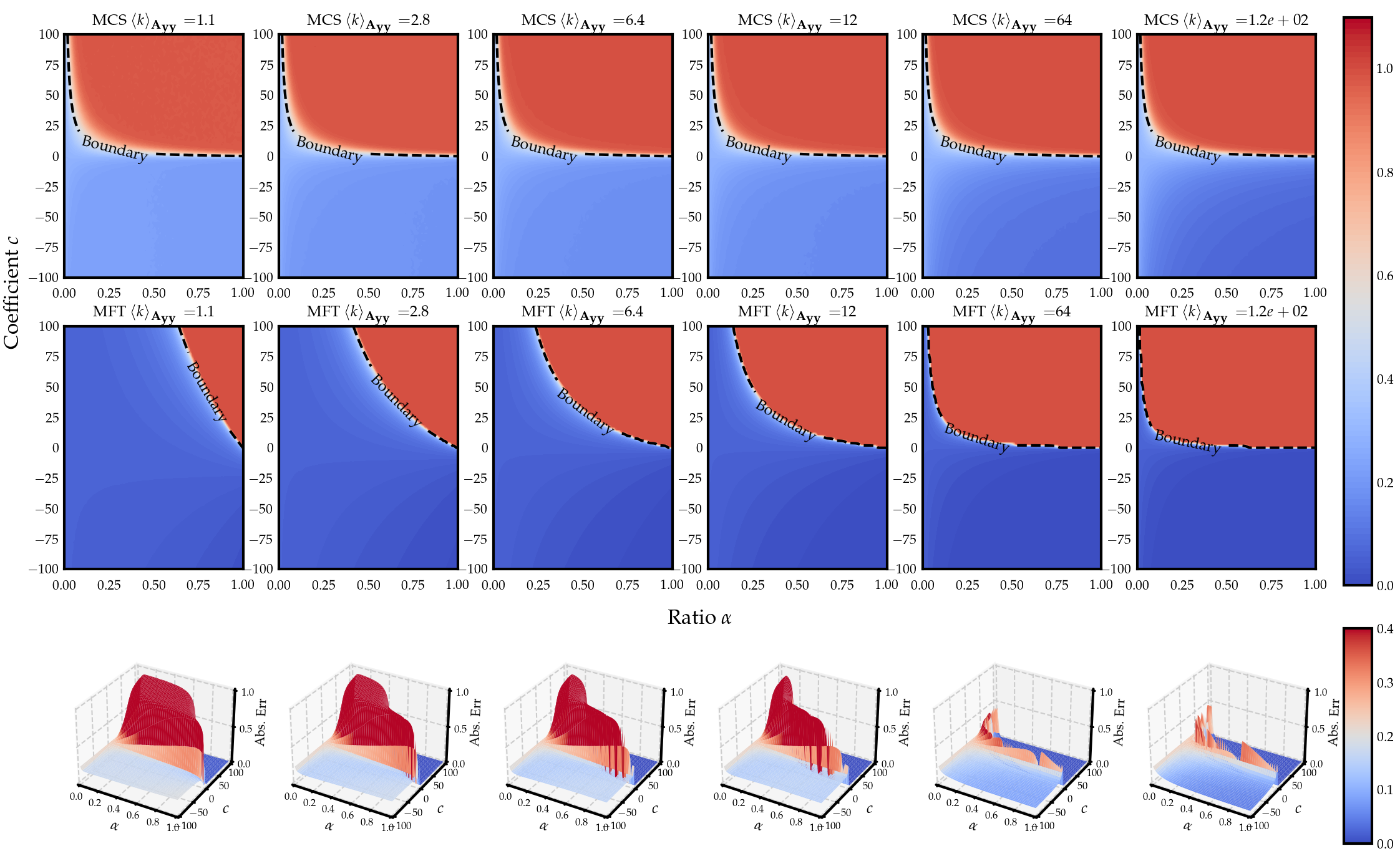
Figure 5: Dependence of regime diagrams on network connectivity; increased average in-degree expands the emotional amplification domain in phase space.
Control strategies designed using the analytic limit-state function demonstrate the hierarchy of intervention efficacy: direct reduction of hazard prevalence (Axy9) is orders-of-magnitude more effective (by gradient magnitude) than interventions on network structure (modifying social or exposure connectivity).
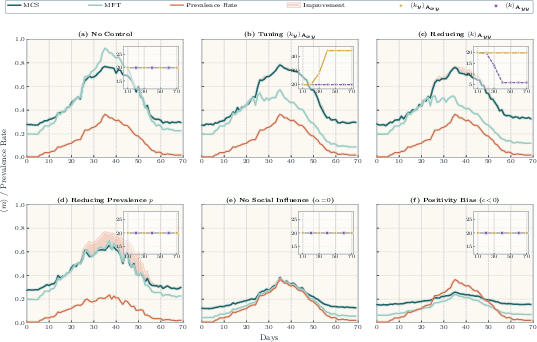
Figure 6: Synthetic stress prevalence evolution in response to different intervention scenarios; reduction of hazard prevalence outperforms network-based mitigation.
Socioeconomic Impact: Emotional Amplification Drives Macroeconomic Volatility
Monthly macroeconomic indicators (NGSP, RGSP, PCPI, UR, POP, HPI, CEAI) aligned with stress prevalence and COVID prevalence are used to compute variance-based first-order Sobol indices. Results across 50 states and 36 months show that as hazard prevalence rises, stress prevalence—rather than viral prevalence—becomes the dominant driver of variance in macroeconomic outcomes, particularly from 2022 onward and most prominently for the Coincident Economic Activity Index.
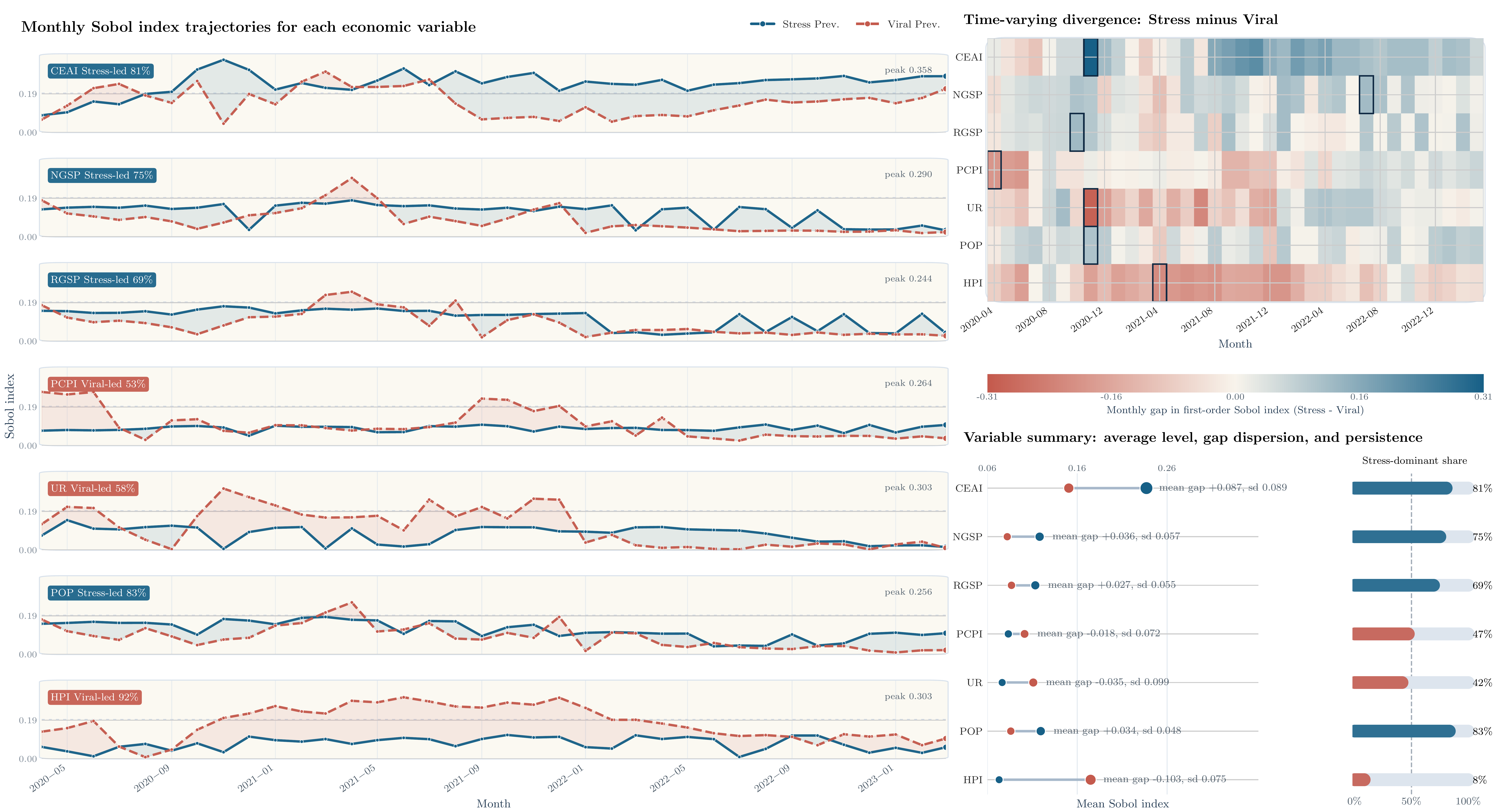
Figure 1: Time-resolved Sobol index analysis: stress prevalence supersedes viral prevalence as the principal determinant of variance in key macroeconomic indicators as epidemics mature.
Implications and Future Directions
The analytic and empirical results substantiate that collective emotional responses, especially under epidemic hazard, are “governed” by a small set of parameters controlling the balance of social amplification, negativity bias, and hazard forcing. Policymaking under such hazards cannot treat population emotional states as simple reflections of risk exposure; instead, network-driven contagion and bias dominate, making “tipping” and collective irrationality generic rather than anomalous. This further entails that effective resilience policies should focus not only on epidemiological intervention but also on managing social amplification—for example, by targeting network structure, emotional bias in communications, or rapid suppression of negative emotional feedback.
The statistical physics formalism is structurally extensible to general classes of hazards and network/geographic heterogeneity, inviting further research on control of emotional polarization in disinformation campaigns, climate disasters, or compound crisis events. Richer agent-based simulation could elucidate transient and out-of-equilibrium path dependency, while fine-grained observation models could enable high-resolution, real-time emotional state diagnosis.
Conclusion
"Social Amplification Dominates Collective Hazard Response" provides an analytically tractable, mechanistically transparent model linking micro-level emotional contagion to emergent collective regimes. The empirical data strongly support the claim that collective emotions—and their economic impacts—are dominated by social dynamics, not hazard magnitude. The insights and methods here form a theoretical and computational substrate for operational emotional resilience strategies and for further study of collective risk perception and behavioral polarization during large-scale hazards.
(2603.29282)