- The paper introduces a unified four-field total-pressure formulation that eliminates volumetric locking in classical poroelastic models.
- It proposes a global-in-time iterative decoupling scheme that enables robust, parallel-in-time simulations with unconditional contraction.
- Numerical experiments validate optimal convergence rates and oscillation-free behavior even under nearly incompressible and degenerate conditions.
Introduction and Motivation
The paper "A Unified Model for Thermo- and Multiple-Network Poroelasticity with a Global-in-Time Iterative Decoupling Scheme" (2603.29275) develops a unified mathematical and numerical framework that subsumes both linear thermo-poroelasticity and multiple-network poroelasticity (MPET), encompassing dual-porosity Biot-type models and fully-coupled thermo-hydro-mechanical processes. Stability, robustness, and efficiency in the space-time discretization and iterative solution of such coupled PDE systems are longstanding challenges. Incompressibility, low-permeability limits, and heterogeneous coefficients typically give rise to locking and pressure oscillations in displacement-pressure formulations, while conventional operator splitting and monolithic approaches each suffer drawbacks in terms of accuracy, stability, and scalability.
This work proposes: (1) a four-field unified total-pressure-based weak/strong formulation that eliminates the locking mechanisms present in classical and multi-network poroelastic models and (2) a rigorously contractive, global-in-time iterative decoupling scheme enabling robust and efficient solution strategies on arbitrary time intervals, with direct implications for parallel-in-time simulation and model reduction.
The foundation is a system coupling linear elasticity with multiple transport networks (generalized pressures, such as pore pressure, temperature, or multiple network pressures). For a vector-valued displacement u and two generalized pressures ϕ, ψ, the governing equations are: −∇⋅σ(u)+α∇ϕ+β∇ψ=f c1∂tϕ−b0∂tψ+α∇⋅∂tu−∇⋅(K∇ϕ)+γ(ϕ−ψ)=g c2∂tψ−b0∂tϕ+β∇⋅∂tu−∇⋅(D∇ψ)+γ(ψ−ϕ)=h
subject to appropriate Dirichlet and Neumann boundary and initial conditions.
By introducing the total pressure variable ξ=−λ∇⋅u+αϕ+βψ, the system is recast in a four-field form. This reformulation is crucial for eliminating volumetric locking and ensuring inf-sup stability in the near incompressible regime. The system, written in strong or weak form, admits the classical Biot, Barenblatt-Biot (MPET), and thermo-poroelasticity as special cases via specific choices of parameters and variable identification.
Theoretical well-posedness of the weak (variational) formulation is established using Galerkin approximations, energy estimates, and arguments for differential-algebraic equations of index one. Coercivity and inf-sup conditions are rigorously justified.
Space-Time Discretization and Iterative Decoupling
The paper designs a robust mixed finite element method for the unified four-field formulation, employing Taylor–Hood elements for (u,ξ) and Lagrange elements for (ϕ,ψ). Stabilization terms are incorporated for the transport equations to suppress nonphysical oscillations, particularly in low-permeability and high-contrast settings.
A central algorithmic contribution is the global-in-time iterative decoupling scheme, which alternates between fully solving the transport subsystem for (ϕ,ψ) with an explicit (in time) treatment of ∂tξ followed by a quasi-static elasticity solve for (u,ξ). Unlike time-marching fixed-stress or fixed-strain splits, the proposed method decouples the entire space-time trajectory of mechanics and transport over the chosen interval, enabling “parallel-in-time” solution strategies for the transport step.
A rigorous contraction proof demonstrates that the decoupling iteration is globally and unconditionally convergent with a contraction factor independent of all physical and discretization parameters, provided certain constraints (e.g., ϕ0) hold. This is substantiated by sharp energy estimates and discrete summation analogues in the finite element and backward-Euler fully discrete implementations.
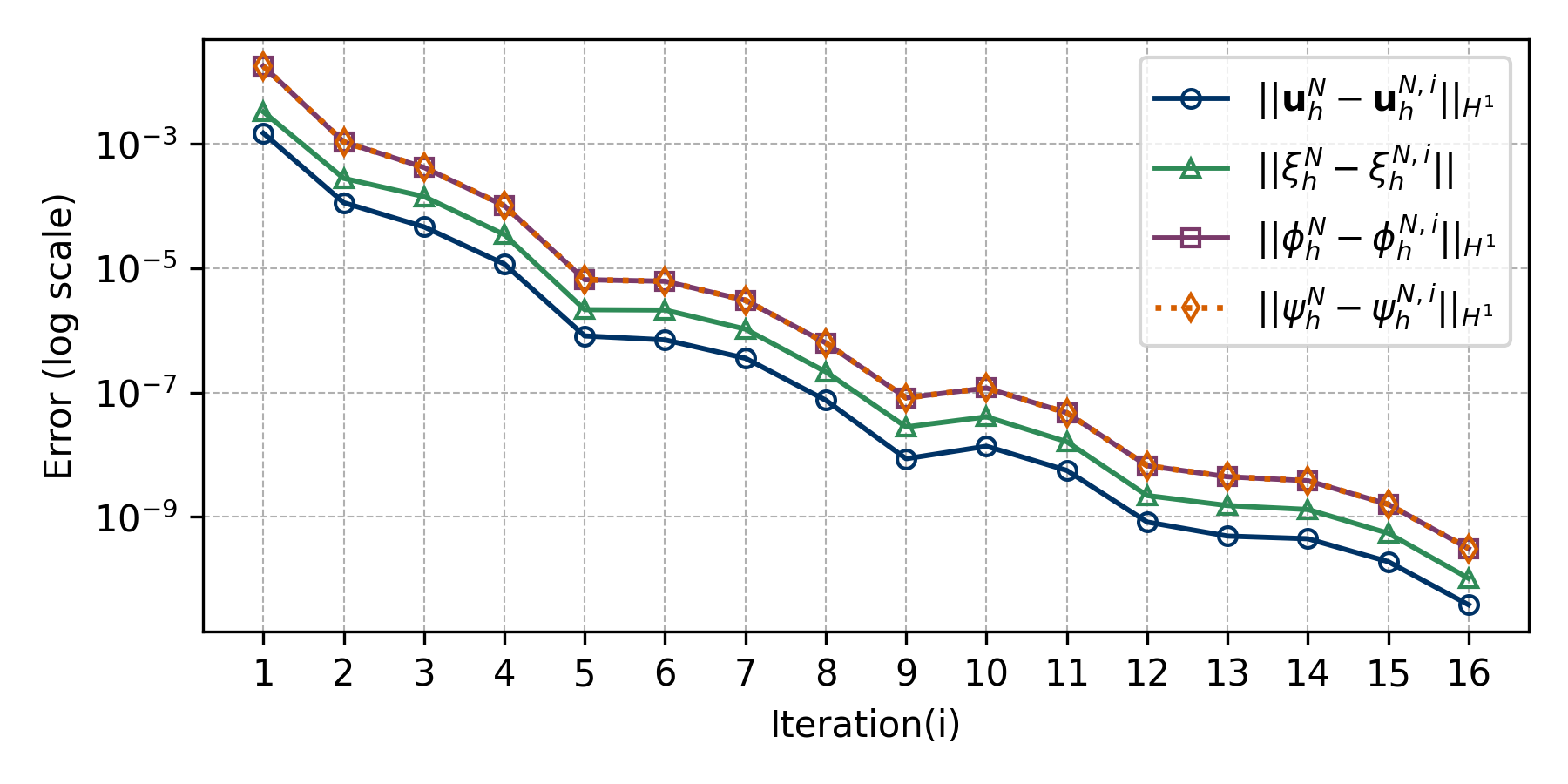
Figure 1: Convergence behavior of the relative iterative errors demonstrating unconditional and monotonic contraction for the global-in-time scheme.
Numerical Validation and Behavior
The theoretical findings are corroborated by comprehensive numerical experiments. Method of manufactured solutions is used to verify optimal convergence rates in both space and time. Mesh refinement studies show first-order convergence in time (consistent with backward Euler) and optimal order in space, as dictated by the underlying polynomial order.
Critically, simulation on challenging benchmarks such as a generalized Barry-Mercer problem for multi-network poroelasticity, featuring localized sources and anisotropic transport, demonstrates oscillation-free behavior in the generalized pressures for both monolithic and global-in-time decoupled schemes.
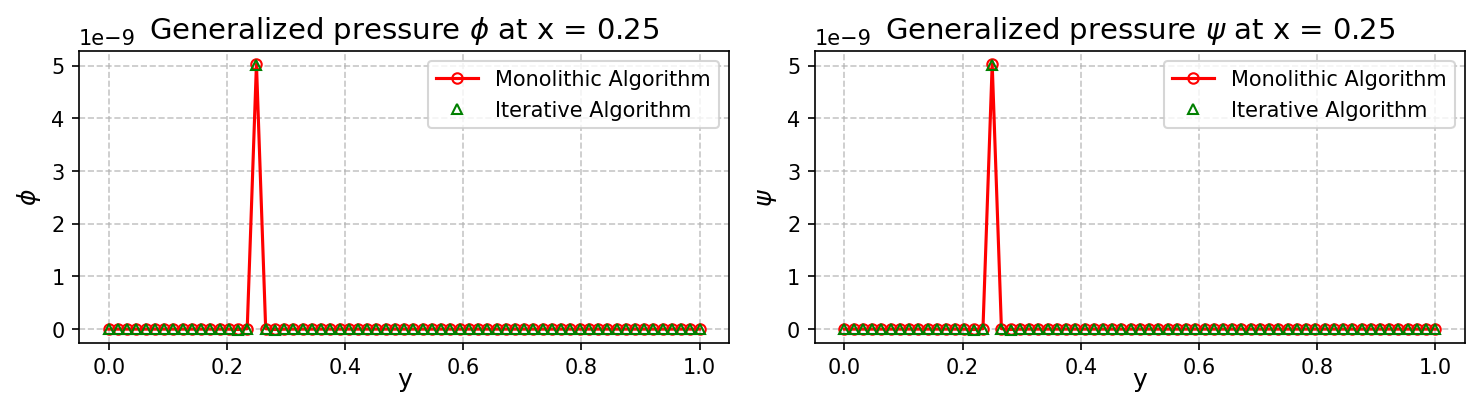
Figure 2: Cross-section of the generalized pressures ϕ1 and ϕ2 showing suppression of spurious oscillations under stabilization.
At later times, excellent agreement with analytical or reference solutions is achieved, and the solutions remain robust with respect to nearly incompressible and degenerate physical limits.
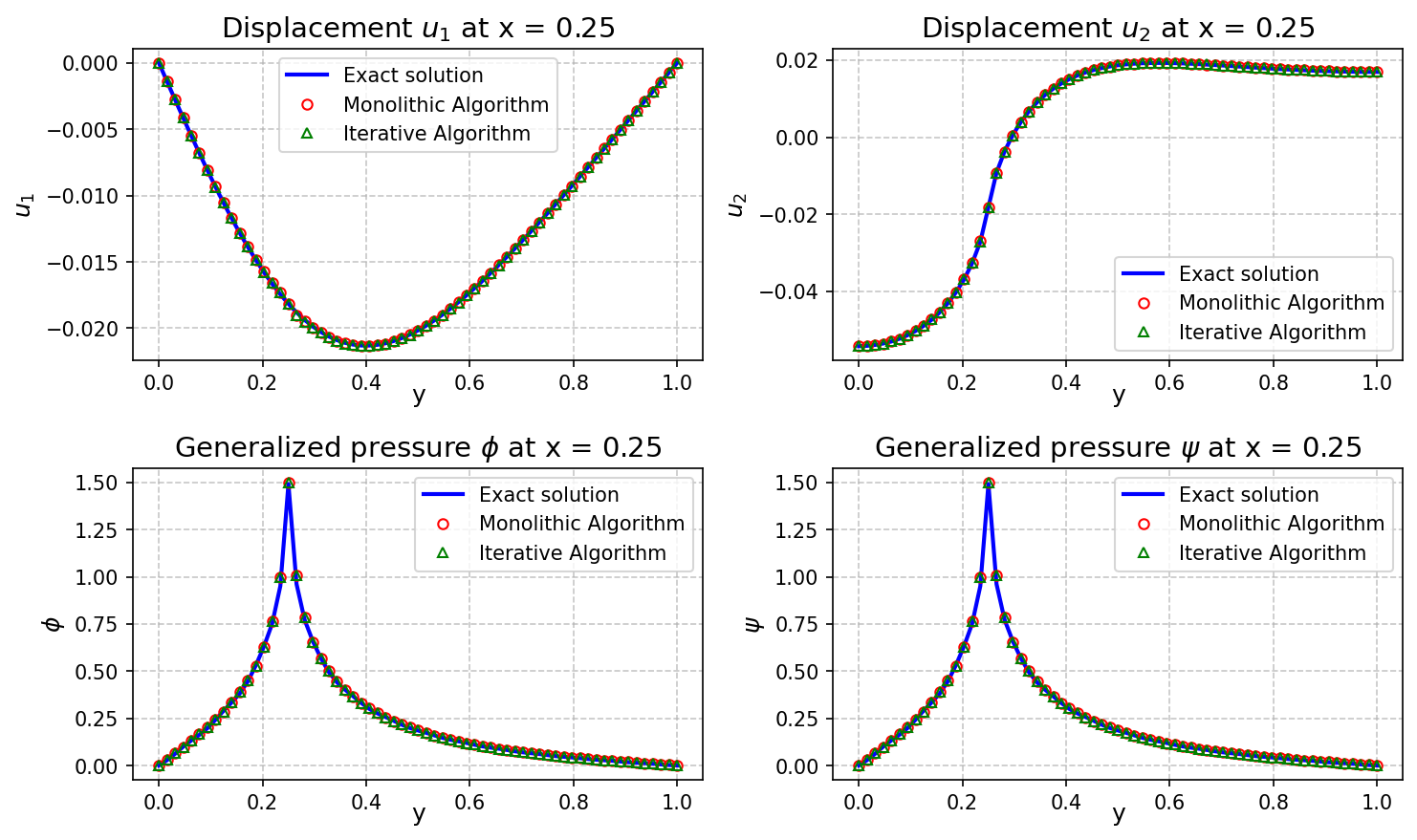
Figure 3: Numerical solution profiles for the generalized Barry-Mercer problem at ϕ3, validating stability and accuracy of the unified space-time decoupling scheme.
Theoretical and Practical Implications
The unified total-pressure-based formulation and the associated space-time decoupling iteration have multiple implications:
- Generalization: Accommodates a wide range of Biot-type models including thermo-hydro-mechanical and multi-network systems within a single unified DAE framework and weak formulation.
- Modularity and Scalability: The structure supports parallel-in-time and domain-decomposition approaches, and is readily amenable to reduced-order modeling and machine learning surrogates for trajectory-level solvers.
- Stability and Robustness: The unconditional contraction and oscillation-free nature enable safe application in parameter regimes (incompressibility, stiff couplings) where classical splitting and monolithic approaches fail or require severe stabilization or step-size restrictions.
- Computational Efficiency: Being provably accurate and contractive, the method admits early stopping strategies, error quantification, and adaptive time-stepping or parallelization, facilitating simulation of large-scale, multi-physics problems in geo- and biomechanics.
Conclusion
The work advances the mathematical and algorithmic foundations for coupled poroelastic multiphysics modeling. The total-pressure four-field formulation, together with the global-in-time contractive decoupling scheme, provides a unified and robust strategy for the simulation of complex coupled problems in porous media. Theoretical results are validated by strong numerical evidence with optimal convergence and oscillation-free solutions across diverse parameter regimes. These developments inform the design of scalable solvers for large-scale nonlinear coupled systems and open further avenues for time-parallelization, model reduction, and machine learning integration in computational multiphysics.