- The paper introduces a two-stage framework that leverages superquadric similarity matching to rapidly generate diverse grasp candidates from partial point clouds.
- The evaluation and refinement stage, powered by a PointNet++ based network, achieves over 94% task success in both simulated and real-world tests.
- The approach outperforms baselines like PointNetGPD and Contact-GraspNet, demonstrating strong generalization even in dense, cluttered environments.
SuperGrasp: Superquadric-Based Single-View Grasping with Evaluation and Refinement
Introduction
Object grasping in unstructured environments with single-view observations is a persistent challenge in robotics, primarily due to geometric incompleteness and the unreliability of inferring stable grasp poses from partial, noisy sensory data. The paper "SuperGrasp: Single-View Object Grasping via Superquadric Similarity Matching, Evaluation, and Refinement" (2603.29254) addresses these issues by proposing a two-stage framework leveraging superquadric-based shape abstraction for rapid grasp candidate generation, and a PointNet++-based evaluation-refinement network (E-RNet) for accurate grasp filtering and local adjustment. This essay describes the methodology, experimental results, and implications of the approach.
Superquadric Similarity Matching for Grasp Candidate Generation
Superquadrics provide a compact, parametric representation for a broad class of geometric primitives via five intrinsic parameters and a full pose. The framework utilizes EMS-based fitting to extract superquadric coefficients from single-view point clouds, enabling the abstraction of objects despite partial observations.
A pre-computed database of 1,500 volumetric primitives (cylinders, frustums, elliptical cylinders, cuboids, etc.) at various scales supports efficient similarity matching.
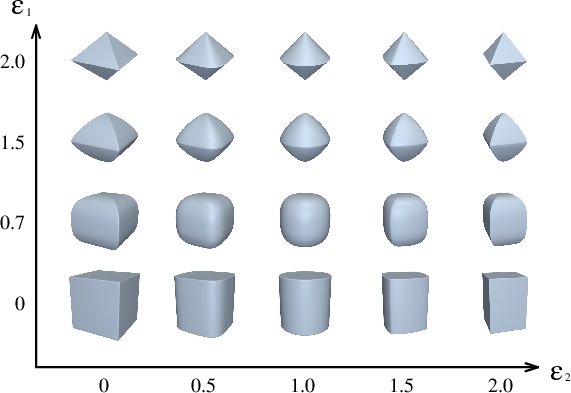
Figure 1: Convex superquadric shapes under different parameter settings.
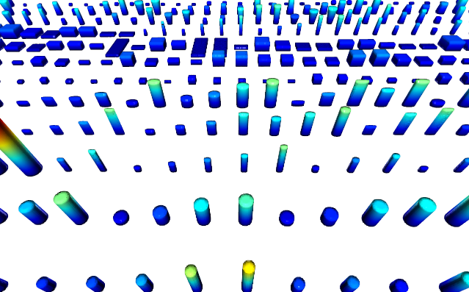
Figure 2: The primitive object database constructed in this work, containing 1.5k objects of various shapes and scales for superquadric similarity matching.
Matching proceeds in two stages. A coarse filter leverages shape parameters (ϵ1,ϵ2) and normalized axis ratios to eliminate geometrically dissimilar candidates. Finer ranking incorporates absolute and axis-wise scale differences, ensuring both structural and metric consistency. The grasp poses associated with the top-ranked primitives are directly transferred to the observed object using alignment transformations. Additional geometric filtering removes infeasible grasps (e.g., candidate collisions, insufficient contact points, or adverse orientation with respect to surface normals), resulting in a diverse, robust set of grasp candidates.
This pipeline provides rich and structure-aware candidate generation even under incomplete geometric input, outperforming naive sampling approaches in both diversity and quality of initial grasps.
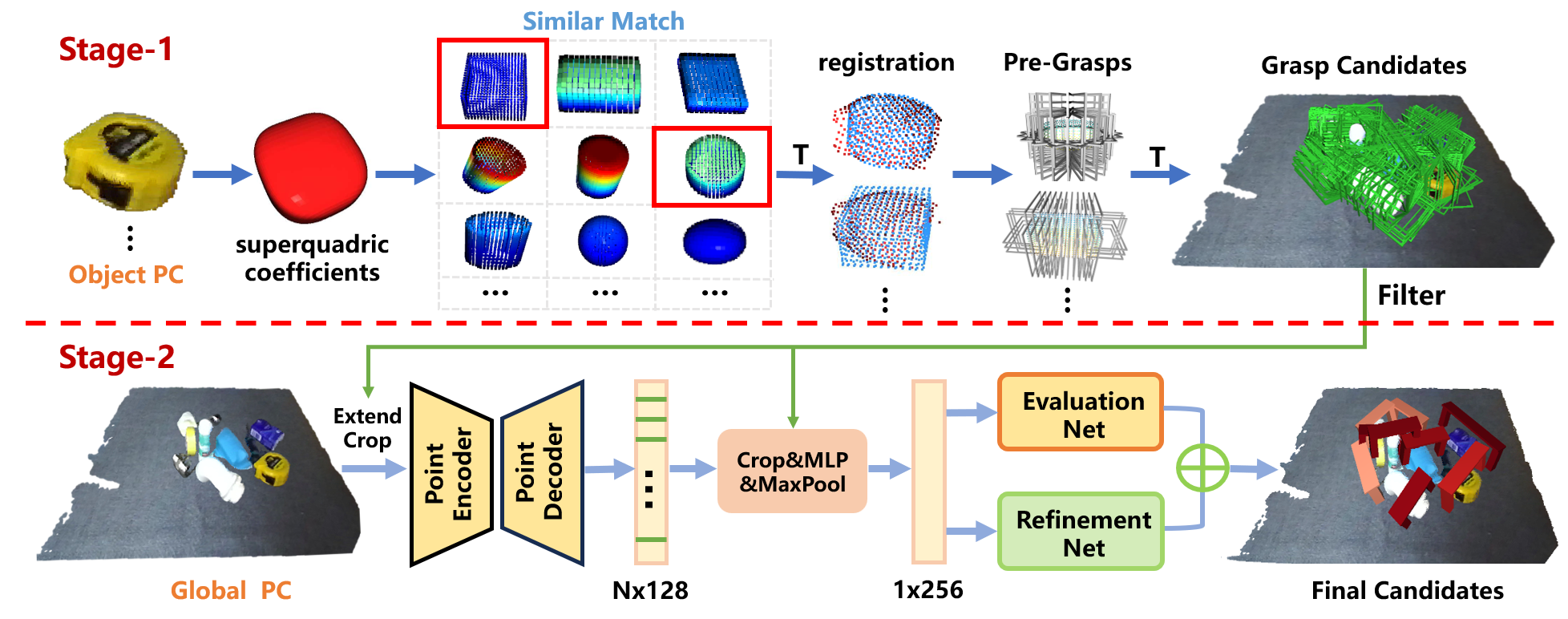
Figure 3: SuperGrasp framework overview — stage one generates grasp candidates through superquadric similarity matching and transfer; stage two performs regional evaluation and refinement.
Evaluation and Local Refinement via E-RNet
The second stage introduces a novel architecture for grasp evaluation and refinement, building on PointNet++. To compensate for noise and angular misalignments—especially common in occluded or cluttered scenarios—the method establishes an expanded region of interest around each initial grasp and transforms the point cloud into the local gripper frame. Features extracted therein are separated into those colocalized with the gripper closing region (“grasp anchor”) and complementary contextual points. Aggregation and classification of these features via MLPs enable accurate and robust grasp feasibility prediction.
To further address failure modes due to small initial misalignments, the framework employs a dedicated refinement head that scores the feasibility of minor pose perturbations (deepenings, rotations about the approach direction) from each anchor. This leverages the local geometric context, supporting flexible adaptation and increased grasp robustness in dense or unfamiliar scenes.
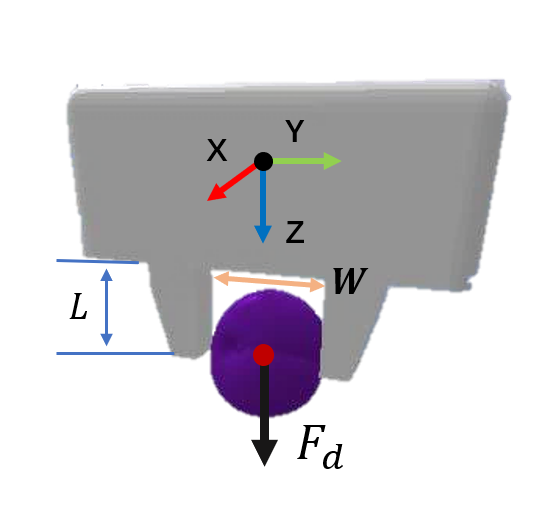
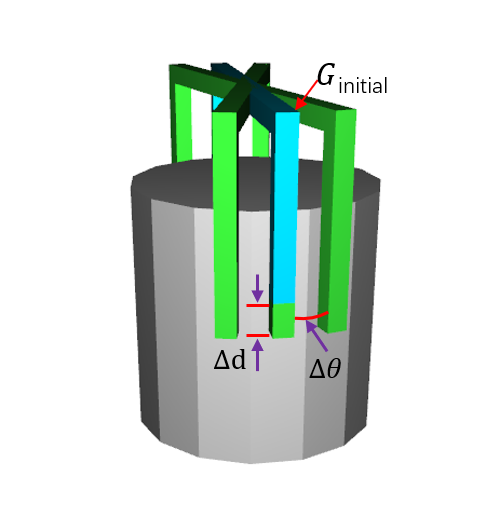
Figure 4: Gripper coordinate system, definition of gripper parameters, and refinement strategy based on vertical deepening and in-plane rotation.
The E-RNet is trained end-to-end using cross-entropy (for evaluation classification) and binary cross-entropy (for multi-option refinement), on a large-scale simulated grasp dataset (100k instances across 124 objects from YCB, KIT, and DexNet datasets).
Simulation and Real-World Experimental Results
Extensive benchmarking was performed in PyBullet simulation and on a customized real-world platform. Simulations cover a spectrum of table-top decluttering tasks with varying object counts (10, 20) and include evaluations on previously unseen object classes.
Results demonstrate substantial gains in both grasp and task success rates over strong baselines (PointNetGPD, Contact-GraspNet) in all configurations. Under the most challenging unseen-object settings, SuperGrasp maintains a task success rate above 94%, outperforming PointNetGPD by 85% and Contact-GraspNet by 43%. Gains are particularly pronounced in denser clutters, where local refinement makes the most significant difference.
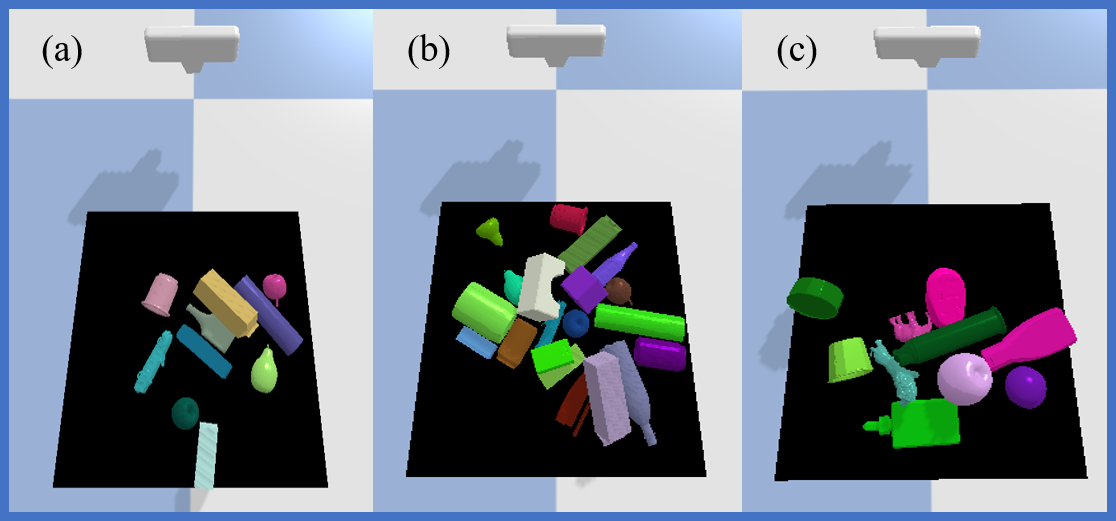
Figure 5: Simulation experiment setups with varying object numbers and compositional novelty.
In real-world scenarios, the method is consistently robust. Zero-shot transfer from simulation-trained models achieves grasp and task success rates above 94% on novel objects, with runtime per attempt remaining within practical bounds (sub-second per stage).
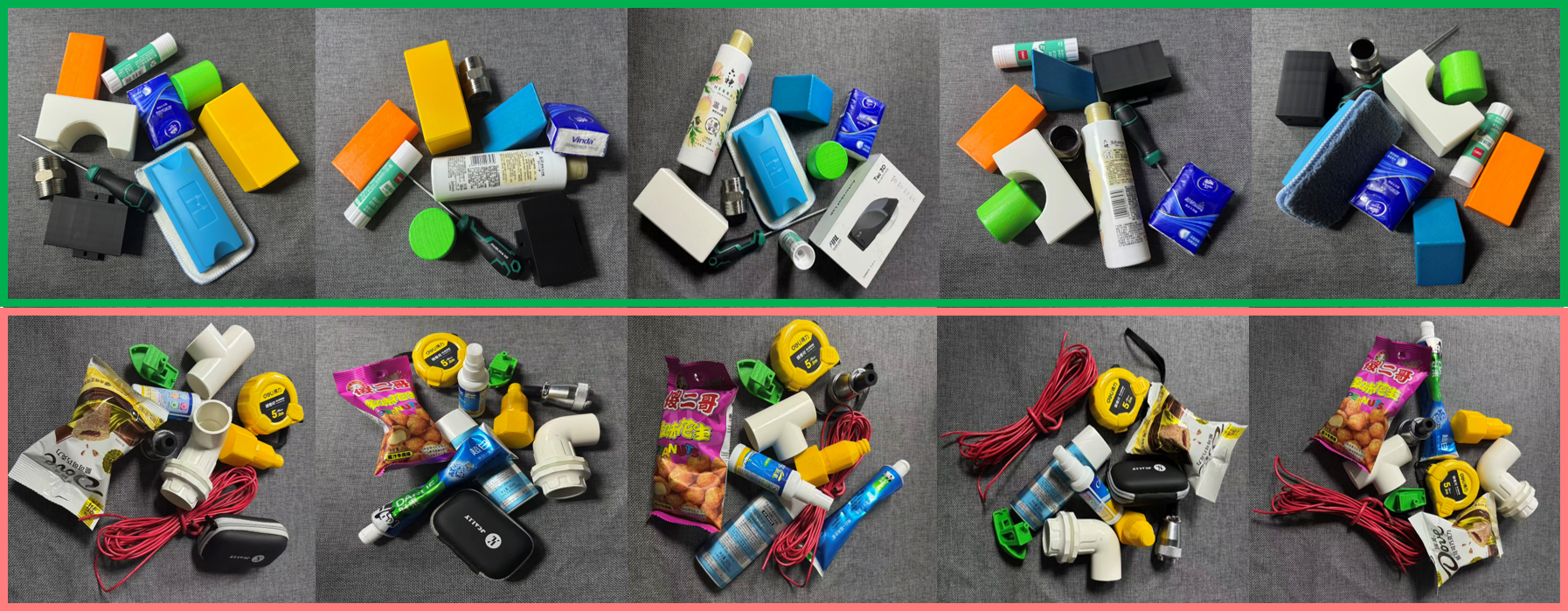
Figure 6: Real-world testbed for object grasping, demonstrating strong generalization to novel objects with significant shape and scale variation.
Ablation studies further validate the contribution of each module—the candidate generation via similarity matching and the evaluation-refinement network both contribute substantial, orthogonal gains. Notably, the refinement module contributes value under occlusion, surface complexity, and dense clutter, where initial shape-aligned grasps may otherwise fail.
Implications and Future Directions
SuperGrasp offers an explicit, interpretable mechanism for generalizing grasp synthesis to novel shapes and incomplete point clouds. By decoupling structural representation via superquadrics and leveraging deep local feature aggregation, it bridges the parametric data inefficiency of early methods and the representational limitations under sparse observations seen in end-to-end networks.
Key implications include:
- Practical generalization: The ability to transfer simulated models to varied real-world objects and novel environments without real-world fine-tuning.
- Efficiency: The superquadric stage yields rapid candidate generation, and the local context-aware E-RNet supports accurate and computationally efficient downstream selection and adaptation, outperforming exhaustive sampling.
- Modularity: The architecture allows for independent improvements and supports extension to alternative primitive representations or more complex gripper kinematics.
Future research trajectories should include tighter integration with online 3D reconstruction for persistent scene understanding, adaptation for multi-finger or soft grippers, and methods to further reduce the runtime of the evaluation-refinement stage.
Conclusion
SuperGrasp demonstrates that informed geometric abstraction, via superquadric similarity matching, combined with deep regional evaluation and refinement, addresses the primary obstacles faced in single-view robotic grasping. In both simulation and real-world settings, the approach achieves state-of-the-art stability, generalization, and computational efficiency, surpassing both classical and modern baselines. This work substantiates the value of combining interpretable geometric reasoning with local learning-based adaptation for robust manipulation under severe perceptual constraints.

