- The paper introduces a new systolic convexity notion based on the systolic ratio, bridging geometric and dynamical rigidity in symplectic topology.
- It deploys ECH capacities, shape invariants, and dynamical zeta functions to quantitatively distinguish and classify subclasses of Liouville domains.
- The study quantifies large-scale symplectic geometry via the Banach-Mazur distance and provides counterexamples to existing conjectures on symplectic embeddings.
Geometry and Dynamics on Liouville Domains in T∗T2
Overview and Motivation
The study explores the structural parallels between subclasses of star-shaped domains in (R4,ωstd)—notably toric, symplectically convex, and dynamically convex domains—and their analogues within Liouville domains of the cotangent bundle (T∗T2,ωcan). Central to this framework is a novel notion of convexity rooted in the systolic ratio, which bridges geometric and dynamical rigidity in symplectic topology.
A comprehensive machinery—including ECH capacities, shape invariants, and dynamical zeta functions—is mobilized for discriminating, comparing, and quantifying relations between domain subclasses. The study delineates the large-scale geometry of these Liouville domains with respect to Banach-Mazur distance, constructs codisc bundles resistant to flattening under exact symplectomorphisms, and establishes normalized capacity coincident results for a broad class of domains.
Subclass Relations and Convexity Notions
The paper defines and investigates multiple subclasses of star-shaped and fiberwise star-shaped domains, establishing their inclusion and strict separation.
- Product Domains (TT∗T2): These are domains of the form T2×A, where A⊂R2 is star-shaped.
- Codisc Bundles (F): Arising from Finsler metrics, these have fibers that are convex, but they do not uniformly ensure dynamical convexity.
- Systolically Convex Domains (S): Defined by dynamical convexity and the systolic ratio ρsys,T∗T2(X)≤1/4 (Equation 1), adapting rigidity concepts from Euclidean domains.
The relations between these subclasses are graphically synthesized to highlight their differentiability and containments.

Figure 1: Relations between subclasses of star-shaped domains in R4.
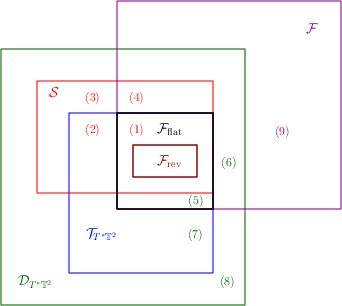
Figure 2: Relation between subclasses of fiberwise star-shaped domains in (R4,ωstd)0, with distinguishing examples provided in Theorem class proof.
The systematic construction of separating examples rigorously verifies the strict inclusions. For instance, product domains with non-convex fibers are not in the codisc bundle class, and domains built via exact symplectomorphism lifts can escape product structure while preserving dynamical convexity.
Quantitative Symplectic Invariants
The primary dynamical convexity criteria employed (as per Hofer-Wysocki-Zehnder) involve lower bounds on Conley-Zehnder indices for closed orbits. The study shows that product domains (R4,ωstd)1 admit non-contractible closed Reeb orbits, inherently achieving dynamical convexity.
An explicit computation of closed Reeb orbit actions in product domains yields sharp systolic ratio bounds (Examples illustrate triangles and polygons in (R4,ωstd)2 treated via smoothing and convex hull arguments) and the calculation of capacities via ECH combinatorial formulas. This bridges symplectic and contact topological invariants.

Figure 3: Smoothing triangle (R4,ωstd)3 at vertex (R4,ωstd)4, used to compute lower bounds for Reeb actions.
Symplectic Banach-Mazur Distance and Large-Scale Geometry
The Banach-Mazur distance is extended from Euclidean to cotangent bundle contexts, with precise scaling actions provided. Homological Banach-Mazur distance ((R4,ωstd)5) is introduced, requiring embeddings to be exact and (R4,ωstd)6-trivial, a refinement motivated by the topology of (R4,ωstd)7.
Using shape invariants and explicit constructions of product domains with combinatorial polygonal fibers, the paper achieves isometric embeddings from (R4,ωstd)8 into the space of fiberwise star-shaped domains, directly quantifying large-scale symplectic geometry.
Distinguishing via Dynamical Zeta Functions
Product domains are shown to have trivial dynamical zeta functions ((R4,ωstd)9), while carefully constructed non-flat codisc bundles (using Randers metrics and bumping techniques) yield nontrivial zeta factorization. This confirms that certain codisc bundles cannot be symplectomorphic (even exactly) to product domains built from flat metrics, leveraging Theorem 1.16 in referenced works.
Normalized Capacities and Systolic Ratio Conjectures
Ball-normalized and cube-normalized symplectic capacities are proven to coincide in broad classes, such as codisc bundles of flat torus (under symmetry and systolic ratio constraints) and monotone toric domains. Results rely on explicit ECH capacities and ball packing combinatorics.
Proposition 1.11 in referenced works offers exact formulas for ECH in codisc bundles, used to establish sharp coincidence results. The Gromov width and Hofer-Zehnder capacities for Lagrangian products are connected to the cotangent bundle capacity computations, with counterexamples constructed in centrally symmetric convex domains.

Figure 4: Star-shaped domain (T∗T2,ωcan)0 illustrating polygon-based embeddings crucial for large-scale geometry.
Practical and Theoretical Implications
The results inform classification and rigidity questions in symplectic topology, yielding:
- Criteria for systolic convexity as a contact-invariant notion in cotangent bundles, refining dynamical and geometric convexity concepts.
- Mechanisms for distinguishing Liouville domains even under exact symplectomorphisms, pertinent to symplectic flexibility and rigidity theory.
- Quantitative embeddings for symplectic Banach-Mazur geometry, signposting new directions for metric structure in symplectic domains.
- Explicit counterexamples to strong Viterbo-type conjectures, reinforcing the necessity of fiber-symmetry and capacity coincidences.
The theoretical developments anticipate refined symplectic invariants in higher-genus cotangent bundles, capacities for non-flat fibrations, and further interplay between combinatorial and topological machinery. Practically, these results may sharpen constraints for symplectic embedding problems, Reeb dynamics analysis, and computational symplectic topology.
Conclusion
The paper meticulously develops a parallel framework for subclasses of Liouville domains in (T∗T2,ωcan)1, anchored by systolic ratio convexity and dynamical invariants. Through combinatorial, capacity-theoretic, and geometric constructions, strict separation of subclasses is achieved, and the large-scale geometry of domain spaces is quantified. The use of dynamical zeta functions and shape invariants provides essential tools for distinguishing domains beyond classical convexity. Capacity coincidence results and systolic ratio bounds yield nontrivial constraints for symplectic embeddings, advancing both theoretical rigor and quantitative understanding of symplectic geometry in cotangent bundles.