- The paper presents a high-resolution simulation that reproduces star-by-star chemical evolution by incorporating key nucleosynthetic channels including WR, SNII, SNIa, AGB, and NSM.
- It quantifies spatial and temporal metallicity correlations, revealing injection scales, mixing lengths, and distinct gas-star abundance offsets.
- The study demonstrates a robust linear model linking nucleosynthetic channel differences to observed ISM and stellar abundance correlations, validating chemical tagging approaches.
Ripples of Stellar Enrichment: Star-by-Star Chemical Evolution and Mixing in the Milky Way
Introduction and Scope
"Ripples of Stellar Enrichment (RoSE) -- simulating element production and mixing in the Milky Way star-by-star" (2603.29242) presents an advanced framework for numerically resolving the generation, spatial redistribution, and inheritance of chemical elements in a Milky Way-like isolated disk at star-level granularity. RoSE systematically incorporates all significant nucleosynthetic channels—Wolf-Rayet (WR) winds, SNII, SNIa, AGB stars (young and old), and neutron star mergers (NSM). The simulation tracks nine key isotopes and follows the environmental imprint and mixing of their yields in both the interstellar medium (ISM) and newly formed stars. The analysis combines spatial, temporal, and cross-correlation statistics with source decomposition, targeting the connection between injection physics, turbulent mixing, and the resulting chemodynamical architecture of the ISM and stellar populations.
Simulation Methodology
RoSE builds on the isolated disk setup of the AGORA project, transferring initial conditions from Wibking & Krumholz (2023) and refining the mass resolution to 286 M⊙ with adaptive softening lengths to sub-parsec scales. The simulation utilizes meshless, finite-mass MHD (Gizmo-MFM), includes a non-equilibrium chemical network, and couples with the Grackle cooling module. Star formation is implemented at nth=103 H cm−3 with ϵff=0.01, except for extreme overdensities, and resolved through star-by-star IMF sampling (slug framework).
The yield treatment assigns element returns from WR, SNII, and massive AGB stars to "slug" (simulation-formed) particles, and delayed channels (SNIa, NSM, low-mass AGB) to pre-existing particles stochastically. All nine tracked isotopes (12C, 14N, 16O, 24Mg, 32S, 56Fe, nth=1030Ba, nth=1031Ce, nth=1032Eu) are decomposed by nucleosynthetic source. Newly formed stars inherit chemically from the local ISM, enabling fully self-consistent feedback between gas and star abundance distributions.
Nucleosynthetic Channel Decomposition and Steady-State
The temporal build-up of element masses is dominated by their channel-dependent delay timescales and spatial clustering. The simulation rapidly approaches a quasi-steady-state after an initial star formation burst associated with resolution ramp-up.
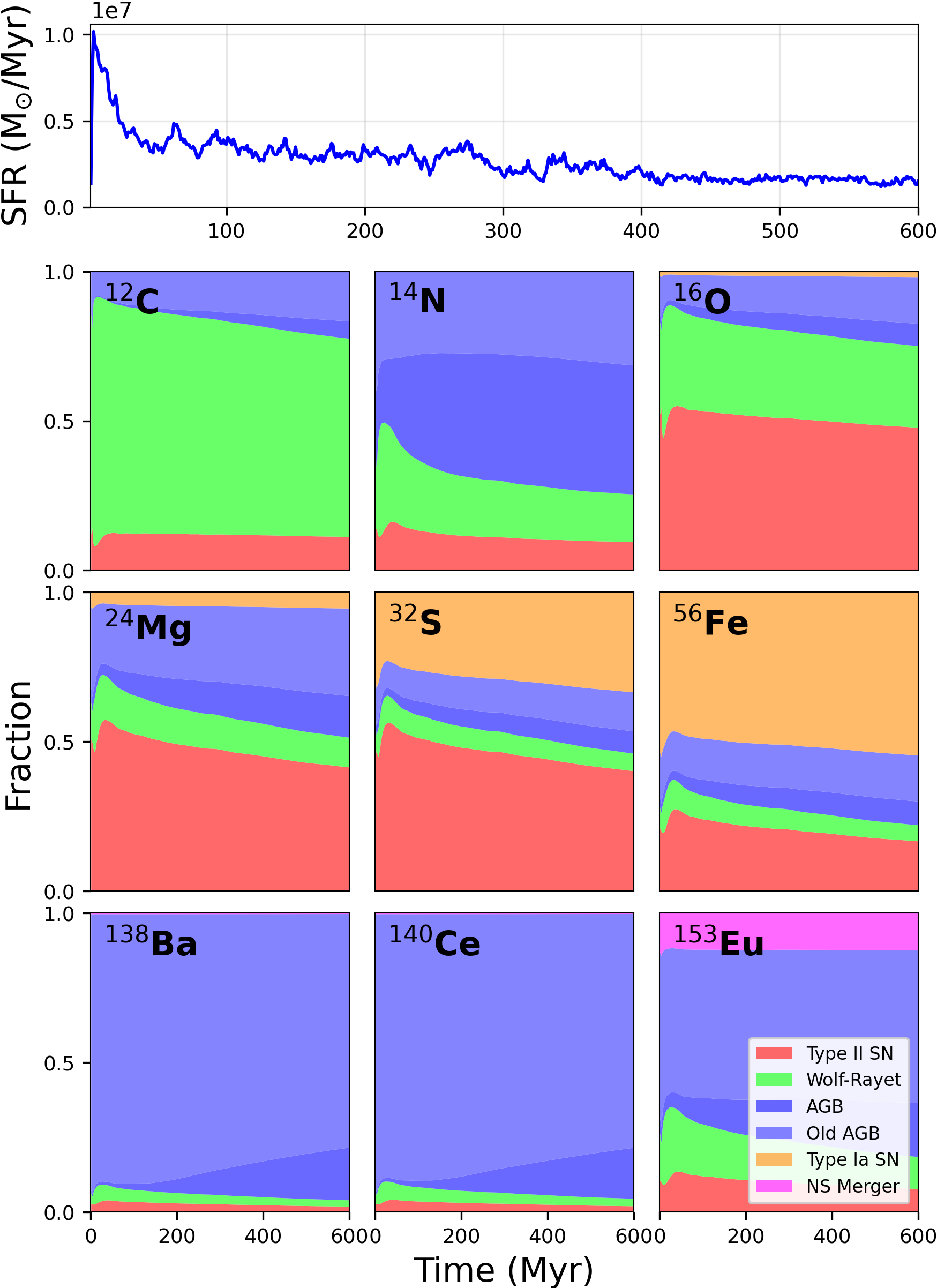
Figure 1: Fractional cumulative contributions of each nucleosynthetic channel to tracked isotopes as a function of time, with SFR as reference.
Key results: WR stars supply most C, SNII dominate nth=1033-elements (O, Mg, S), SNIa contribute the majority of Fe, and AGB/NSM sources shape the heavy neutron-capture elements. Once SFR stabilizes, the isotopic source fractions also converge, as required for a stationarity between injection and turbulent mixing.
Spatial and Temporal Correlation Structure
The spatial and temporal chemical inhomogeneities of individual elements are quantified via pixelized metallicity fluctuation maps with the dominant radial profile subtracted. The autocorrelation at lag nth=1034 or nth=1035 (space/time) is fit for two parameters: the physical injection scale nth=1036 and the large-scale correlation length nth=1037 (or the dimensionless ratio nth=1038), as motivated by KT18's analytic mixing-injection theory.
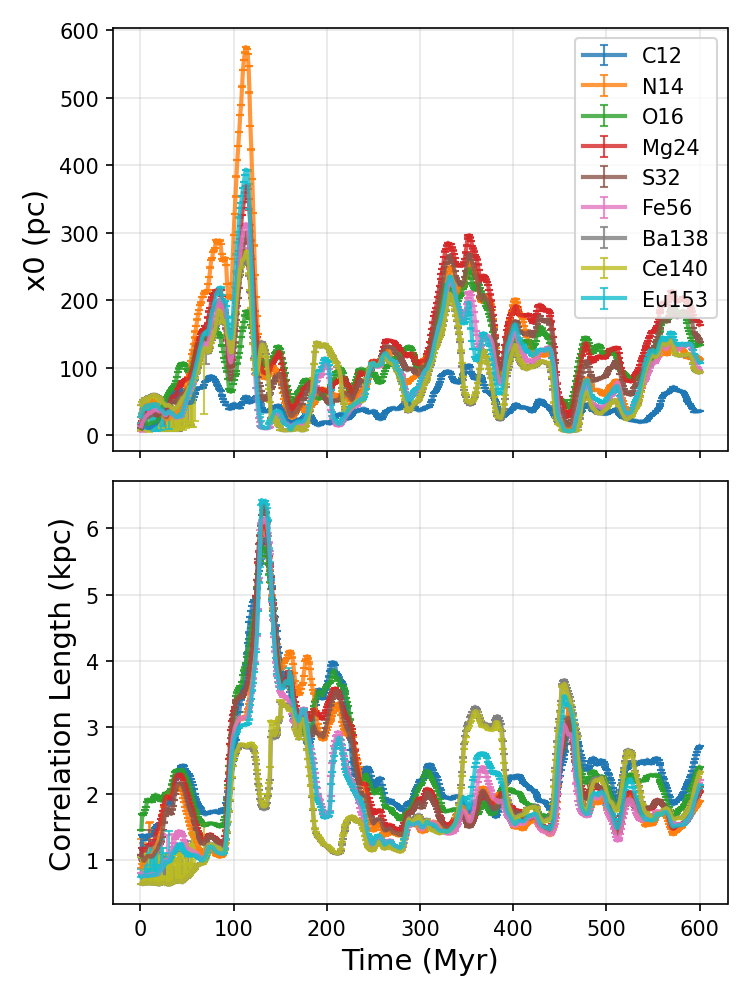
Figure 2: Time evolution of injection width and correlation length for all tracked isotopes.
After a 200 Myr transient, nth=1039 stabilizes at tens of parsecs and −30 oscillates in the 1–3 kpc range for all elements. Channel clustering is evident: C (WR) exhibits the lowest injection scale and highest correlation length; SNII products (O, Mg, S) have intermediate, nearly identical values; Fe (SNIa) has higher −31 and shorter −32; Ba, Ce, Eu (AGB/NSM) show extended correlation lengths reflecting stochastic site rarity and late-time injection. This validates that the dominant nucleosynthetic channel completely determines element distribution topology.
Temporal correlations, evaluated following de-rotated lagged maps, confirm this pattern: SNII-dominated elements (O, Mg, S) display the slowest decorrelation—temporal correlation timescales up to several Myr—while NSM- and SNIa-driven elements mix out on much shorter intervals.
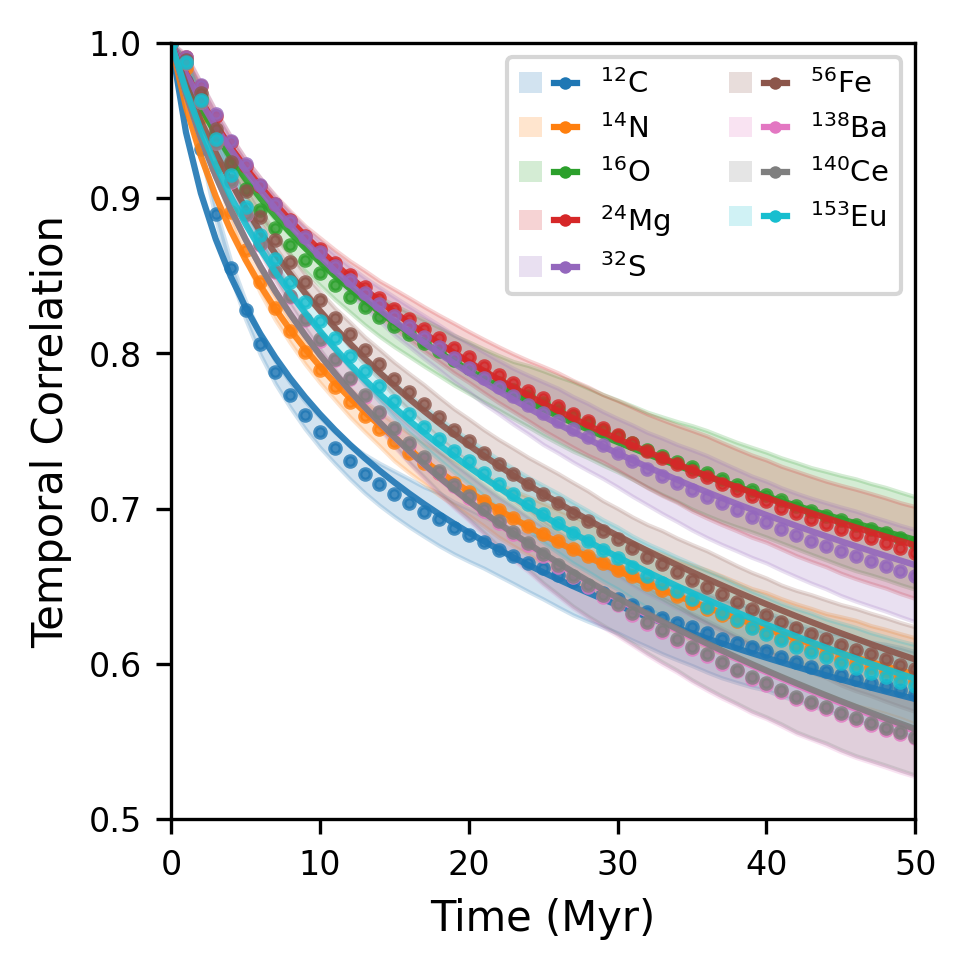
Figure 3: Mean temporal correlation and variance as a function of time lag, with model fits.
Cross-Correlation Patterns and Predictive Modeling
Inter-element cross-correlations are computed via normalized Pearson coefficients between fluctuation fields (gas and stars). Elements sharing the same production site show near-unity cross-correlation (e.g., O–Mg, O–S), while pairs from channels with disparate delay times correlate poorly (e.g., C–Ba or O–Ba). The time evolution and ensemble-mean cross-correlation matrix highlight both the temporal fluctuation and stability at late times.
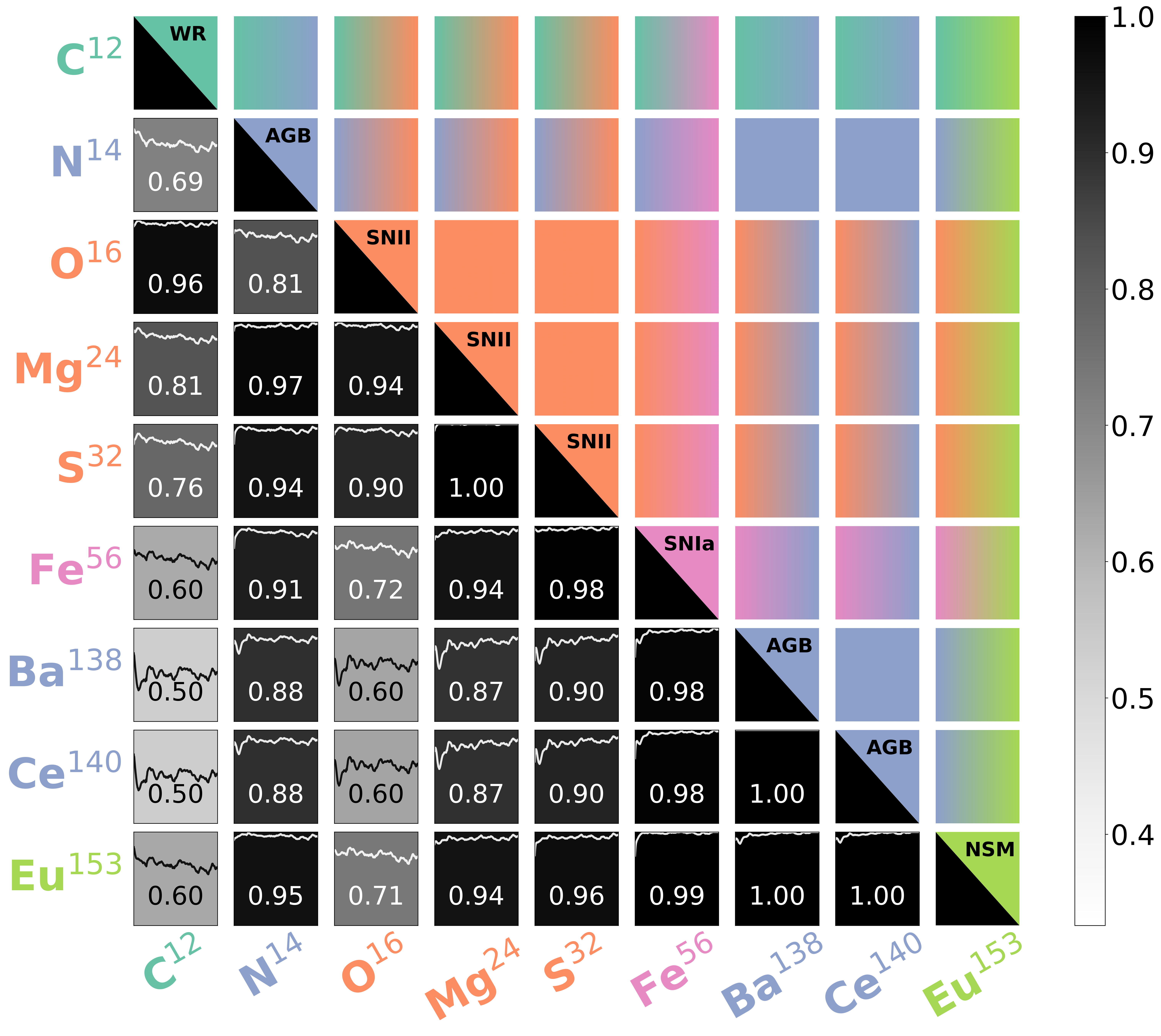
Figure 4: Gas-phase cross-correlation matrix for all isotopes, with channel highlights and time-averaged values.
Stellar populations inherit—at fixed birth epoch—the abundance correlations present in the ISM, but with subtle and systematic offsets: for prompt-source pairs, stellar correlations are higher than gas-phase (due to formation site selection and the non-participation of the hot ISM phase in star formation); for delayed-source pairs, gas-phase correlations are higher (as ongoing source injection modifies ISM composition after star formation ceases for a given cohort).
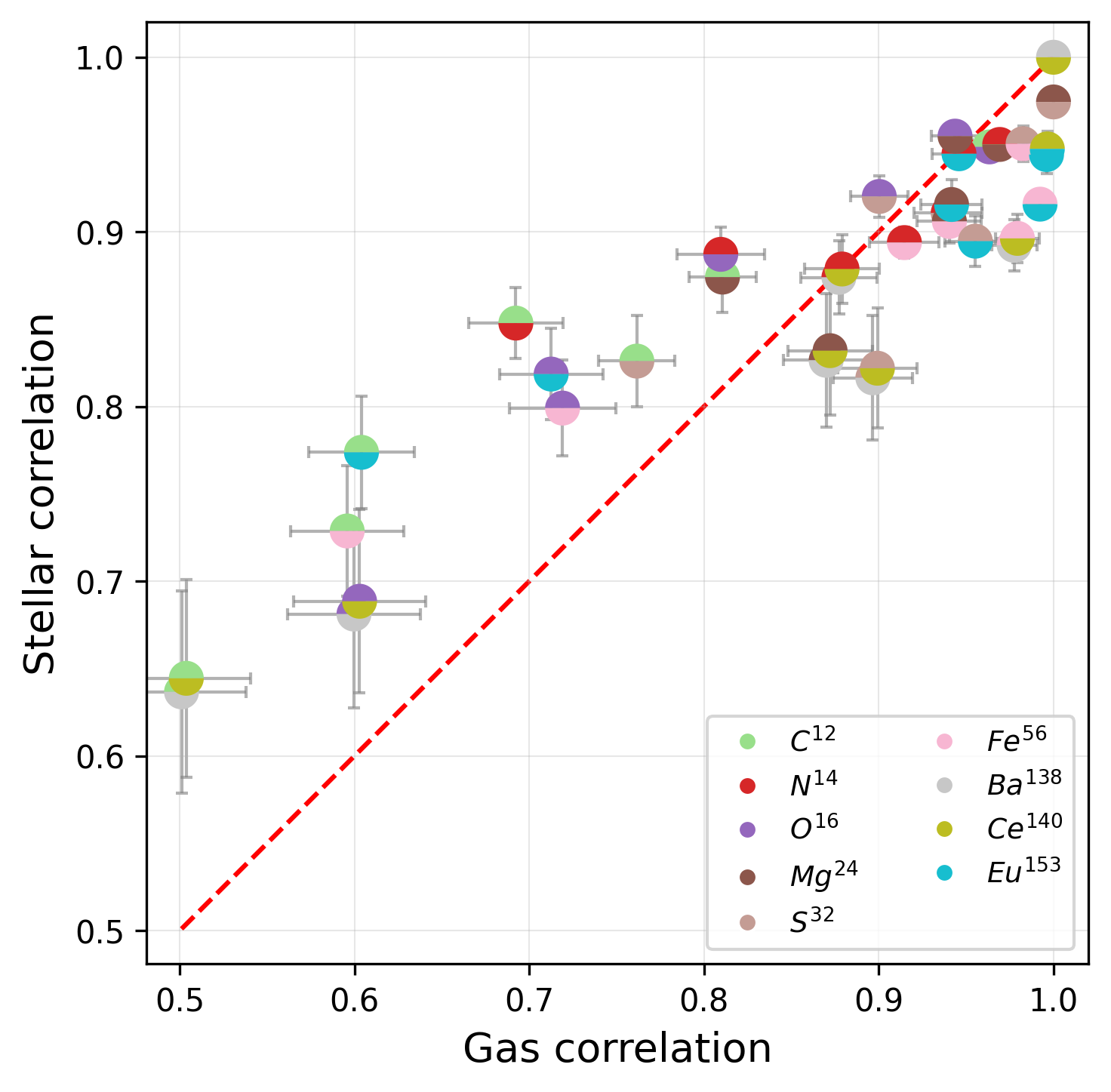
Figure 5: Gas vs. stellar cross-correlation comparison, with pairwise composition coding.
A critical result is the demonstration that a linear model based solely on the vector of per-element differences in nucleosynthetic source fraction robustly predicts gas- and star-phase cross-correlations with −33 and −34 respectively (strong for any physically-motivated chemodynamical metric). Notably, the model underpredicts C–O (WR–SNII) correlations in gas, linked to the erasure of WR-borne structure by subsequent SNII feedback.
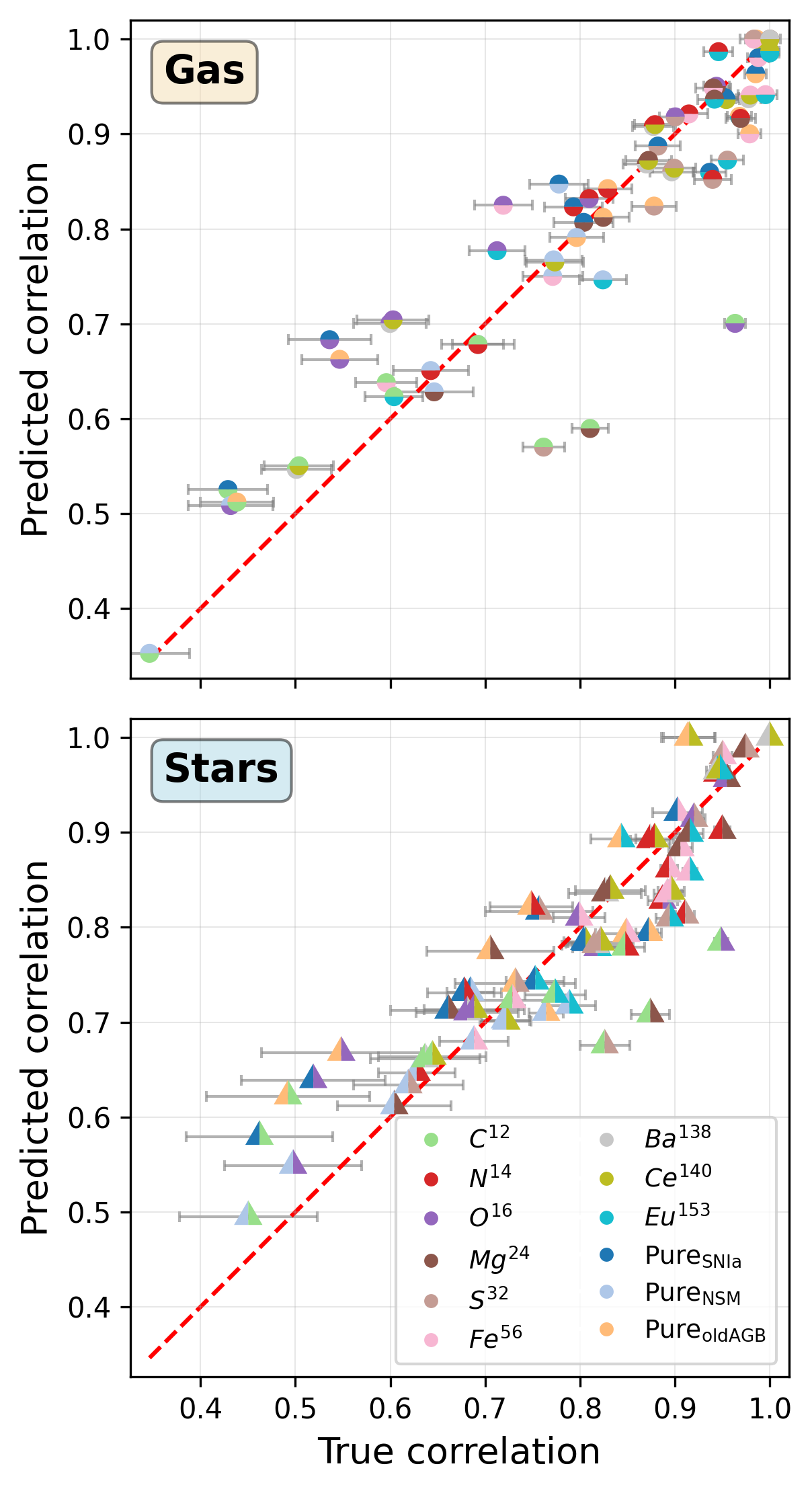
Figure 6: True vs. predicted cross-correlations, validating the source-difference linear model.
Gas–Star Offsets and Theoretical Implications
Quantitative differences between gas and stellar phase cross-correlation coefficients primarily follow the relative impact of hot bubble feedback. Elements injected primarily into SNII-driven hot ISM show lower correlation in the gas phase (high spatial mixing but hot-phase bias), yet stars selectively sample the cold, dense, well-mixed phase. This is directly confirmed by comparing cross-correlations between hot and cold ISM, with the star-cold gas alignment mirroring and explaining observed phase dependence.

Figure 7: Cross-correlation differences: stars–gas (lower-left), hot–cold ISM (upper-right).
This has broad implications for the theoretical interpretation of chemical tagging and ISM mixing: observed stellar abundance patterns may preserve structure erased in present-day ISM, and the effective chemical dimensionality is channel- and phase-dependent.
Connection with Observational Data
Direct comparison to Milky Way stellar associations (Ness et al. 2026, Casali et al. 2020) shows qualitative agreement: same-channel element pairs are most correlated, differing-channel pairs less so, and the absolute magnitude of simulated cross-correlation matches the observed one within the inter-dataset variance (typically −35–−36). Remaining biases are partially attributable to differences in sample selection (age, [Fe/H], −37), measurement precision, and pipeline systematics rather than exclusively to simulation physics.
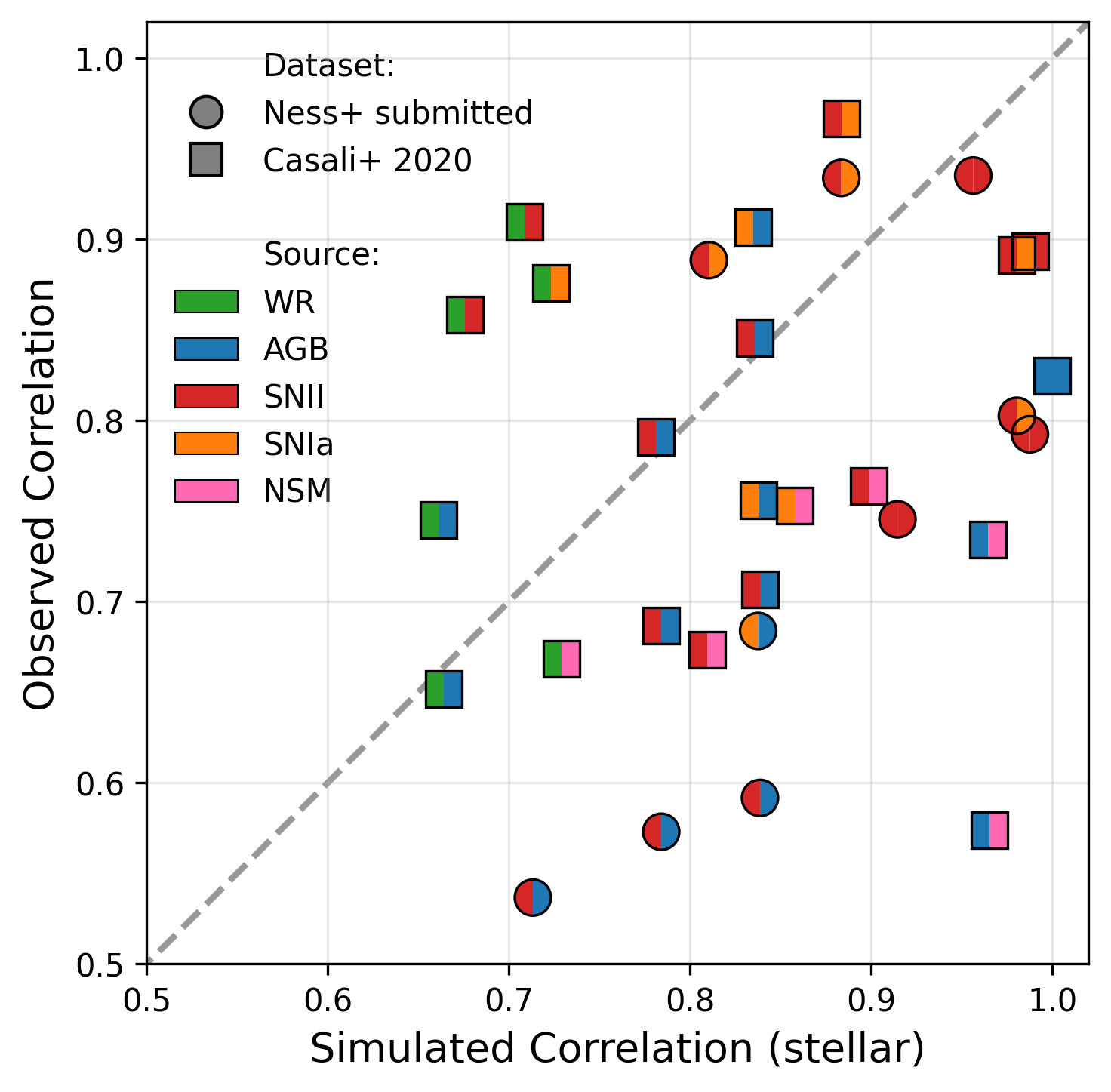
Figure 8: Simulated vs. observed pairwise stellar cross-correlations for two major spectroscopic datasets.
Notably, both data and RoSE simulations reveal pronounced age-dependent patterns in cross-correlation, especially in the −38–−39 Gyr regime, implying memory of the Galactic SFH (see Appendix, Figure 9 in the paper).
Implications and Future Directions
This work establishes the nucleosynthetic channel as the fundamental organizing principle for spatial, temporal, and compositional chemical structure in disk galaxies. The strong performance of a simple "source fraction difference" model implies that, to first order, the spatial and temporal complexity of galactic chemical evolution is reducible to few intrinsic parameters: injection delay, event clustering, and ISM mixing rates.
The results imply that galactic chemical tagging, ISM abundance mapping, and the disentangling of multi-channel yields can be modeled and inverted with physically-motivated, low-dimensional models. The distinction between hot and cold ISM phases in imprinting stellar chemistry is directly quantifiable, with immediate relevance for interpretation of large-scale IFU surveys (e.g., BlueMUSE) and next-generation stellar abundance datasets (e.g., 4MOST, WEAVE-StePS, SDSS-V).
Forward modeling in cosmological zoom-ins, treatment of non-axisymmetric structures (e.g., bars, radial migration), and expansion of isotope tracking are projected paths to address residual discrepancies and probe time variability over multi-Gyr baselines.
Conclusion
"Ripples of Stellar Enrichment" defines and validates a direct, physically-grounded link between the nucleosynthetic origin of elements and the spatial, temporal, and compositional correlation structure of abundances in both gas and stars of a Milky Way-like disk. Its key findings—channel-controlled correlation topology, robust linear predictive modeling, and hot-cold ISM differentiated inheritance—provide a rigorous empirical and simulation-driven template for future studies in galactic chemodynamics and chemical tagging. The work exposes the chemical kernel connecting star formation history, ISM mixing, and the multi-element information structure of galaxies, setting the stage for interpretable inference as multi-element, spatially resolved spectroscopic data becomes available.