- The paper shows that asymmetric, unidirectional radiation pressure induces a non-Hermitian skin effect by launching elastic waves in nanostructured membranes.
- It employs a discrete mass–spring model to reveal nonreciprocal wave dynamics and complex eigenmode localization analogous to the Hatano–Nelson model.
- The findings provide key insights for designing interstellar lightsails, emphasizing the need to balance optomechanical stability with wave amplification.
Radiation-Pressure-Induced Non-Hermitian Skin Effect in Elastic Membranes
Introduction and Physical Context
The paper "Radiation-pressure-induced non-Hermitian skin effect in elastic membranes" (2603.29111) investigates the direct coupling of optical radiation pressure with longitudinal elastic waves propagating perpendicular to the incident light. Traditional analyses treat radiation pressure primarily as a rigid-body force, but recent work has revealed its ability to launch elastic waves parallel to light incidence. This study departs from such established paradigms by identifying a fundamentally distinct interaction regime—where unidirectional, transverse radiation pressure, enabled by asymmetric in-plane scattering (e.g., nanostructured diffraction gratings or metasurfaces), gives rise to nonreciprocal elastic-wave propagation and the non-Hermitian skin effect (NHSE).
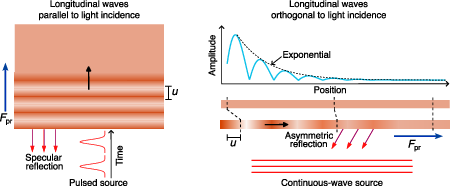
Figure 1: Schematic of the in-plane elastic wave excitation by specular (left) and unidirectional (right) radiation pressure, with the latter inducing nonreciprocal, non-Hermitian dynamics via asymmetric optical scattering.
Theoretical Model and Analysis
A one-dimensional discrete mass–spring model is employed to capture the essential features of the elastic membrane with locally varying optomechanical response. Radiation pressure is modeled as a unidirectional, elongation-sensitive force acting in the direction parallel to the membrane plane, with asymmetry arising from intentionally engineered surface nano-patterning (e.g., gratings with unit-cell scale deformation). The force on each mass includes a term linear in the local strain, which is determined by both the light intensity and the derivative of the optomechanical force efficiency factor with respect to elongation.
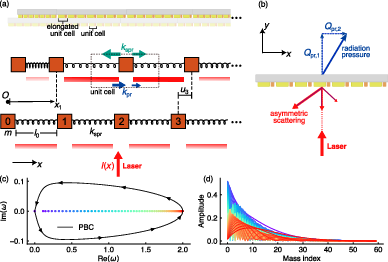
Figure 2: Discrete mass–spring representation of the nanopatterned illuminated membrane, highlighting strained unit cells and force distribution.
The key outcome of the linearized dynamics is a nonreciprocal wave equation, mathematically analogous to the Hatano–Nelson model, where the elastic restoring force is modified by a unidirectional radiation-pressure term. For periodic boundary conditions (PBC), the normal-mode spectrum is complex, with frequency winding in the complex plane. For experimentally relevant open boundary conditions (OBC), eigenmodes under NHSE are exponentially localized at one membrane edge, with stabilities and growth rates governed by the magnitude of the radiation–elongation coupling.
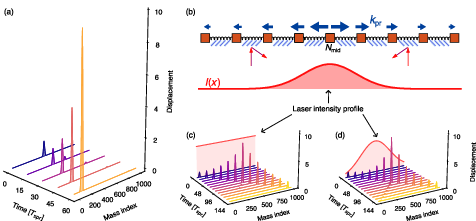
Figure 3: Spatio-temporal evolution of membrane displacement, demonstrating NHSE-induced exponential amplification of elastic waves propagating against the direction of applied radiation pressure.
Non-Hermitian Signal Amplification and Enhancement
Although radiation pressure is typically weak, its effects are dramatically enhanced by optically dispersive nanostructured designs. The study utilizes topology optimization to maximize the linear elongation–scattering coupling (∂Q/∂s), finding that values as high as 5×10⁶ can be achieved in tailored diffraction gratings. This enables measurable, order-unity amplification of elastic-wave perturbations over experimentally accessible (centimeter-scale) propagation distances, which is otherwise negligible for nondispersive membranes.
Application to Interstellar Lightsails
A major applied context analyzed is the stability of ultrathin, nanostructured lightsails for laser-driven relativistic propulsion. Such photonic sails demand unprecedented optomechanical performance, including both broadband reflectivity (across the Doppler-shifted spectrum) and mechanical resilience. The study quantitatively evaluates the NHSE-induced amplification of longitudinal elastic waves for leading Si3N4 designs, showing that under realistic mission parameters (10 nm thickness, multi-watt/cm2 illumination), even minuscule strain perturbations can be exponentially amplified—potentially tearing the sail within sub-meter flight distances if ∣∂Q/∂s∣ is not minimized.
The observed trade-off is further complicated by requirements for beam-riding stability, which also rely on tailored in-plane and out-of-plane optical forces. The analysis demonstrates that the growth of longitudinal instabilities can be exacerbated by laser-beam profile nonuniformity and relativistic Doppler shifting of the action spectrum, necessitating a global optimization across acceleration, stability, and mechanical criteria.
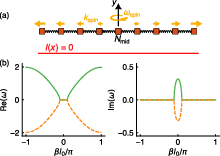
Figure 4: Effect of centrifugal (spin-induced) stabilization and associated bandgap formation in the elastic-wave spectrum, counterbalancing transverse and longitudinal instabilities.
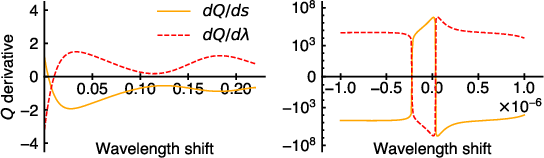
Figure 5: Contour plot of ∂Q/∂s as a function of elongation and wavelength, illustrating the complex trade-offs intrinsic to broadband operational requirements.
Implications, Limitations, and Prospects
This work provides the first evidence that purely optical, passive engineering of nonreciprocal mechanical dynamics is possible in nanostructured membranes, presenting a scalable and tunable experimental platform for non-Hermitian physics. The results imply that radiation–structure feedback—not just the absolute magnitude of radiation pressure—can fundamentally alter the mechanical landscape, especially for ultralight, highly engineered systems such as spacecraft sails.
From a design perspective, the presence of the NHSE establishes critical new constraints on sail architecture, requiring that longitudinal wave coupling coefficients be evaluated and minimized in parallel to more conventional optomechanical stability and thermal management criteria. The findings also generalize to broader fields involving light–matter–mechanics interactions, including cavity optomechanics, phononic metamaterials, and reconfigurable nanophotonics.
Future research directions include:
- Extension of the model to two-dimensional membranes and flexural modes, potentially leading to higher-order NHSE phenomena.
- Incorporation of nonlinear and photoelastic effects at high strain or intensity.
- Realization of controlled non-Hermitian amplification and localization in laboratory platforms using nanofabricated membranes and high-power lasers.
- Exploration of trade-offs between propulsion efficiency, wave stability, and fabrication yield in large-area metasurfaces.
Conclusion
The paper establishes a new interaction regime in which radiation pressure, mediated by asymmetric nano-optical scattering, acts as a passive, linear, and tunable source of nonreciprocal amplification for elastic waves—a mechanical NHSE. The results reveal potentially catastrophic wave amplification in applications such as interstellar lightsails if not optimally controlled, and provide a unified theoretical and computational methodology for predicting and mitigating these effects in the next generation of photonic-mechanical space structures.

