- The paper establishes that detecting Digiorno-like objects in the Flavor Zone is impractical with current and foreseeable instrumentation.
- It models DLOs as radiatively heated, flat-disk artifacts with precise thermal characteristics tied to food preparation.
- The study contrasts transit photometry and high-contrast imaging, emphasizing extreme contrast limitations that preclude reliable detection.
SETI in the Culinary Regime: Detectability of Digiorno-like Objects in the Flavor Zone
Introduction and Motivation
The study leverages the conceptual framework of the habitable zone (HZ) and recontextualizes it as the "Flavor Zone" (FZ), defined as the precise circumstellar region optimal for direct thermal preparation of food, bypassing any intermediaries such as electricity or internal combustion. The paper formalizes this notion via the introduction of Digiorno-like Objects (DLOs)—archetypal frozen pizza analogs—serving as proxies for artificial artifacts directly utilizing stellar flux for thermal preparation. The investigation thus forms an intersection between SETI, exoplanetary science, and object detectability thresholds, asking whether it is technically feasible to observe such objects if deployed by technologically advanced extraterrestrial agents.
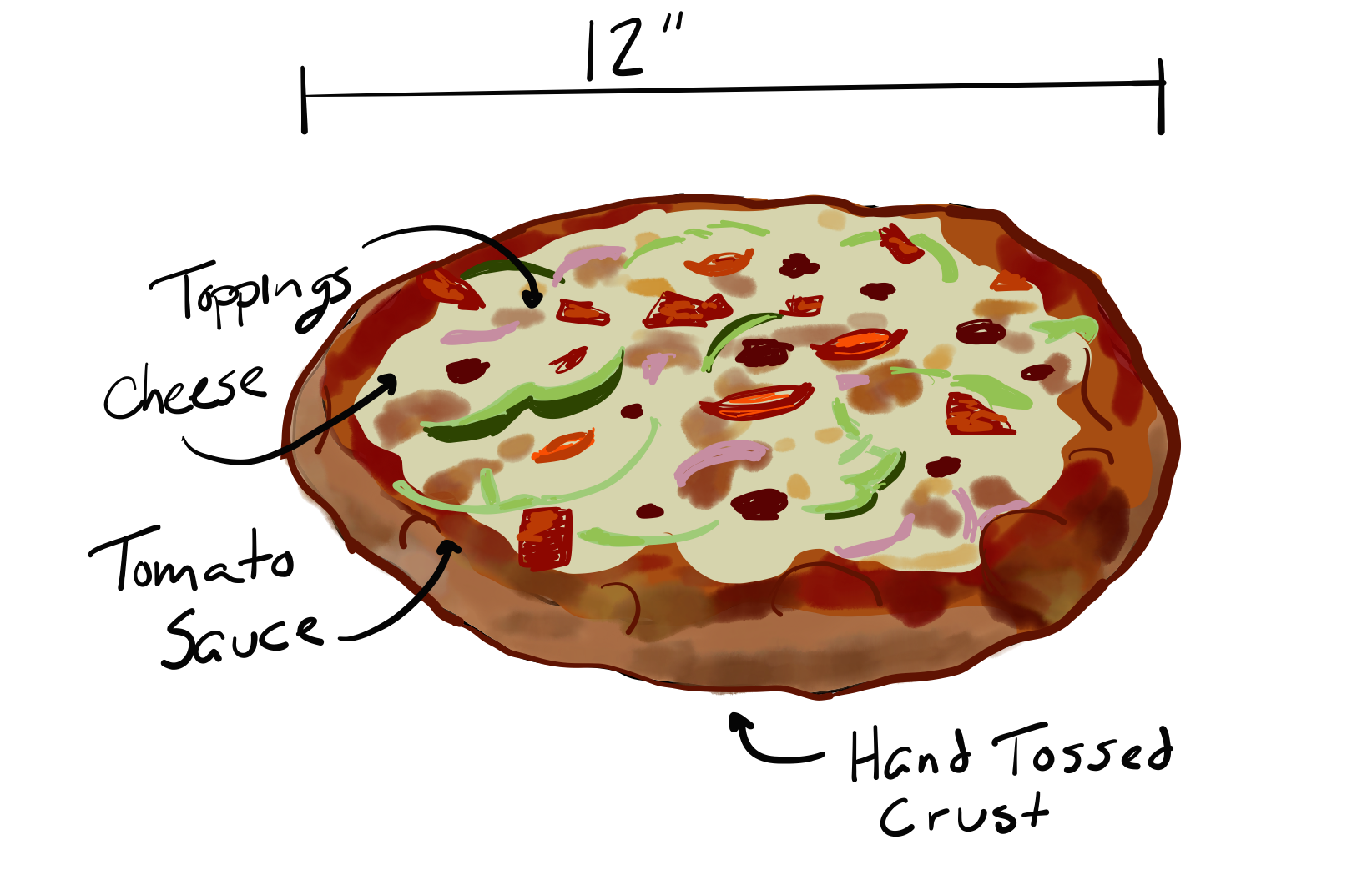
Figure 1: The structure of the Digiorno-like Object (DLO) used as a toy model for circumstellar food preparation.
The FZ is quantified according to the radiative equilibrium temperature corresponding to typical food preparation instructions for a Digiorno pizza (400∘F ≈ 477.6~K). The DLO is modeled as a flat disk (diameter 12 inches, hand-tossed crust with standard toppings), characterized by a radius of 15.24~cm, and a mass ∼900~g. The FZ for a given star is established through energy balance:
TDLO=[4r2(1−A)R⊙2T⊙4]1/4
where A (albedo) is assigned as 0.06, adopting the reflectance properties of cheddar cheese. The boundaries of the FZ are then set by constraining TDLO within the range [463.7~K, 491.5~K]. This yields FZ distances between $0.31-0.35$ AU (for the Sun) and sub-milli-AU separations for ultracool dwarfs, with associated angular scales critically affecting direct detection prospects.
Physical Constraints: Orientation, Orbits, and Perturbative Effects
Unlike isotropic terrestrial ovens, the directivity of stellar irradiation imposes orientation-dependent heating constraints. "Cheese-on" orientation maximizes incident flux, but necessitates rotation (at least one 180∘ flip) for uniform cooking. "Crust-on" orientation reduces incident area by an order of magnitude, dramatically increasing required exposure times.
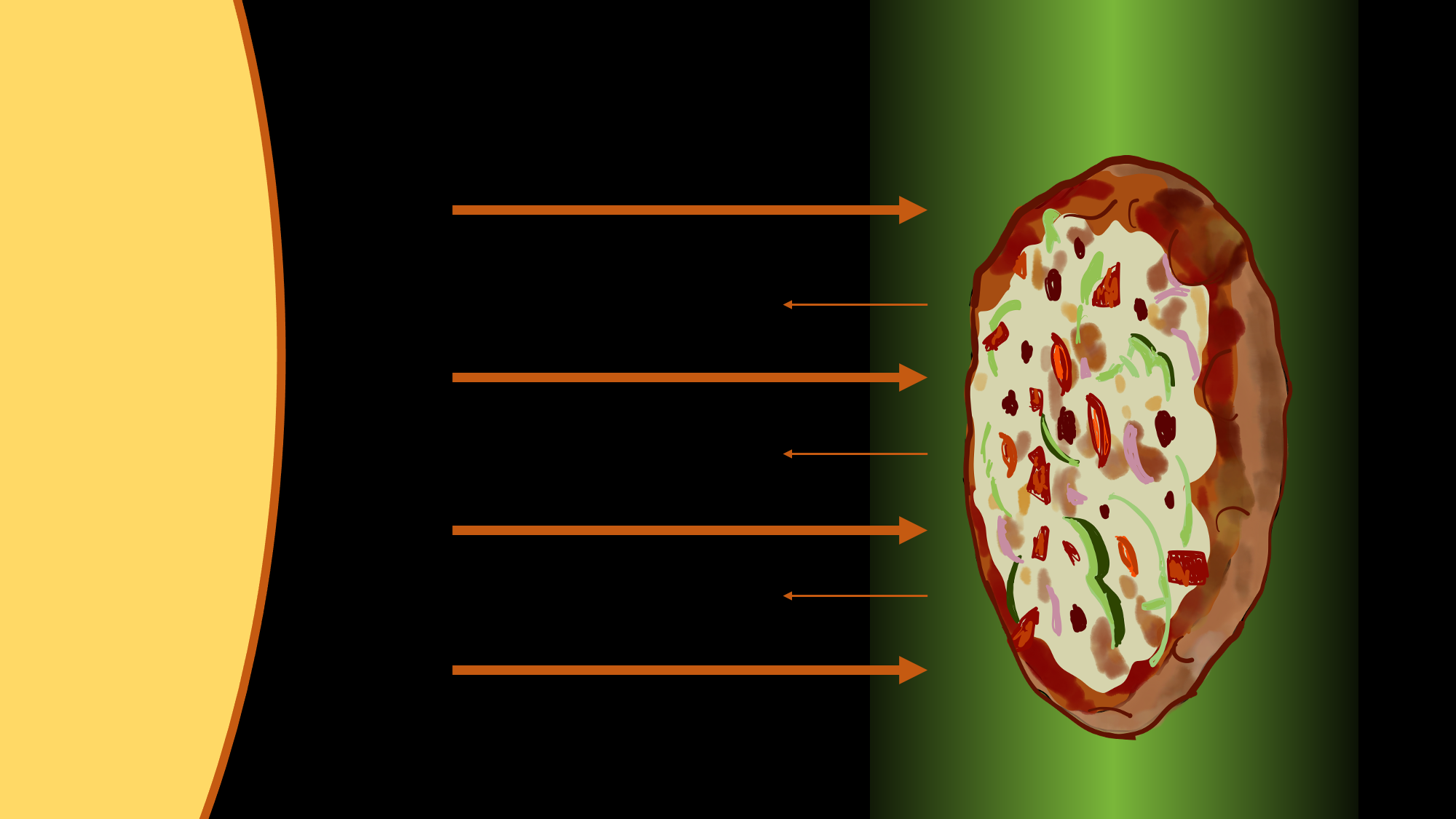
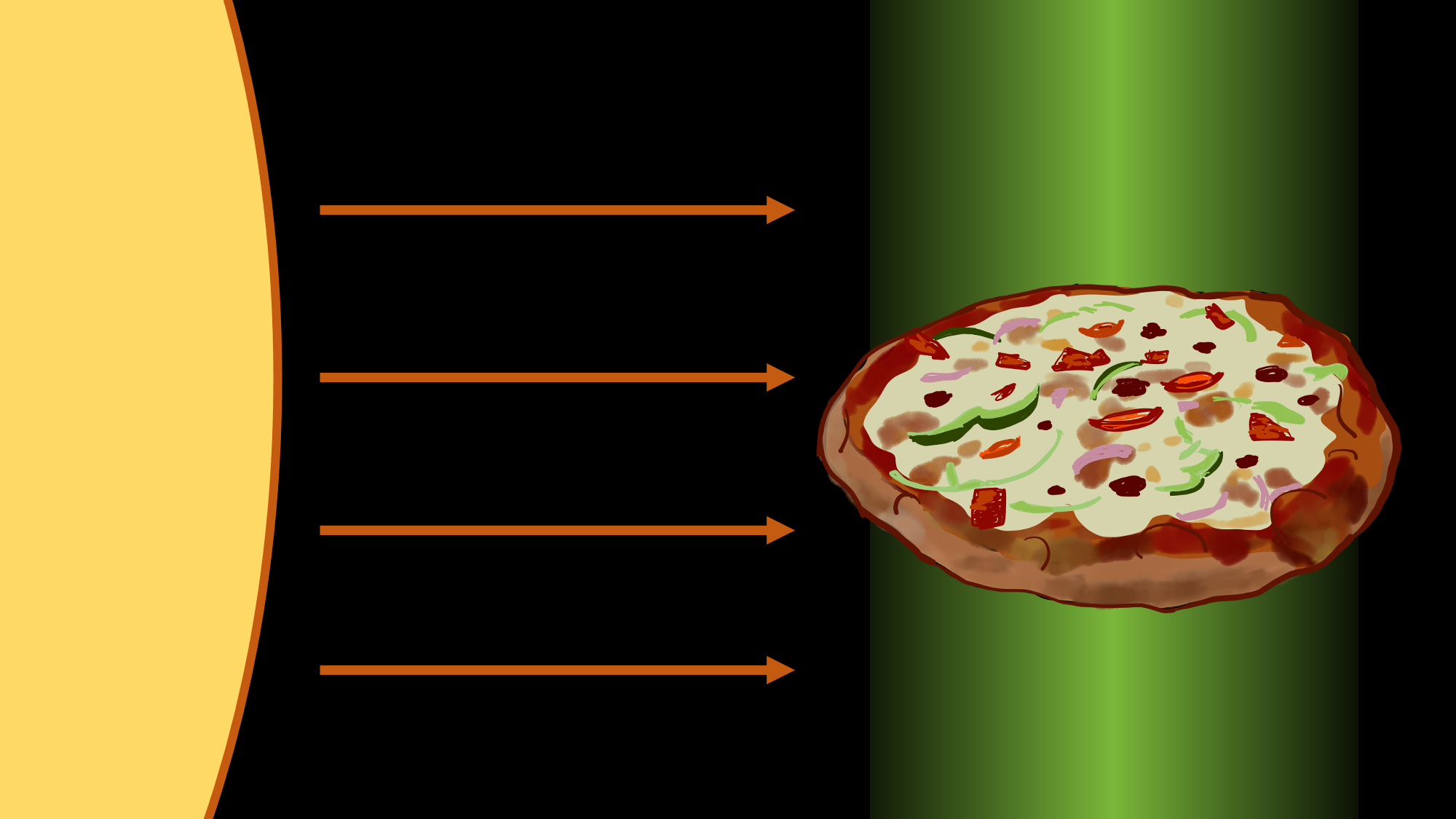
Figure 2: Schematic of DLO orientation, comparing maximal (cheese-on) and minimal (crust-on) radiative exposure.
Optimal DLO deployment mandates a circular orbit strictly within the FZ for consistent thermal input. The study calculates that for Proxima Centauri, only orbits with eccentricity <0.06 guarantee confinement within the FZ during the entire orbital period, despite the trivial mass of the DLO compared to the host star. The impact of solar radiation pressure (SRP) is acknowledged as potentially nontrivial for such a low-mass, large-area artifact, although detailed computations are explicitly deferred.
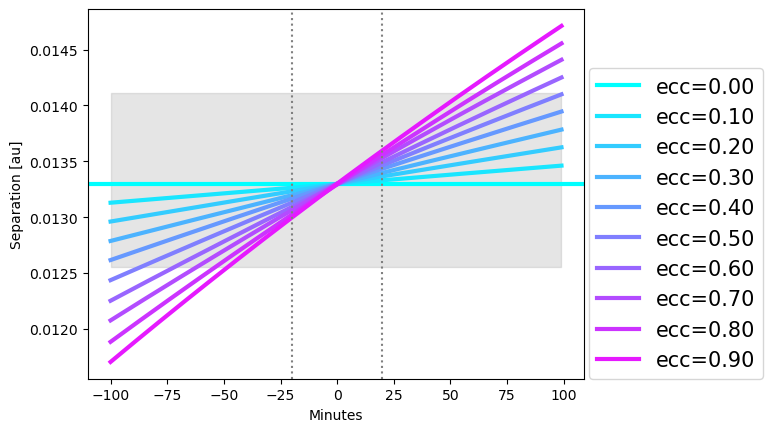
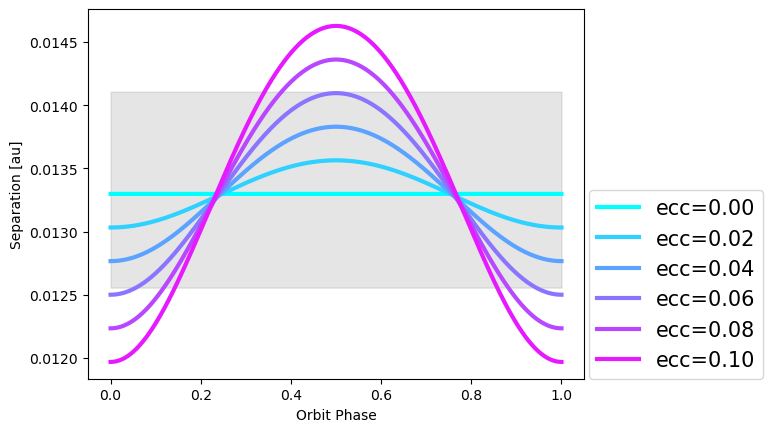
Figure 3: Time-dependent stellar separation and orbital phase for DLOs of varying eccentricity, demonstrating FZ residency constraints.
Observational Prospects: Transit and Direct Imaging Analysis
Transit Photometry
The photometric transit signature of a DLO crossing its host star is simulated using the planetplanet package. Even for the nearest target systems, the expected transit depth is of order 10−9 or smaller—far beneath current photometric precision and photon noise limitations, even for instrumentation such as JWST. No meaningful detection is possible using this method with foreseeable hardware.
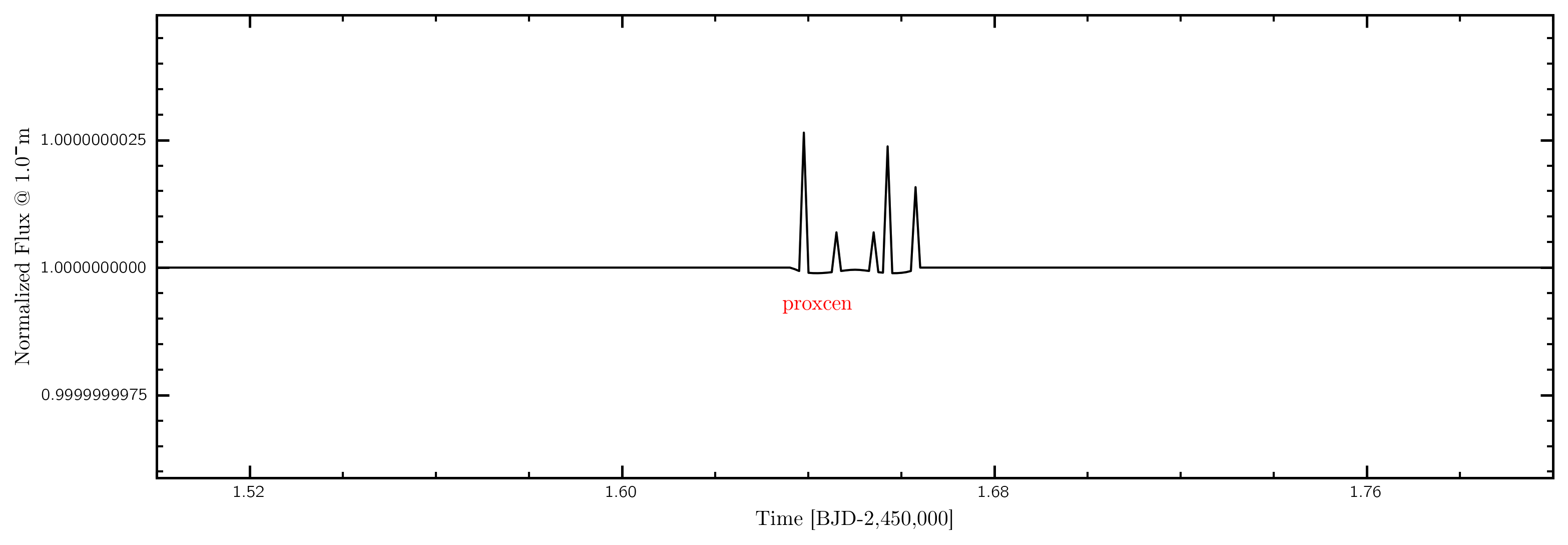
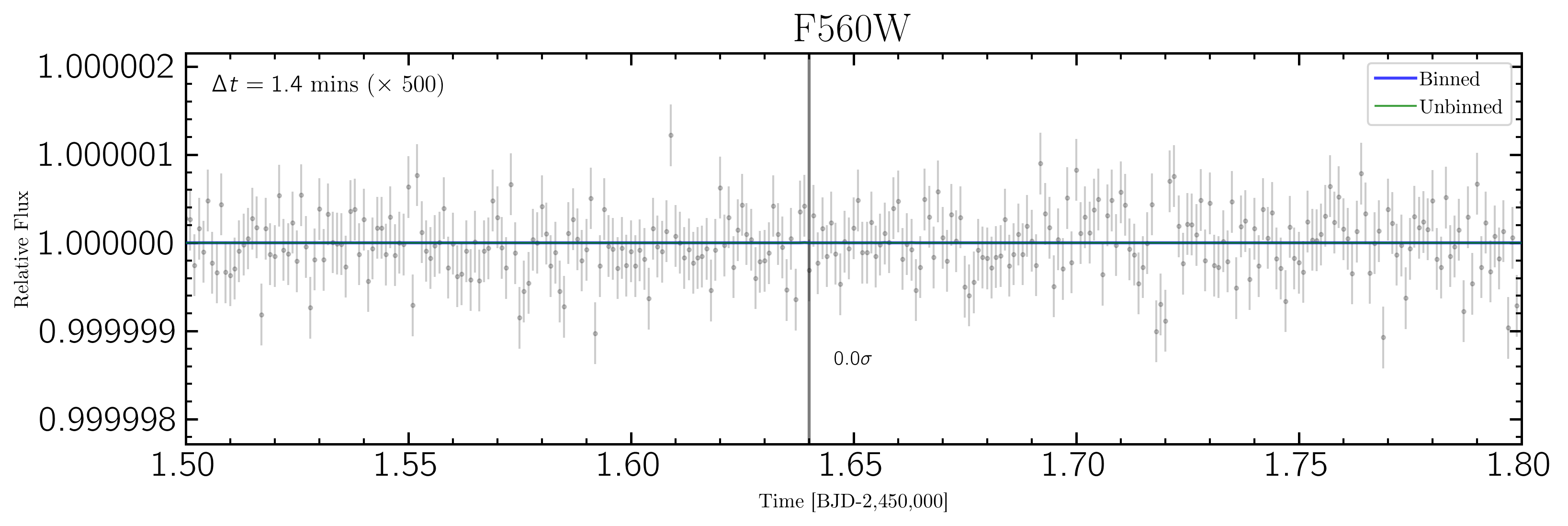
Figure 4: Modeled transit light curve and simulated JWST F560W observation for a DLO transiting Proxima Centauri; signal vanishes in background noise.
High-Contrast Imaging
Thermal emission modeling treats the DLO as a blackbody at 477.6~K. At typical FZ separations for solar-type or nearby stars, predicted contrast ratios in the thermal-IR regime (e.g., at 10.7~μm) reach ≈0 (or ≈157 magnitudes), vastly exceeding the dynamic range of state-of-the-art imagers. Reflected-light detection is equally infeasible, requiring contrasts below ≈2 (or nearly 60 magnitudes), even under optimistic albedo assumptions.
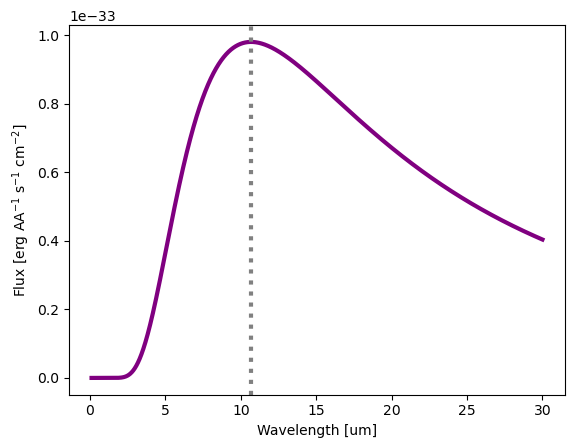
Figure 5: DLO blackbody spectrum at stellar proximity, peaks at ≈3; flux lies orders of magnitude below host star emission.
The phase dependence of reflected light is considered, highlighting further reductions in detectability for realistic geometries given the extreme area-to-star separation ratios.
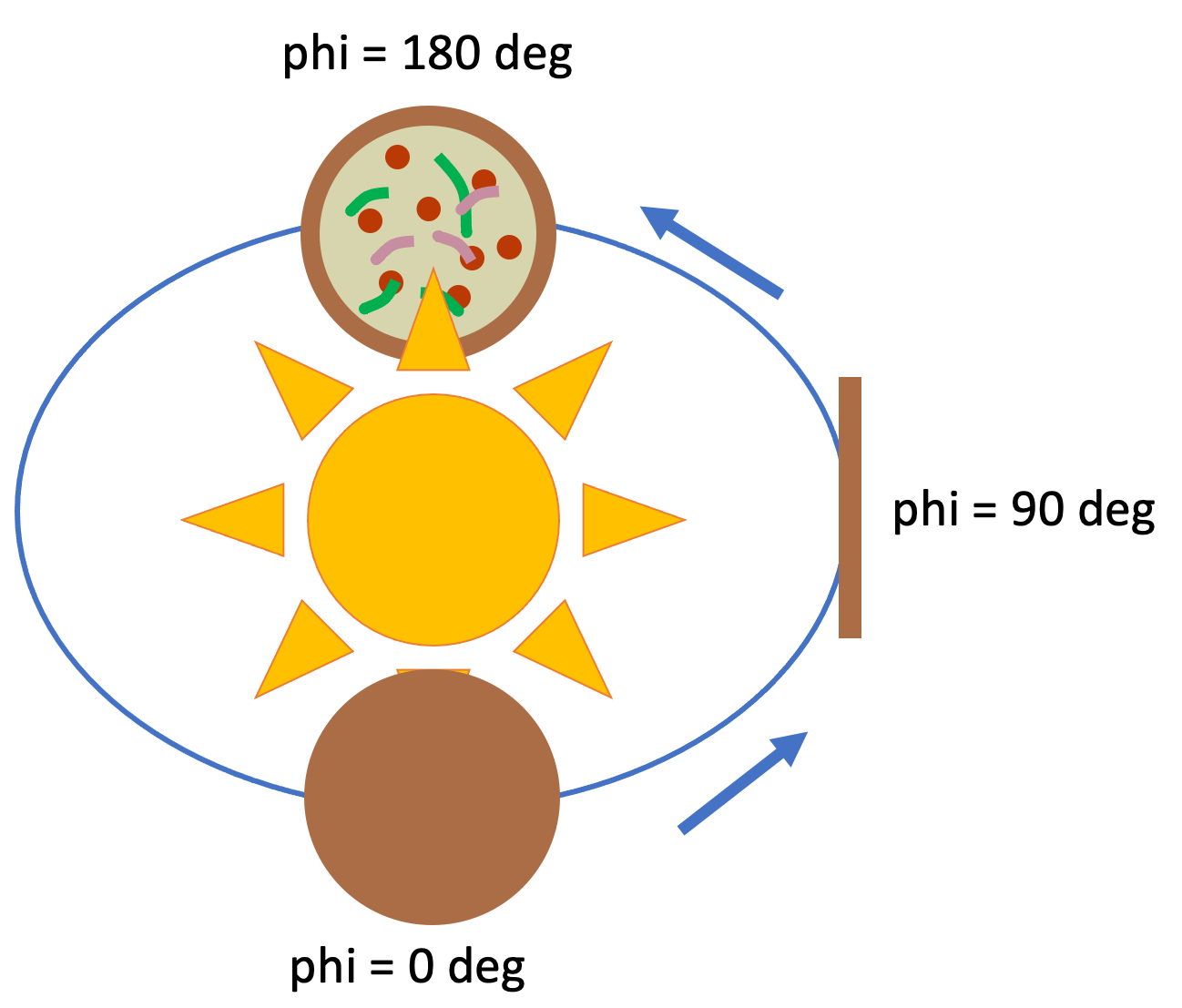
Figure 6: Reflected light phase curve variation for a DLO in a close-in orbit, emphasizing the unfavorable contrast across all plausible phases.
Implications, Theoretical Context, and Outlook
The exercise formally demonstrates that, given present and foreseeable astronomical instrumentation, the detection of DLOs in the FZ—even under highly favorable conditions of proximity and albedo—is precluded by fundamental limitations in contrast ratio, angular resolution, and sensitivity in both photometric and HCI regimes. The work underscores the futility of allocating technical resources toward SETI strategies predicated on detection of small, highly radiative-inefficient artificial objects in the circumstellar context. The analysis indirectly reinforces the energetic and practical plausibility of conventional Dyson architectures or megastructures as the preferential signatures of advanced engineering, given their vastly superior observational accessibility.
Conclusion
This work establishes an upper bound on the detectability of star-orbiting, radiatively heated objects with cross sections typical of human culinary artifacts. The derived limits are several orders of magnitude beneath current or conceivable detection frontiers. There are no favorable parameter regimes—stellar, orbital, or compositional—where DLO detection is plausible, and resources should not be devoted to searches predicated on the presence of such artifacts. This finding consolidates the argument for focusing SETI programs on macroscopically large, high-energy impact engineering products, and motivates no further inquiry in the direction of direct detection of circumstellar food preparatory objects.
(2603.28977)