- The paper proposes a novel ORSIFlow pipeline that reparameterizes mask generation using a deterministic latent flow, outperforming prior methods.
- The method integrates SFCN and LSFN for multi-scale saliency feature extraction and deterministic velocity field learning, ensuring robust object boundary recovery.
- Experimental results demonstrate significant improvements in accuracy and efficiency over both diffusion-based and discriminative approaches on multiple ORS benchmarks.
ORSIFlow: Saliency-Guided Rectified Flow for Optical Remote Sensing Salient Object Detection
Introduction
Salient Object Detection in Optical Remote Sensing Images (ORSI-SOD) confronts substantial challenges due to prevalent background clutter, low-contrast objects, scale variations, and intricate object morphologies. Traditional discriminative CNN and Transformer-based pipelines, while effective to some extent, often fail in scenarios characterized by highly ambiguous semantics and irregular object boundaries. Generative diffusion-based approaches provide enhanced expressivity but typically suffer from inefficient and stochastic sampling dynamics, adversely impacting inference efficiency and boundary fidelity.
Methodology
ORSIFlow proposes a deterministic and efficient solution to ORSI-SOD by reparameterizing mask generation as a rectified latent flow matching problem, eschewing pixel-level stochastic denoising in favor of linear, deterministic generative processes within a compact latent manifold. The framework entails two principal components: Salient Feature Conditional Network (SFCN) and Latent Space Flow Network (LSFN).
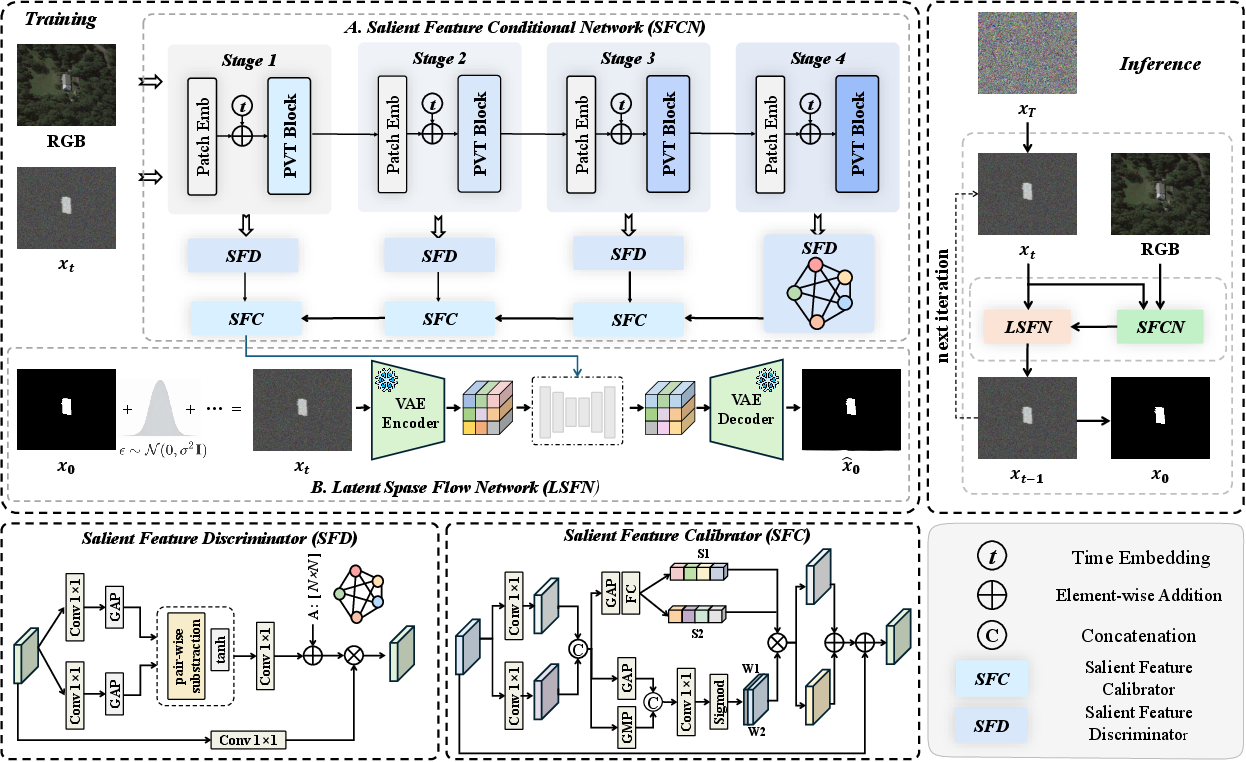
Figure 1: The end-to-end ORSIFlow network: SFCN for multi-scale saliency feature extraction, LSFN for deterministic velocity field learning and latent-space generative transport.
Salient Feature Conditional Network
SFCN employs a four-stage PVTv2-b4 backbone, hierarchically fusing RGB visual cues with the noisy mask, resulting in temporally-aware multi-scale conditional features. Two modules enhance feature quality:
- Salient Feature Discriminator (SFD): Global semantic discrimination is improved via channel-wise graph convolution, informed by a dynamically constructed importance map, thereby suppressing semantically ambiguous background noise.
- Salient Feature Calibrator (SFC): Dual-branch gating dynamically aggregates local context and global statistics, yielding structurally precise and scale-adaptive feature representations, improving both small-object and intricate-boundary detection.
Latent Space Flow Network
Mapping mask generation from pixel space to a VAE-compressed latent space, LSFN learns a conditional, deterministic rectified flow (velocity field) between an initial Gaussian noise sample and the target saliency latent code. The key training loss optimizes velocity field predictions with respect to the exact linear transport vector. During inference, a few ODE steps suffice for high-fidelity latent recovery, after which the decoder reconstructs the sharp, well-formed saliency mask.
Experimental Results
Quantitative and Qualitative Evaluation
Comprehensive evaluations were performed against state-of-the-art discriminative and generative baselines on ORSSD, EORSSD, and ORSI-4199 datasets using metrics Sα, Fβmax, Eξmax, and MAE. ORSIFlow sets a new benchmark, achieving:
- On ORSSD: Sα=0.9586, Fβmax=0.9262, Eξmax=0.9883, MAE=0.0050
- On EORSSD: Sα=0.9437, Fβmax=0.9010, Eξmax=0.9840, Fβmax0
- On ORSI-4199: Fβmax1, Fβmax2, Fβmax3, Fβmax4
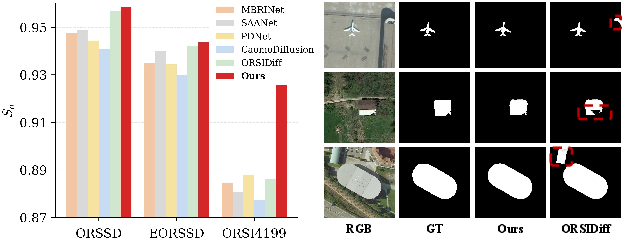
Figure 2: SOTA comparison on Fβmax5 (left: metric curve; right: qualitative comparison against prior methods, with red boxes showing failure cases for competitors).
The method demonstrates notable accuracy and structural consistency, outperforming diffusion-based methods in both detection completeness and boundary sharpness. Qualitative analysis confirms that ORSIFlow preserves small object details, mitigates background false positives, and recovers thin/elongated structures with superior precision.
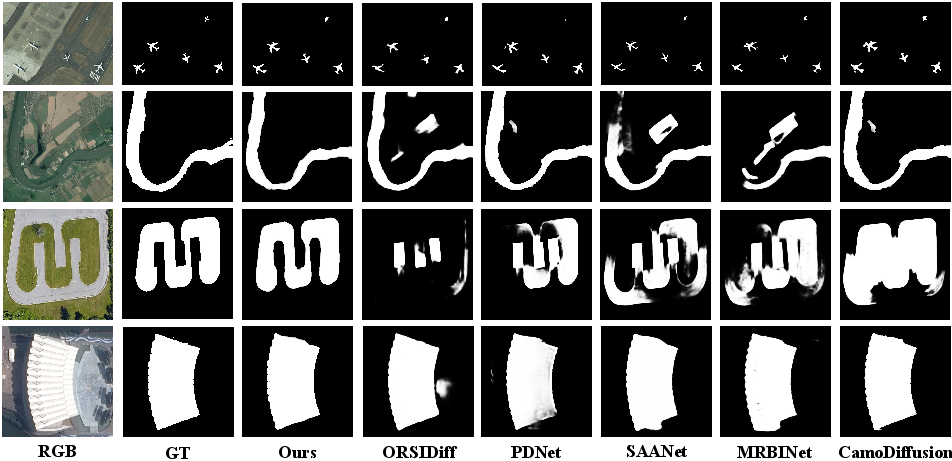
Figure 3: Qualitative visual comparison highlighting enhanced object completeness, contour preservation, and clutter suppression by ORSIFlow.
Ablation Study
Incremental ablation validated the necessity of the VAE compression and both SFD and SFC modules. Isolated ablation led to deterioration in all accuracy metrics, confirming that each component synergistically contributes to performance.
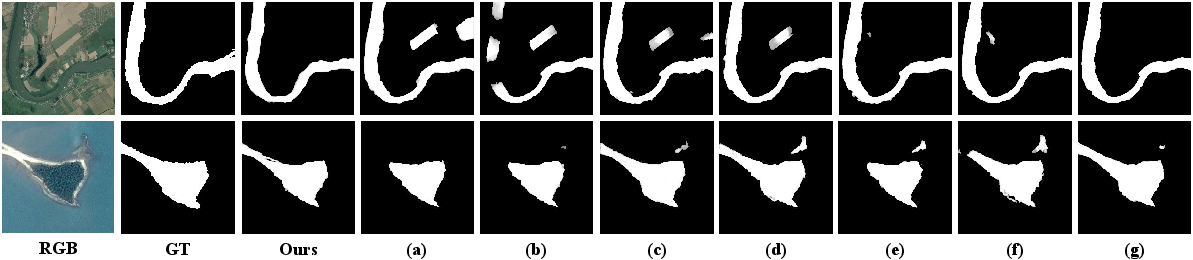
Figure 4: Ablation visualization: removal of SFD/SFC yields fragmented or incomplete salient mask predictions, underscoring their necessity.
Efficiency Analysis
While diffusion-based generative models (e.g., CamoDiff, ORSIDiff) require 10 sampling steps and incur high FLOPs, ORSIFlow accomplishes superior detection with only 3 deterministic ODE steps, reducing computational cost to 5.68 GFLOPs per image and supporting real-time inference at 19 FPS. This represents a significant efficiency gain over all prior generative SOD approaches.
Implications and Future Directions
The introduction of saliency-guided rectified flows in a VAE latent space marks a shift towards highly efficient, structurally coherent remote sensing SOD. Deterministic flow-based generative methods bypass the inefficiency and instability of pixel-level stochastic diffusion, while saliency-guided feature extraction further resolves ambiguity and enhances fine-grained object structure recovery.
Potential extensions include integrating more expressive dynamical flows, learning adaptive latent priors, or incorporating task-driven self-supervision for joint object discovery and domain adaptation. The approach provides a scalable paradigm for generative mask prediction in other remote sensing and medical imaging settings, particularly where large-scale deployment and inference speed are critical.
Conclusion
ORSIFlow delivers a deterministically sampled, computationally efficient, and saliency-aware SOD pipeline for optical remote sensing, achieving SOTA accuracy, robust generalization, and substantial efficiency improvements over both discriminative and diffusion-based methods. Its modular design and empirical superiority establish rectified latent flows as a compelling direction for future generative saliency modeling (2603.28584).