- The paper establishes that extremizing the black hole potential fixes the axion-dilaton moduli solely by conserved charges in N=4 supergravity.
- The paper applies analytical perturbative methods and numerical integrations to validate the universal attractor flows near the black hole horizon.
- The paper verifies a 1/4-BPS supersymmetry preservation for generic dyonic charge configurations, reinforcing theoretical black hole entropy predictions.
Supersymmetry and Attractor Mechanisms in N=4 Supergravity
Introduction and Theoretical Framework
The paper "Supersymmetry and Attractors in N = 4 Supergravity" (2603.28495) systematically investigates the attractor mechanism in extremal, spherically symmetric black holes within pure N=4 Poincaré supergravity, emphasizing both numerical and analytical approaches to moduli dynamics and preserved supersymmetry. Attractor behavior—a phenomenon where scalar fields at the horizon are fixed solely by conserved charges—has been foundational in understanding black hole entropy in supergravity and string theory, especially for N-extended models.
The authors dissect pure N=4 supergravity in the superconformal formalism, detailing the field content: metric, axion-dilaton moduli, six vector multiplets, and intricate auxiliary fields from the Weyl multiplet. Gauge fixing and elimination of auxiliary fields yield the effective theory, with the non-trivial moduli parameterized by the complex axion-dilaton τ=ϕ+iχ. The spherically symmetric ansatz allows reduction to a one-dimensional action, enabling tractable analysis of moduli dynamics and black hole potential extremization.
Black Hole Potential and Constant Moduli Solutions
Central to attractor dynamics is the black hole potential VBH(ϕ,Q), whose extremization fixes the moduli at the horizon. For generic charge configurations (pI,qI), imposing ∂ϕVBH=0 yields stable, constant moduli solutions, provided the charge invariants satisfy p2q2>(p.q)2 and p2,q2<0, ensuring the physical domain and positivity of the horizon area.
The explicit solution for the axion-dilaton at the horizon is:
N=40
with the entropy given by the Bekenstein-Hawking relation:
N=41
The extremal metric solution exhibits the expected double zero structure at the horizon, with radius N=42.
Perturbative Analysis and the Attractor Flow
The authors expand around the constant moduli solution:
N=43
and show via coupled ODEs for N=44, N=45 that perturbations vanish at the horizon, universalizing the attractor property. The metric functions only admit perturbative corrections at N=46, which similarly vanish at N=47, ensuring invariance of horizon geometry and entropy under finite moduli deformations.
A recursive structure is demonstrated for higher-order corrections, with convergence analysis near N=48 substantiating the robustness of the attractor flow. These results extend the attractor mechanism beyond supersymmetric configurations, relying solely on extremality.
Numerical Demonstrations of Attractor Behavior
The paper provides numerical integrations of the exact equations given perturbative boundary conditions near the horizon. For various choices of initial moduli parameters N=49, the attractor flows consistently converge to the analytic attractor values at N0, independent of their asymptotic values. These visualizations clearly substantiate the universality of attractor dynamics in N1 black holes.
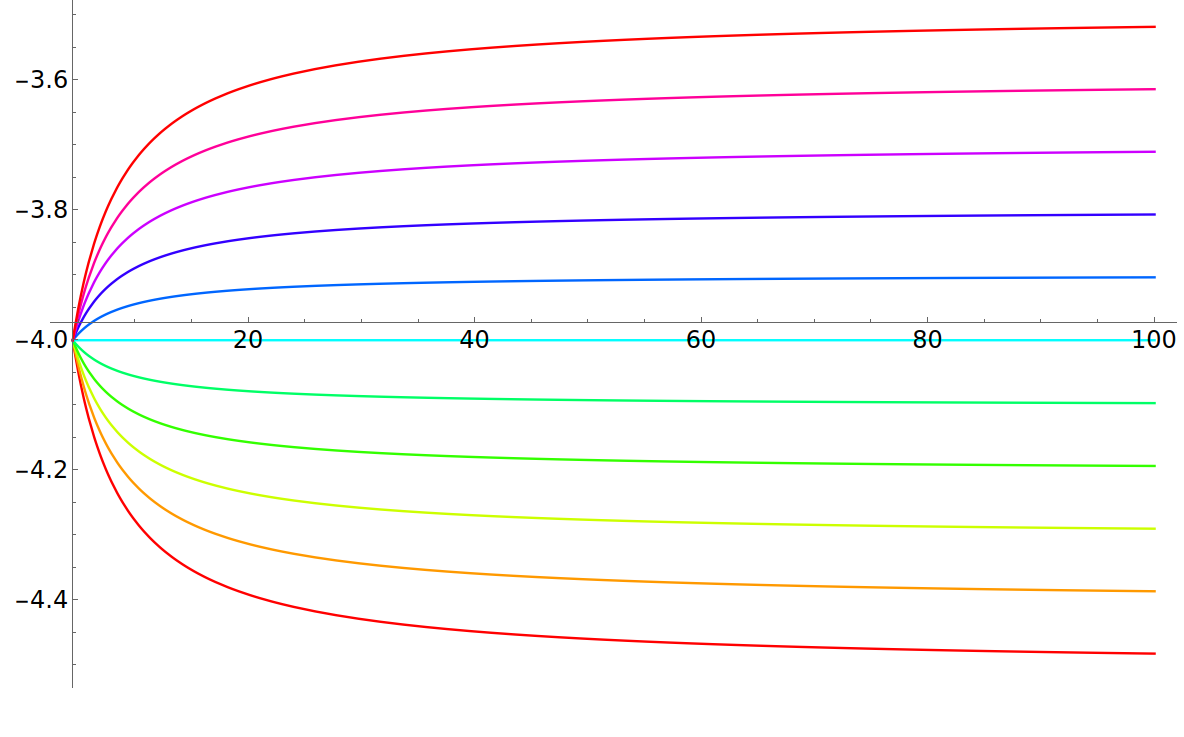
Figure 1: The attractor flow of N2 with attractor value N3 for N4, across various initial boundary conditions.
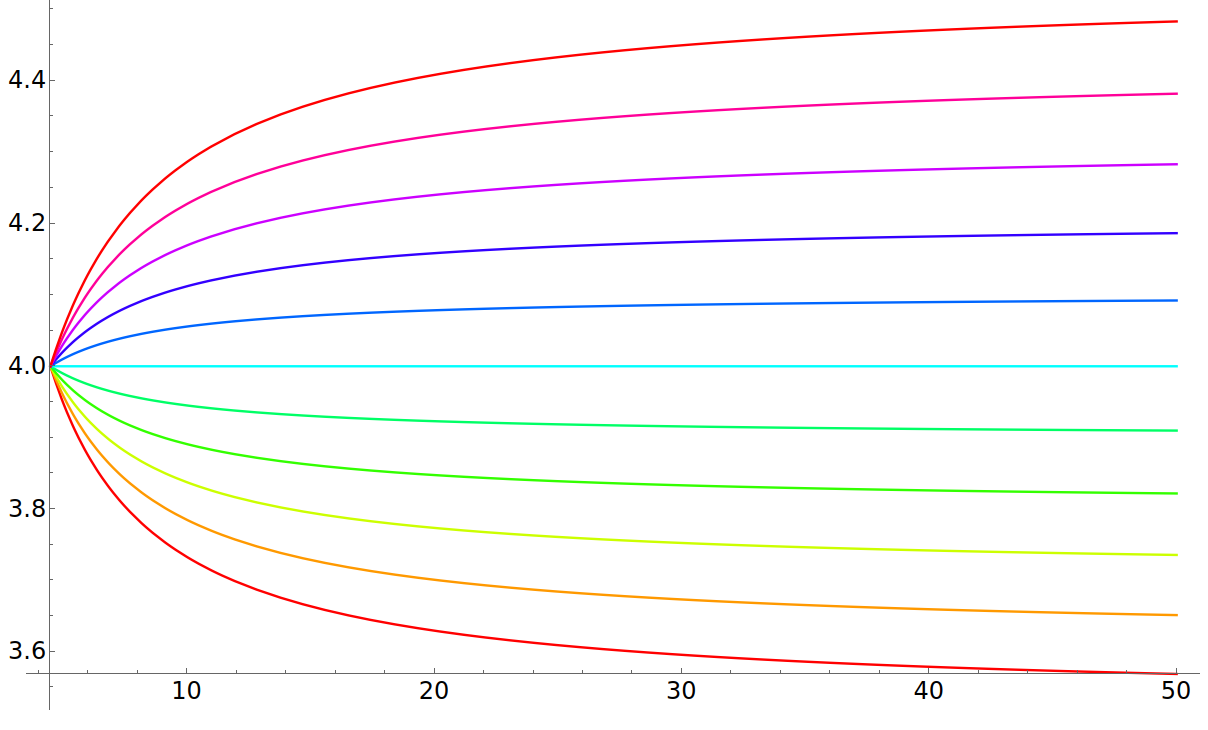
Figure 2: The attractor flow of N5 with attractor value N6, fixed by the charges, confirming horizon stability against initial deformations.
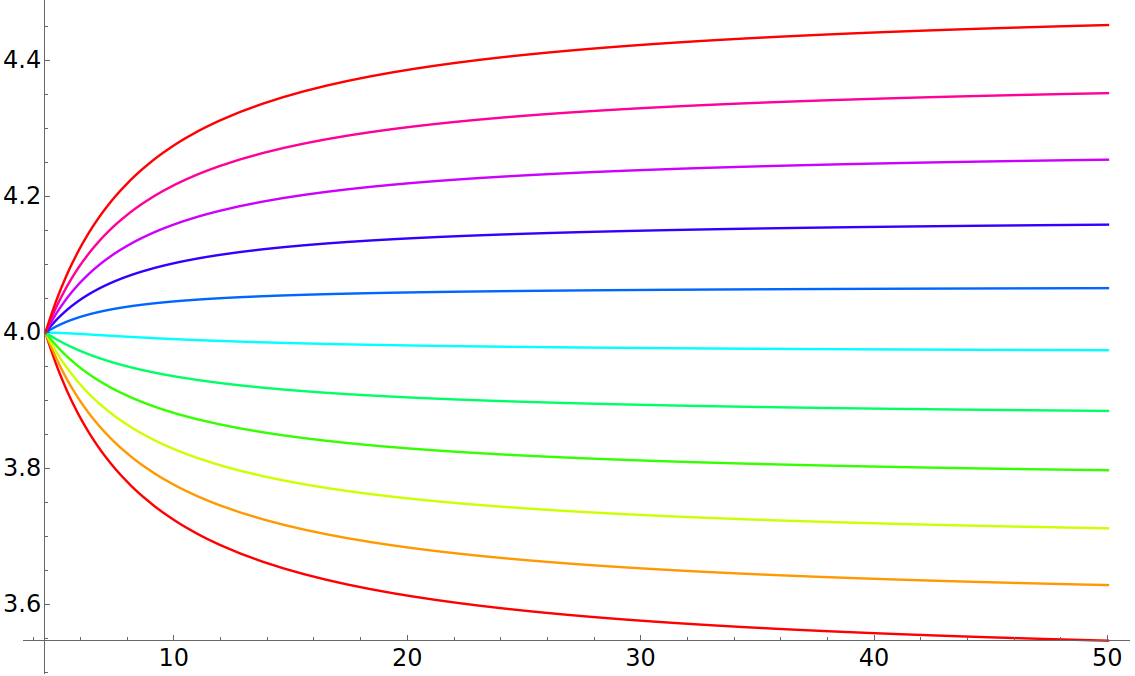
Figure 3: Additional attractor flows for N7 with nontrivial initial conditions, highlighting the role of non-linear couplings in the attractor regime.
Supersymmetry and BPS Structure
A key assertion is the explicit analysis of preserved supersymmetry: For generic dyonic configurations satisfying N8, the constant moduli solution is always 1/4-BPS, i.e., preserving one quarter of the available supersymmetries. This result is demonstrated by solving the Killing spinor equations in the superconformal formalism, leveraging block-diagonalization of the N9 charge matrices and employing gauge fixing in the N=40 scalar sector.
Projection conditions on the Killing spinors are identified, structurally akin to those appearing in generalized axion-dilaton solutions and the SWIP family (Israel-Wilson-Perjes analogs) in N=41 supergravity. Consequently, the attractor solutions, constant or otherwise, are expected to be continuously connected within the 1/4-BPS branch, an assertion supported by charge orbit classifications under electromagnetic duality.
Implications, Extensions, and Future Directions
The formalism presented is pivotal for understanding entropy and microstate counting in string-theoretic models with extended supersymmetry. The attractor mechanism elucidated here, together with the explicit BPS classification, sets the stage for leveraging higher-derivative corrections and computing supersymmetric indices in more intricate setups (e.g., matter-coupled and higher-derivative N=42 supergravity).
The block structure of Killing spinor constraints and their role in constructing projection operators suggest pathways for a complete classification of 1/4-BPS and 1/2-BPS solutions in higher-derivative settings, potentially enabling analytic computation of entropy formulae in terms of holomorphic functions of N=43 and extending the gravitational index methodology.
Conclusion
This paper provides a rigorous analysis of attractor dynamics and preserved supersymmetry in pure N=44 supergravity, combining perturbative, numerical, and algebraic techniques to demonstrate universal moduli fixation at the black hole horizon and explicit 1/4-BPS characterization for generic dyonic charges. The results have direct theoretical and practical implications in string-inspired black hole physics and pave the way for advances in the classification and quantification of supersymmetric solutions in extended supergravity models.