- The paper introduces a novel scheme using a mesoscopic array of two-level atoms to form an effective quantum cavity, yielding 1/N² interferometric precision.
- It employs input-output theory to derive the reflection phase sensitivity, with the derivative scaling as N² under optimized conditions.
- The protocol achieves super-Heisenberg scaling without requiring entangled states and remains robust under experimental imperfections.
1/N2 Precision Interferometry with Collectively Enhanced Atomic Mirror
Introduction
The paper "1/N2 Precision Interferometry with Collectively Enhanced Atomic Mirror" (2603.28471) formulates a new paradigm in quantum metrology based on collectively enhanced optical response in atomic arrays. It demonstrates that a mesoscopic array of N two-level atoms coupled to a semi-infinite waveguide, terminated by a perfect reflector, forms an effective quantum cavity with reflection phase whose sensitivity to the sensor-mirror distance exhibits a N2 enhancement. This leads to a measurement precision scaling as 1/N2, thereby surpassing the Heisenberg limit conventionally considered the ultimate quantum-enhanced sensitivity. The protocol operates on single photons and does not require the preparation of entangled or exotic quantum states, making it robust and experimentally favorable.
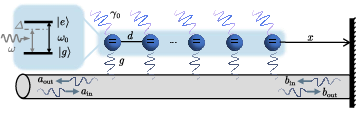
Figure 1: Schematic of the system—N atoms (blue dots) coupled to a semi-infinite waveguide terminated by a perfect reflective boundary at distance x; incident single photons ain are reflected from the system.
Theoretical Framework
The system consists of N identical two-level atoms arranged with spacing d=λ and collectively coupled to a one-dimensional waveguide with coupling rate 1/N20. The atomic array resides a distance 1/N21 from a waveguide-terminating mirror. Incoming single photons interact with the array and the mirror sequentially. The collective enhancement manifests as an effective coupling rate scaling as 1/N22, resulting from constructive interference of atomic responses.
The total reflection coefficient 1/N23 for the combined CEAM-mirror cavity is analytically derived via standard input-output theory, under the assumptions of Markovian evolution and the rotating-wave approximation. The key quantity for metrology is the phase 1/N24 of this reflection coefficient, whose sensitivity to the cavity length 1/N25 determines the achievable measurement precision.
Super-Heisenberg Phase Sensitivity
A major result is the explicit quadratically improved scaling of phase sensitivity with atom number, achieved without quantum correlations among probes. The derivative 1/N26 is shown to scale as 1/N27 in the large-1/N28 regime for fixed detuning, far exceeding Heisenberg's 1/N29 scaling.
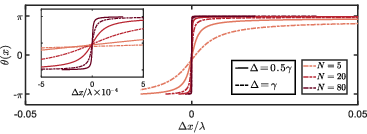
Figure 2: Phase sensitivity of the system as a function of N0 for various N1 and atom-photon detunings; the inset highlights the enhancement on an expanded N2-axis.
Optimal sensitivity is achieved at detunings and cavity lengths where the denominator N3 (arising from the input-output formalism) is minimized—i.e., close to destructive interference between direct and multiply reflected amplitudes. Analytical approximations identify the conditions for maximal enhancement and provide explicit expressions linking collective cooperativity to the sensitivity scaling.
From the quantum Fisher information analysis, the protocol yields N4, so the minimum achievable error for N5 estimation is N6 for N7 repeated measurements—substantially exceeding standard quantum and Heisenberg-limited protocols.
Physical Origin and Resource Counting
Unlike traditional schemes requiring entangled input probes or harnessing nonlinear interactions, the enhanced resource here is the effective cavity finesse, scaling as N8 with the number of atoms. Each photon undergoes a larger number of indistinguishable coherent roundtrips due to the high reflectivity of the CEAM, leading to large interferometric phase accumulation.
The scaling must be interpreted in light of a generalized resource theory for quantum metrology. While the Heisenberg limit is traditionally defined by probe number, this work recontextualizes the static atomic array as part of the overall quantum resource—a composite probe system engineered for maximum sensitivity. The protocol thus achieves super-Heisenberg scaling without technological requirements for complex probe state preparation or highly nonlinear dynamics.
Experimental Feasibility and Robustness
The design is robust to realistic imperfections. The authors analyze the impact of inhomogeneous atomic transition frequencies, coupling strengths, and position disorder, incorporating parameter spreads typical of superconducting circuit QED platforms.
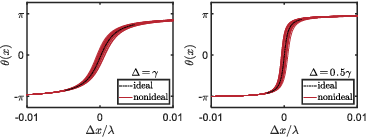
Figure 3: Robustness of phase sensitivity under experimentally realistic disorders for N9 transmon qubits at different detunings; the ideal case (black dashed) and 20 random disorder realizations are shown.
Numerical results confirm that the N20 scaling of sensitivity persists under moderate static imperfections. Most experimental nonidealities, such as static frequency disorder or spatial misalignment, can be calibrated or compensated post-fabrication. Only fast dynamical noise (dephasing, frequency drift) potentially limits ultimate sensitivity, but even then, the protocol remains competitive.
A detailed proposal is provided for implementation in Josephson circuit systems, with N21 transmons coupled to a coplanar waveguide and frequencies tunable to MHz precision. Calibration of the control and characterization of static noise ensures operational viability of the sensor at near-ideal sensitivities.
Implications and Future Directions
The demonstrated protocol opens a route to scalable, robust quantum metrology leveraging collective enhancement in engineered quantum interfaces. This approach redefines the practical role of hardware design in quantum sensing, showing that well-structured but unentangled multi-atom devices can outperform fragile entangled-state protocols for photonic interferometry.
Practically, this architecture is compatible with integrated waveguide platforms and can be generalized to alternative quantum emitters or photonic architectures. The demonstrated N22 scaling underlines the potential of collective light-matter interfaces for scalable, high-precision sensing in domains ranging from microwave to optical frequencies.
Theoretically, the results stimulate further resource theory investigations into metrological scaling—particularly the interplay between static resources (sensor arrays) and dynamic probe numbers. Extensions to multi-photon or nonclassical light fields (e.g., squeezed, entangled states) in conjunction with CEAM architectures may reveal further scaling improvements or new classes of hybrid quantum sensors.
Conclusion
This work provides a rigorous theoretical and practical framework for achieving N23 distance measurement precision using a collectively enhanced atomic mirror in a single-photon interferometric protocol (2603.28471). The paradigm exploits static collective enhancement rather than photon entanglement or nonlinear protocols, and is robust to realistic disorder consistent with state-of-the-art circuit QED technologies. The approach can be generalized to other engineered quantum platforms and invites further exploration of hybrid quantum resources in metrology.

