- The paper demonstrates that vortex-antivortex collisions in the φ⁶ model yield stable, long-lived oscillons as emergent attractors.
- It employs numerical simulations to contrast the energy dissipation in the φ⁶ model with the direct radiation seen in the φ⁴ case.
- The study reveals significant cosmological implications, suggesting that oscillon dynamics may impact axion relic abundances and dark matter models.
Introduction and Motivation
This work examines the dynamics of global vortex-antivortex (VAV) annihilation in (2+1)D complex scalar field theories with ϕ4 and ϕ6 potentials, focusing on the existence, formation, and characteristics of oscillons in the broken vacuum sector (2603.28298). The investigation is motivated by implications for axionic string evolution in the early universe and the associated axion relic abundance, since oscillons—long-lived, spatially localized, nontopological field configurations—can dramatically alter the energy budget following string decay processes.
The central result is that, contrary to expectations from the absence of a mass gap in the broken vacuum, the complex ϕ6 model supports robust oscillon formation as an emergent attractor after VAV collisions. This is in stark contrast to the ϕ4 case, where VAV annihilation is direct and no oscillon plateau is observed.
Theoretical Framework: Global Vortices in Complex Scalar Models
The Lagrangian considered is
L=21∂μϕ∂μϕ−V(∣ϕ∣),
where ϕ is a complex scalar and V(∣ϕ∣) is parameterized to interpolate between ϕ4 (Mexican hat) and ϕ6 models:
V(∣ϕ∣)=8(1+ν2)1(ν2+∣ϕ∣2)(∣ϕ∣2−2)2,
with ϕ60 controlling the potential structure.
Both cases feature a ϕ61 symmetry and broken phase with ϕ62, supporting global vortices with nontrivial ϕ63 topology. The key distinction lies in the potential at ϕ64: for ϕ65 (ϕ66), there is a true/unbroken vacuum, while for ϕ67 (ϕ68), it is a maximum.
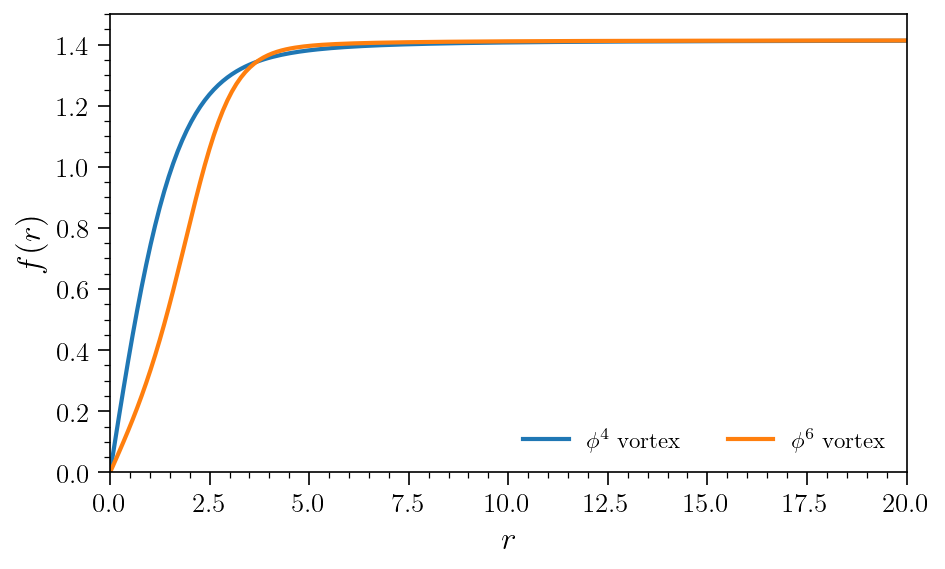
Figure 1: Profiles of the unit charge vortices in the ϕ69 (blue curve) and ϕ60 models (orange curve).
Vortex-Antivortex Collision Dynamics and Oscillon Emergence
Resonant Structure in ϕ61 VAV Collisions
Numerical simulations of head-on VAV collisions reveal that, in ϕ62, post-collision dynamics often settle into a long-lived, spatially localized, radially symmetric oscillating structure—a genuine oscillon—centered at the origin. This oscillator has a dominant frequency ϕ63, beneath the radial perturbation threshold ϕ64, and displays modulated amplitude oscillations.
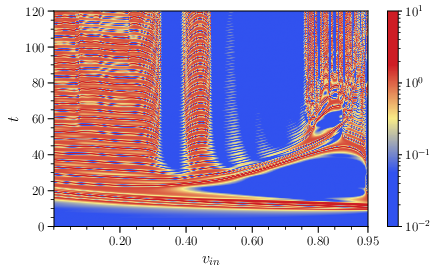
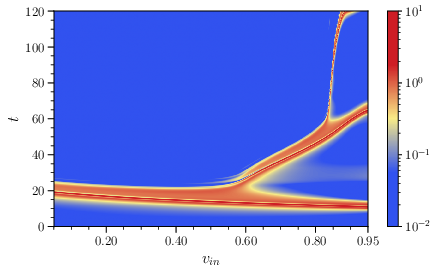
Figure 2: The VAV collision. Energy density at the origin as a function of time for various initial velocities ϕ65. Upper: ϕ66, Lower: ϕ67.
This result is highly nontrivial: in conventional wisdom, the flat direction in the broken vacuum implies gapless Goldstone modes rendering oscillons immediately radiative and thus non-existent except in highly fine-tuned situations. The simulations, however, show that in the complex ϕ68 potential, oscillons are generic attractors for a wide class of violent initial data, not artifacts of fine tuning.
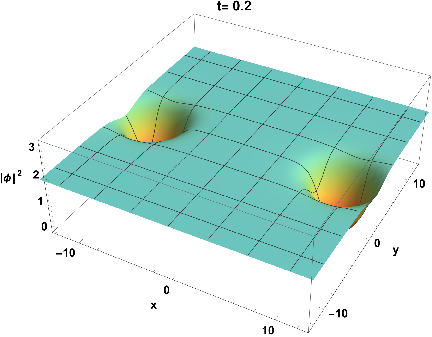
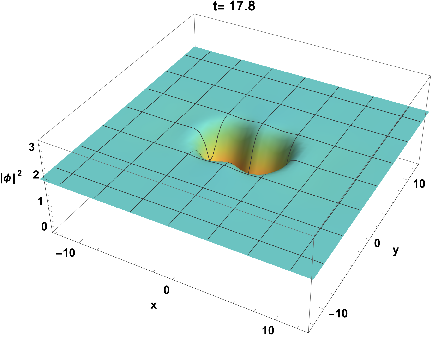
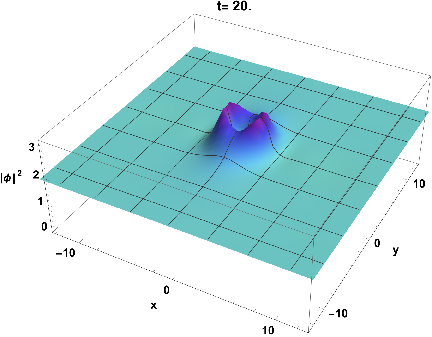
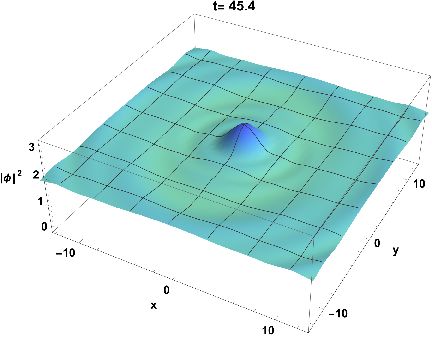
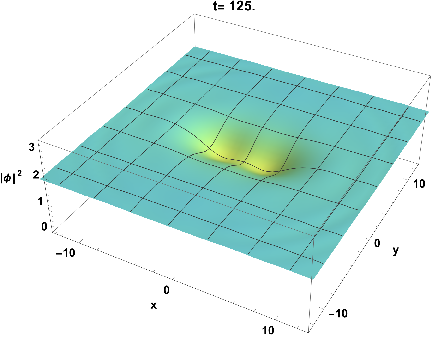
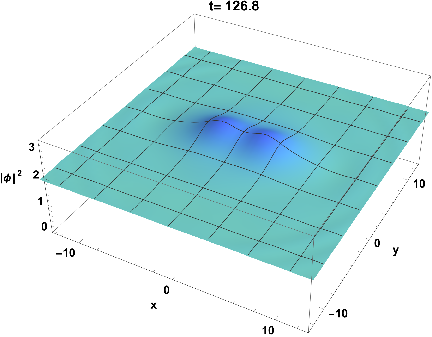
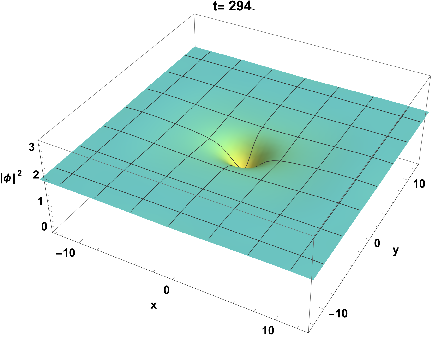
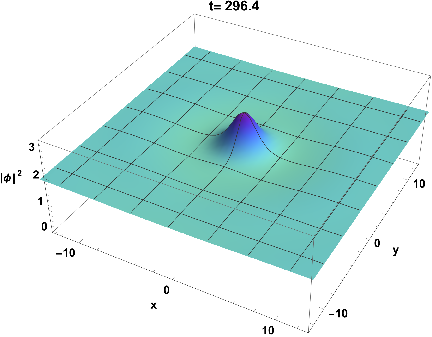
Figure 3: Formation of a radially symmetric oscillon in the VAV collision in the ϕ69 model with ϕ40.
Absence of Oscillons in the ϕ41 Model
By contrast, in the complex ϕ42 theory, VAV collision energy is efficiently radiated through massless Goldstone channels, and intermediate oscillon-like plateaus are absent; the system quickly settles to vacuum.
Field Content of Post-collision Oscillon
Examination of the field components at the origin shows the imaginary part decays rapidly via radiation, leaving only a stable, real, breathing oscillation. The power spectrum analysis confirms the coherence and modulation structure of this oscillon.
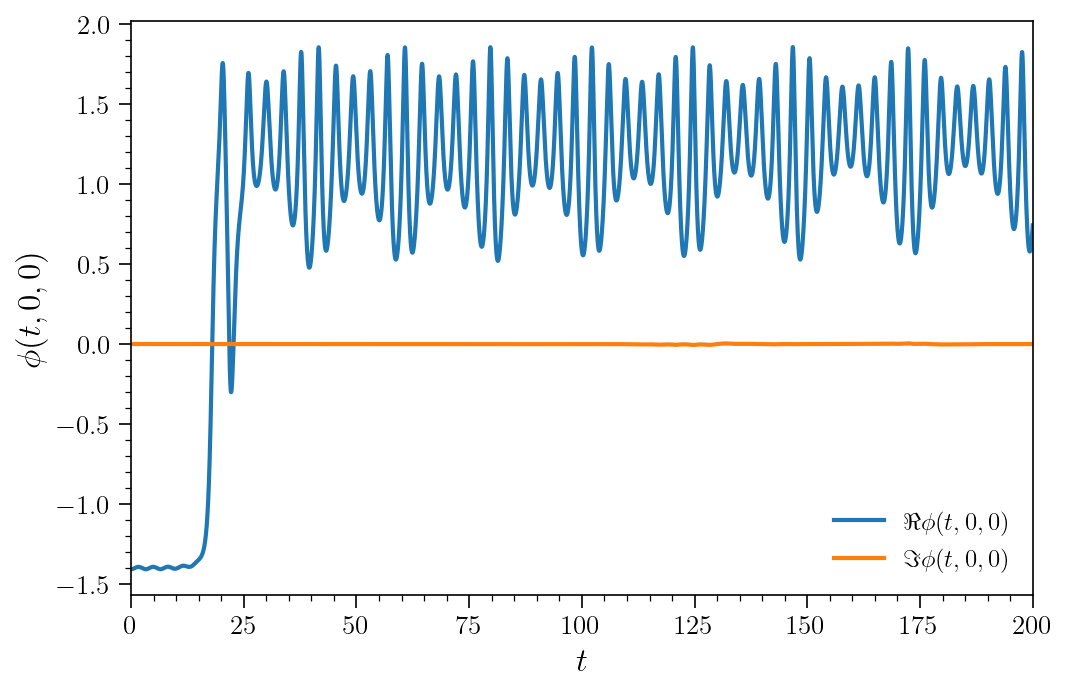
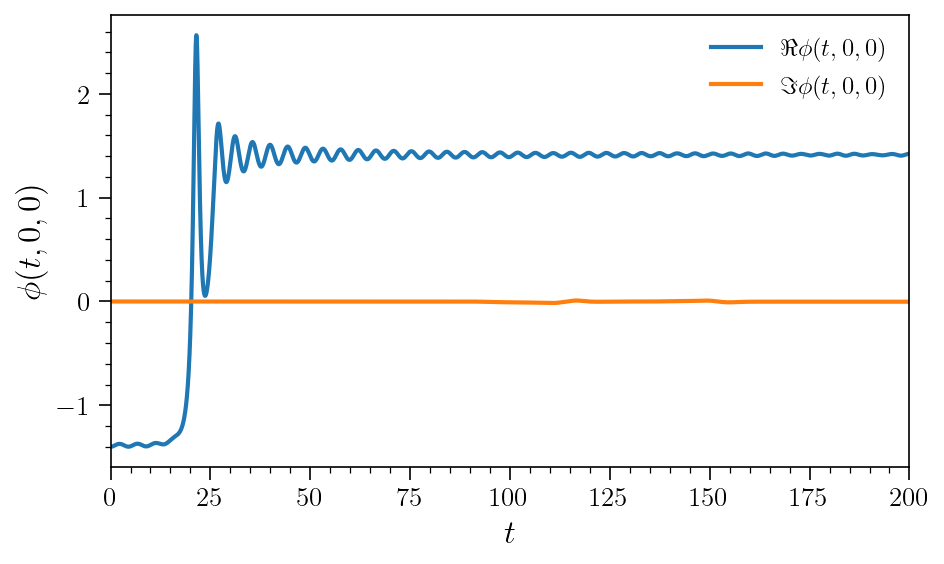
Figure 4: The real and imaginary component of ϕ43 at the origin in the VAV collision with ϕ44 and ϕ45. Upper: ϕ46, Lower: ϕ47.
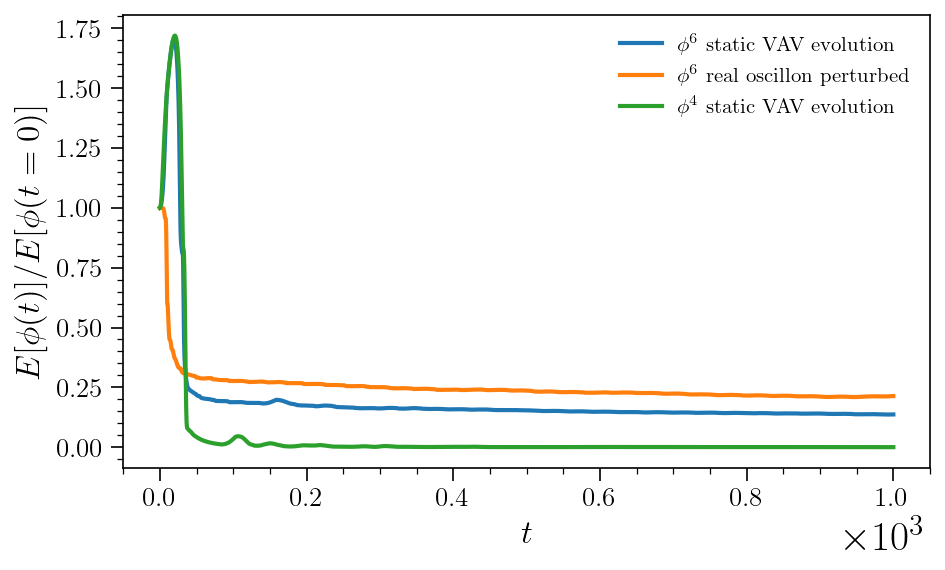
Figure 5: Evolution of the normalized energy enclosed in a disc of radius ϕ48 for ϕ49 in L=21∂μϕ∂μϕ−V(∣ϕ∣),0 (blue), L=21∂μϕ∂μϕ−V(∣ϕ∣),1 (green), and perturbed Gaussian data (orange).
Origin and Robustness of the Broken Vacuum Oscillon
The oscillon observed aligns with those generated directly from real scalar Gaussian initial data in the L=21∂μϕ∂μϕ−V(∣ϕ∣),2 theory, perturbed along the imaginary direction. Independent of the route (VAV collision or crafted pulse), the attractor is the same modulated real oscillon, with comparable frequencies and dynamical properties.
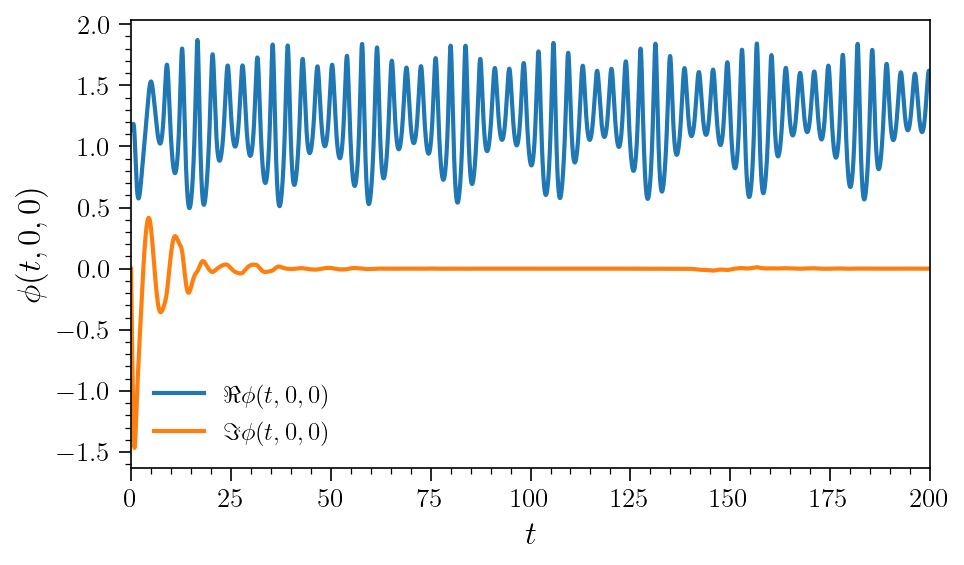
Figure 6: Embedded real L=21∂μϕ∂μϕ−V(∣ϕ∣),3 oscillon (from Gaussian data with L=21∂μϕ∂μϕ−V(∣ϕ∣),4, L=21∂μϕ∂μϕ−V(∣ϕ∣),5), showing rapid decay of the imaginary component.
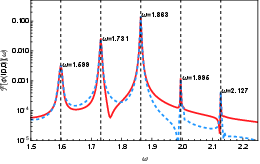
Figure 7: Power spectrum at the origin for the oscillon found via VAV collision (L=21∂μϕ∂μϕ−V(∣ϕ∣),6, L=21∂μϕ∂μϕ−V(∣ϕ∣),7, red) and embedded oscillon from perturbed Gaussian initial data (L=21∂μϕ∂μϕ−V(∣ϕ∣),8, L=21∂μϕ∂μϕ−V(∣ϕ∣),9, blue dashed).
Energy analysis shows these oscillons can inherit only ϕ0 of the original VAV energy, with the rest radiated, emphasizing their nature as strong attractors. The parameter scan in the potential, varying ϕ1, demonstrates oscillon stability only for sufficiently deep false (unbroken) vacua at ϕ2—a marked dependence on global (not local) potential structure.
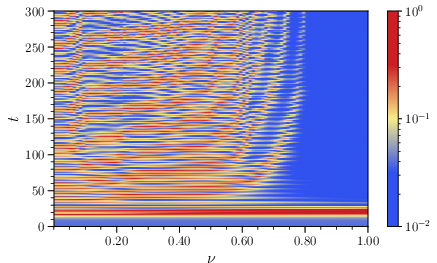
Figure 8: Oscillon existence as a function of the parameter ϕ3 in ϕ4 for ϕ5.
Contrasts with Other Soliton Dynamics
- The formation mechanism and oscillation frequencies are not associated with Feshbach-like internal modes of the global vortex. Instead, the oscillon arises as a genuine collective phenomenon unrelated to single-vortex vibrational spectra.
- In Abelian-Higgs (local) vortex models, oscillons are allowed due to the mass gap; in the complex ϕ6 theory, even embedding real ϕ7 oscillons proves unstable because of immediate coupling to radiative massless modes.
Cosmological and Theoretical Implications
The presence of robust, long-lived, broken vacuum oscillons induced by VAV annihilation in higher-order potential models signifies a profound alteration of post-phase-transition field dynamics. For axionic string networks, this implies energy sequestration into oscillons, potentially changing axion emission rates and dark matter relic computations.
Since the existence of these oscillons depends sensitively on the remote structure of the scalar potential (e.g., the depth of the false vacuum at the origin), minor modifications to high-energy extensions of the Standard Model may yield macro-scale consequences for nonperturbative early universe dynamics. Extensions to local vortices and monopole systems with higher-order interactions are natural next directions.
Conclusion
This study conclusively demonstrates that the complex ϕ8 model supports dynamically robust, long-lived oscillons in the broken vacuum following global vortex-antivortex collision, overturning expectations based on the absence of a mass threshold. The existence and properties of these oscillons are governed not by local vacuum structure but by the global topology of the potential, specifically the presence of a sufficiently deep, distant (false) vacuum at the origin. This result necessitates reconsideration of nonperturbative energy relaxation mechanisms in axionic and related cosmological scenarios, with implications for dark matter phenomenology and the physics of physics beyond the Standard Model.
(2603.28298)