- The paper presents a novel adiabatic ramping protocol replacing the abrupt quench in quantum-enhanced MCMC to improve energy localization and acceptance rates.
- Methodological analysis using bottleneck bounds and Landau-Zener dynamics demonstrates a transition from exponential to polynomial spectral gap scaling in integrable systems.
- Numerical studies in spin-glass models confirm reduced scaling exponents and robust error resilience, indicating effective implementations on near-term quantum hardware.
Adiabatic Dressing in Quantum-Enhanced Markov Chains: Theory, Scaling, and Implications
Introduction
The paper "Adiabatic dressing of quantum enhanced Markov chains" (2603.28076) introduces a novel protocol for quantum-enhanced Markov chain Monte Carlo (QMCMC) sampling, leveraging adiabatic ramping to control the delocalization of quantum states. This approach proposes a significant improvement over the traditional "quench" protocol, demonstrating enhanced spectral gap scaling and error resilience. The protocol is rigorously analyzed in integrable and spin-glass models, with implications for practical quantum sampling and optimization applications.
Quantum-Enhanced MCMC and Adiabatic Protocol
Traditionally, quantum-enhanced MCMC utilizes quantum evolution under a classical Hamiltonian with a transverse field to generate non-local proposals, with a classical Metropolis-Hastings acceptance ensuring convergence to the Boltzmann distribution. Prior work identified an optimal transverse field hopt, balancing energy locality and Hamming nonlocality of proposals, but noted that excessive delocalization leads to poor acceptance rates and exponentially slow mixing [orfi2024barriers].
The adiabatic protocol introduced here replaces the abrupt "quench" with a time-symmetric ramp in the transverse field strength. The ramp includes smooth ramp-up and ramp-down phases, with a plateau at maximum field (illustrated in the paper). This preserves symmetric proposal distributions, maintaining efficient Metropolis-Hastings acceptance calculations, and avoids the intractability of computing ratios for asymmetric quantum proposal distributions.
Control over the ramp duration (α) enables tuning the energy localization of proposals: short ramps mimic quenches (delocalized), while long ramps approach adiabatic evolution (localized). Optimal intermediate α achieves improved mixing without excessive energy excursions.
Bottleneck Analysis and Spectral Gap Scaling
The Markov chain mixing time is governed by the spectral gap δ of the transition matrix, which is intractable for large systems due to exponential scaling. The authors leverage bottleneck analysis and equilibrium flow metrics to upper-bound δ, focusing on subsets B of configuration space with high energy.
For the Ising chain, analytical access is provided by a Jordan-Wigner transformation and independent Landau-Zener dynamics for each momentum mode. Ramp duration α controls diabatic transitions, directly affecting spectral gap and mixing time.
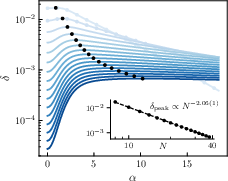
Figure 1: Bottleneck bound on the spectral gap δ for the Ising chain at β=5, h=1.5, exhibiting polynomial scaling in system size.
Increasing ramp time α0 enhances the spectral gap, transitioning from exponential scaling (quench) to optimal polynomial scaling α1 (matching classical spin-flip MCMC), provided α2 scales as α3—a result derived analytically via Landau-Zener and confirmed numerically. At smaller α4, ramp times scale logarithmically with α5 in optimal performance.
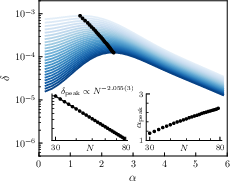
Figure 2: Bottleneck bound on the spectral gap at α6 versus ramp time α7. Insets: polynomial scaling of peak gap (left) and logarithmic scaling of α8 (right).
Spin-Glass Models: SK and 3-Spin Scaling Exponents
Infinite-range spin-glass models, such as the Sherrington-Kirkpatrick (SK) and 3-spin models, present exponentially slow mixing for classical updates [barahona1982computational]. The adiabatic protocol is evaluated via exact diagonalization of the transition matrix over disorder realizations.
Strong numerical evidence is provided for improved scaling exponents relative to the quench protocol across all tested system sizes and transverse fields, with exponent values α9 (SK) and α0 (3-spin) (see Table). This represents a substantial reduction in exponential decay rate compared to quench gaps (α1 and α2, respectively).
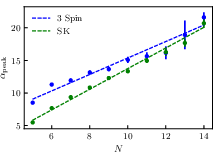
Figure 3: System-size scaling of α3 for SK and 3-spin models, demonstrating linear dependence.
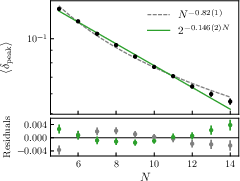
Figure 4: System-size dependence of the SK model peak gap with both power-law and exponential fits; residuals indicate systematic deviations at large α4.
Crucially, the scaling is robust to ramp schedule details and choice of ramp time prescription—both instance-optimized and linearly scaled (α5) ramp times yield close agreement in α6 (see comparison). The protocol enables practical experimental implementation without fine-tuning.
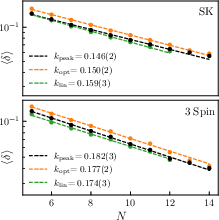
Figure 5: Comparison of scaling exponents α7 for different ramp time prescriptions, showing robustness and near equivalence among methods.
Practical and Theoretical Implications
The adiabatic protocol enables improved spectral gap scaling, enhancing mixing times in both integrable and spin-glass models. For Ising chains, polynomial mixing is achieved, circumventing exponential bottlenecks present in quenched protocols. In spin glasses, exponential scaling persists but with dramatically reduced exponents, suggesting that the method can tackle larger systems than previously feasible.
The method retains error resilience and robustness to quantum proposal imperfections, aligning with near-term quantum hardware constraints. Its performance insensitivity to protocol specifics and absence of fine-tuning requirements makes it experimentally feasible. Furthermore, it preserves convergence to the target distribution.
Theoretically, adiabatic dressing introduces a continuous control parameter (α8) in quantum-enhanced MCMC, fundamentally altering accessible regime and bridging quench and adiabatic limits. The analysis provides insight into delocalization effects, energy localization, and spectral gap scaling via rigorous bottleneck bounds.
Future developments may extend the protocol to non-integrable Hamiltonians, more complex optimization landscapes, and hybrid proposals incorporating neural network samplers. Potential exists for polynomial-time mixing in broader classes of energy landscapes, opening avenues in combinatorial optimization, statistical mechanics, and probabilistic inference.
Conclusion
Adiabatic dressing in quantum-enhanced Markov chains delivers substantial spectral gap and mixing time improvements, analytically and numerically validated in both Ising chains and spin-glass models. Ramp protocol control enables energy localization regulation, reconciling quantum proposal nonlocality with efficient acceptance. The method's robustness, error resilience, and experimental suitability implicate its practical utility for large-scale sampling and optimization on quantum hardware, with broad theoretical ramifications for MCMC algorithm analysis and quantum-classical hybrid computation.