- The paper establishes a mechanism where the triplet order parameter serves as a spin sink to convert quasiparticle spin into a dissipationless spin supercurrent.
- It employs a scattering theory framework with time-dependent perturbation to derive spin-current and spin-torque operators, revealing distinct temperature-dependent behaviors.
- Numerical results confirm that spin supercurrents are robust, reversible, and highly controllable, promising advances in superconducting spintronic devices.
Analysis of "Pumping of Spin Supercurrent in Unitary Triplet Superconductors" (2603.27945)
Introduction and Motivation
The paper introduces a general theoretical framework for generating spin supercurrent in unitary triplet superconductors via coherent magnetization dynamics. Building on the established analogy with Andreev reflection in conventional s-wave superconductors, the work elucidates the symmetry and conservation principles that govern charge and spin transport in superconducting systems. Charge supercurrent generation in conventional superconductors relies on charge conservation—the transport of quasiparticle charge into Cooper pairs—while the generation of spin supercurrent in triplet superconductors is here shown to be fundamentally governed by spin conservation, with the triplet order parameter acting as a spin sink through an emergent spin torque.
Spin Conservation and Spin-Torque Mechanism
The analysis is rooted in the continuity equation for spin, incorporating the effects of the triplet p-wave order parameter Δp. The authors rigorously derive the corresponding spin-current (J^s) and spin-torque (T^s) operators. In unitary triplet superconductors, where the Cooper pairs do not carry equilibrium spin polarization (d×d∗=0), the spin of quasiparticles is wave-vector dependent. This spin nonconservation at the quasiparticle level is compensated by the triplet order parameter, which allows for the conversion of quasiparticle spin into a spin supercurrent.
The conceptual analogy with Andreev reflection is explicit: just as a singlet order parameter serves as a charge sink in conventional systems, the triplet order parameter is responsible for the spin sink, enabling dissipationless spin transport.
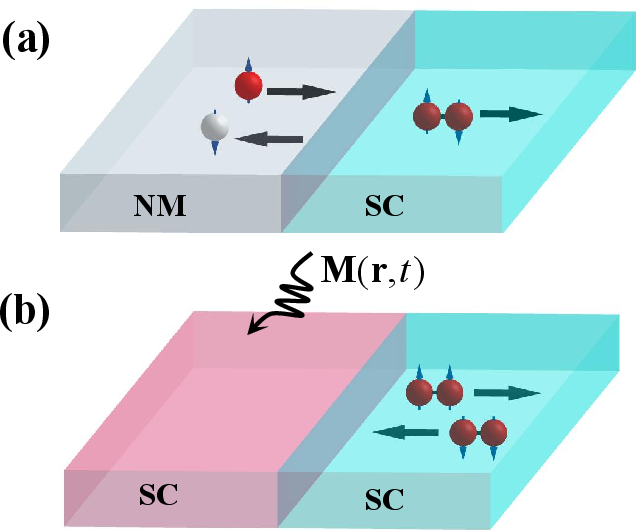
Figure 1: Schematic comparison of charge supercurrent generation in s-wave SCs (a) versus spin supercurrent pumping in p-wave unitary triplet SCs (b); showing how spin torque from a dynamic exchange field drives spin supercurrent under spin conservation.
A general scattering theory is developed to describe the dynamics induced by a time-dependent, spatially confined exchange field, representative of a proximate ferromagnetic nanowire undergoing ferromagnetic resonance (FMR). The Hamiltonian explicitly includes the interfacial exchange coupling, which does not perturb the overall superconducting order due to its sub-coherence length scale and modest energy splitting.
The time-evolution of the system is analyzed using time-dependent perturbation theory, yielding analytic expressions for the wave functions, scattering matrix (T-matrix) elements, and ultimately the spin-current and spin-torque densities. The framework generalizes to nonlinear regimes and beyond conventional spin pumping, where the spin current is not limited to the familiar (dM/dt)×M form, but admits more complex combinations of magnetization components, reflecting the inherent symmetries of the triplet state.
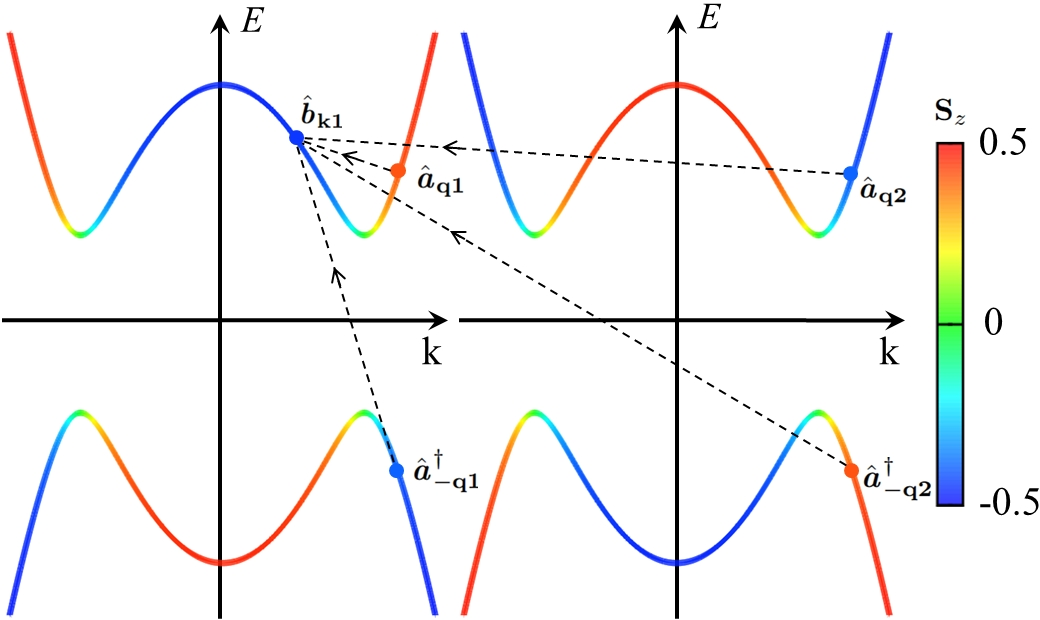
Figure 2: Band structure–resolved spin expectation of quasiparticles; schematic of inelastic scattering driving spin flips and projection onto Cooper pairs in the presence of the triplet order parameter.
Implementation: Spin Pumping in p0-Wave Superconductors
The practical implementation focuses on a p1-wave triplet superconductor, particularly motivated by experimental systems such as the LaAlOp2/KTaOp3 interface with robust 2D p4-wave order. The exchange field, localized via the nanowire, provides an oscillatory FMR-driven field, and the resulting dynamics are analyzed with explicit parameterizations extracted from realistic material systems.
Selection rules for spin current and torque polarization are derived, showing that both dissipative and dissipationless spin supercurrents can be engineered, their flow and polarization controlled by geometric configuration and the symmetry of the applied magnetization.
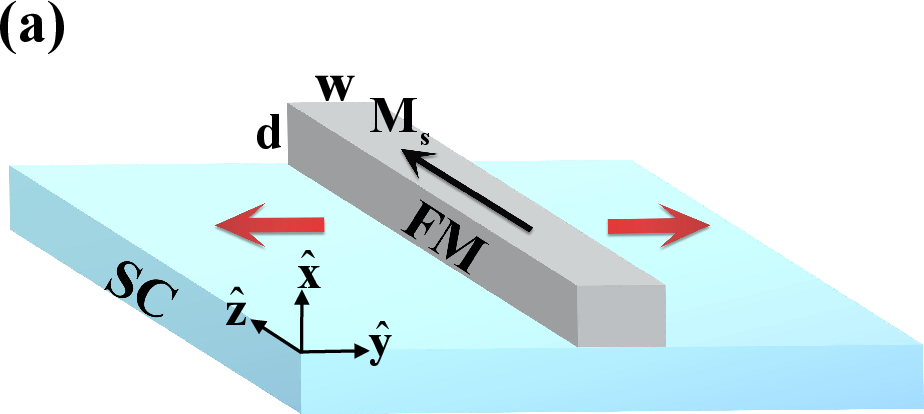
Figure 3: Geometry of the proposed heterostructure—ferromagnetic nanowire atop a p5-wave unitary superconductor—with dynamic exchange field driving spin supercurrent.
Numerical Results: Pumped Spin Current and Spin Supercurrent
Numerical calculations support the analytic theory, using quasiparticle distribution functions and realistic exchange coupling constants. Key observations include:
- The pumped spin current is strongly temperature-dependent, vanishing as p6, consistent with the lack of thermally excited quasiparticles, and increasing with p7 as p8.
- The spin supercurrent, calculated via the spatial derivative of the spin-torque profile, peaks at an intermediate temperature (below p9) and vanishes outside the pumping region.
- The magnitude of the spin current is of the order Δp0, comparable to those produced by electric field–induced spin Hall effects, indicating high experimental accessibility.
- Reversal of the nanowire’s saturation magnetization flips the polarization of the pumped spin current and supercurrent, verifying the direct control of spin transport direction.
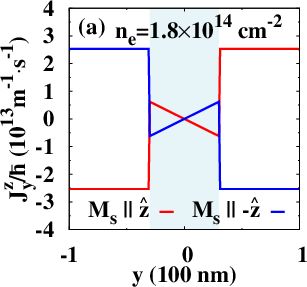
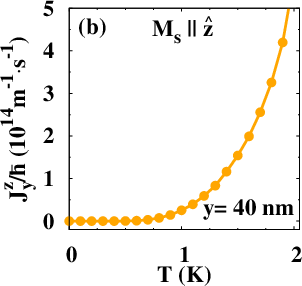
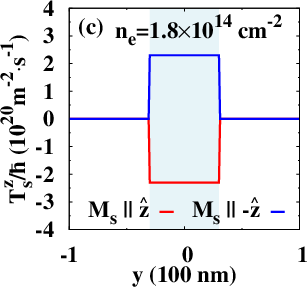
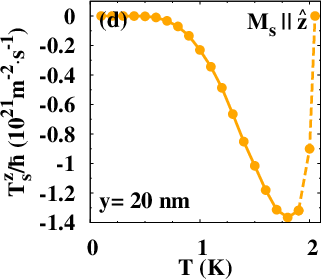
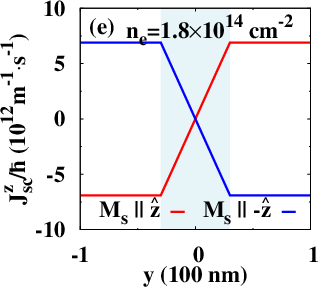
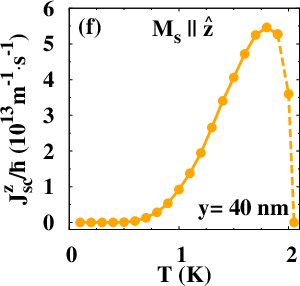
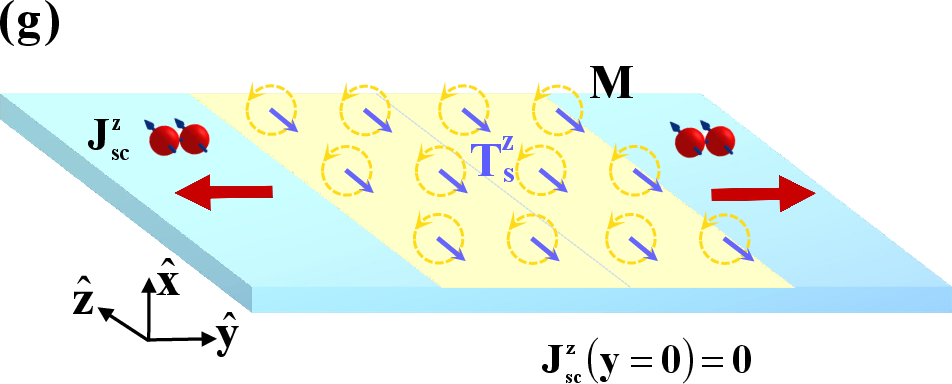
Figure 4: (a–b) Spatial and temperature dependence of the pumped spin current; (c–d) spin-torque density profiles; (e–f) spatial and temperature dependence of the resultant spin supercurrent; (g) schematic summary of spin torque and supercurrent generation.
Theoretical and Practical Implications
The results have substantial implications:
- The analogy to Andreev reflection establishes a fundamental basis for understanding spin conservation in unconventional superconductors and for linking charge and spin transport phenomena at the operator level.
- The mechanism works even in unitary triplet superconductors, where equilibrium Cooper pair polarization is absent and conventional approaches (temperature gradients, charge supercurrents) to spin supercurrent generation are ineffective.
- The efficiency and flexibility of the mechanism suggest direct applicability for superconducting spintronic devices, especially in systems where spin-orbit coupling is weak or absent.
This framework paves the way for highly efficient, coherent, and gateable spin current devices, and motivates further experimental work on intrinsic triplet superconductors and engineered heterostructures with locally driven magnetic dynamics.
Conclusion
This paper delivers a comprehensive microscopic theory for spin supercurrent generation in unitary triplet superconductors via coherent interfacial magnetization dynamics. By leveraging the analogy with charge conservation in conventional superconductors, the authors establish the triplet order parameter as a spin sink, enabling both dissipative and dissipationless spin transport. The combination of analytic scattering theory and quantitative modeling demonstrates that spin supercurrents can be pumped with high efficiency and precise control in realistic heterostructures, significantly expanding the repertoire of superconducting spintronic phenomena. The theoretical framework presented has direct implications for future device architectures leveraging non-dissipative spin currents in superconducting environments.

