- The paper introduces DaiSy, a unified library for exact similarity search over massive data series and vector data.
- It integrates state-of-the-art algorithms (ParIS+, MESSI, SING, Odyssey) optimized for disk, in-memory, GPU, and distributed systems.
- Rigorous benchmarks on 100M-scale datasets show up to 14× speedup over baseline methods, ensuring practical performance for real-world analytics.
DaiSy: A Unified Library for Scalable, Exact Data Series Similarity Search
Motivation and Problem Statement
Exact similarity search over massive collections of data series remains a fundamental operation in analytics across domains such as finance, astrophysics, neuroinformatics, seismology, and engineering. With the proliferation of high-dimensional data, the requirement for scalable, exact (non-approximate) search methods, able to operate across diverse hardware and resource environments, is increasingly critical. Existing solutions are fragmented, specialized, or limited to specific execution contexts, impeding practical integration and adoption. DaiSy addresses this gap by providing a single, unified library that consolidates state-of-the-art algorithms for exact data series similarity search—including versatile support for both data series and general vector data—across disk-based, in-memory, GPU-accelerated, and distributed systems (2603.27719).
Library Architecture and System Design
DaiSy's architecture follows strict modularity and extensibility principles, enforcing separation of concerns along three axes: distance computation (exact and lower-bound), data access (adapter-based, agnostic to physical layout), and execution strategy (independent search algorithms). The C++ core layer encapsulates foundational primitives and is mirrored by a Python interface, ensuring API uniformity.
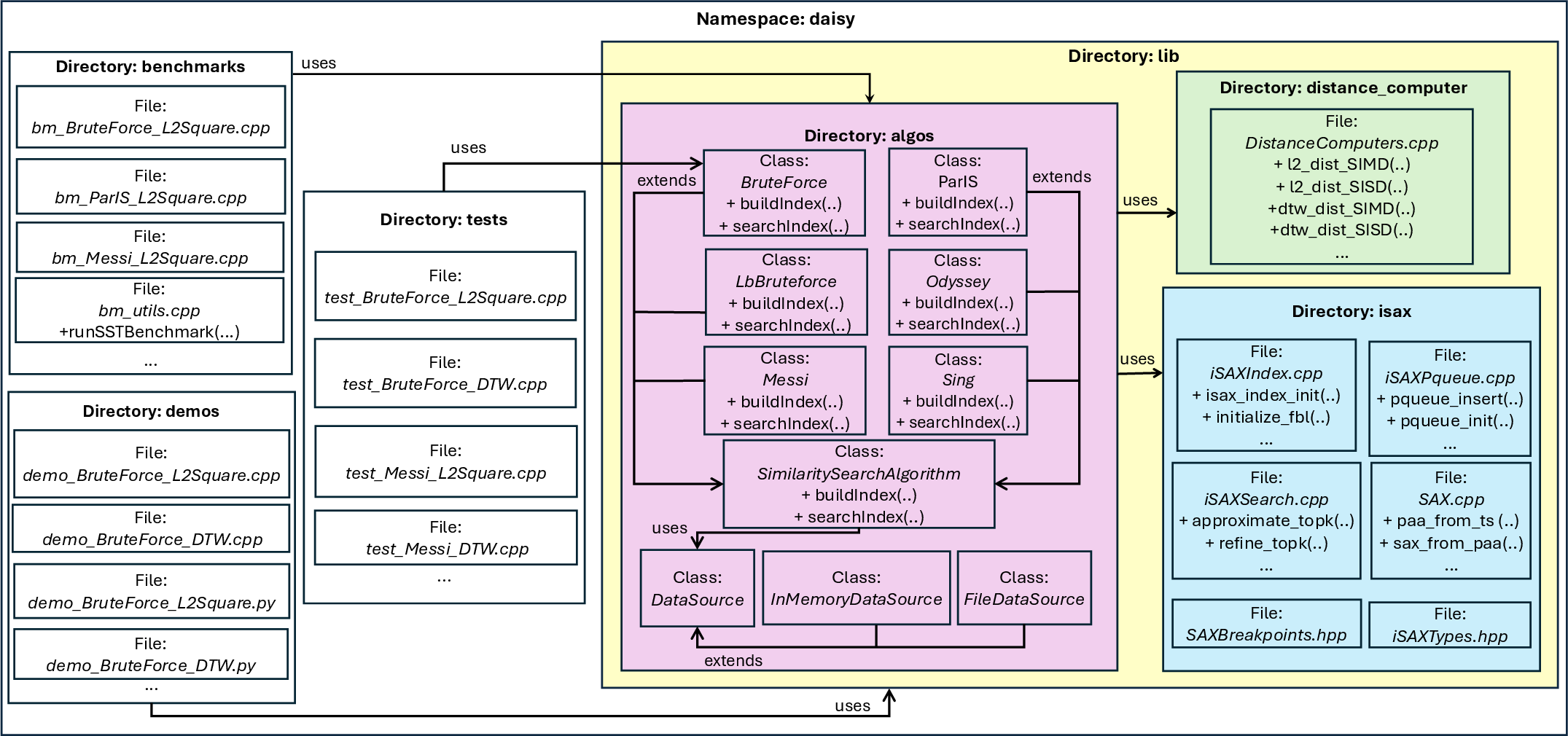
Figure 1: Component diagram illustrating DaiSy’s modular, layered architecture separating core primitives, indexing, and execution models.
The index layer encapsulates an iSAX-based structure, facilitating hierarchical discretization and representation. It supports structured access to data series without constraining search strategy. The similarity search layer adopts execution model–centric abstraction, exposing algorithms optimized for disk-based (ParIS+), in-memory (MESSI), GPU-based (SING), and distributed (Odyssey) environments, each guaranteeing exact answers. Importantly, these methods are interchangeable and can be configured via a unified interface, with hyperparameters defaulted to recommended values from prior research.
Supported Algorithms and Execution Models
DaiSy integrates four state-of-the-art algorithms, each the best-in-class for its execution environment:
- ParIS+ (Disk-Based): Efficient index-guided similarity search when datasets exceed RAM capacity.
- MESSI (In-Memory): Parallel, index-guided in-memory search, combining exploration and refinement phases.
- SING (GPU-Accelerated): Leverages GPU hardware for scalable acceleration, with in-memory indexing and offloaded computation.
- Odyssey (Distributed): MPI-based, multi-node, distributed-memory algorithm suited for petabyte-scale datasets.
In addition, DaiSy provides brute-force and lower-bound–enhanced (LbBruteforce) exhaustive search implementations for baseline evaluation.
Algorithm Selection and Practical Usage
DaiSy automates algorithm selection via decision logic based on dataset size and resource availability (RAM, GPU, distributed cluster). When the dataset fits in RAM, Odyssey is prioritized in distributed settings, SING is used if GPU acceleration is present, and MESSI is chosen otherwise; ParIS+ is used for disk-based cases.
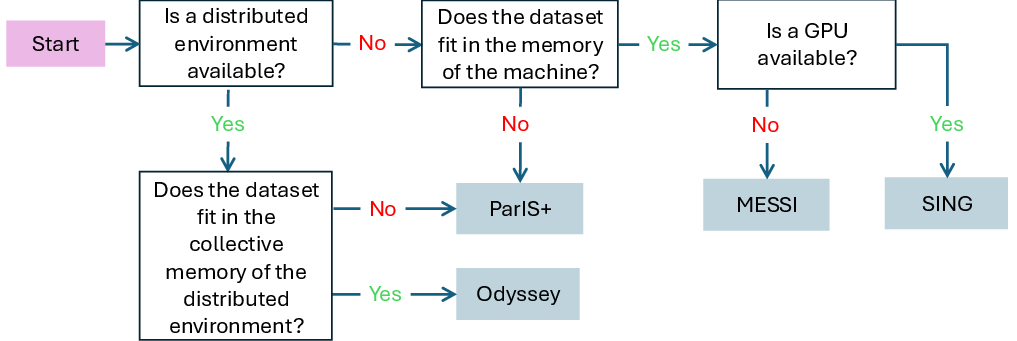
Figure 2: Decision tree depicting DaiSy’s algorithm selection process based on data size and hardware resources.
The API exposes standardized calls: buildIndex for initialization, and searchIndex for querying. Both C++ and Python interfaces are provided, facilitating adoption in academic and industrial settings.
Rigorous benchmarking demonstrates DaiSy's superiority for exact vector search, outperforming FAISS-IndexFlat (the de facto baseline for vector search) by substantial margins. On 100 million–scale datasets (Deep100M, Seismic100M), DaiSy-MESSI achieves up to 12× speedup for deep image embeddings and 14× speedup for seismic data series. Performance improves further as thread count increases.

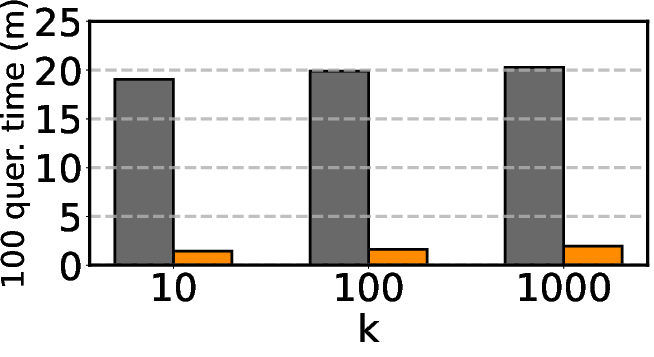
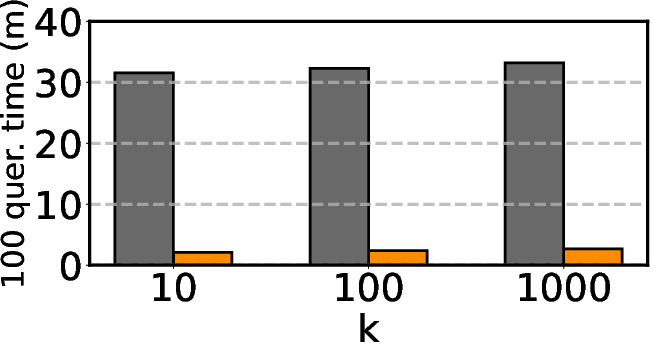
Figure 3: Query answer time (seconds) for 100 queries on Deep100M as k varies, showing 12× speedup of DaiSy-MESSI over FAISS-IndexFlat.
These results underscore DaiSy’s practical impact, making it the solution of choice for applications requiring exact answers—both for real-world analytics and for generating ground-truth in approximate search evaluations.
Implications and Future Directions
DaiSy's unified, scalable framework sets the stage for practical adoption in domains requiring exact series and vector search at scale, including scientific discovery, anomaly detection, and high-precision retrieval. The architectural separation ensures extensibility for future advancements, including incorporation of algorithms from alternate summarization families (e.g., APCA, Hercules), automatic hyperparameter optimization (e.g., Bayesian techniques), and support for emerging use cases such as subsequence similarity search, streaming data analytics, and progressive/early termination methods. The open-source release and API uniformity further promote reproducibility and system integration.
On the theoretical front, DaiSy's abstraction of index management from execution strategy offers a template for future indexing architectures, facilitating algorithmic innovation without API fragmentation. Practical implications extend to benchmarking pipelines for approximate vector search, where DaiSy can generate exact ground-truth efficiently—a capability previously limited by naive brute-force baselines.
Conclusion
DaiSy establishes itself as a comprehensive library for scalable, exact similarity search, integrating leading algorithms into a unified, extensible framework. Its modular architecture, superior performance, and broad applicability to both data series and vectors position it as a foundational tool for future research and application development in large-scale analytics (2603.27719).