You Only Erase Once: Erasing Anything without Bringing Unexpected Content
Abstract: We present YOEO, an approach for object erasure. Unlike recent diffusion-based methods which struggle to erase target objects without generating unexpected content within the masked regions due to lack of sufficient paired training data and explicit constraint on content generation, our method allows to produce high-quality object erasure results free of unwanted objects or artifacts while faithfully preserving the overall context coherence to the surrounding content. We achieve this goal by training an object erasure diffusion model on unpaired data containing only large-scale real-world images, under the supervision of a sundries detector and a context coherence loss that are built upon an entity segmentation model. To enable more efficient training and inference, a diffusion distillation strategy is employed to train for a few-step erasure diffusion model. Extensive experiments show that our method outperforms the state-of-the-art object erasure methods. Code will be available at https://zyxunh.github.io/YOEO-ProjectPage/.
Paper Prompts
Sign up for free to create and run prompts on this paper using GPT-5.
Top Community Prompts
Explain it Like I'm 14
A clear, simple explanation of “You Only Erase Once: Erasing Anything without Bringing Unexpected Content”
What is this paper about?
This paper introduces a new way to remove objects from photos called YOEO, short for “You Only Erase Once.” The goal is to erase a chosen object cleanly in one go, without accidentally adding new, weird things into the picture, and to make the erased area blend in naturally with the rest of the image.
What questions are the researchers trying to answer?
They focus on two big questions:
- How can we erase a chosen object without the computer “hallucinating” and drawing extra, unwanted objects in the erased area?
- How can we make the erased spot look like it truly belongs in the scene, matching colors, textures, and the general “feel” of its surroundings?
How did they do it? (Methods in everyday language)
Think of an image editor that acts like a very smart eraser. Many modern image tools use “diffusion models,” which you can imagine as a process that starts with a blurry, noisy version of a picture and step-by-step makes it clear again. These models can be great—but sometimes, when you erase something, they fill the gap with extra stuff that doesn’t belong.
The authors solve this with three key ideas:
- A “teacher–student” setup to make it fast and accurate:
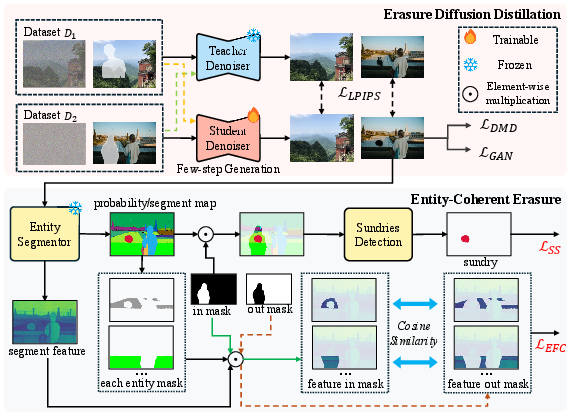
- First, they train a powerful “teacher” model using many steps to learn how to fill in erased areas.
- Then, they train a faster “student” model to do the same job in only a few steps. This is called “distillation,” like teaching a student the important parts so they can work quickly.
- A “sundries detector” to avoid unwanted objects:
- After the model erases something, a checker looks for any new objects that weren’t there before (they call these “sundries,” like random junk). This checker uses a tool that can find and outline objects in a picture (called an “entity segmentation” model).
- If the checker finds any new, unintended objects inside the erased area, it penalizes the model. Over time, this teaches the model not to insert extra stuff.
- A “context matching” rule so the patch fits the scene:
- The model also learns to make the erased area match the surroundings. Imagine replacing a puzzle piece—you want the colors and patterns to line up. The system compares features inside the erased area with features around it and encourages them to be similar, so the result looks natural.
To train the system, they use two kinds of data:
- Paired examples (synthetic): Pictures where they cover part of the background on purpose, so they know exactly what the “correct” answer should look like.
- Unpaired real-world examples: Real photos where they only know which object to erase, but there is no perfect “after” version. The sundries detector and context matching rules guide learning without needing a ground-truth “answer” image.
The training happens in three stages:
- Fine-tune the teacher on the easier, paired cases.
- Distill the teacher’s knowledge into a fast, few-step student.
- Teach the student to avoid unwanted objects and keep context consistent using the checker and the context rule on real-world data.
What did they find, and why is it important?
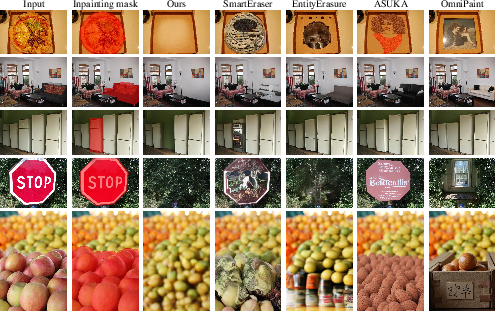
- Cleaner erasing: YOEO removes target objects without adding strange or unwanted stuff in the erased area.
- Better blending: The erased region matches the rest of the photo more naturally, so it looks like the object was never there.
- Faster and lighter: Because the student model works in just a few steps, it runs quickly and uses fewer resources than big, heavy systems.
- Strong performance: In tests on real photos, YOEO produced fewer mistakes (fewer “sundries”) and more consistent results than other leading methods.
Why this matters:
- It makes practical photo editing more reliable—useful for apps, phones, and creative tools.
- It avoids the common problem where AI “makes things up” after you erase something.
- It runs efficiently, which is helpful for devices with limited power or memory.
What’s the bigger impact?
This research shows a smart way to control image-editing AI so it behaves more like a careful eraser than a wild painter. By combining fast models with automatic checks for unwanted content and rules for matching the scene, YOEO makes object removal safer, cleaner, and more realistic. This can improve everyday photo editing, product photography, design workflows, and any task where you need to remove things from images without leaving a trace.
Knowledge Gaps
Knowledge gaps, limitations, and open questions
Below is a concise, actionable list of what remains missing, uncertain, or unexplored in the paper.
- Reliance on a single pretrained segmentor (Mask2Former) for both losses and sundries detection: no quantification of how segmentation errors, domain shift, or calibration affect SS/EFC supervision or final quality.
- Potential circularity/bias in evaluation: sundries metrics (MSN/MARS) and CFD also depend on segmentation; no results with alternative detectors or human judgments to verify robustness of claims.
- Ambiguity in the EFC objective: equations align inpainted features with the erased entity’s feature center, which could implicitly encourage reintroducing the removed entity; need clarification, diagnostics, and variants that align to “background/adjacent context” rather than the erased entity itself.
- SS loss hard-threshold design (IoS > 0.9, p > 0.2) is hand-tuned; no study of sensitivity, adaptive/learned thresholds, or probabilistic handling of uncertainty.
- SS penalizes any new entities in the masked region; may suppress plausible, semantically consistent content (e.g., partially revealed objects behind the erased target). No mechanism to balance “no-new-object” vs realism/plausibility.
- Segmentation-driven SS/EFC cannot detect low-level artifacts (textures, edges, lighting) that are not “entities”; lacks complementary perceptual/physics-based artifact detectors.
- No explicit modeling of geometry, shadows, reflections, or lighting consistency; open question whether integrating depth/normals/shadow cues improves context fidelity after erasure.
- Limited analysis of robustness to mask quality: performance with noisy, coarse, dilated/eroded, or slightly misaligned user masks is not evaluated; no training-time robustness strategies described.
- Generalization to high-resolution and unusual aspect ratios is not assessed; latency/quality trade-offs at 1024px–4K and memory footprint are unreported.
- Claims about edge-device suitability lack empirical evidence on mobile/embedded hardware (latency, memory, power), and comparisons against lightweight baselines under matched deployment constraints.
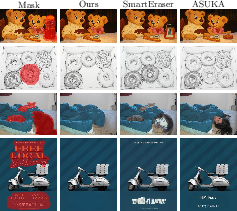
- Domain generalization beyond natural photos is only shown qualitatively; no quantitative evaluation on sketches, comics, posters, medical/remote-sensing, or low-light/night domains.
- No category-wise or mask-size-wise breakdown (thin structures, transparent objects, highly textured backgrounds, tiny vs very large masks); failure modes are not systematically mapped to object or scene types.
- Teacher dependence is unexplored: how method behaves with stronger/other teachers (e.g., SDXL-inpainting, Flux-inpainting) or different schedulers/noise schedules; whether SS/EFC consistently de-bias artifacts from diverse teachers.
- Few-step inference design space: no analysis of step count vs quality/latency (2 vs 3–4 steps), or sample-adaptive step selection for hard cases.
- GAN-in-the-loop for distillation: stability, failure cases, and effect size across scenes not thoroughly quantified; risk of adversarial artifacts under-disclosed.
- Metrics validity: FID on pair-free tasks is weakly aligned with inpainting fidelity; correlation of MSN/MARS/CFD with human preference is unreported; alternative metrics (edge continuity, color/illumination consistency, outside-mask preservation) are not explored.
- Lack of controlled paired benchmarks: no evaluation on synthetic occluder datasets with known ground truth backgrounds to measure structural/color fidelity and boundary accuracy.
- No user study on “clean erasure without unexpected content” to validate that metric improvements translate to perceived gains and practical edit satisfaction.
- Multi-object erasure in crowded scenes: although shown qualitatively, no stress tests quantify interaction failures (e.g., merging, over-erasure, boundary bleeding) under high occlusion and clutter.
- Temporal extension is unaddressed: video erasure and temporal consistency with SS/EFC across frames remain open.
- Controllability is limited to mask-based selection; no text-guided or attribute-guided erasure, nor a mechanism to control aggressiveness (e.g., allow benign background objects) at inference time.
- Thresholds, loss weights, and schedules are mostly fixed; beyond a brief note about sensitivity in the supplement, no systematic or automated tuning (e.g., population-based search) or uncertainty-aware weighting is presented.
- Dataset construction details may limit reproducibility: availability of the exact entity masks/filters, license constraints on Open Images derivatives, and the precise split/processing pipeline are not fully specified.
- Failure case taxonomy is not provided in the main paper; actionable insights (when/why SS or EFC fail, and how to detect/mitigate at inference) are missing.
- Plausibility vs conservatism trade-off: the “erase without introducing any new object” objective may yield over-smooth or under-detailed completions in scenes where plausible object continuation is expected; needs explicit modeling and evaluation.
Practical Applications
Practical Applications of YOEO (You Only Erase Once)
YOEO is a few-step, diffusion-based object erasure system that removes specified objects in a single pass while minimizing hallucinated insertions and preserving context. It uses unpaired real-world supervision via a sundries detector (entity segmentation–based) and an entity feature coherence loss, and distills a multi-step teacher into a low-latency student (2-step LCM). Below are actionable use cases and workflows, grouped by deployment horizon.
Immediate Applications
The following are deployable now using the released model architecture and training recipes (or via a hosted API), especially for still images or low-latency batch jobs.
- Photo post-production cleanup (Media & Entertainment)
- Use case: Remove microphones, wires, dust, light stands, crew reflections from stills.
- Tools/workflows: Integrate YOEO as a Photoshop/GIMP plugin or as a batch CLI; mask selection with SAM/Mask2Former; one-pass erasure; art director review.
- Assumptions/dependencies: High-quality masks; GPU or cloud inference; permissions/credits for edited content.
- E-commerce product imaging (Retail/Marketplace)
- Use case: Automatically remove props, mannequins, tag fasteners, turntables to produce compliant listings.
- Tools/workflows: Seller portal pipeline—segment object-of-interest; generate masks programmatically; apply YOEO at scale; automated QA via CFD/MSN-like metrics thresholds.
- Assumptions/dependencies: Accurate entity masks; domain adaptation may be needed for studio lighting variations; marketplace policy compliance.
- Marketing and ad creative refinement (Advertising/Design)
- Use case: Remove crowded bystanders, unauthorized logos, street clutter in campaign imagery.
- Tools/workflows: Figma/Canva plugin; brand governance step; batch processing for A/B variants.
- Assumptions/dependencies: Legal clearance for edits; brand safety policies.
- Privacy and compliance redaction in images (Public Sector, Legal, Healthcare)
- Use case: Remove faces, license plates, house numbers, tattoos from images prior to release.
- Tools/workflows: Detection (face/plate OCR) → mask creation → YOEO erasure → audit log of edits; optional C2PA provenance stamping.
- Assumptions/dependencies: Accurate detectors; disclosure and compliance with GDPR/CCPA/sector rules; human-in-the-loop for high-risk data.
- Dataset anonymization for ML (Academia, Autonomous Driving, Healthcare Research)
- Use case: Erase identifiable elements from training or publication images while preserving scene context.
- Tools/workflows: Preprocessing stage in MLOps; scheduled batch erasure on flagged entities; provenance logs for reproducibility.
- Assumptions/dependencies: Segmentation accuracy; careful documentation to avoid unintentional bias or data leakage.
- Counterfactual data generation and ablation studies (Academia/ML Research)
- Use case: Create “without-object” counterparts for robustness analysis (e.g., remove co-occurring confounders like snowboards or backpacks).
- Tools/workflows: Programmatic masks via open-vocabulary segmentation; generate controlled counterfactual datasets; evaluate model sensitivity shifts.
- Assumptions/dependencies: Sound experimental design; mask selection reflects study variables.
- Content moderation–friendly edits (Online Platforms)
- Use case: Remove restricted symbols or sensitive imagery from user-uploaded stills as an alternative to outright rejection.
- Tools/workflows: Automatic detection → mask → YOEO; human review for edge cases; rollback via stored originals.
- Assumptions/dependencies: Clear platform policy; risk controls to prevent misuse or over-removal.
- Document and scan artifact cleanup (Digitization/Cultural Heritage)
- Use case: Remove dust, scratches, stains from scanned photos/posters while maintaining texture.
- Tools/workflows: Mask generation from defect detection; batch YOEO; archivist sign-off.
- Assumptions/dependencies: Domain adaptation for historical media; conservative thresholds to avoid over-editing.
- Real-estate and architecture imagery (Construction/PropTech)
- Use case: Remove temporary objects (scaffolding, tools) from property photos for clearer presentations.
- Tools/workflows: Site-photo ingestion → quick segmentation → one-pass YOEO → listing generation.
- Assumptions/dependencies: Disclosure standards; avoid misrepresenting permanent features.
- API microservice for “Erase Object” (Software/SaaS)
- Use case: Provide a simple server endpoint that takes an image + mask and returns an erased image.
- Tools/workflows: Containerized SD1.5-inpainting + 2-step LCM; autoscaling; rate limiting; optional provenance watermarking.
- Assumptions/dependencies: GPU budget; request authentication; monitoring for misuse.
- Satellite/aerial image cleanup pilots (Geospatial)
- Use case: Remove transient vehicles or shadows for map-style composites.
- Tools/workflows: Pre-detected objects → erasure → mosaic generation; QA vs. source tiles.
- Assumptions/dependencies: Significant domain shift—expect to fine-tune on aerial data; careful use to avoid misrepresenting ground truth.
- On-device photo editing via cloud offload (Consumer Apps)
- Use case: “Remove object” button in mobile camera/gallery apps.
- Tools/workflows: On-device mask selection UI + cloud erase call; low-latency round-trip; user consent for upload.
- Assumptions/dependencies: Network privacy; model licensing; user transparency.
Long-Term Applications
These require further research for temporal consistency, broader generalization, lighter models, or tighter integrations with detection, provenance, or hardware.
- Real-time video object erasure with temporal coherence (Media, AR/VR)
- Potential product: Timeline-aware plugin for After Effects/Premiere; AR live cleanup (removing boom mics or undesired overlays).
- Dependencies: Temporal losses, multi-frame “sundries” detection, motion-aware EFC, hardware acceleration on GPUs/NPUs.
- Text- or voice-specified erasure (Open-vocabulary) (Software, Creative Tools)
- Potential product: “Remove all logos” via text; automatic mask proposal from open-vocab segmentation before YOEO.
- Dependencies: Reliable open-vocab detectors; disambiguation UI; safety filters for disallowed edits.
- Mobile/edge deployment at scale (Consumer Devices, Edge AI)
- Potential product: 100–200M-parameter distilled/quantized model running on NPUs for offline use.
- Dependencies: Aggressive quantization/pruning; memory-optimized U-Net; vendor SDKs (CoreML NN, Android NNAPI, Qualcomm/Apple NPUs).
- Multi-view/3D-consistent erasure (AEC, VFX, Digital Twins)
- Potential product: Remove objects consistently across multi-camera rigs or NeRF/mesh reconstructions.
- Dependencies: Multi-view consistency constraints; 3D surface completion; camera pose awareness.
- Safety-forward provenance and redaction audit (Policy, Journalism, Law Enforcement)
- Potential product: Built-in C2PA signing and edit manifests that log masks and operations for chain-of-custody and public transparency.
- Dependencies: Organizational policy buy-in; integration with newsroom and agency workflows; legal standards.
- Automated compliance remediation (Regulated Industries)
- Potential product: Detect-and-erase regulated items (e.g., specific medical devices, PHI) before publishing.
- Dependencies: High-precision detectors; domain-tuned erasure; compliance review loop and exception handling.
- Healthcare image preprocessing and artifact removal (Healthcare)
- Potential product: Removing non-anatomical artifacts (e.g., skin markers in dermatology photos) for publication/education datasets.
- Dependencies: Strong domain validation, clinical oversight, and regulatory clearance; never applied to diagnostic content without approvals.
- Robotics and autonomy dataset curation (Robotics)
- Potential product: Counterfactual training sets to reduce spurious correlations (e.g., traffic signs without nearby poles).
- Dependencies: Large-scale pipeline integration; careful bias analysis; retraining costs.
- Education and pedagogy tools (EdTech)
- Potential product: Interactive images where teachers remove distracting elements to focus attention on core concepts.
- Dependencies: Simple UI to propose masks; content rights; age-appropriate safeguards.
- Synthetic data platforms with erasure primitives (ML Platforms)
- Potential product: Scenario editors enabling “what-if” scene edits (remove object X) for causal training or fairness experiments.
- Dependencies: Automated mask proposal; experiment tracking; clear semantics of edits for reproducibility.
- Secure moderation with human-in-the-loop (Online Platforms)
- Potential product: Semi-automatic removal of harmful symbols with escalation and transparent logs.
- Dependencies: Reliable detection; clear reviewer guidelines; auditability to prevent misuse and overreach.
Key Assumptions and Dependencies
- Mask quality at inference: YOEO assumes a reasonably accurate mask for the target object. Integrations should pair it with high-quality segmentation (e.g., SAM, open-vocab segmentors).
- Segmentation-driven supervision: Training relies on entity segmentation for the sundries detector and EFC. Domain gaps (e.g., medical, aerial) may necessitate segmentation retraining or fine-tuning.
- Model size and compute: Although few-step inference reduces latency, the base model (~860M params) may require GPU or high-end edge accelerators; mobile viability depends on further distillation/quantization.
- Ethical and legal compliance: Edits can mislead or erase evidence. Incorporate edit provenance (e.g., C2PA), user disclosures, and organizational policies; use human review for sensitive applications.
- Domain adaptation: For specialized imagery (satellite, medical, comic art), retraining or fine-tuning on in-domain, unpaired data increases reliability.
- Licensing and distribution: Stable Diffusion 1.5 and datasets carry licensing terms; ensure compliance for commercial use.
- Video support: Current method is optimized for stills; video use requires temporal extensions to avoid flicker and maintain consistency.
Glossary
- Amodal priors: Assumptions about the complete shape or extent of objects beyond the visible regions, used to guide completion or removal tasks. "or geometric and amodal priors~\cite{zhu2025entityerasure,zhu2025georemover}."
- Attention probability maps: The attention weights in transformer-based diffusion models that determine how regions attend to each other during generation. "Several specialized erasure methods try to mitigate hallucination issues by modifying attention probability maps~\cite{magiceraser,erase_diffusion}"
- CFD: A pair-free metric for evaluating context consistency of edited images (introduced by OmniPaint). "and CFD~\cite{Omnipaint} to evaluate context consistency."
- Context coherence loss: An objective encouraging generated content to remain consistent with surrounding context. "under the supervision of a sundries detector and a context coherence loss that are built upon an entity segmentation model."
- Cosine similarity: A feature-similarity measure (cosine of the angle between vectors) used to align features of generated and surrounding regions. "we compute the cosine similarity between the segment feature inside the generated region~(in mask) and those outside the region (out mask) as entity feature coherent loss"
- Denoiser: The core network in a diffusion model that predicts less-noisy latents or the noise itself at each step. "Given a pretrained erasure diffusion model serving as a teacher denoiser"
- Diffusion distillation: Compressing a multi-step diffusion process into a faster, few-step model while preserving generation quality. "To enable more efficient training and inference, a diffusion distillation strategy is employed to train for a few-step erasure diffusion model."
- Distribution Matching Distillation (DMD): A distillation method aligning student and teacher distributions, typically via KL divergence between real and generated data. "Beyond the distillation loss, we employ Distribution Matching Distillation (DMD) to ensure distributional consistency between the student and teacher denoisers."
- DPMSolver++ scheduler: A high-order ODE-based sampler for diffusion models that accelerates inference. "The teacher uses the DPMSolver++ scheduler~\cite{dpm++} with 20 steps."
- Entity feature coherence (EFC) loss: A feature-level objective encouraging the inpainted region’s segmentation features to align with surrounding entities. "we introduce two novel objectives: the sundries suppression (SS) loss and the entity feature coherence (EFC) loss."
- Entity segmentation: Segmenting all distinct objects (entities) in an image, often used for fine-grained guidance or evaluation. "we leverage a pre-trained entity segmentation model~\cite{entity_seg_iccv} as an automatic sundries detector"
- Few-step diffusion model: A distilled diffusion model that produces results in a small number of denoising steps. "a diffusion distillation strategy is employed to train for a few-step erasure diffusion model."
- FID (Fréchet Inception Distance): A metric comparing distributions of generated and real images to assess visual realism. "We also use FID~\cite{fid} to assess the overall image generation quality."
- Flash Diffusion: A training strategy for efficient few-step diffusion with progressive noise scheduling. "Our inpainting diffusion distillation framework is built upon Flash Diffusion~\cite{flash_diffusion}."
- GAN loss: An adversarial objective used alongside diffusion losses to improve realism of generated images. "We also use a GAN loss~\cite{gan_first} to improve the quality of images generated by the student diffusion model."
- Generative Adversarial Networks (GANs): A generative framework with a generator and discriminator trained adversarially. "Early approaches~\cite{Incremental_transformer_gan_inpaint,...} are mostly designed based on Generative Adversarial Networks (GANs)~\cite{gan_first}."
- Hallucination (in generative models): The unintended generation of spurious objects or artifacts by a model. "diffusion-based methods often hallucinate by inserting unintended objects after removing the target ones"
- Inpainting mask: A binary mask specifying regions to remove or fill during inpainting/erasure. "we generate inpainting masks by randomly occluding partial regions of the background in the image."
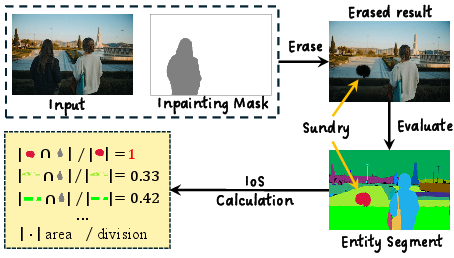
- Intersection over Self (IoS): The ratio between the intersection of a predicted mask with a region and the predicted mask’s area, used to detect newly generated objects. "an object is considered a sundry if the Intersection over Self (IoS)~\cite{zhu2025entityerasure, entity_seg_iccv} between its overlap with the inpainting mask and its total area exceeds a threshold."
- Kullback–Leibler (KL) divergence: A measure of divergence between two probability distributions used here to align student and teacher. "DMD achieves this by minimizing the Kullback–Leibler (KL) divergence between the real and generated distributions."
- Latent space: The compressed representation space where diffusion and discriminators may operate. "It is applied directly in the latent space, with features extracted by the pre-trained teacher diffusion model serving as input to the discriminator."
- LCM scheduler: An inference-time sampler (Latent Consistency Model scheduler) enabling very few-step generation. "During inference, we use the LCM scheduler~\cite{lcm} with the number of steps set as 2."
- LPIPS: A learned perceptual similarity metric used as a distance function in distillation. "for which we adopt LPIPS~\cite{lpips} by default."
- Mask2Former: A segmentation architecture producing masks and per-entity probabilities used here for sundries detection and features. "the pretrained Mask2Former~\cite{mask2former} segmentor predicts entity probabilities and segmentation masks:"
- Mean Area Ratio of Sundries (MARS): A metric quantifying the average area proportion of unwanted generated objects. "We use Mean Sundries Num (MSN) and Mean Area Ratio of Sundries (MARS)~\cite{zhu2025entityerasure} to evaluate whether the model generates additional unwanted objects"
- Mean Sundries Num (MSN): A metric counting the average number of unwanted objects generated. "We use Mean Sundries Num (MSN) and Mean Area Ratio of Sundries (MARS)~\cite{zhu2025entityerasure} to evaluate whether the model generates additional unwanted objects"
- Multimodal models: Models that process and generate across multiple modalities (e.g., text and images) for tasks like object erasure. "recent closed-source multimodal models such as ChatGPT and Nano Banana"
- Noise timestep: The discrete diffusion-time index indicating the current noise level in the forward/backward process. " is a randomly sampled noise timestep"
- ODE (in diffusion sampling): The ordinary differential equation-based formulation of the reverse diffusion trajectory used for multi-step prediction. "where denotes the teacher’s multi-step prediction process"
- Outpainting mask: The complement of the inpainting mask, indicating visible (unmasked) regions used for context. "The outpainting mask , corresponding to the visible (unmasked) region, is defined as the complement of ."
- Pair-free supervision: Training guidance that does not require paired input–target images, suitable when ground-truth erasures are unavailable. "To enable pair-free supervision for real-world erasure scenarios, we introduce two novel objectives"
- Reward-based supervision: Using an automatic signal (reward/evaluator) rather than paired labels to guide generation quality. "Inspired by reward-based supervision~\cite{pick_reward,aligning_reward,raft_reward_rank,image_reward_nips,Human_preference_score_reward,ren2024byteedit}, we introduce a sundries detector"
- Score distillation: Aligning student and teacher diffusion models via gradients derived from score matching. "Another line of work employs score distillation to align the distributions of teacher and student diffusion models"
- Sundries detector: An automatic evaluator that flags unwanted generated objects/artifacts after erasure. "we introduce a sundries detector that evaluates whether the generated image contains unwanted artifacts."
- Sundries suppression (SS) loss: A loss penalizing the presence of newly generated unwanted entities within the erased region. "we introduce two novel objectives: the sundries suppression (SS) loss and the entity feature coherence (EFC) loss."
- Supervised Fine-Tuning (SFT): Training a model on labeled (paired) data with standard losses, without task-specific erasure guidance. "existing methods rely solely on Supervised Fine-Tuning (SFT)"
- Teacher–student distillation: Training a compact student model to mimic a larger teacher model’s behavior or outputs. "During training, we combine teacher-student distillation with the erasure-related supervision"
- Warm-up schedule: A training strategy that gradually changes sampling or learning parameters over time for stability. "and apply a warm-up schedule that gradually increases the probability of selecting higher-noise timesteps."
Collections
Sign up for free to add this paper to one or more collections.

