- The paper introduces a first-order Maxwell operator framework to symmetrically quantize electric and magnetic fields while explicitly incorporating volumetric and boundary noise contributions.
- The methodology reformulates Maxwell’s equations using a dual-field representation, yielding a versatile quantum input-output theory applicable to arbitrary nanophotonic networks.
- The approach resolves ambiguities in structured photonic environments by unifying classical propagation, reciprocity, and fluctuation-dissipation in a self-consistent QED framework.
Motivation and Context
The traditional macroscopic quantum electrodynamics (QED) formalism employs the second-order Helmholtz equation and dyadic Green's functions, focusing on quantizing the electric field and effectively discarding explicit boundary terms. This framework is appropriate for homogeneous or infinite lossy media but fails when considering open-system environments, such as nanophotonic devices, photonic crystals, waveguides, and arbitrary structured dielectrics. Recent theoretical developments highlight the necessity of retaining boundary-induced contributions for a self-consistent QED treatment in finite systems [drezet2017quantizing, ciattoni20240719quantum].
The paper "First order Maxwell operator formalism for macroscopic quantum electrodynamics" (2603.27475) introduces a formalism based on the first-order Maxwell operator, treating E and H symmetrically as a dual field and enabling the inclusion of both volumetric and boundary quantum noise sources. This formalism naturally yields a quantum input-output theory applicable to arbitrary photonic environments, encompassing structured boundaries, nontrivial dielectric arrays, and waveguide-cavity hybrid systems.
The approach reformulates Maxwell’s equations in a first-order operator framework, combining the electric and magnetic fields into a dual vector E=[E,Z0H]T. The Maxwell operator M=i∇ˉ×−k0εˉ acts on this dual field. The retarded first-order Green operator g describes propagation between source and field locations, including both bulk and surface-mediated contributions.
The separation of the electromagnetic response into volume and boundary terms is made explicit via a decomposition
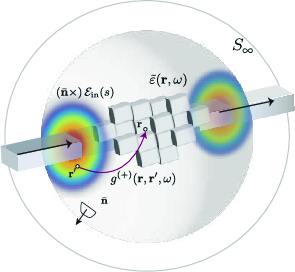
Figure 1: Field decomposition geometry and system consideration. A lossy, dispersive medium with material tensor εˉ occupies a region V enclosed by surface S; the Green operator g(+) propagates both volumetric sources and incoming boundary fields.
The field at point r obeys the propagation formula
H0
with surface integrals retaining the "input" quantum noise channel inherent to open-system boundary conditions.
The Green tensor admits a surface-volume decomposition relating direct bulk propagation to mediated surface pathways:
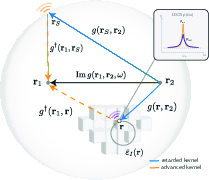
Figure 2: Surface-volume decomposition of the Green tensor: direct response between H1 and H2 includes volume absorption and boundary-induced effects.
Classical Identities from Operator Symmetries
The Maxwell operator is self-adjoint under distinct inner products, yielding fundamental classical identities central to electromagnetic theory:
- Energy inner product: Gives power balance (Poynting theorem), decomposing dissipation into bulk absorption and boundary radiation.
- Reciprocal inner product: Provides Lorentz reciprocity, dictating the symmetry of Green's functions under source-detector interchange.
- The operator formulation leads to generalized optical theorem expressions relating the anti-Hermitian part of the Green’s function to both absorption and emitted flux.
An exact composition rule enables cascaded propagation between arbitrary surfaces via transfer operators, facilitating multi-component quantum networks:
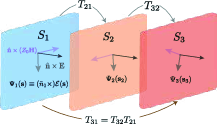
Figure 3: Plane-to-plane transfer of the tangential electromagnetic state, with the transfer operator H3 propagating boundary states between surfaces.
Quantization proceeds via a Heisenberg–Langevin framework, explicitly distinguishing the electromagnetic field, the material polarization (absorptive bath), and the boundary input channel. The total Hamiltonian is
H4
with H5 (dual polarization) linearly coupled to the electromagnetic field and bath reservoirs.
The frequency-domain constitutive relation incorporates both coherent and noise-driven responses:
H6
where the noise operator is fixed by the fluctuation-dissipation theorem:
H7
The macroscopic field operator solution, via the first-order Green operator, is
H8
with quantum noise contributions sourced from both material absorption and boundary input states. The boundary noise is quantized with its own canonical commutator.
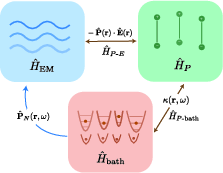
Figure 4: Quantization scheme: the Hamiltonian couples electromagnetic field, polarization, and bosonic bath; noise enters via both bulk polarization and boundary input.
Quantum Commutation Relations and Optical Theorem
The operator algebra closes exactly via a generalized optical theorem. The canonical commutator of the internal field at points H9 and E=[E,Z0H]T0 is found to be
E=[E,Z0H]T1
with E=[E,Z0H]T2 encoding the anti-Hermitian part of the Green operator, accounting for all quantum fluctuations irrespective of system geometry, loss, or boundary structure.
The boundary fields are naturally treated as input-output channels, with explicit transfer operators propagating quantum states between surfaces, maintaining canonical commutation relations in lossless and lossy environments. The formalism enables cascading of arbitrary photonic components, with the output commutator determined exactly by transfer, boundary, and bulk-noise contributions.
Practical and Theoretical Implications
Practical Implications
- Fully general input-output quantum descriptions can be formulated for arbitrary nanophotonic networks, including non-modal photonic crystals, inverse-designed photonic elements, atom arrays, and hybrid cavity-waveguide systems.
- The required physical object is the numerically computed Green operator for the photonic environment, enabling seamless interfacing with finite element, finite-difference time-domain, and rigorous coupled wave analysis solvers [JianFEM, chewFDTD, Moharam1995RCWA].
- This resolves longstanding ambiguities in quantizing structured environments, ultrafast QED, and open-system dynamics in latest-generation quantum devices.
Theoretical Implications
- The first-order operator formalism unifies classical propagation, reciprocity, and quantum fluctuation-dissipation in a single framework.
- The inclusion of E=[E,Z0H]T3 and E=[E,Z0H]T4, generalized to bianisotropic and topological materials, allows extension to nonreciprocal and chiral photonic systems [silveirinha2018topological, scheel2012macroscopic, rapp2025purcell].
- Boundary channels are treated without asymptotic modal constraints, allowing for input-output theory in arbitrary environments with structured or mixed boundary conditions.
- The approach directly generalizes to multi-component, multi-channel photonic networks, suitable for scalable quantum information and nanophotonic architectures.
Future Developments
A modal input-output theory supplementing the first-order formalism is anticipated, enabling explicit mapping of boundary fields to guided, radiative, and hybrid eigenmodes in complex environments. Cascaded quantum photonic networks, chiral and topological quantum light-matter interaction, and nonlocal/nonreciprocal magnetodielectric structures will be accessible within this framework.
Extensions to strongly nonlinear, time-varying, and non-equilibrium media are plausible, leveraging the operator algebra's compatibility with generalized constitutive relations.
Conclusion
The first-order Maxwell operator formalism for macroscopic QED provides a rigorous, computationally tractable, and physically complete framework for quantizing electromagnetic fields in arbitrary open-system environments. By retaining both E=[E,Z0H]T5 and E=[E,Z0H]T6, and explicitly encoding boundary contributions, the formalism enables quantum input-output theory in structured photonic devices. The generalized optical theorem ensures exact closure of quantum commutation relations, unifying classical and quantum electromagnetic theory. This paradigm facilitates theoretical and practical progress in quantum nanophotonics, complex photonic networks, and advanced quantum electrodynamics.