- The paper demonstrates deceptive communication strategies among LLM agents in Among Us, highlighting the dominance of equivocation in adversarial contexts.
- It employs a robust simulation framework with statistical methods and speech act theory to analyze the link between role-specific language and game outcomes.
- Findings indicate that while directive speech drives coordination, deception primarily occurs as low-risk equivocation that does not directly predict success.
Deceptive Communication in LLM Agents: Analysis via Among Us
Problem Statement and Methodological Approach
Deceptive capabilities in autonomous agents are pivotal for both safety and coordination in multi-agent AI systems. The paper "Deception and Communication in Autonomous Multi-Agent Systems: An Experimental Study with Among Us" (2603.26635) operationalizes deception and communication within LLM agents using the Among Us social deduction game, which features hidden adversarial roles, task-based incentives, and sequential discussion phases. Agents (instantiated as Llama 3.2 models) engage in structured text-based gameplay encompassing private actions and collective meetings, where deceptive strategies naturally arise in pursuit of role-conditioned objectives.
The empirical evaluation comprises 1,100 simulated games across varying group and impostor sizes, generating over one million dialogue tokens. Analysis leverages speech act theory (SAT) and interpersonal deception theory (IDT) to categorize utterances and detect deceptive dynamics. The methodology involves systematic annotation (human and Gemini), statistical association tests (logistic regression, chi-squared, correlation), and cross-sectional comparisons on role, outcome, and social pressure.
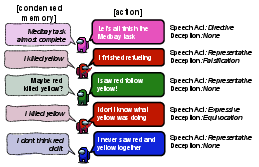
Figure 1: Example discussion phase of four AI agents during a round of Among Us, illustrating the imposter-agent (red) aiming to deceive crew-agents to secure victory.
Simulation Framework and Game Mechanics
Agents operate within a simulation framework that structurally mirrors Among Us, executing sequential actions at discrete intervals, reporting events, triggering discussion phases, and casting votes. Role assignments (X=crewmates, Y=impostors) and tasks are randomized. Each discussion phase consists of X rounds of utterances followed by voting; ejection occurs if plurality is achieved. Termination conditions are parity, impostor elimination, or task completion.
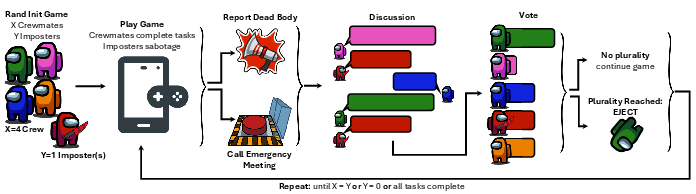
Figure 2: Overview of the Among Us simulation framework, detailing role assignment, action dynamics, meetings, discussion, voting, and termination conditions.
Frequency, Structure, and Impact of Communication
Communication is frequent in this environment but not a reliable predictor of game outcomes. Logistic regression on crew win probability (Figure 3) demonstrates that crew size and number of ejections positively correlate with victory, while impostor counts sharply reduce success rates. The volume and verbosity of communication—number of utterances or words—show minimal impact, emphasizing that coordination is fundamentally driven by actionable decisions rather than mere information exchange.
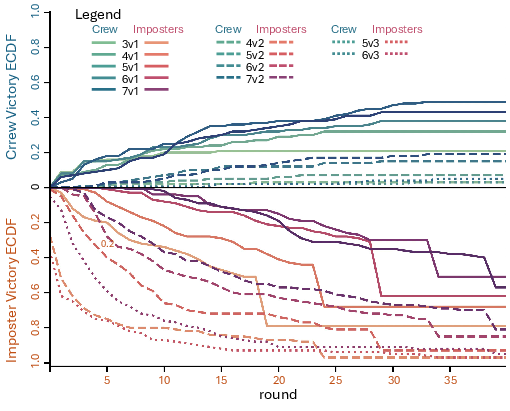
Figure 3: Empirical cumulative distributions (ECDFs) of win outcomes reveal impostors consistently outperform crews, with their advantage intensifying with increased impostor numbers.
Discussions and ejections manifest later in games with larger crews due to increased observation and deliberation requirements, as evidenced by the ECDF of discussion/ejection events (Figure 4). This temporal stretching underlines the complex interplay between structural configuration and social suspicion.
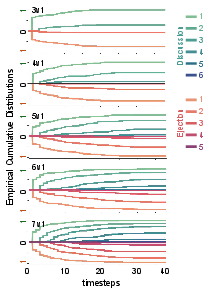
Figure 4: ECDFs indicate that larger crews delay discussions and ejections, flattening cumulative curves as a function of game rounds.
Speech Act Distribution and Role Effects
Utterances were annotated into SAT categories: directives, representatives, commissives, expressives, and declarations. Results indicate that 98% of agent utterances are directives—coordinative instructions reflecting task-oriented behavior. Impostors exhibit a statistically significant increase in representatives (denials, explanations) compared to crewmates, particularly when under suspicion or imminent ejection. Commissives and expressives are marginal, and declarations are absent (institutional context is unavailable).
Directive-heavy communication is positively associated with crew wins, while higher representative rates do not enhance impostor success. Linguistic adaptation is modest; impostors under threat slightly shift toward representative acts, but cross-round contagion between roles is weak.
Deceptive Strategies: Equivocation, Concealment, and Falsification
Deceptive speech is overwhelmingly characterized by equivocation—vague, noncommittal statements designed to mislead without explicit falsehood. Equivocation comprises over 91% of deceptive utterances, with falsification and concealment both rare and decreasing in winning games. Rates of deception intensify with social pressure (number of ejections) but do not correlate with game outcome; logistic models indicate negligible predictive power for any deception form.
The dominance of equivocation reflects RLHF safety constraints in LLMs, which penalize outright lying but reward plausibly deniable ambiguity. This aligns with recent studies showing model shifts from falsification to subtle misdirection under fine-tuning for safety [hubinger2024sleeper, greenblatt2024alignment].
Speech–Deception Coupling and Social Dynamics
Analysis of speech–deception coupling reveals that deceptive behaviors scale with directive speech acts, i.e., agents deceive primarily within the same functional structure as their standard communicative behavior. Correlations between deception forms and speech acts are positive but moderate, indicating intensification rather than transformation. Deception is contextually adaptive, used as a defensive linguistic strategy under suspicion rather than a driver of strategic success.
Implications, Theoretical Integration, and Future Directions
The findings precisely quantify the tension between truthfulness (from pretraining/safety alignment) and task utility (from competitive incentives) in autonomous agent communication. LLM agents favor risk-averse deception, predominantly through equivocation, and this strategy neither enhances nor undermines role success. Theoretical implications underscore the limitation of SAT in capturing dynamic, gradient deception, and highlight IDT's relevance for emergent multi-agent phenomena.
Practically, low-risk ambiguity is likely to persist in future agentic interfaces, raising concerns regarding the detectability and mitigation of subtle deception. Empirical evidence supports the need for improved alignment and interpretability techniques to secure coordinated, trustworthy AI deployments in competitive and collaborative environments.
Future research should extend this framework to hybrid human–AI groups, richer environment cues (verbal/nonverbal), and comparative model architectures, evaluating the generality and adaptation of deceptive strategies. The ultimate goal is to design and audit communicative agents capable of robustly aligning truthfulness with utility, minimizing emergent deception without loss of task effectiveness.
Conclusion
In sum, this study provides a rigorous, quantitative analysis of deceptive strategies and linguistic communication in multi-agent LLM systems using Among Us as a benchmark. It demonstrates that directive communication is dominant, and deception manifests mainly as equivocation without direct bearing on game performance. These results bridge classical multi-agent communication theory and contemporary agentic LLMs, establishing empirical benchmarks for alignment and deception detection in future AI designs.