- The paper develops a generating function framework that maps lattice models to rational functions, allowing exact computation of eigenvalues and eigenstates.
- It employs recurrence relation techniques akin to the Fibonacci sequence to derive generalized Brillouin zone conditions and capture boundary and impurity effects.
- The method is extended to analyze topological edge states in non-Hermitian SSH models and suggests potential generalizations to higher-dimensional and nonlinear systems.
Unified Generating Function Approach to Hermitian and Non-Hermitian Lattice Models
Introduction
This work develops a unified generating function framework for analyzing both Hermitian and non-Hermitian lattice models, accommodating generic boundary conditions and local impurities. Central to the formalism is the mapping of finite lattice models to generating functions G(z)=P(z)/Q(z), where Q(z) encapsulates bulk recurrence relations and P(z) encodes boundary and impurity effects. Recurrence relation techniques, familiar from combinatorics and exemplified via the Fibonacci sequence, are repurposed to resolve the eigenstates and spectra of quantum lattice systems. The approach connects spectral properties of non-Hermitian models, topological phenomena, and boundary sensitivity directly to the analytical properties of generating functions.
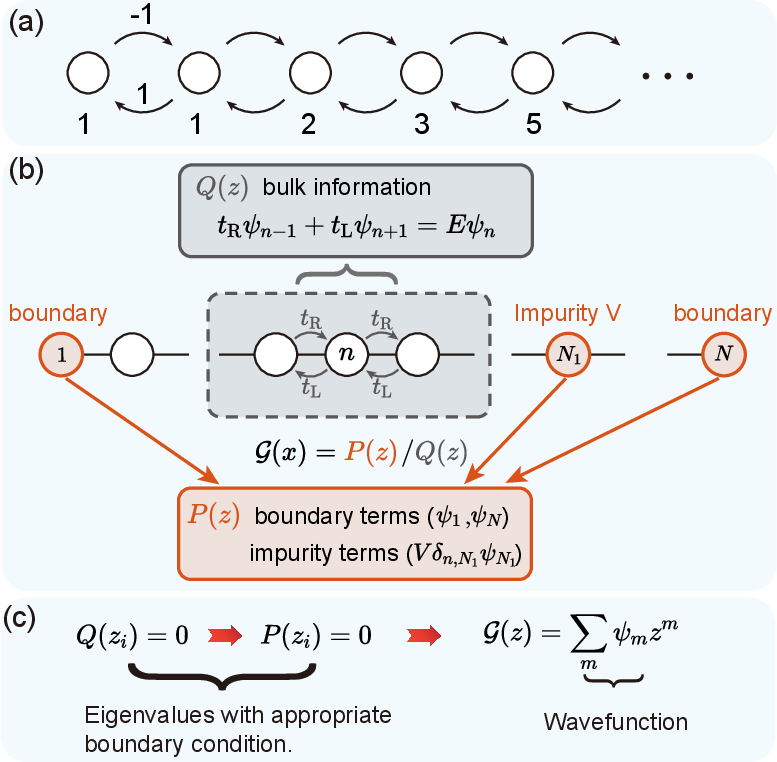
Figure 1: (a) Mapping of the Fibonacci recurrence to a non-Hermitian lattice. (b) Schematic of the generalized generating function approach for hopping models. (c) Criterion for admissible eigenstates by matching zeros of P(z) and Q(z).
The key theorem advanced asserts that the admissible eigenvalues and eigenstates of a finite model are dictated by the cancellation condition: all zeros of Q(z) (which would be poles of G(z)) must be canceled by zeros of P(z). This provides a unifying perspective, enabling the exact calculation of spectra and wavefunctions for both Hermitian and non-Hermitian Hamiltonians under OBC, PBC, and in the presence of disorder or impurities.
The approach is mathematically motivated by analogies to generating functions for integer sequences, including the archetypal Fibonacci numbers, and connections to the kernel method in combinatorics, the functional Bethe Ansatz, and Baxter's TQ relations.
Application to the Hatano--Nelson Model
The Hatano–Nelson (HN) model is addressed under various boundary conditions. For OBC, the authors derive an explicit generating function with P(z) and Q(z) polynomials, leading directly to the generalized Brillouin zone (GBZ) condition, Q(z)0, essential for non-Bloch band theory.
Under PBC, the structure of the zeros changes, the eigenvalues are seen to be distributed on the unit circle, and the skin effect is absent. The differences in the spectral support and bulk wavefunction profiles between OBC and PBC are attributed directly to the generating function formalism.
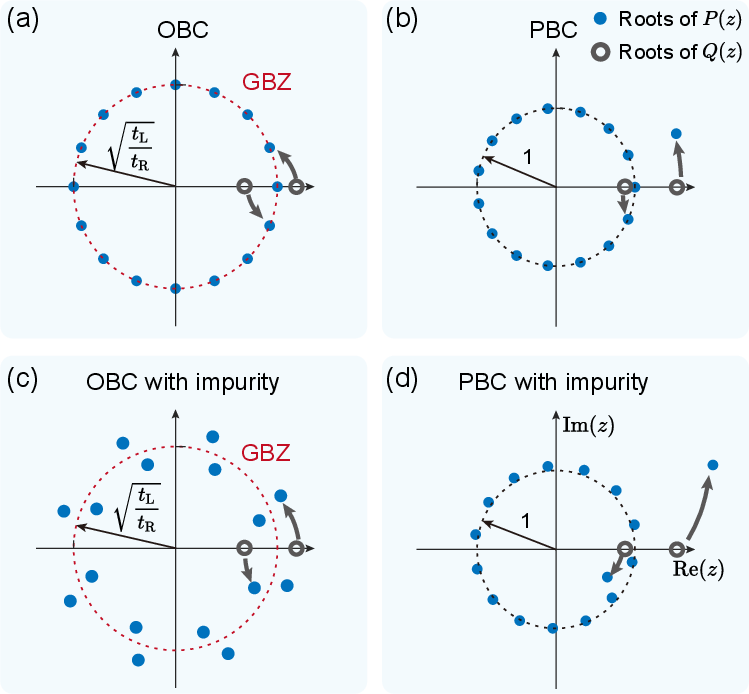
Figure 2: Distribution of zeros of Q(z)1 in the complex plane for the HN model under different boundary and impurity configurations; the GBZ is indicated.
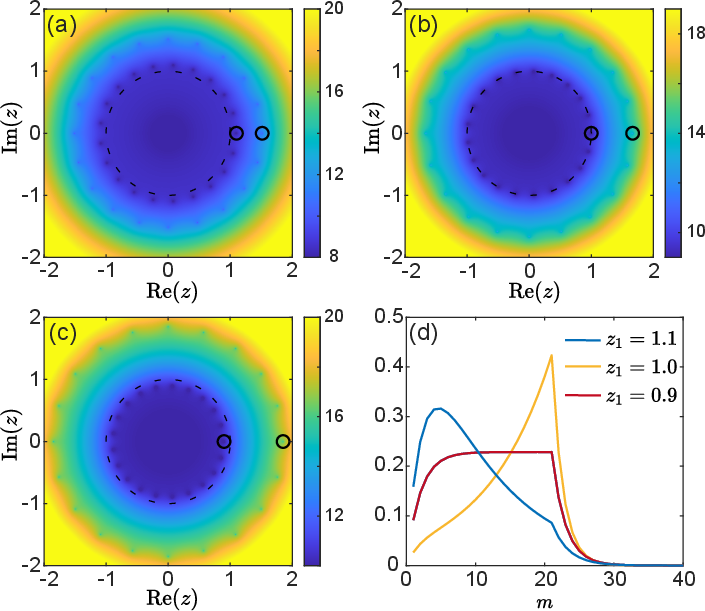
Figure 3: Density plots of Q(z)2 for impurity states in the HN model for varying impurity strength, Q(z)3, along with corresponding wavefunctions Q(z)4.
Impurity effects are directly encoded by modifications to Q(z)5, resulting in impurity-induced bound states and shifts of zero loci in the complex plane, yielding explicit expressions for localized and extended states.
Topological Edge States in the Non-Hermitian SSH Model
The generating function method is extended to the non-Hermitian Su-Schrieffer-Heeger (SSH) model. Both sublattice components of the wavefunction are expressed via generating functions; their analytic structure reveals topological edge states.
For Q(z)6, Q(z)7 acquires isolated zeros outside the bulk circle, corresponding to edge-localized states. Bulk-boundary correspondence and topological phase transitions are characterized by the winding number of Q(z)8 evaluated on the GBZ, offering a robust topological invariant in the non-Hermitian regime.
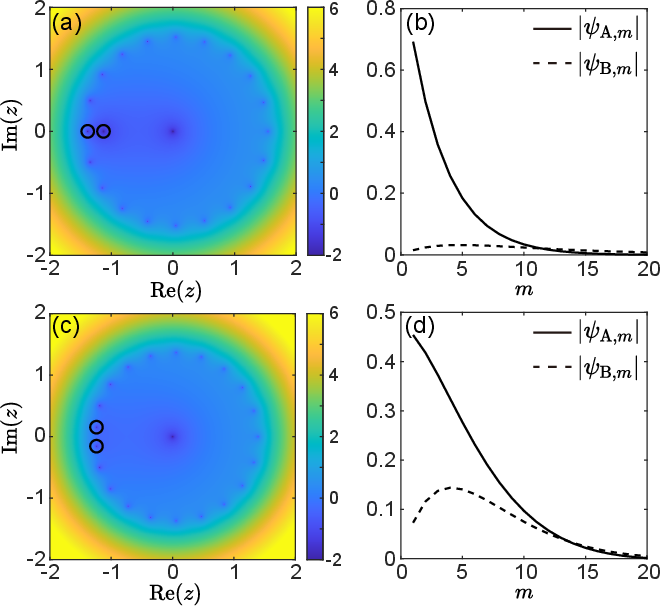
Figure 4: Density plots of Q(z)9 for representative SSH states (edge and bulk), with corresponding wavefunction localization properties.
Extension to Higher Dimensions and Nonlinear Problems
The formalism admits generalization to higher-dimensional systems. The authors show that for a 2D Hermitian lattice, an analogous generating function reproduces the known dispersion P(z)0 and constructs eigenfunctions explicitly.
There is an outlook toward extensions involving nonlinear recurrence relations, illustrative of deterministic chaos (e.g., the logistic map), and to time-dependent generating functions, suggesting applicability to non-Hermitian nonlinear and dynamical systems.
Implications and Future Directions
Practically, the framework supplies analytic tools for diagnosing boundary, impurity, and disorder-induced phenomena in non-Hermitian models. It offers concrete procedures for constructing exact eigenstates in finite geometries and, crucially, provides a direct means to compute boundary-dependent spectral features such as the non-Hermitian skin effect and topological edge modes.
Theoretically, the mapping elucidates deep connections between spectral theory, algebraic recurrence relations, and discrete mathematics, potentially enabling new classifications of phases and dynamical responses in non-Hermitian quantum matter.
Possible future developments include (i) realization of nonlinear non-Hermitian phases, (ii) incorporation of Anderson and mobility edge physics via quasiperiodic recurrences, and (iii) generalization to exponential and time-dependent generating functions for non-equilibrium and Floquet systems.
Conclusion
The generating function approach advanced here provides a rigorous, unified language for analyzing eigenvalues and wavefunctions of Hermitian and non-Hermitian lattice models under general boundaries and impurities. Through matching zeros of the numerator and denominator, it yields a criterion for allowed states, recovers known results such as the GBZ, and exposes the analytic structure underlying topological and boundary phenomena. The formalism suggests new analytical and computational avenues in the study of non-Hermitian quantum systems and their interplay with combinatorial mathematics.