- The paper introduces a scalable topological quantum computing framework using recursively built Matryoshka Sine-Cosine chains to encode multiple qubits or qudits.
- It details the chain construction, spectral properties, and a quasi-adiabatic defect transfer protocol that maintains fidelity in state propagation.
- The work extends to scalable quantum gates and memory architectures via Y-junction braiding and hierarchical lattices, enhancing error resilience.
Scalable Topological Quantum Computing with Matryoshka Sine-Cosine Chain Models
Overview and Motivation
The paper "Scalable topological quantum computing based on Sine-Cosine chain models" (2603.25952) details a scalable framework for quantum computing leveraging recursively constructed Sine-Cosine chains (“Matryoshka models”), which generalize square-root topological insulator (TI) paradigms. The motivation arises from the resource overhead in current quantum architectures, mainly qubit arrays with complex error correction layers, and the limitations in scaling such systems due to decoherence and physical isolation requirements. This work addresses these bottlenecks by encoding multiple qubits or high-dimensional qudits within a single hierarchical topological lattice, significantly reducing hardware overhead while still maintaining partial topological protection.
Matryoshka Chain Construction and Spectral Properties
Matryoshka chains are constructed by recursively applying a square-root operation to the SSH chain, yielding a sequence of lattices with staggered sine-cosine hopping terms and an exponentially increasing number of energy bands and edge states. The recursive process involves combining the lattice with its line graph and tuning hopping amplitudes to preserve onsite potentials and chiral symmetry. With each order P, the number of energy gaps increases as 2P+1−1 and the possible edge states scale as 2P+2−2 under open boundary conditions.
(Figure 1)
Figure 1: Lattice representation of the first orders of Matryoshka chains, showing unit cell growth and sine-cosine alternating hopping structure.
The Hamiltonian's square produces decoupled sublattices whose energy spectra mirror the parent structure with global offsets. The edge states associated with weak links unfold and double with each squaring, but their original topological robustness is gradually diluted for large P. Energy dispersion maintains chiral symmetry, and correlated disorder preserves the protection of edge states localized in the chain’s gaps.
(Figure 2)
Figure 2: Decoupled sublattices resulting from Hamiltonian squaring, tracing the emergence of effective hoppings and onsite potentials.
(Figure 3)
Figure 3: Band structure evolution for orders P=0, 1, and 2, illustrating spectral doubling and unfolding of edge states.
Quantum State Transfer in Hierarchical Chains
Quantum state transfer protocols typically exploit adiabatic defect motion along topological chains, as in the SSH protocol. This work shows that the square-root architecture allows direct inheritance of the parent’s defect transfer mechanism, mapping the zero-energy SSH defect onto higher-energy Matryoshka defects (ε=±1,0). The transfer protocol preserves fidelity under quasi-adiabatic sweeps, enabling robust defect propagation across the chain despite increasing dilution for higher P.
(Figure 4)
Figure 4: Adiabatic defect transfer protocol adapted from SSH chain to Matryoshka chain, emphasizing state localization dynamics.
Through careful tuning of hopping angles, simultaneous transfer of multiple defect states is feasible, allowing qudit (multi-component) state propagation.
(Figure 5)
Figure 5: Mapping and inheritance of defect states across consecutive square-root chains, highlighting recursive defect support.
(Figure 6)
Figure 6: Simultaneous quasi-adiabatic transfer of multiple defect states (ε=1,−1,0), showing controlled phase evolution.
Scalable Quantum Gates via Y-Junction Braiding
The implementation of scalable topological gates exploits Y-junction geometries and adiabatic braiding of defects. The paper generalizes SSH-based braiding to Matryoshka Y-junctions, where each defect can encode multiple states. Through controlled phase acquisition, the braiding protocol realizes extended gate operations across a qudit basis, with the transfer operator naturally decomposing into block-diagonal gate matrices.
(Figure 7)
Figure 7: Braiding process in SSH and Matryoshka Y-junctions, delineating defect exchange and phase acquisition pathways.
The hierarchical lattice allows scalable gate operations using composite defects, providing a pathway for implementing Pauli gates and generalized qudit rotations.
(Figure 8)
Figure 8: Scalable Y-junction gate architecture with successive square-root operations yielding an exponential increase in defect encoding capability.
Robustness to disorder is quantified using numerically calculated fidelity and entropy under smooth perturbations of hopping angles, onsite terms, and correlated disorder.
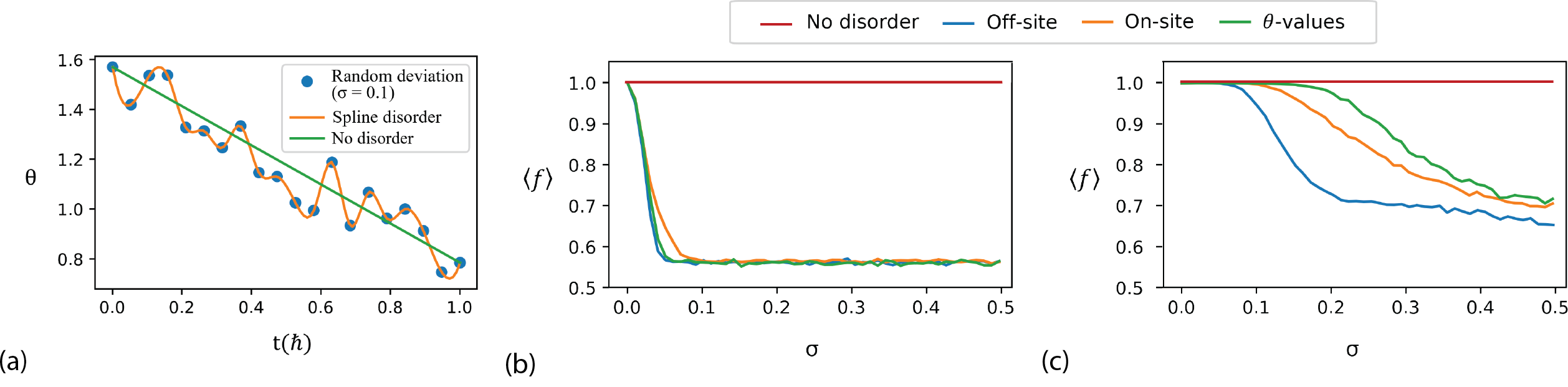
Figure 9: Fidelity and entropy trends for N=1000 disorder realizations, demonstrating partial topological protection and error accumulation in gate operations.
Quantum Memory Architectures
The same Matryoshka chain framework is extended to quantum memory design. High-fidelity storage and retrieval protocols leverage edge states and Rabi oscillations, allowing storage of multiple qubits or higher-dimensional qudits in a single chain. The number of available protected memory sites (edge states) scales exponentially with the chain order, increasing storage density.
(Figure 10)
Figure 10: Quantum memory protocol schematic, demonstrating controlled Rabi transfer between qubit and memory chain.
Matryoshka-chain memory fidelity behavior conforms to SSH chain predictions, with oscillation dynamics controlled by edge state hybridization and hopping parameter tuning.
(Figure 11)
Figure 11: Transfer model for encoding qubits into Matryoshka chain edge states, with protocol variants for different symbolic energy eigenstates.
Energy spectrum analysis reveals degeneracy lifting and oscillation periods directly linked to hybridized edge states, determining optimal storage and retrieval timing.
(Figure 12)
Figure 12: Energy spectrum for N=21 (2P+1−10) chain highlighting edge state degeneracies and shifts under varied hopping parameter regimes.
Fidelity evolution over storage periods confirms periodic maxima and predictable decay patterns, especially as edge state overlap increases.
(Figure 13)
Figure 13: Fidelity versus storage time, with density plots validating state localization and retrieval dynamics.
Robustness and Disorder Analysis
The partial topological protection of the Matryoshka chain is critically examined through simulations with various disorder regimes. Fidelity loss is predominately driven by energy level crossing and hybridization-induced state mixing, with correlated angle disorder yielding the greatest robustness. Detailed analytical modeling confirms that adiabatic conditions and minimum energy gaps are essential for preserving transfer fidelity.
Multi-Qubit and Qudit Memory Scalability
The methodology generalizes memory architectures to multi-qubit and qudit encoding, allowing transfer and storage of high-dimensional quantum states via controlled hopping configurations. Chains of order 2P+1−11 provide exponentially scaling Hilbert spaces for defect state support.
(Figure 14)
Figure 14: Transfer model for a 4-component qudit (2 qubits) connected to a Matryoshka chain (2P+1−12), emphasizing scalable coupling and defect localization.
Spectral analysis corroborates the exponential increase in edge states, and explicit hopping amplitude assignments enable direct transfer to specific defect modes.
(Figure 15)
Figure 15: Energy spectrum for 2P+1−13 chain with 80 sites, illustrating the clustering of defect states suitable for qudit encoding.
(Figure 16)
Figure 16: Controlled transfer and localization protocol for qubit states within Matryoshka defect manifolds, confirming adiabatic evolution and robust protection.
Practical and Theoretical Implications
This approach presents compelling advantages for scalable quantum hardware, minimizing the physical footprint required for multi-qubit and qudit architectures. The partial topological protection aids in disorder resilience but requires careful adiabatic tuning to avoid fidelity deprecation from level crossings. Experimentally, photonic, topolectrical, and acoustical implementations are feasible due to the flexible design of discrete hopping parameters and sublattice engineering. Theoretical advances in hierarchical topological models bridge the gap between error-correcting codes and physical protection, pointing toward hybrid protocols for robust quantum information processing.
Conclusion
The Matryoshka-type Sine-Cosine chain model offers a scalable foundation for topological quantum computing by exponentially increasing the encoding and storage capabilities per physical chain. It generalizes state transfer and gate protocols for high-dimensional systems, maintaining partial protection and robustness even in the presence of local disorder. This work delineates a pathway for low-overhead, high-capacity quantum architectures leveraging hierarchical topological lattices and adiabatic defect dynamics, significantly advancing both theoretical paradigms and practical experimental prospects in quantum information science.

