- The paper reports the most stringent upper limits on continuous gravitational wave emissions from key supernova remnants, constraining neutron star deformations.
- The study employs five complementary pipelines that cover broad frequency and derivative ranges to robustly search for continuous gravitational waves.
- Results surpass indirect spin-down predictions by setting limits on GW strain, ellipticity, and r-mode amplitudes, informing neutron star physics.
Searches for Continuous Gravitational Waves from Supernova Remnants in the LIGO-Virgo-KAGRA O4 Run
Introduction
This work (2603.25808) presents a comprehensive search for continuous gravitational waves (CWs) from young neutron stars in supernova remnants (SNRs), utilizing data from the early phase of the LIGO-Virgo-KAGRA fourth observing run (O4). Such CWs, primarily sourced by non-axisymmetric deformations or oscillations in neutron stars, represent an essential probe for extreme matter equations of state and the dynamics of young remnants. Given the absence of electromagnetic pulsations from many SNRs, searches must span large parameter spaces, challenging algorithmic and computational boundaries. This paper provides a systematic application of state-of-the-art pipelines, reports the most stringent direct upper limits on CW emission from several key targets, and advances the astrophysical inferences that can be drawn in the absence of detection.
Search Targets and Methods
The search focuses on several well-known SNRs containing promising neutron star candidates, including Vela Jr. (G266.2-1.2), Cassiopeia A (Cas~A), G347.3-0.5, and SNR~1987A, among others. The search parameter space for each target is defined by indirect age and distance constraints, covering broad ranges in frequency and first/frequency derivatives, as shown for Vela Jr. in Figure 1.
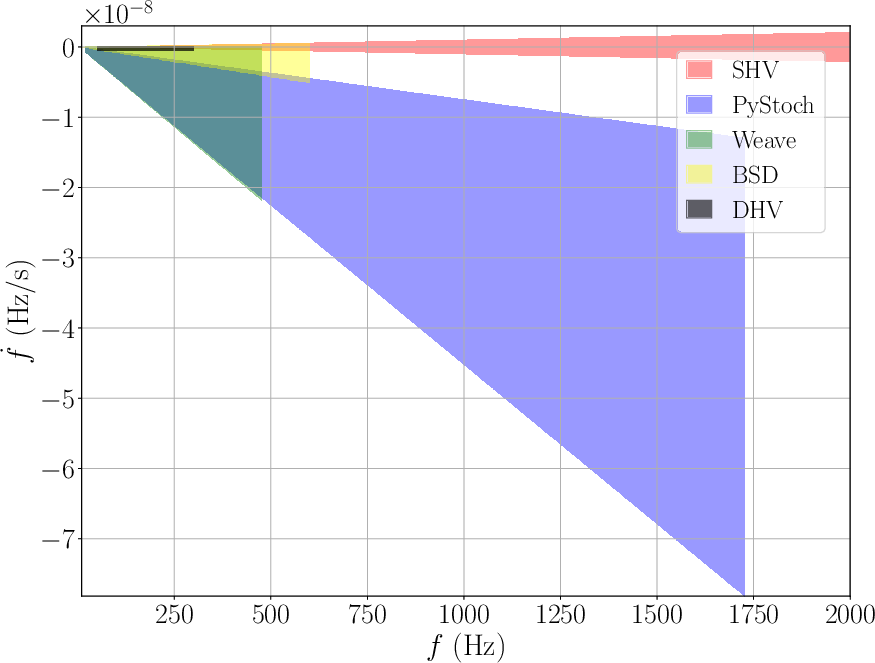
Figure 1: Parameter space covered by each of the 5 pipelines for G266.2-1.2 (Vela Jr.).
A suite of five complementary pipelines, each optimized for different regions of parameter space and signal morphologies, are applied: F-statistic-based semi-coherent methods, the Viterbi-based method (for dual/single harmonics), the Weave coherent pipeline, PyStoch, and the Band Sampled Data (BSD) framework. The multi-pipeline strategy both widens sensitivity reach and increases robustness to systematic uncertainties in the signal model.
Upper Limits on Gravitational Wave Emission
No evidence for CWs is found in any target. For each SNR, 95% confidence upper limits are placed on the intrinsic GW strain amplitude, h0. For the Vela Jr. target, all pipelines achieve upper limits well below indirect spin-down-based bounds, as depicted in Figure 2.
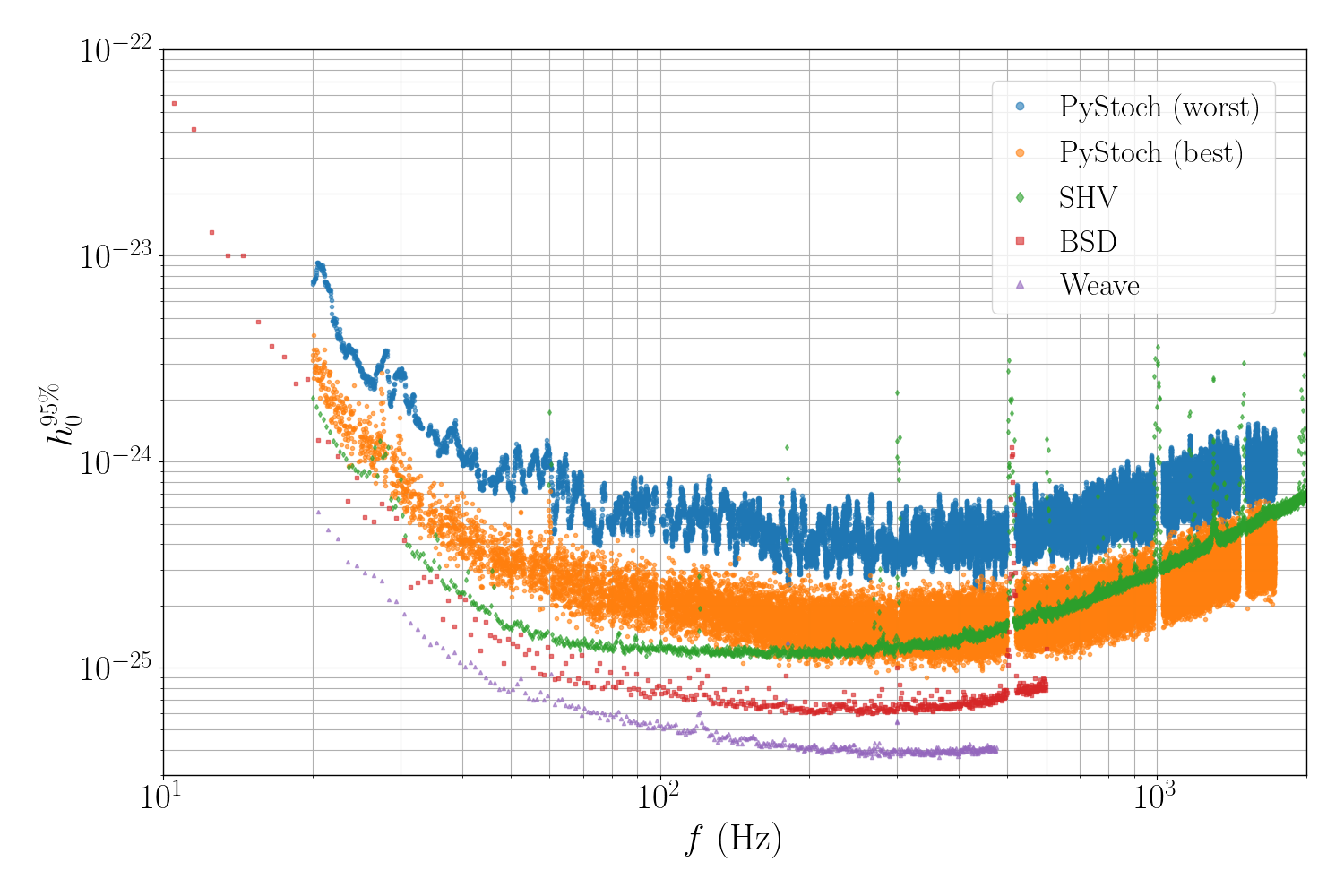
Figure 2: Upper Limits for the source G266.2-1.2 (Vela Jr.) obtained for the pipelines assuming the single harmonic emission scenario.
For the best constrained SNRs (e.g., Cas~A, Vela Jr., G347.3-0.5), h095% sensitivities reach the 10−25 regime in significant portions of the parameter space. Figure 3 displays this result, confirming that the achieved upper limits surpass the so-called age-based indirect limits (h0age) in all frequency bands.
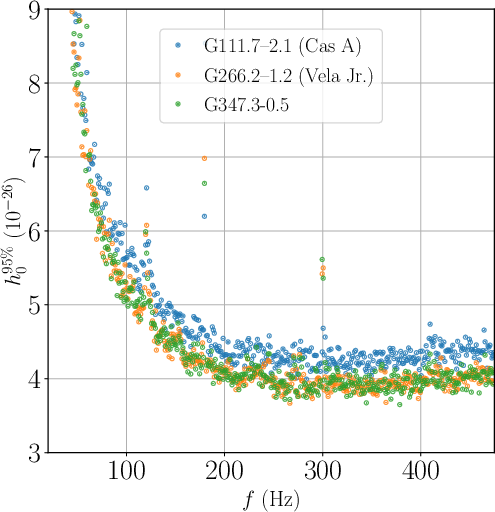
Figure 3: GW strain amplitude upper limits (95\% confidence level) in each 1-Hz band for Cas A (blue), Vela Jr. (orange), and G347.3-0.5 (green) using Weave; all bands are below the age-based limit.
Complementary searches (e.g., PyStoch) span broader frequency bands and additional SNRs, with the most sensitive and least sensitive bands for all targets synthesized in Figure 4.
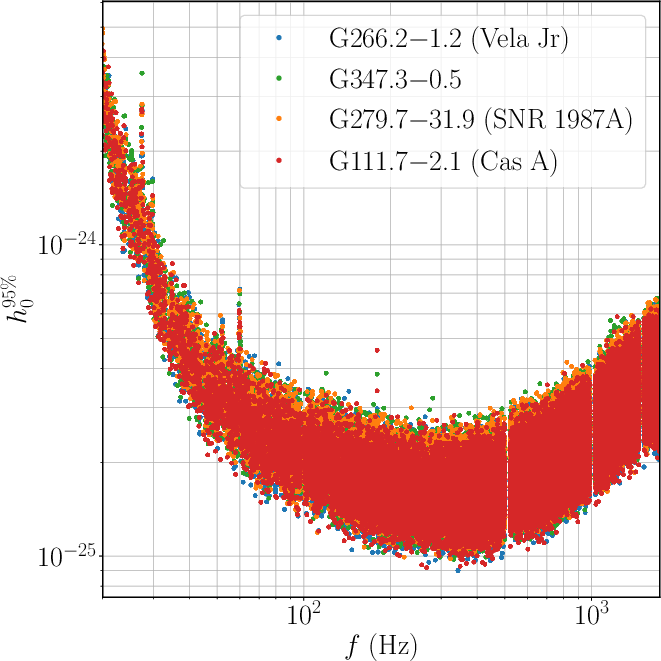
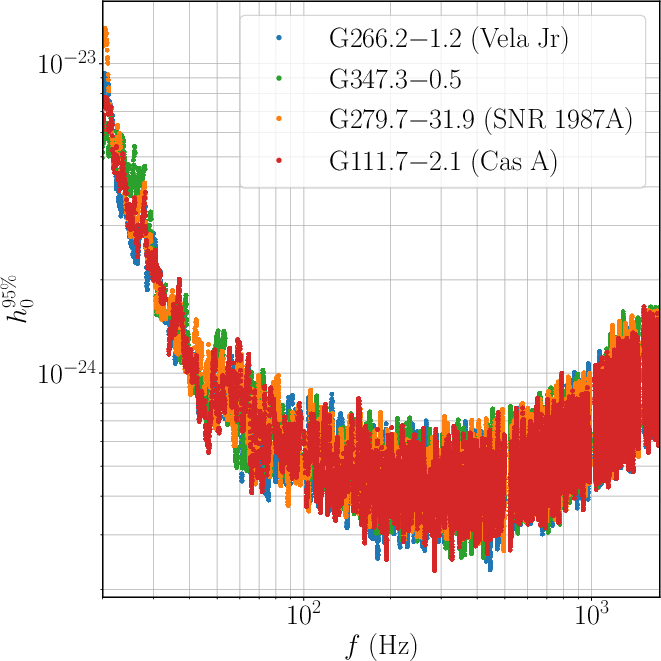
Figure 4: Best (left) and worst (right) 95\% confidence-level upper limits between 20 and 1726 Hz with PyStoch for each target.
Astrophysical Implications
These stringent upper limits can be mapped into bounds on key neutron star properties such as equatorial ellipticity (ϵ) and r-mode oscillation amplitude (α). Figures 3, 4, and 6 show the constraints on the ellipticity and α for the BSD, PyStoch, and Weave pipelines, respectively.
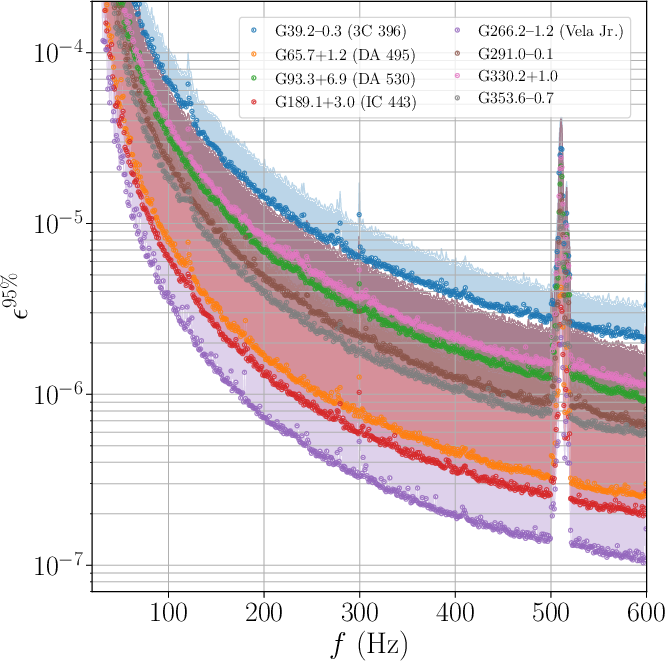
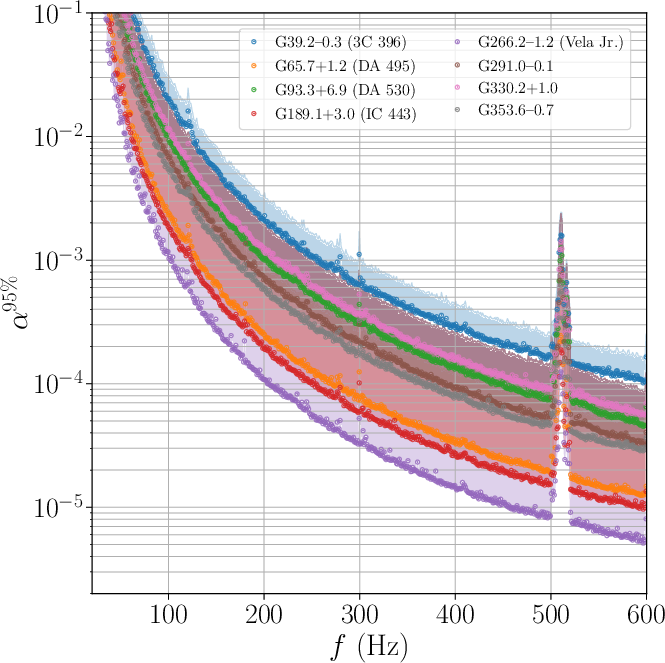
Figure 5: Equatorial ellipticity (left) and r-mode amplitude alpha (right) with 95% confidence for BSD targets; filled circles reflect minimum estimated source distance.
The main implication is that for the closest and/or youngest SNRs the obtained upper limits rule out uniform (bulk) deformations at the level predicted by certain crystalline quark matter models, and for some targets begin to probe the regime relevant for standard neutron-star crustal deformations. Notably, the constraints on r-mode amplitudes are beginning to intersect with ranges predicted by nonlinear saturation models, especially for Vela Jr. and Cas~A.
Methodological Advancements and Pipeline Cross-Comparison
The multi-pipeline approach allows for both optimized coverage and critical cross-validation. Figure 1 illustrates the distinct but overlapping parameter domains scanned by each pipeline. The agreement among upper limits across pipelines (see Figure 2) provides a robust, systematic error budget and validation of the results. For G266.2-1.2 (Vela Jr.) and other key targets, targeted parameter choices (see Figure 6) maximize sensitivity within computational feasibility.
Figure 7 demonstrates the sensitivity profiles for all SHV-pipeline-analyzed targets, further illustrating variations across the search parameter space and the ability of the pipeline suite to systematically surpass indirect limits.
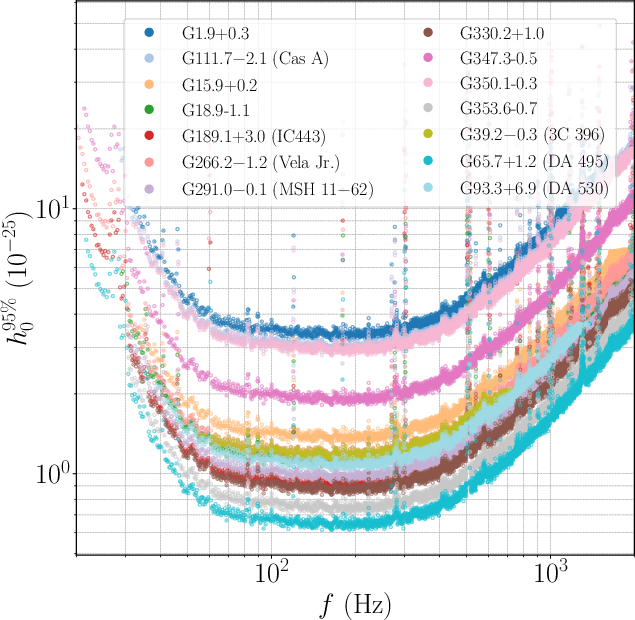
Figure 7: Upper limit curves for all SHV pipeline targets; scatter points give sensitivity estimates.
Future Prospects and Theoretical Implications
The null results, while not yielding a GW detection, cement upper limits that will inform theoretical work on neutron star deformation mechanics, equation of state models, and mechanisms of angular momentum loss in young neutron stars. As detector sensitivity increases and multi-messenger data (e.g., improved distance/age estimates from radio or X-ray) refines search parameter spaces, these search strategies will offer ever greater promise for first detection, or for strongly constraining exotic compact object scenarios.
Further, the developed pipelines lay critical groundwork for more generic (e.g., machine learning enhanced) CW searches and facilitate the integration of observational constraints from independent electromagnetic counterparts.
Conclusion
This analysis delivers the most thorough, sensitive searches for continuous gravitational waves from young neutron stars in SNRs using LIGO-Virgo-KAGRA O4 data. No signals are observed; however, upper limits on GW strain, ellipticity, and r-mode amplitudes improve upon prior constraints and, for several SNRs, surpass the indirect spin-down predictions across all searched frequencies. These results place strong constraints on extreme-matter physics in neutron stars and motivate continued development of advanced data analysis frameworks in the continuous wave regime.