Published 26 Mar 2026 in quant-ph | (2603.25358v1)
Abstract: Importance sampling based on quasi-probability decomposition is the backbone of many widely used techniques, such as error mitigation, circuit knitting, and, more generally, virtual quantum resource distillation, as it allows one to simulate operations that are not accessible in a given setting. However, this class of protocols faces a fundamental problem -- it only allows to estimate expectation values. Here, we provide a general framework that lifts any quasi-probability-based protocol from expectation value estimation to a weak simulator, realizing sampling from the desired distribution only using a restricted class of quantum resources. Our method runs with the sampling cost proportional to the negativity of the quasi-probability, in stark contrast to the naive estimation-based approach that requires a large number of samples even in the case of small negativity. We show that our method requires significantly fewer samples in a number of relevant scenarios, such as error mitigation, entanglement distillation and magic state distillation. Our framework realizes the weak simulation of quantum resources without actually distilling the state, introducing a new notion of quantum resource distillation.
The paper presents a weak distillation framework that extends quasiprobability methods from expectation estimation to sampling tasks using rejection sampling.
It demonstrates that the proposed protocol achieves sample complexity scaling linearly with negativity, thus efficiently simulating quantum resource output distributions.
The method is validated through applications in error mitigation, entanglement distillation, and magic state distillation, outperforming traditional estimation-based approaches.
Weak Distillation of Quantum Resources: Lifting Quasiprobability Protocols from Expectation Estimation to Weak Simulation
Introduction and Motivation
Quasiprobability-based methods, leveraging importance sampling on quasiprobability decompositions, have become fundamental in a range of quantum protocols, particularly for tasks such as error mitigation, circuit cutting/knitting, and virtual resource distillation. These approaches enable the estimation of expectation values of observables for otherwise inaccessible quantum operations or states by simulating their action through a linear combination (possibly involving negative weights) of physically realizable operations or states. While powerful, this paradigm exhibits a critical limitation: it is inherently restricted to expectation value estimation, not allowing for genuine sampling from the output distribution of a resourceful quantum process. Numerous quantum algorithms and certification tasks, however, crucially require sampling rather than estimation.
The paper "Weak distillation of quantum resources" (2603.25358) addresses this gap, developing a rigorous framework for "weak distillation" — i.e., efficient sampling from the output distribution associated with a target resource state using only operations and resources available in a restricted set, and without direct access to the target state itself. The authors introduce a generic protocol rooted in rejection sampling, quantitatively analyze its performance, and contrast it with naive full-probability estimation approaches.
Framework: From Virtual Distillation to Weak Simulation
Quasiprobability Decompositions and Importance Sampling
The foundational setting is a resource theory, defined by a convex, finite-dimensional set F of "free" (available) states and a set O of available operations. For a target state ρ∈F (the resource state of interest), and a sampling task over the computational basis, the virtual distillation framework provides a quasiprobability decomposition: ρ=c+σ+−c−σ−,
with σ±∈F, c±≥0, and c+−c−=1. The "negativity" c− quantifies the amount of nonclassical resource required, coinciding with robustness resource monotones [PhysRevA.59.141, Regula2018convex].
Via importance sampling, this decomposition allows direct estimation of any observable's expectation by weighted random measurements on σ±. However, sampling exactly from the distribution px=⟨x∣ρ∣x⟩ remains outside its capabilities.
Lifting to Weak Distillation: Rejection Sampling Approach
The main innovation is a rejection sampling protocol enabling approximate sampling from px using only access to σ±. The protocol defines a proposal distribution
qx=c++c−c+⟨x∣σ+∣x⟩+c++c−c−⟨x∣σ−∣x⟩
and sets up an acceptance ratio Rx=qxpx, but since px is unknown, this must be estimated from repeated measurements. The cost analysis thus focuses on bounding the total variation distance (TVD) between the empirical output distribution and the target distribution as a function of sample size N, negativity c−, and entropy of the proposal distributions.
This rejection sampling-based weak distillation is shown to possess two crucial features:
The expected sample cost, and the upper bound on TVD, scale proportionally to the negativity c−.
The approach is smoothly connected to the free-state regime (c−=0), unlike probability estimation methods, where cost exhibits an unnatural discontinuity.
Theoretical Results: Sampling Complexity
Cost Analysis for Probability Estimation
The naive approach ("estimation-based") reconstructs px via repeated expectation estimation and samples from the resulting empirical distribution. The sample complexity (number of measurements required to reach trace distance ϵ with failure probability δ) is
N≤4ϵ2γ2(221H1/2(qx)+8logδ2)2,
where γ=c++c−, qx is the proposal distribution, and H1/2 is the Rényi entropy.
Cost Analysis for Rejection Sampling (Weak Distillation)
For the proposed rejection sampling method, the sample complexity is
where px− is the computational basis distribution of σ−, δ1,δ2 partition the failure probability, and M is an additional term tracking the number of resamples required for acceptance in the rejection step.
This scaling is linear in negativity c−, providing efficiency especially near the free-state boundary where c−→0, in contrast to the baseline method. The paper also discusses a tradeoff in the scaling with failure probability (δ): while the probability estimation method offers logarithmic scaling in δ, the rejection sampling protocol achieves this only under an alternative bound that sacrifices c− proportionality.
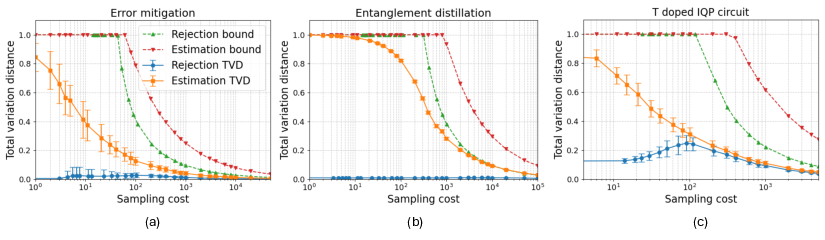
Figure 1: Comparative analysis of the total variation distance (TVD) vs. sampling cost for rejection sampling (blue) and estimation-based techniques (orange) in the contexts of error mitigation, entanglement distillation, and magic state distillation; dotted lines mark theoretical upper bounds.
Empirical Evaluation
Three principal application scenarios are demonstrated:
Error Mitigation for Local Depolarizing Noise: The protocol efficiently simulates error-mitigated distributions for circuits suffering from local depolarizing noise, using a decomposition for the inverse channel.
Entanglement Distillation: Weak distillation prepares ideal Bell states from noisy or isotropic entangled states, leveraging the available weakly entangled or isotropic resources in the experiment, rather than limiting to separable states.
Magic State Distillation: The method is applied to IQP circuits with noisy T-states, essential for implementing fault-tolerant non-Clifford gates.
In all cases, the rejection sampling framework outperforms the estimation method, especially at low negativity and for moderate sample sizes, as evidenced by lower TVD for given sample costs in Figure 1.
Notably, the TVD behavior exhibits a nonmonotonic "bump" at small sample numbers in rejection sampling, reflecting sensitivity to rapid changes in empirical acceptance ratios with sparse statistics. As sample size increases, TVD decreases sharply, highlighting the protocol's effectiveness with sufficient sampling.
Implications and Theoretical Significance
The weak resource distillation framework provides a significant extension of the operational meaning of resource quantifiers like robustness and negativity, embedding them into sampling tasks rather than mere expectation value estimation. Practically, it unlocks the use of powerful quasiprobability-based error mitigation and simulation techniques in settings where sampling tasks are mandatory, such as output distribution certification, randomized benchmarking, and potential quantum advantage demonstrations.
From a theoretical perspective, an important consequence is the circumvention of no-go theorems that hamstring conventional distillation of pure resource states from mixed inputs via joint operations: weak distillation can "simulate" any target distribution as long as the quasiprobability decomposition is available, without incurring such limitations.
This work also frames natural avenues for future research: optimizing the analytical sample complexity bounds (bridging the gap between observed and proven costs), extending the protocol to infinite-dimensional or nonconvex resource sets, and analyzing rejection sampling for more general classes of resource theories.
Conclusion
The paper advances the landscape of quantum resource simulation by extending quasiprobability-based protocols from expectation value estimation to sampling tasks — a shift underpinned by a rigorous rejection sampling mechanism. The method's sampling complexity, scaling with negativity, provides a computationally and experimentally attractive route for weak simulation of quantum resources across broad applications. This contribution offers a unifying operational framework for a variety of quantum information processing protocols, and motivates further investigation into both the foundational and practical aspects of resource theory in quantum technologies.
“Emergent Mind helps me see which AI papers have caught fire online.”
Philip
Creator, AI Explained on YouTube
Sign up for free to explore the frontiers of research
Discover trending papers, chat with arXiv, and track the latest research shaping the future of science and technology.Discover trending papers, chat with arXiv, and more.