- The paper provides a comprehensive sensitivity atlas for BBN by varying 77 fundamental and nuclear parameters, revealing their effects on light-element abundances and Nₑff.
- It employs updated nuclear reaction rates, dual normalization schemes, and linear error propagation, reconciling theoretical predictions with high-precision LBT helium observations.
- Results highlight key uncertainties from neutron lifetime, n-p mass difference, and nuclear cross-sections, guiding future probes into beyond Standard Model physics.
Inside the Black Box of BBN: Parameter Sensitivity in Light of new LBT Data
Introduction
This work presents a rigorous, comprehensive sensitivity atlas for Big Bang Nucleosynthesis (BBN), quantifying the response of primordial helium-4 (Yp), deuterium (D/H), lithium-7 (7Li/H), and the effective number of neutrino species (Neff) to all relevant input parameters: 14 fundamental constants and cosmological parameters as well as 63 thermonuclear reaction rates. The analysis leverages the PRyMordial (Burns et al., 2023) numerical framework, systematically studying both the impact of parameter variations and the theoretical uncertainty budgets with updated nuclear networks and weak-interaction schemes. Central to the study is the utilization of new high-precision LBT Yp observations, which halve the Yp observational error and motivate a re-examination of error budgets.
Implementation and Methodology
The BBN calculation is structured into three computational stages: background thermodynamics (including neutrino decoupling and expansion history), neutron-proton interconversion (weak interaction rates), and nuclear reaction networks, producing in tandem the predicted light-element abundances and Neff.

Figure 1: Schematic overview of the BBN pipeline in PRyMordial, with colored nodes indicating varied input parameters and arrows tracing sensitivity pathways.
Parameter response functions and theoretical uncertainties are evaluated in a strictly uniform framework. Each parameter is varied independently, and results are reported for both the PRIMAT [Pitrou:2018cgg] and NACRE-II [Xu:2013fha] reaction rate compilations, using both weak-norm parameterizations (fundamental and τn normalization). Sensitivities are tabulated as local logarithmic derivatives or absolute derivatives with respect to non-standard parameters. Uncertainties are propagated via linear error analysis, providing transparency in the decomposition of the total theory error.
Observational Anchors
Helium-4 (Yp): The new LBT emission-line survey yields Yp=0.2458±0.0013 [Aver:2026dxv], a ∼2× improvement over prior constraints and in excellent agreement with Standard Model (SM) predictions.
Deuterium: Current observations yield D/H=(2.508±0.029)×10−5 [PDG2025], with a (model-dependent) mild tension with SM BBN depending on nuclear rates.
Lithium-7: The old "lithium problem" persists: the inferred primordial 7Li/H underpredicts the SBBN value by ∼3--4σ; all parameter sensitivities/uncertainties for 7Li/H are presented, though no nuclear/astrophysical solution emerges within 1σ.
Neff: The latest joint CMB+BAO+BBN result is Neff=2.990±0.070 [Goldstein:2026iuu], reducing the error bar by nearly a factor of two.
Parameter Sensitivity Overview
Fundamental parameter variations propagate into the light-element and Neff predictions through several mechanisms:
- Neutron lifetime (τn): Dominates Yp and D/H uncertainties in the τn normalization. Increasing τn shifts weak freezeout to higher temperatures, raising n/p at BBN and increasing both Yp and D/H.
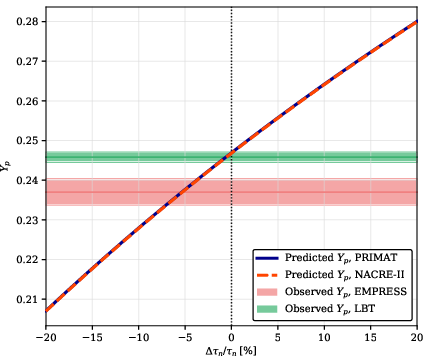
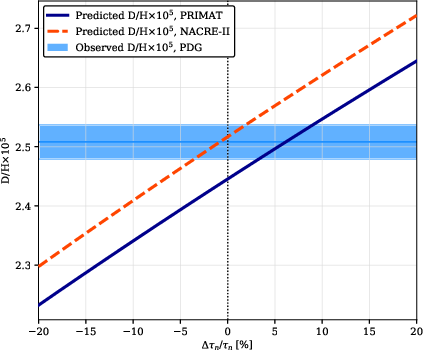
Figure 2: Yp variation as a function of τn/τnSM, for both PRIMAT and NACRE-II rates; Yp increases approximately linearly with τn.
- n-p Mass Difference (Q): Qualitatively different impact depending on weak-rate normalization; in the fundamental normalization, increasing Q reduces final element yields (all dlnY/dlnQ<0), while in τn normalization the sign flips.
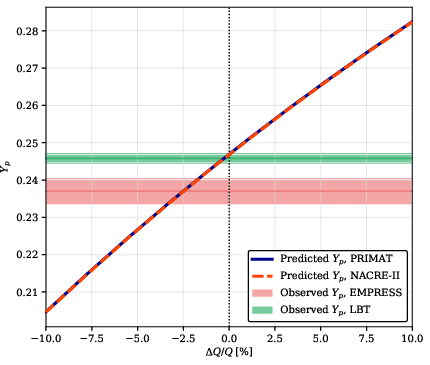
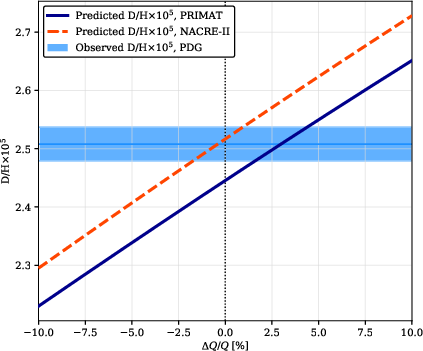
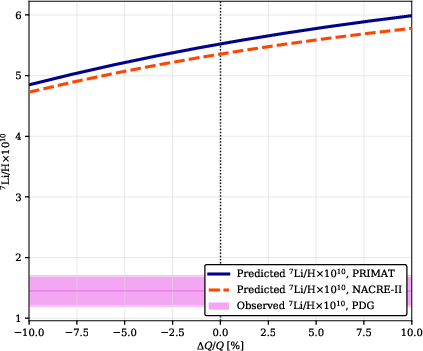
Figure 3: Yp vs Q/QSM, τn normalization: Yp increases with Q; fundamental normalization: Yp decreases with Q.
- Fine structure constant (αEM): Shifts weak rates and QED corrections, weakly increasing Yp and D/H with αEM, and raises Neff by increasing the coupling at neutrino decoupling.
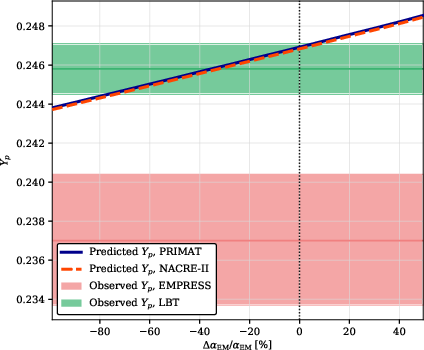
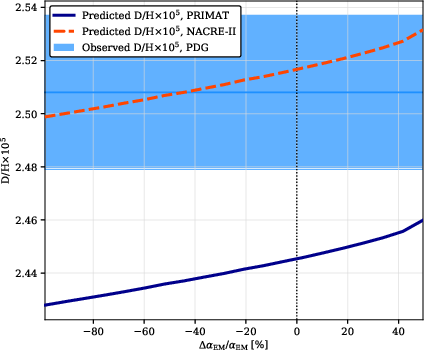
Figure 4: Yp as a function of αEM/αEMSM. The effect is subdominant but non-negligible in the precision regime.
- Gravitational constant (GN): Affects both expansion rate and baryon-to-photon conversion. Increasing GN increases Yp and D/H (via earlier weak decoupling and less time for nuclear burning).
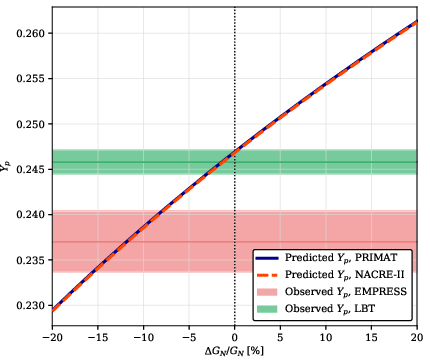
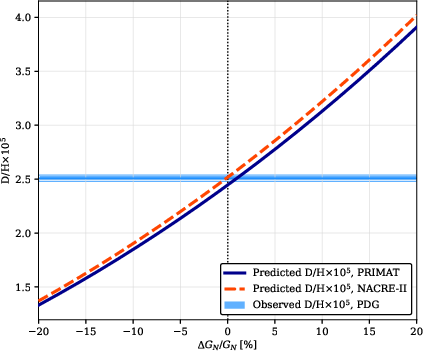
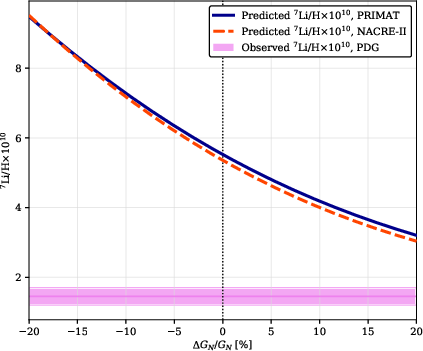
Figure 5: Yp as a function of GN/GNSM, for both nuclear libraries; the slope quantifies the sensitivity to new gravitational physics.
- Neutrino sector (ΔNeff, ξν): Raising ΔNeff, with variance taken from combined CMB+BAO+BBN, increases Yp sharply, dominating the Yp theory error budget if left free.
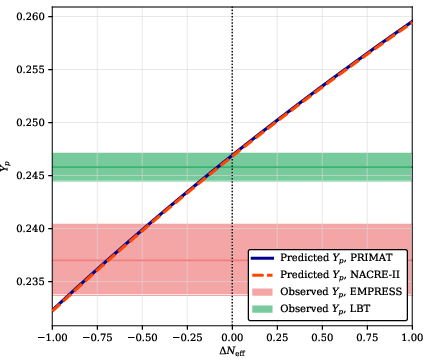
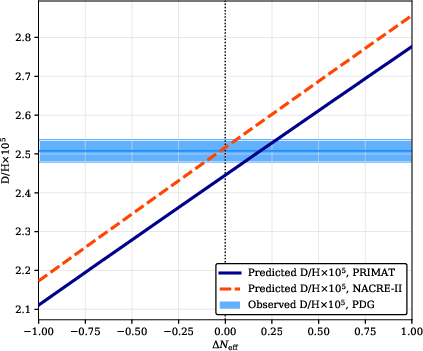
Figure 6: Yp as a function of ΔNeff. Current errors on ΔNeff directly translate to an O(0.001)uncertaintyinY_p.</p></p><ul><li><strong>Baryonabundance(\Omega_b h^2):</strong>ControlsD/Hand^7Li/Hlinearly.</li></ul><p><strong>Nuclearrateuncertainties</strong>:D/Hand^7Li/Hretainsignificantrate−limiteduncertainties,withthedominantratesbeingd(p,\gamma)^3He,d(d,n)^3He,and^3He(^4He,\gamma)^7Be.<imgsrc="https://emergentmind−storage−cdn−c7atfsgud9cecchk.z01.azurefd.net/paper−images/2603−22414/all12sigmacompare.png"alt="Figure7"title=""class="markdown−image"loading="lazy"><pclass="figure−caption">Figure7:D/Hisstronglysensitivetod(p,\gamma)^3Heandd(d,n)^3He,^7Li/Hto^3He+^4He\rightarrow^7Be;Y_pisinsensitivetonuclearratesatthislevel.</p></p><h2class=′paper−heading′id=′uncertainty−budgets−and−ranking′>UncertaintyBudgetsandRanking</h2><p>ForSMinputparameters(fixedN_{\rm eff}),Y_perrorsaredominatedby\tau_n(weak−norm)org_A/V_{ud}(fundamentalnorm);D/Herrorsswitchfrom\Omega_b h^2dominance(PRIMATrates)tod(d,n)^3He(NACRE−II);^7Li/Hisalwaysnuclear−limited.</p><p>Whenallowing\Delta N_{\rm eff}tofloatwiththelatestuncertainty,itaccountsfor>90\%ofthetotalY_perror,entirelysettingtheprecisionfrontierforBBN−basedphysicssearches.D/Hisincreasinglylimitedbynuclearphysics,signalingtheneedforimprovedratemeasurementstoexploitfuturehigh−precisiondeuteriumobservations.</p><h2class=′paper−heading′id=′numerical−results−and−theory−data−comparison′>NumericalResultsandTheory−DataComparison</h2><p>Thetheoreticalpredictionsforprimordialabundances,comparingthetwonuclearratesetsandnormalizationschemes,confirm:</p><ul><li><strong>ExcellentagreementforY_p</strong>withnewLBTandCMB+BAO+BBNvalues.Observationalerrorsandtheoreticalsystematicsarenowatparityforthefirsttime,greatlytighteningconstraintsonnewphysicsinMeV−scalecosmology.</li><li><strong>MildD/Htension</strong>remains(forPRIMATrates),butcanbealleviatedbymodest,physicallyplausibleshiftsinnuclearratesorbaryondensity(thoughCMB−concordancediscouragesthelatter).</li><li><strong>Nonuclearfixforthelithiumproblem</strong>isfoundat1\sigma.Resolvingthediscrepancywithnuclearratevariationswouldrequireseveraljointly>3\sigmashiftsinkeyreactions,disfavoredbyexistingexperimentaldata.</li></ul><h2class=′paper−heading′id=′implications−and−prospects′>ImplicationsandProspects</h2><p><strong>Practically:</strong>ThisatlasprovidesdefinitiveguidanceforwheretheoryandexperimentmustfocustofurthersharpenBBNasaprobeofMeV−scaleand<ahref="https://www.emergentmind.com/topics/branch−solve−merge−bsm"title=""rel="nofollow"data−turbo="false"class="assistant−link"x−datax−tooltip.raw="">BSM</a>physics.TheprincipalleverageforY_pcomesfromn/pratioparameters(\tau_n,g_A,V_{ud},Q),forD/Hfrombothbaryondensityandselectnuclearrates,andforN_{\rm eff}allimprovementhingesonfutureCMBexperiments(e.g.,<ahref="https://www.emergentmind.com/topics/simons−observatory−so"title=""rel="nofollow"data−turbo="false"class="assistant−link"x−datax−tooltip.raw="">SimonsObservatory</a>[SimonsObservatory:2025wwn]).</p><p><strong>Theoretically:</strong>Thedecouplingofparametersensitivities(independentlocalvariations)supportsrapidmappingofanyBSMscenariowitharbitraryshiftstocouplingsorrates—crucially,thesignandmagnitudeofeachresponsefunctionaretabulated;fullcovariancepropagationissupportedforcorrelatedparameterscenarios.</p><p><strong>Speculation:</strong>AsobservationalY_perrorscontinuetodeclineandconstraintson\Delta N_{\rm eff}tighten,thenextgenerationofBBNtestswillhavecapacitytoconstrainnewlightdegreesoffreedom,neutrino−neutrinointeractions,gravitational/expansionphysics,andevensubtletime−variationinstandardconstantsatthe10^{-4}–10^{-3}$ level. D/H's ultimate utility is limited by laboratory nuclear cross-sections, making additional measurements of $d(p,\gamma)^3Heandd(d,n)^3Hevital.</p><h2class=′paper−heading′id=′conclusion′>Conclusion</h2><p>ThiscomprehensiveanduniformBBNsensitivityatlasprovidestheresearchcommunitywithanauthoritativeguidetothelocalresponseanduncertaintypropagationofallrelevantSMandnuclearinputparameters,indirectconnectionwiththelatestobservationalandcosmologicalconstraints.TheresultsenablerapidassessmentofBSMimpacts,identifycurrentlimitingtheoreticalandexperimentalcontributions,andchartthecriticalpathforfurtherprogress.Fulldataandnumericalresultsarereleasedwiththepaper.</p><hr><p><strong>References:</strong></p><ul><li>(2603.22414)(thispaper)</li><li>PRyMordialBBNcode:(<ahref="/papers/2307.07061"title=""rel="nofollow"data−turbo="false"class="assistant−link"x−datax−tooltip.raw="">Burnsetal.,2023</a>)</li><li>Nuclearratenetworks:[Pitrou:2018cgg],[Xu:2013fha]</li><li>LatestLBTY_presults:[Aver:2026dxv]</li><li>CombinedCMB+BAO+BBNN_{\rm eff}$ constraint: [Goldstein:2026iuu]
Simons Observatory forecasts: [SimonsObservatory:2025wwn]