Can QCD Axions Survive the Cosmological Constant Problem?
Published 20 Mar 2026 in hep-ph, astro-ph.CO, and hep-th | (2603.20008v1)
Abstract: Mechanisms that dynamically relax the vacuum energy offer a concrete way to approach the cosmological constant problem, but because relaxation is not confined to the vacuum energy alone it can have consequences for the rest of low-energy physics. We explore this issue using the recently proposed 'yoga' relaxation models as an explicit framework and show how relaxation differentially suppresses 'slow' physics relative to a characteristic timescale set by the mass of the relaxon. It therefore need not alter e.g. Higgs & collider physics but can dramatically change how light scalar fields participate in cosmology. We revisit the QCD axion in this setting and show that the suppression of the axion's vacuum potential reshapes its behaviour on cosmological timescales while leaving fast, high-energy processes unaffected. The result is to alter the axion mass-coupling relation away from the standard QCD band, driving it into a regime already ruled out by observational constraints. In particular, suppression of the vacuum axion potential allows the QCD matter-induced potential to dominate even for matter densities relevant to cosmology and everyday matter, potentially driving the axion away from the CP-conserving minimum for QCD-motivated parameters. We conclude that conventional QCD axions are unlikely to remain viable in their standard form within vacuum-energy relaxation frameworks.
The paper demonstrates that vacuum-energy relaxation mechanisms suppress the QCD axion potential, altering its mass–coupling relation and excluding the standard QCD axion scenario.
It utilizes higher-dimensional models and slow-roll dynamics to show that the dilaton's coupling enforces a significant suppression of the axion's periodic potential.
The study reveals that matter-induced potentials dominate in astrophysical environments, invalidating the conventional strong-CP solution and axion dark matter production.
QCD Axion Viability Within Vacuum Energy Relaxation Mechanisms
Introduction
The cosmological constant problem stands as a pivotal obstruction in high-energy physics and cosmology, prompting proposals that invoke dynamic relaxation mechanisms to address the observed smallness of vacuum energy. However, such mechanisms are not scalar-potential specific and can propagate consequences to other sectors of low-energy physics, particularly for light scalar fields such as the QCD axion. The QCD axion, introduced via the Peccei-Quinn mechanism, plays a critical role in resolving the strong CP problem, with its phenomenology tightly connected to the structure and size of its vacuum potential. This paper systematically analyzes the fate of the QCD axion within the context of "yoga"-style relaxation frameworks, which implement suppression of the vacuum energy through slow-roll dynamics in an extended scalar sector.
Theoretical Framework: Natural Relaxation and Scalar Potential Suppression
The relaxation setup is grounded in higher-dimensional models, with the low-energy effective theory manifesting an accidental scaling symmetry. The relaxation scalar—the relaxon—adapts to quantum vacuum and matter sector parameters, dynamically suppressing the vacuum energy density. In the 4D effective theory, the dilaton τ encodes the extra-dimensional volume, and its dynamics enforce a potential suppressed by powers of 1/τ. Notably, all brane-localized fields, including the Peccei-Quinn complex scalar, couple universally to this scaling degree of freedom.
The scalar potential generically takes the form V(ϕ,τ)∼Mp4/τ2∣wx−c1w/τ∣2+…, and relaxation is achieved by minimizing with respect to the modulus field ϕ. The residual potential after relaxation is of order Mp4/τ4, naturally suppressing the cosmological constant to the observed scale for large τ∼1028.
QCD Axion Embedding and Modified Potential Structure
Embedding the QCD axion into this relaxation mechanism sources several nontrivial effects. The axion enters as a brane-localized field; its periodic vacuum potential, normally V(θ)∼ΛQCD4cosθ, is suppressed in the relaxed theory. The underlying reason is that the axion-generated potential constitutes a portion of the total potential subject to relaxation, thereby inheriting the same suppressive prefactor. After relaxation, the effective axion potential is Vrel(θ)∼ε2Mp4/τ4cosθ, where ε encodes the QCD scale hierarchy.
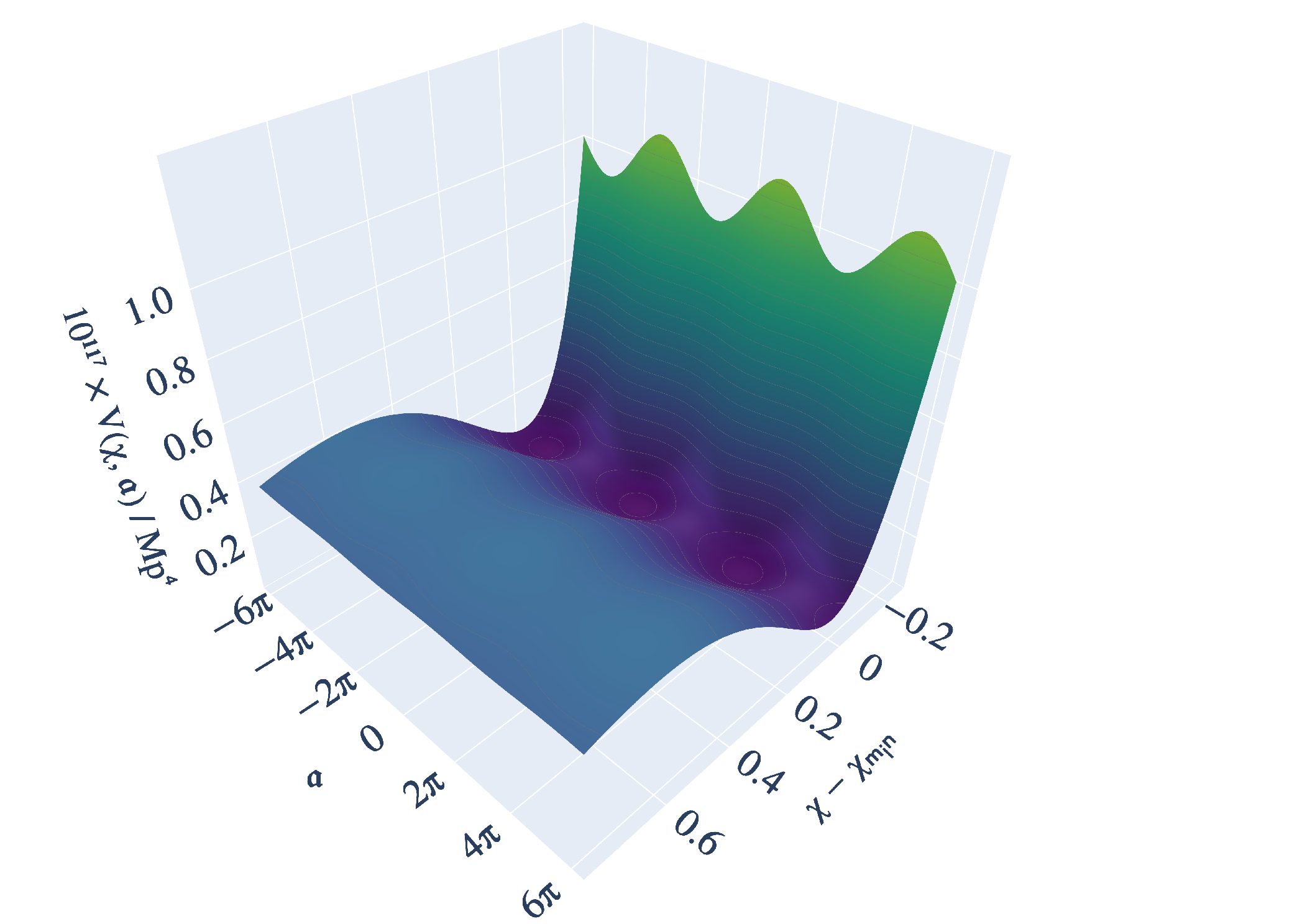
Figure 1: Surface plot of the axion–dilaton potential, revealing the trough structure characteristic of the relaxed scenario with a stabilized dilaton and suppressed, periodic axion potential.
The relaxed axion’s mass and coupling are therefore displaced from their standard QCD values. For the canonical scenario (fa∼Mp,ΛQCD∼0.1 GeV), the relaxed mass is ma∼εMp/τ3/2, which can be as low as ∼10−20 eV. This is parametrically lighter than conventional QCD axions for the same decay constant.
Parameter Space Implications and Phenomenological Constraints
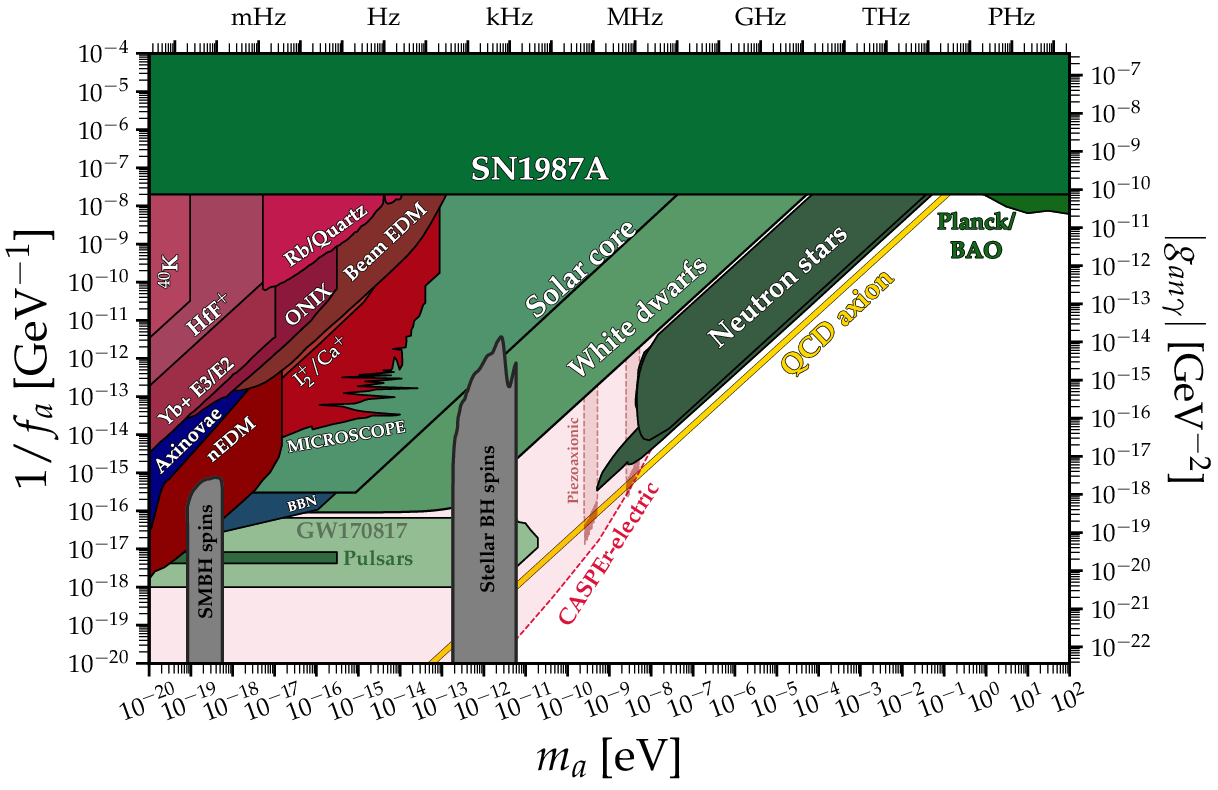
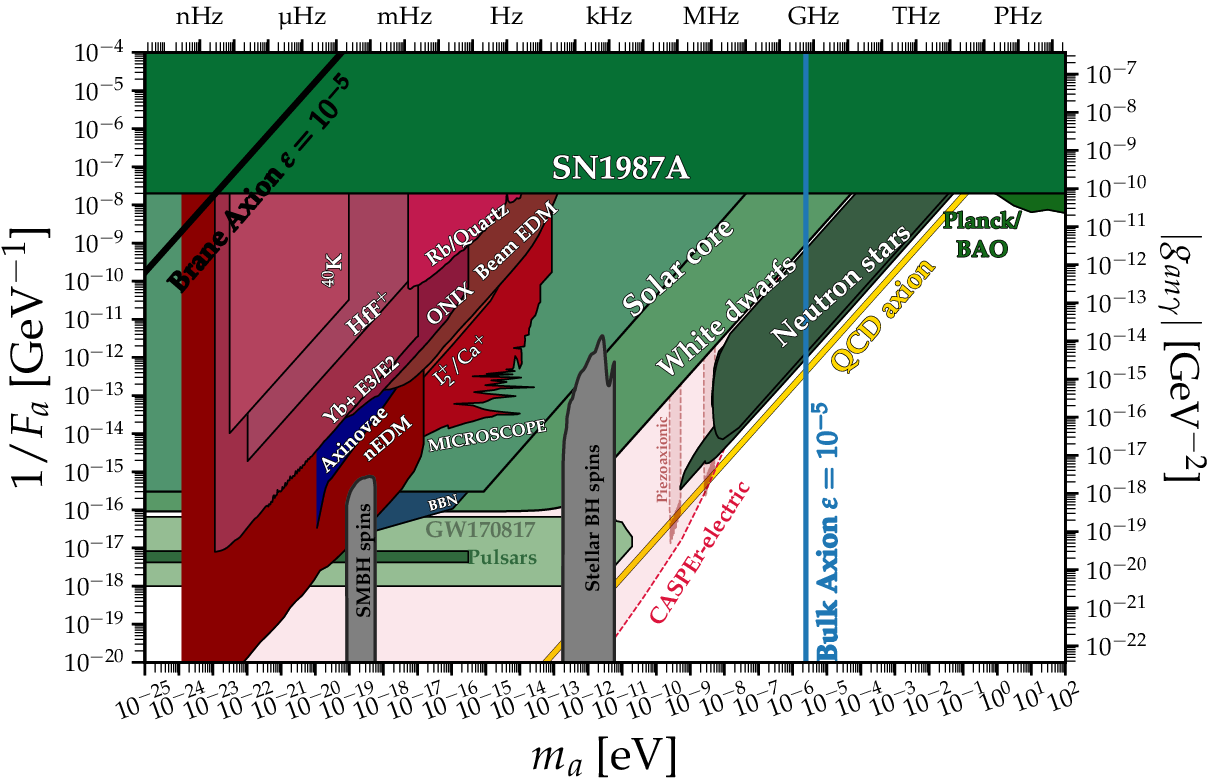
The suppression of the axion potential shifts the theoretically predicted ma–1/Fa relation in parameter space, moving the "QCD band" out of its canonical location into regions that are already tightly constrained by experiment and astrophysical observations.
Figure 2: Experimental and observational constraints on the QCD axion parameter space, showing the standard QCD band.
Figure 3: Modified axion parameter space illustrating the displacement of the QCD band for both brane and bulk axion embeddings within the yoga relaxation framework.
For brane-localized axions, both the mass and derivative coupling scale as fa/τ, pushing the axion line into highly excluded regions. In dual or bulk axion constructions, the kinetic structure modifies the relation between the decay constant and matter couplings, but does not resolve the primary issue: the cosmological vacuum potential is still suppressed, and the constraints from matter-induced potentials become dominant.
Matter-Induced Potentials and Cosmological Dynamics
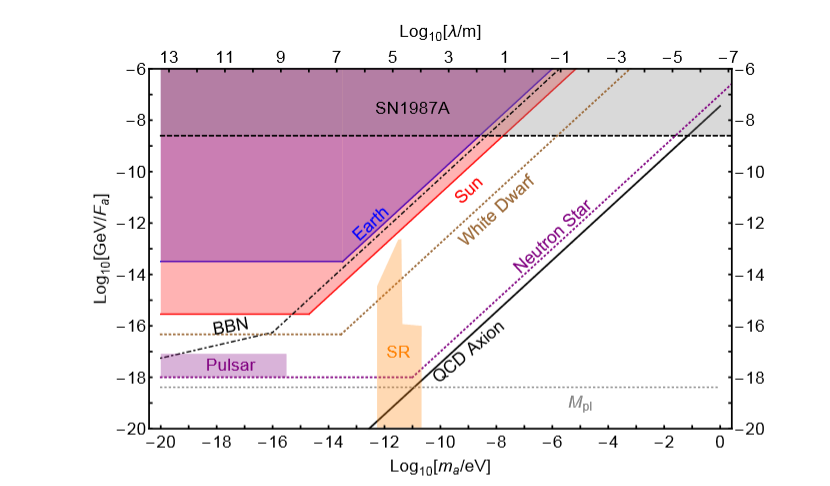
A key result is that when the axion vacuum potential is relaxed, nuclear and baryonic matter induce an effective potential for the axion through their dependence on θQCD. In the standard scenario, this matter potential is subdominant to the vacuum term except at supranuclear densities, but with relaxation, the suppression makes the matter term dominant even at everyday and cosmological background densities.
Figure 4: The region in 1/Fa–ma space where the QCD matter potential overcomes the vacuum potential in astrophysical environments, including Earth, the Sun, white dwarfs, and neutron stars.
Cosmologically, this generically drives the axion field away from the CP-conserving minimum for any QCD-motivated parameters throughout the post-BBN universe. Calculations demonstrate that the threshold density at which the vacuum and matter potentials are comparable is always exceeded in the observable universe for QCD-scale axions, leading to a strong exclusion of their viability as a strong-CP solution.
The paper emphasizes that the suppression is adiabatic and therefore only significant for slow processes; high-energy collider or laboratory timescales are faster than the relaxon’s response, thus particle-physics observables (e.g., in Higgs sector phenomenology) are unaffected.
Theoretical and Phenomenological Consequences
Bold, nonstandard result: Conventional QCD axions cannot survive in their standard form in any vacuum-energy relaxation scenario where the suppression is inherited by all vacuum potentials. The primary exclusion originates not from direct detection experiments but from the dominance of matter-induced potentials in cosmological and stellar environments, preventing alignment with the CP-conserving minimum. The standard QCD axion dark matter production via misalignment is likewise invalidated, as the adiabatic tracking mechanism alters the axion's cosmological history.
On the model-building side, any realistic implementation of vacuum-energy relaxation must plausibly accommodate the QCD axion solution without unwanted suppression, or otherwise provide alternative solutions to the strong CP problem. Otherwise, models must invoke sectoral sequestering, axions with only derivative couplings, or additional screening mechanisms to evade the outlined constraints.
Conclusion
The analysis systematically demonstrates that dynamic mechanisms for vacuum energy suppression induce unavoidable modifications to the QCD axion potential, decisively altering its mass–coupling relation and rendering the standard axion scenario phenomenologically inviable for strong-CP resolution and dark matter. Only axion models decoupled from matter-induced potentials or with nonstandard couplings may persist in such frameworks. These results further highlight the broader principle that solutions to the cosmological constant problem are tightly interwoven with the viability of light scalar sectors and must be considered jointly in consistent UV completions.
Future efforts should aim to construct and classify relaxation models that bypass these issues and clarify how multi-field screening or sectoral sequestering can be consistently achieved in high-energy completions, potentially retaining the successes of the Peccei-Quinn mechanism without incurring fatal cosmological or astrophysical tension.