Controllable Text-to-Motion Generation via Modular Body-Part Phase Control
Abstract: Text-to-motion (T2M) generation is becoming a practical tool for animation and interactive avatars. However, modifying specific body parts while maintaining overall motion coherence remains challenging. Existing methods typically rely on cumbersome, high-dimensional joint constraints (e.g., trajectories), which hinder user-friendly, iterative refinement. To address this, we propose Modular Body-Part Phase Control, a plug-and-play framework enabling structured, localized editing via a compact, scalar-based phase interface. By modeling body-part latent motion channels as sinusoidal phase signals characterized by amplitude, frequency, phase shift, and offset, we extract interpretable codes that capture part-specific dynamics. A modular Phase ControlNet branch then injects this signal via residual feature modulation, seamlessly decoupling control from the generative backbone. Experiments on both diffusion- and flow-based models demonstrate that our approach provides predictable and fine-grained control over motion magnitude, speed, and timing. It preserves global motion coherence and offers a practical paradigm for controllable T2M generation. Project page: https://jixiii.github.io/bp-phase-project-page/
Paper Prompts
Sign up for free to create and run prompts on this paper using GPT-5.
Top Community Prompts
Explain it Like I'm 14
Controllable Text-to-Motion: A Simple Explanation
What is this paper about? (Brief overview)
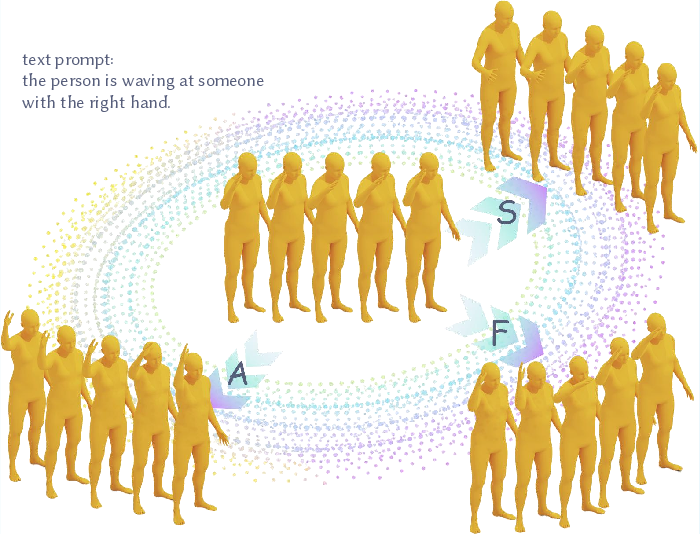
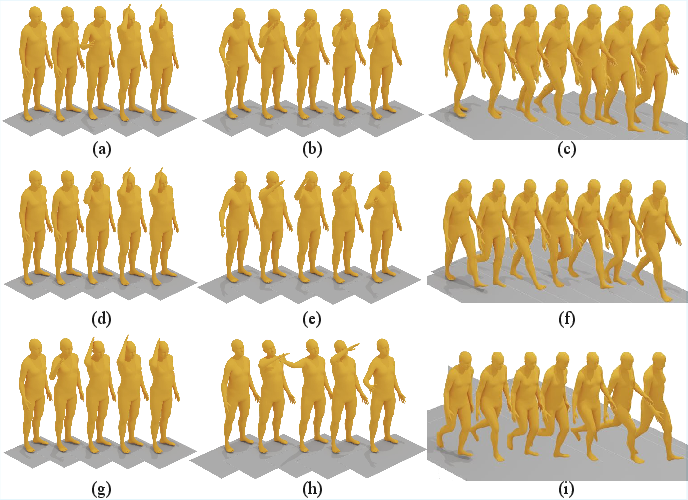
This paper shows a new way to make computer-generated human motions (like walking, waving, or dancing) that follow a short text description—and lets you easily adjust specific body parts. For example, you can make just the right arm wave bigger, the legs step faster, or a gesture start slightly earlier, all while keeping the rest of the body natural and coordinated.
What questions are the researchers trying to answer? (Key objectives)
- How can we give people simple, predictable controls to edit only certain body parts in a motion (like “make the arm swing bigger”) without messing up the rest of the body?
- Can we make these controls easy to understand—using just a few numbers—so artists and users don’t have to draw complex paths for every joint?
- Can this control system work with different kinds of AI motion generators?
How does their method work? (Approach in everyday terms)
Think of a human motion like a song:
- Amplitude = how big the movement is (like how loud a note is)
- Frequency = how fast a movement repeats (like the speed of a beat)
- Phase shift = when a movement happens in time (like starting a note a bit earlier or later)
- Offset = the base position (like the resting volume)
The authors use these “music-like” controls to steer body parts.
Here’s the simple pipeline:
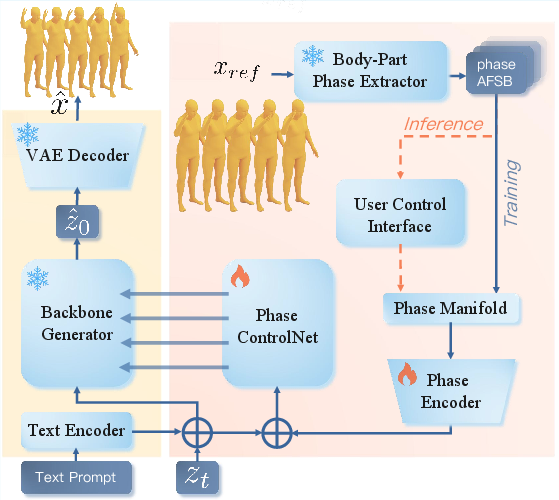
- Split the body into parts (left arm, right arm, left leg, right leg, trunk).
- For each part, read its “rhythm” from a motion example using just a handful of numbers: amplitude, frequency, phase shift, and offset.
- Let the user edit those numbers directly (e.g., “arm amplitude × 1.5” to make it swing bigger).
- Feed the edited “rhythm sheet” into an add-on helper network (called Phase ControlNet) that gently nudges the main AI generator at multiple stages so the final motion follows the plan.
- The main motion generator (which turns text into motion) stays unchanged; the add-on just guides it—like a conductor guiding sections of an orchestra while the symphony plays.
This add-on works with two popular kinds of motion generators:
- Diffusion models (imagine sculpting a motion from noisy data step by step)
- Flow models (imagine guiding a smooth path from random motion toward a good motion)
What did they find? (Main results and why they matter)
- Precise, local control: You can reliably adjust how big, how fast, or when a specific body part moves without breaking the whole motion.
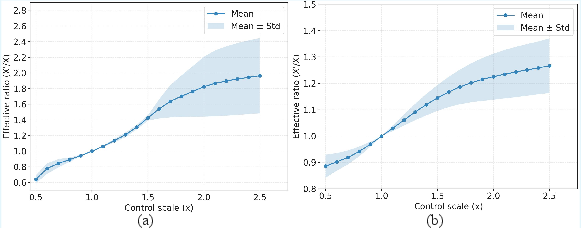
- Predictable behavior: When you tell it “make the movement 1.2× bigger,” the result closely matches that scale, especially within normal editing ranges.
- Good overall quality: Motions still look realistic and match the text well. Their scores on standard tests improved or stayed strong compared to other methods.
- Works across engines: The same control idea plugs into both diffusion-based and flow-based models.
- Fast and practical: The add-on adds only a tiny delay to generation.
Why this matters: Animators, game developers, and creators can tweak motions quickly with simple sliders instead of drawing detailed joint paths for every frame—or hoping a vague text edit does the right thing.
What does this mean for the future? (Implications and impact)
- Easier, interactive animation: This “phase control” gives artists a simple, musical way to edit motion parts—great for games, movies, and virtual avatars.
- Better tools for creators: Fast, predictable, local edits support quick trial-and-error and fine-tuning.
- Plug-and-play design: Because it’s an add-on, it can be used with different motion generators without redesigning them.
A few limitations to keep in mind:
- It works best for rhythmic or repeating motions (like walking or waving). Very irregular motions may need more complex controls.
- If the skeleton (body setup) is very different, the phase reader may need retraining.
Overall, the paper introduces a clear, simple control interface—using amplitude, frequency, and timing—that makes text-to-motion generation much more precise and user-friendly.
Knowledge Gaps
Knowledge gaps, limitations, and open questions
Below is a concise, actionable list of what remains missing, uncertain, or unexplored in the paper.
- Generalization across datasets and skeletons: The approach is only evaluated on HumanML3D and a single skeleton; robustness to new datasets (e.g., AMASS, KIT-ML) and different skeletal topologies (joint counts, bone lengths) is untested.
- Retargeting without retraining: The body-part phase extractors need retraining when skeletons change; methods for cross-skeleton retargeting or universal phase extractors remain unexplored.
- Coverage of aperiodic and contact-rich motions: The phase parameterization is tailored to (quasi-)periodic dynamics; efficacy on highly aperiodic, contact-rich, or transitional behaviors (e.g., sit/stand, jumps, falls, manipulation) is not evaluated.
- Long-horizon control: How well phase-based control scales to long sequences with evolving rhythms or behavior transitions is unaddressed.
- Time-varying controls: The study focuses on global scalar edits (constant A/F/S over windows); controllability with time-varying control curves (piecewise or continuous schedules) and smooth transitions between edit segments is not investigated.
- Part granularity and customization: Only five coarse parts are used; the impact of finer or adaptive body-part partitioning and user-defined grouping remains unknown.
- Number of harmonics (K) and windowing: Sensitivity to the number of sinusoidal bases (K=2) and temporal window length/stride for phase extraction is not analyzed; optimal multi-scale or adaptive phase bases are not studied.
- Identifiability and estimation error: The accuracy, stability, and identifiability of the learned phase parameters (A, F, S, B) under noisy or complex motions are not quantified; error propagation to control fidelity is unmeasured.
- Offset (B) control: Although an offset term is included in the formulation, user control and empirical analysis focus on A, F, S; the utility and side effects of offset control are left unexplored.
- Control fidelity metrics: Beyond correlation curves for A and F, there is no standardized metric suite quantifying local control accuracy (target vs. realized A/F/S), locality (leakage into unedited parts), or edit predictability across conditions.
- Locality and leakage: The extent to which edits on a target part affect unedited parts (e.g., shoulder–torso coupling, leg–pelvis balance) is not systematically measured.
- Physical plausibility and contacts: Effects of edits on foot sliding, contact timing, joint-limit violations, momentum/balance, and ground interactions are not evaluated; integration with physics or constraint enforcement is open.
- Text–control conflicts: How phase edits interact with or contradict textual semantics (e.g., increasing leg frequency when the prompt implies “slow walk”) is not analyzed; strategies for resolving such conflicts are absent.
- Multi-part simultaneous edits: The framework supports multi-part edits, but systematic evaluation of coupled changes (e.g., upper- and lower-body edits together) and conflict resolution is missing.
- Iterative editing stability: The stability and drift of motions under multi-round edits (accumulated deviations or degradation over repeated refinement) are not studied.
- Initialization without reference motion: The interactive loop assumes extracting phase from a reference or current generation; workflows for initiating edits from scratch (no reference) and default parameter selection remain unspecified.
- Compatibility with other control modalities: How phase-based control composes with trajectory constraints, keyframes, audio/beat signals, or scene geometry is untested; potential interference or synergy is unknown.
- Root trajectory and global speed: The method emphasizes limb/trunk dynamics; explicit control of global translation/orientation and their coupling with limb frequencies is not addressed.
- Training mask design (M): The construction, automation, and generalization of the spatio-temporal mask used in the phase consistency loss are not described; sensitivity to mask choices is unclear.
- Control strength calibration: The mapping between user-facing scale factors and motion-space effects is only partially characterized; automatic calibration or normalization across actions and subjects is missing.
- Backbone integration details: Only two backbones are shown (MotionLCM and a flow model); the generality of the ControlNet injection scheme (layer choices, scaling, conditioning at different depths) across diverse architectures is not explored.
- Runtime in interactive settings: AITS is reported for batch inference; edit-to-visualization latency in interactive loops and performance on commodity/edge hardware are not evaluated.
- Robustness to noisy or low-quality references: The impact of inaccurate phase extracted from noisy/generated reference motions on subsequent control outcomes is not analyzed.
- Multi-person and interactions: Extension to multi-actor scenes, interactions, or object-centric tasks is not discussed.
- Broader evaluation diversity: Only HumanML3D-style metrics are reported; user studies on edit intuitiveness, preference, and perceived locality, as well as task-specific metrics (e.g., contact F1), are absent.
Practical Applications
Immediate Applications
Below are concrete, deployable use cases that can be built now on top of the paper’s modular, body-part phase control for text-to-motion generation.
- Media & Entertainment (Animation, VFX, Games): Phase-driven motion editing plugins
- What: Add A/F/S sliders per body part (amplitude, frequency, phase shift) to tweak waves, strides, and gestures after a text-to-motion (T2M) generation pass.
- Tools/products/workflows:
- “Phase Editor” add-ons for Blender, Maya, Unreal/Unity: generate from text, extract part-phase, tweak sliders, re-generate, retarget to rigs, export FBX.
- Batch variant generator for directors to quickly compare gesture magnitude and timing alternatives.
- Dependencies/assumptions:
- Requires a compatible T2M backbone (e.g., MotionLCM, flow-based model) and skeleton retargeting.
- Best for periodic/quasi-periodic motions (walks, waves, dance motifs); less precise for highly aperiodic, contact-heavy acts.
- May need retraining of the phase extractor for non-HumanML3D skeletons.
- XR/Avatars/VTubing: Live or near-live gesture shaping
- What: Creators adjust arm/hand amplitude and timing while streaming; avatars appear more energetic/calm by scaling A/F in upper limbs.
- Tools/products/workflows:
- Integration with VRM-compatible avatar controllers; small UI with preset styles (e.g., “subtle,” “expressive”) mapped to scalar edits.
- Prosody-to-gesture mapping that shifts S to align beats/phrases with gestures.
- Dependencies/assumptions:
- Latency budget must accommodate the ControlNet pass (MotionLCM one-step helps); true real-time may require optimization or caching.
- Speech prosody analysis module to drive timing automatically.
- Social VR and Telepresence: Personalized gesturing styles
- What: User-level knobs that globally scale arm amplitude (A) or leg cadence (F) for stylized locomotion and gestures.
- Tools/products/workflows:
- “Expressiveness” and “Pace” presets implemented as global scaling of A/F for selected parts; plug-in for platforms like VRChat/Spatial.
- Dependencies/assumptions:
- Stable skeleton mapping across users’ avatars; per-platform SDK integration.
- Crowd Simulation and Previsualization: Rapid diversity in motion libraries
- What: Generate base motions from text, then create diverse variants by randomly sampling A/F/S per body part to populate crowds or previz.
- Tools/products/workflows:
- “Crowd Phase Variator” that auto-perturbs A/F/S for legs/arms while keeping semantics coherent.
- Dependencies/assumptions:
- Works best for locomotion and cyclic behaviors; apply constraints to avoid extreme, non-plausible scales.
- HCI and Presentation Tools: Gesture-speech alignment
- What: Align key gestures to speech by phase-shifting arm motions (S) to land on keywords or beats.
- Tools/products/workflows:
- TTS/ASR prosody analysis → map emphasis timings to S edits; re-generate motion synced to narration.
- Dependencies/assumptions:
- Requires robust keyword/beat detection; minor latency acceptable for offline authoring.
- Training Data Augmentation (ML/Academia): Controlled motion variants
- What: Generate systematic A/F-controlled variants for gesture/locomotion datasets to improve model robustness.
- Tools/products/workflows:
- Augmentation pipeline that scales A/F/S and labels each variant’s phase attributes for downstream training.
- Dependencies/assumptions:
- Synthetic-to-real gap; ensure physics/contacts remain plausible within moderate scale ranges.
- Motion Quality Assurance (Studios): Phase-based QC checks
- What: Use extracted per-part phase to check consistency of gait frequency, swing amplitude, or timing across takes.
- Tools/products/workflows:
- “Phase Consistency Monitor” reports deviations per body part; flags out-of-spec shots.
- Dependencies/assumptions:
- Requires defining studio-specific thresholds and acceptable ranges.
- Education and E-Learning (Dance/Sports Basics): Pace and magnitude tailoring
- What: Create lesson content with adjustable pace (F) and magnitude (A) for learners (e.g., slow practice vs. full speed).
- Tools/products/workflows:
- Educator sets difficulty presets (A/F multipliers); students visualize differences side-by-side.
- Dependencies/assumptions:
- Focused on repetitive movement pedagogy; expert validation for instructional accuracy.
- Accessibility: Simplified expressive control for avatars
- What: Users with limited dexterity select high-level styles (e.g., “bigger arm gestures”) mapped to A/F changes, rather than micromanaging joints.
- Tools/products/workflows:
- Accessibility UIs exposing minimal, meaningful sliders for expressiveness and pacing.
- Dependencies/assumptions:
- Requires personalization to user intent and comfort; on-device performance optimization for assistive contexts.
- Academic Research: Controlled perceptual studies and motion analysis
- What: Use A/F/S as independent variables to test human perception of motion timing/magnitude or to study co-speech gesture effects.
- Tools/products/workflows:
- Experiment scripts that automatically generate stimuli with precisely controlled per-part edits.
- Dependencies/assumptions:
- IRB and ethical considerations for human-subject studies.
Long-Term Applications
These applications are promising but need further research, scaling, physics integration, or domain-specific validation before deployment.
- Robotics (Legged and Manipulation): Phase-informed rhythmic controllers
- What: Map human phase controls (A/F/S) to robot gait/gesture controllers for walking, periodic manipulations, or handover timing.
- Tools/products/workflows:
- Phase-to-CPG (central pattern generator) bridge; sim pipelines that co-optimize A/F/S and stability constraints.
- Dependencies/assumptions:
- Requires contact modeling, dynamics, and balance guarantees; robust retargeting to robot kinematics; extensive sim-to-real validation.
- Rehabilitation and Physical Therapy: Patient-tailored motion exemplars
- What: Generate exercise demonstrations with personalized pace (F) and range of motion (A) for patients; adjust timing (S) to breathing cues.
- Tools/products/workflows:
- Clinician dashboards with safety-checked amplitude limits and medically validated routines.
- Dependencies/assumptions:
- Clinical trials, regulatory compliance, and biomechanical accuracy; capture of patient-specific constraints.
- Social Robotics and Assistive Agents: Gesture-speech synchronization and style control
- What: Social robots that adjust arm-hand A/F and S to match conversational dynamics or cultural norms.
- Tools/products/workflows:
- Speech prosody pipeline feeding S; cultural style presets mapping to A/F envelopes.
- Dependencies/assumptions:
- Real-time performance on embedded hardware; human factors studies to validate acceptability.
- Game Runtime Animation Systems: Dynamic, style-aware controllers
- What: NPCs alter locomotion pace and gesture amplitude in response to gameplay states (fatigue, stealth, excitement) via live phase edits.
- Tools/products/workflows:
- Hybrid systems combining T2M with runtime controllers; caching or distillation to lightweight models.
- Dependencies/assumptions:
- Real-time constraints; robust contact handling to avoid foot sliding; integration with physics/IK solvers.
- Sports Analytics and Coaching: Controlled comparative exemplars
- What: Produce exemplar motions with precise A/F adjustments to illustrate technique differences and timing cues.
- Tools/products/workflows:
- Analyst tools to overlay variants; linking to wearable sensor streams for biofeedback.
- Dependencies/assumptions:
- Domain-specific accuracy requirements and expert review; extension beyond periodic motions.
- Motion Database Search and Compression: Phase descriptors for indexing
- What: Use compact per-part phase codes as search keys (e.g., “high arm swing, slow leg cadence”) and for library deduplication/compression.
- Tools/products/workflows:
- Phase-indexed retrieval systems; phase-aware similarity metrics for curation.
- Dependencies/assumptions:
- Requires large-scale re-encoding of libraries; validation of retrieval relevance across genres.
- Music/Beat-Synchronized Choreography: Automatic tempo alignment
- What: Map music tempo to leg/arm frequency (F) and shift (S) to lock movements to beats for auto-choreography.
- Tools/products/workflows:
- Beat/tempo detectors feeding F and S; co-optimization for aesthetics and contact plausibility.
- Dependencies/assumptions:
- Musicality and stylistic constraints; better handling of complex transitions and non-periodic accents.
- Digital Humans for Training/Simulation (Public Safety, Industry): Procedural scenario authoring
- What: In emergency response or factory training sims, authors quickly tailor urgency via stride frequency and gesture magnitude without re-keyframing.
- Tools/products/workflows:
- Scenario authoring UIs with role-based presets; provenance metadata tagging controlled edits.
- Dependencies/assumptions:
- Validation for realism and safety; standards for synthetic content disclosure in regulated training.
- Policy & Standards: Interfaces for controllable motion generation
- What: Establish interoperable schemas for A/F/S-based control in T2M tools; guidelines for disclosure/watermarking of synthetic human motion.
- Tools/products/workflows:
- Open APIs for phase control; metadata standards (e.g., sidecar files) recording edit history.
- Dependencies/assumptions:
- Multi-stakeholder coordination (studios, engine vendors, standards bodies); alignment with broader synthetic media policies.
- On-device/Edge Animation for AR Wearables: Low-latency expressiveness control
- What: Lightweight, phase-aware generators enabling expressive avatars on AR glasses with limited compute.
- Tools/products/workflows:
- Model distillation or pruning of ControlNet; hardware-aware deployment pipelines.
- Dependencies/assumptions:
- Significant model optimization; adaptation to different skeletons and energy budgets.
Cross-cutting assumptions and risks
- Skeleton and dataset dependency: Phase extractors may need retraining for new skeleton topologies, domains (e.g., mocap vs. video), or styles.
- Motion class suitability: The phase interface excels for periodic/quasi-periodic dynamics; performance degrades on highly aperiodic, contact-rich, or long-horizon tasks unless extended.
- Physical plausibility: Large amplitude/frequency edits can induce sub-linear, less plausible responses; integration with physics/IK/contact constraints is advisable for high-stakes uses.
- Compute and latency: While overhead is small in one-step diffusion, strict real-time applications may require distillation/caching and GPU access.
- Ethics and IP: Ensure licensing of training data; adopt provenance and disclosure for synthetic human motion to mitigate deepfake concerns.
Glossary
- AdamW: An optimizer that decouples weight decay from gradient-based updates for stable training. "We train the Phase Encoder and Phase ControlNet using AdamW, cosine learning-rate decay, and 1K-step linear warm-up"
- AITS (Average Inference Time per Sentence): A runtime metric measuring the average time to generate a motion for one input sentence. "We follow~\cite{chen2023executing} to report the \underline{A}verage \underline{I}nference \underline{T}ime per \underline{S}entence (AITS) to evaluate the inference efficiency of models."
- amplitude (A): The magnitude of a periodic or quasi-periodic motion component; controls movement intensity. "By scalar editing the phase parameters of a target body part, namely amplitude (A), frequency (F), and phase shift (S)"
- CFG (Classifier-Free Guidance): A guidance technique for diffusion sampling that trades off fidelity and diversity by scaling conditional scores. "MotionLCM~\cite{dai2024motionlcm} (one-step sampling, CFG )"
- ControlNet: An auxiliary control branch that injects conditioning signals into a generative backbone to enforce constraints. "control branches~\cite{mdm,xie2023omnicontrol,dai2024motionlcm,karunratanakul2023guided,pinyoanuntapong2024mmm,wan2024tlcontrol,guo2025motionlab,pinyoanuntapong2025maskcontrol,liu2024programmable,bae2025less,hwang2025motion}"
- coupling path: A path interpolating between source and target latents used in flow matching to define training trajectories. "We define a linear coupling path"
- denoiser: In diffusion models, a network that predicts noise to iteratively remove it from a noised latent. "We learn a conditional denoiser with text embedding as condition"
- diffusion timestep: The discrete time index in the diffusion process indicating noise level. "where is a pre-defined noise schedule and denotes the diffusion timestep."
- flow matching: A training objective that learns a velocity field to transport samples along a predefined path between distributions. "We follow a flow-matching formulation for text-to-motion generation in the latent space of a pretrained motion VAE."
- frequency (F): The repetition rate of a periodic motion component; controls execution pace. "By scalar editing the phase parameters of a target body part, namely amplitude (A), frequency (F), and phase shift (S)"
- Fréchet Inception Distance (FID): A distributional metric comparing generated and real samples using feature statistics. "echet Inception Distance (FID) is adopted as a principal metric to evaluate the feature distributions between the generated and real motions."
- HumanML3D: A benchmark dataset of human motions paired with textual descriptions. "We experiment on the popular HumanML3D~\cite{guo2022generating-HumanML3D} dataset"
- inpainting: A technique to fill in missing or constrained parts; used to impose geometric controls during generation. "mechanisms such as condition injection, inpainting, or ControlNet-based branches."
- kinematic phase: A representation of the state within a motion cycle characterized by attributes like amplitude, frequency, and timing. "Our key insight is that kinematic phase serves as an excellent descriptor for human motion dynamics."
- latent rectified-flow network: A flow-based generative model variant that improves sampling by rectifying flow fields in latent space. "a latent rectified-flow network trained via flow-matching for our flow backbone"
- latent space: The compressed representation space produced by an encoder (e.g., a motion VAE) where generation is performed. "We formulate diffusion-based text-to-motion generation in the motion latent space."
- MM Dist (Multimodal Distance): A metric measuring the mean distance between generated motions and their corresponding texts. "Multimodal Distance (MM Dist) calculates the mean distance between motions and texts."
- MModality (MultiModality): A diversity metric quantifying variation across multiple generations conditioned on the same text. "MultiModality (MModality) measures the generation diversity conditioned on the same text"
- motion VAE: A variational autoencoder trained on motion sequences, providing latent encodings and decodings for motion. "a frozen motion VAE encoder "
- noise schedule: The sequence controlling the amount of noise added at each diffusion timestep. "where is a pre-defined noise schedule"
- ODE (ordinary differential equation): A continuous-time equation integrated during flow-based inference to transform noise into data. "and integrate the ODE backward from to "
- periodic autoencoder: An autoencoder architecture tailored to capture and reconstruct periodic or quasi-periodic signals. "built upon a periodic autoencoder architecture~\cite{starke2022deepphase}"
- phase consistency loss: An auxiliary loss enforcing that the generated motion’s phase features match a reference. "To enforce high-fidelity phase alignment, we introduce an auxiliary phase consistency loss"
- Phase ControlNet: The paper’s control branch that injects phase-conditioned residuals into the backbone at multiple layers. "we introduce a Phase ControlNet that injects the phase signal through multi-layer residual modulation."
- phase manifold: A structured, time-dependent representation of phase features (e.g., cos/sin embeddings of phase). "a time-dependent phase manifold is formed by a Body-Part Phase Module"
- phase shift (S): A temporal offset in a periodic signal controlling alignment of motion events in time. "By scaling the amplitude () of the right upper limb, we directly control the spatial magnitude of the waving gesture." (context elsewhere includes "phase shift (S)")
- quasi-periodic: Describes signals that are nearly periodic but may vary slowly over time. "Phase is a compact descriptor for periodic or quasi-periodic motion"
- R-Precision: A retrieval metric reporting top-k matching accuracy between generated motions and text. "we calculate the motion-retrieval precision (R-Precision) to report the text-motion Top-1/2/3 matching accuracy"
- residual feature modulation: Modifying backbone features by adding learned residuals to impose control signals. "A modular Phase ControlNet branch then injects this signal via residual feature modulation"
- sinusoidal basis functions: A set of cosine (or sine) components used to approximate periodic motion signals. "can be compactly approximated by a set of sinusoidal basis functions"
- sinusoidal embeddings: Encodings using sine and cosine of phase to represent periodic signals in a continuous, differentiable form. "we map these scalar parameters into a continuous, time-dependent phase manifold via sinusoidal embeddings"
- spatio-temporal mask: A mask that selects specific body parts and time ranges for targeted losses or edits. "and is a spatio-temporal mask focusing the penalty on the specific edited parts."
- velocity field: In flow models, a function specifying the instantaneous rate of change of latents along the transport path. "learn a text-conditioned velocity field "
- zero-initialized projections: Projection layers initialized to zero so the control branch initially exerts no effect on the backbone. "uses zero-initialized projections to output block-aligned residuals"
Collections
Sign up for free to add this paper to one or more collections.