$R$-equivalence on Cubic Surfaces I: Existing Cases with Non-Trivial Universal Equivalence
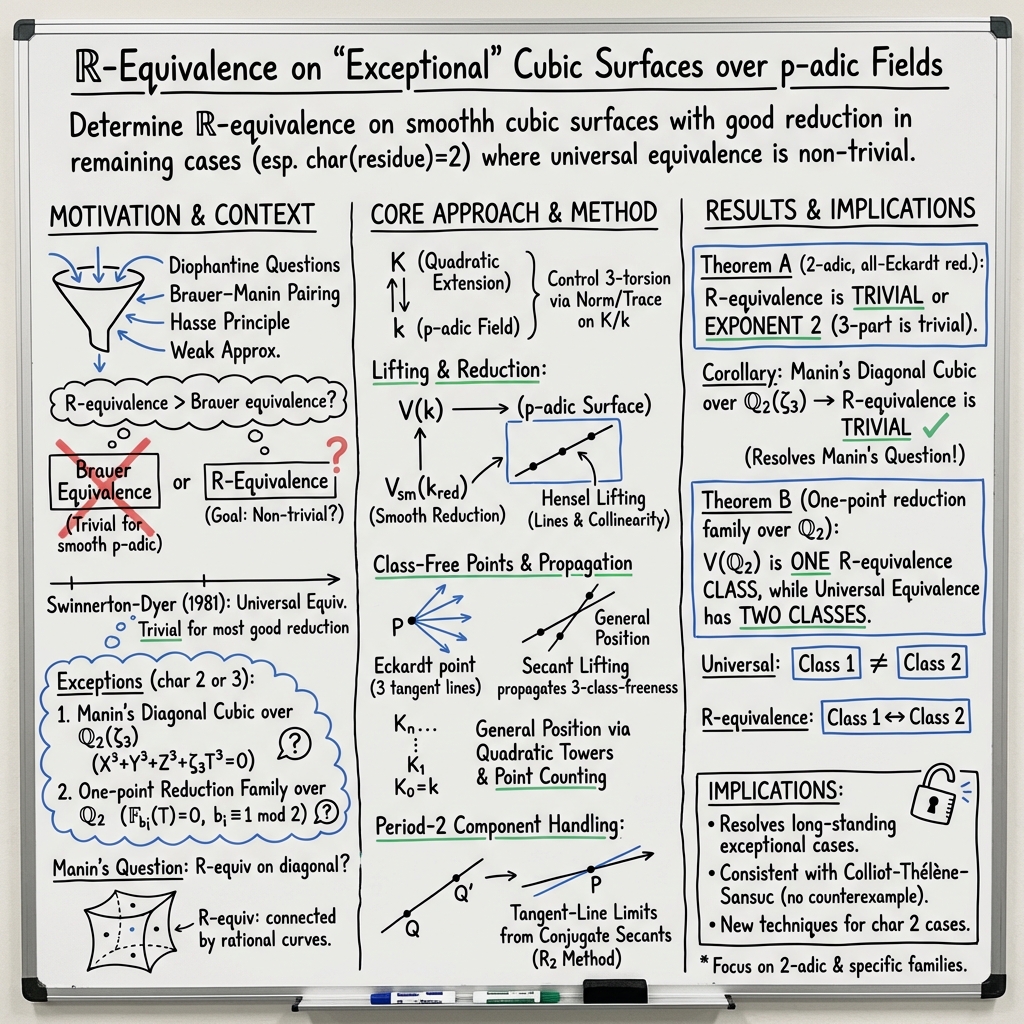
Abstract: Let $V$ be a smooth cubic surface over a $p$-adic field $k$ with good reduction. Swinnerton-Dyer (1981) proved that $R$-equivalence is trivial on $V(k)$ except perhaps if $V$ is one of three special types--those whose $R$-equivalence he could not bound by proving the universal (admissible) equivalence is trivial. We consider all surfaces $V$ currently known to have non-trivial universal equivalence. Beyond being intractable to Swinnerton-Dyer's approach, we observe that if these surfaces also had non-trivial $R$-equivalence, they would contradict Colliot-Thélène and Sansuc's conjecture regarding the $k$-rationality of universal torsors for geometrically rational surfaces. By devising new methods to study $R$-equivalence, we prove that for 2-adic surfaces with all-Eckardt reductions (the third special type, which contains every existing case of non-trivial universal equivalence), $R$-equivalence is trivial or of exponent 2. For the explicit cases, we confirm triviality: the diagonal cubic $X3+Y3+Z3+ζ_3 T3=0$ over $\mathbb{Q}_2(ζ_3)$--answering a long-standing question of Manin's (Cubic Forms, 1972)--and the cubic with universal equivalence of exponent 2 (Kanevsky, 1982). This is the first in a series of works derived from a year of interactions with generative AI models such as AlphaEvolve and Gemini 3 Deep Think, with the latter proving many of our lemmas. We disclose the timeline and nature of their use towards this paper, and describe our broader AI-assisted research program in a companion report (in preparation).
Paper Prompts
Sign up for free to create and run prompts on this paper using GPT-5.
Top Community Prompts
Explain it Like I'm 14
Overview
This paper studies a “who’s-connected-to-who” question on special curved shapes called cubic surfaces. Imagine lots of points sitting on a smooth, wavy surface defined by a single cubic equation. Two points are considered “the same” if you can walk from one to the other along a chain of simple curves called rational curves. This notion is called R-equivalence. The paper focuses on cubic surfaces over 2-adic number fields (think of numbers measured by how divisible they are by 2) and settles several tricky cases that had been open for decades, including a question asked by the famous mathematician Yuri Manin.
What questions are they trying to answer?
Here are the main questions, phrased simply:
- If you pick any two points on one of these cubic surfaces, can you always connect them by a chain of very simple “straight-ish” curves (rational curves)? If yes, then all points are in one R-equivalence class (everything is connected in that simple way).
- In the special and hardest cases—when the surface looks smooth even after “reducing modulo 2” (a kind of low-resolution snapshot) and every reduced point is an “Eckardt point” (a special triple-crossroad where three lines meet on the surface)—is R-equivalence still trivial (only one class), or could there be a small number of different classes?
- In two well-known example surfaces, including Manin’s diagonal cubic, what exactly is the R-equivalence? Are all points connected, or not?
How do they approach the problem?
The authors use a mix of geometry and number theory, with a few key ideas:
- Rational curves as “roads”: On a cubic surface, a rational curve is like a very simple road. If you can go from point A to point B along a chain of such roads, then A and B are R-equivalent (belong to the same “connected group”).
- Reduce and lift (high/low-resolution views): They look at the surface modulo 2 (think of taking a very coarse, black‑and‑white snapshot). This is called reduction. If the reduced picture is still smooth (“good reduction”), then information can often be carried back up to the original 2-adic world (this is called lifting). They also prove that lines you see in the reduced picture lift to lines upstairs, which helps connect points.
- Special points (Eckardt points): An Eckardt point is where three lines on the surface meet. Surfaces whose reduced picture has only Eckardt points are rare and tricky. The paper develops tools tailored for these.
- A “norm map” across fields: Sometimes they move to a slightly bigger number system (a quadratic extension, like stepping into a bigger room), solve a problem there, then use a special “norm” map (think of compressing back down) to bring information home. They extend an older idea of Manin’s norm map so it works not just for “3-like” behavior but also for “2-like” behavior (explained next).
- Two kinds of “group-like” behavior: When you combine equivalence classes using the surface’s geometry, the structure naturally splits into:
- A “period-3” part (doing the operation 3 times brings you back), and
- A “period-2” part (doing it twice brings you back).
- The authors show how to control both parts, especially the period-2 part in the hard 2-adic cases.
- Choosing points in “general position”: They prove there’s always a way (after going up a tower of small field extensions) to pick points so lines between them behave nicely, which lets their lifting and norm techniques work cleanly.
What did they discover?
The paper delivers several results; together they close long-standing gaps:
- Main general theorem (2-adic, all-Eckardt reduction): If your cubic surface is over a 2-adic field, has good reduction, and the reduced surface has only Eckardt points, then R-equivalence is either trivial (all points are connected) or has period 2 behavior. In simple terms, the worst possible situation is a “two-step” kind of splitting—no wild behavior.
- Manin’s diagonal cubic is connected: For the famous surface X3 + Y3 + Z3 + ζ₃ T3 = 0 over the field Q₂(ζ₃), the authors prove that R-equivalence is trivial. That means any two points can be linked by a chain of simple rational curves. This answers Manin’s 1972 question positively.
- A one-point reduction example: For a specific family of 2-adic cubic surfaces whose modulo‑2 snapshot has exactly one point, they precisely compute the equivalence:
- There are exactly two classes for the finer “universal admissible” equivalence, but
- There is only one class for R-equivalence.
- In other words, even though a finer lens splits the points into two bins, the “walk along simple curves” lens sees everything as connected.
Why is this important? These are exactly the cases that earlier methods (from Swinnerton‑Dyer and others) could not settle. The results also support a well-known conjecture (by Colliot‑Thélène and Sansuc) about how certain geometric objects (called universal torsors) should behave: if R-equivalence had been nontrivial here, it could have contradicted that conjecture. Instead, the new results line up with the conjecture.
What’s the broader impact?
- Closing long-standing questions: The paper answers Manin’s decades-old question for the diagonal cubic and fills the last known gaps in a classic 1981 theorem of Swinnerton‑Dyer, at least in the cases currently known to have nontrivial “universal” behavior.
- New tools for hard cases: The extended norm-map techniques and the careful reduce‑and‑lift strategy offer a playbook for attacking similar problems on other surfaces and in other number systems.
- Support for a big conjecture: The results are consistent with the Colliot‑Thélène–Sansuc conjecture on the rationality of universal torsors over rational surfaces, suggesting the arithmetic geometry story here is coherent and on track.
- A note on research practice: The authors also describe how modern AI tools helped them develop and check parts of the work. For young readers, this highlights how math research can blend human insight with computational assistance to tackle tough, technical problems.
In short, the paper shows that even in the trickiest 2-adic scenarios, points on these cubic surfaces are connected in a simple, understandable way, resolving classic puzzles and strengthening the bridge between geometry and number theory.
Knowledge Gaps
Knowledge gaps, limitations, and open questions
The paper advances the 2-adic, good-reduction, all-Eckardt case for cubic surfaces, but several aspects remain unresolved or only partially addressed. The following concrete gaps highlight directions for future work:
- Classification beyond case (iii) of Swinnerton-Dyer’s Theorem 2:
- Determine -equivalence for the other exceptional cases: (i) residue characteristic $3$ with Hessian touching at every rational point, and (ii) residue characteristic $2$ with vanishing normalized Hessian. Develop techniques analogous to those used here or new tools adapted to the Hessian conditions.
- Trivial vs. exponent-2 dichotomy:
- Provide necessary and sufficient conditions that decide when -equivalence is trivial versus of exponent $2$ for 2-adic smooth cubic surfaces with all-Eckardt reduction. The paper proves the dichotomy but does not give a general criterion to distinguish the two outcomes.
- Existence of nontrivial exponent-2 -equivalence:
- Construct an explicit example with nontrivial -equivalence of exponent $2$ in the all-Eckardt, good-reduction, 2-adic setting (or prove impossibility under clear hypotheses). The paper confirms triviality in the explicit cases it analyzes.
- Dependence on the existence of -rational Eckardt points:
- Analyze cases where the reduction is all-Eckardt but contains no -rational Eckardt point. Clarify whether triviality of -equivalence still follows, and if not, identify precise obstructions.
- Effective bounds in quadratic extension arguments:
- Make the tower-of-quadratic-extensions arguments effective by giving explicit bounds on the minimal height (and ramification behavior) required to guarantee general position, appearance of lines in reduction, or other needed properties.
- Formalization and generalization of the norm-map method:
- Provide a fully general, functorial framework for the norm map on -equivalence classes that treats both 3-torsion and 2-torsion components uniformly. Extend beyond quadratic extensions and clarify compatibility with the commutative Moufang loop structure.
- Algorithmic computation of -equivalence:
- Develop practical algorithms to compute from a defining cubic form over a -adic field (with or without good reduction), including automated detection of the “all-Eckardt” condition and certification of the trivial/exponent-2 outcome.
- Bad or semistable reduction:
- Extend methods to cubic surfaces with mild or semistable bad reduction over -adics. Identify which aspects of the lifting and norm-map arguments survive, and characterize new phenomena affecting -equivalence.
- Residue characteristic $3$ methods:
- Create techniques tailored to that can handle the “Hessian-touching” condition, potentially via alternative invariants or deformation arguments distinct from those used in the 2-adic case.
- Size and structure of CMLs in the all-Eckardt setting:
- Determine the exact number of universal- and -equivalence classes and their CML structure for general all-Eckardt reductions (beyond the two explicit examples). Provide geometric interpretations and explicit class representatives.
- Diagonal and near-diagonal families:
- Systematically classify -equivalence for diagonal cubics over $2$-adic fields for units , and study persistence under small $2$-adic deformations of coefficients (stability of triviality/exponent-2 outcomes).
- Minimal chain lengths:
- Establish quantitative bounds on the minimal length of chains of rational curves realizing -equivalence on these surfaces. Such bounds would strengthen the qualitative results with effective complexity measures.
- Interaction with the Colliot-Thélène–Sansuc program:
- Make the implication chain between -equivalence, , and the rationality of universal torsors fully rigorous in this context, and either construct a counterexample or prove broader injectivity results supporting the conjectural picture.
- Weak approximation connections:
- Investigate whether the triviality of -equivalence in the resolved cases yields new consequences for weak approximation on cubic surfaces over number fields, and whether the methods here can inform local-to-global principles.
- Generalization to higher dimensions:
- Explore whether the techniques (norm maps, lifting arguments, torsion decomposition of CMLs) extend to higher-dimensional smooth cubic hypersurfaces over local fields, particularly in residue characteristics $2$ and $3$.
- Effect of lines over extensions:
- Give explicit criteria for when lines on the special fiber appear over unramified versus ramified quadratic extensions, and evaluate how such occurrences influence -equivalence on the base field.
- Moduli-level and density questions:
- Assess the prevalence (density in moduli over ) of the all-Eckardt reduction condition and of each -equivalence type (trivial vs. exponent 2), including how often the needed hypotheses for the paper’s methods are met.
Practical Applications
Overview
The paper develops new tools to compute and bound R-equivalence on smooth cubic surfaces over p-adic fields with good reduction, especially in the long-standing “all-Eckardt” and “one-point” reduction cases in residue characteristic 2. It proves that in these cases R-equivalence is either trivial or of exponent 2, and fully resolves two flagship examples (including Manin’s diagonal cubic). The work also demonstrates and documents a sustained generative-AI–assisted mathematical research workflow. While the results are foundational, they enable concrete tooling and workflows in computational algebra/number theory, education, and AI research practice, and suggest longer-term directions for software, formal methods, and research policy.
Below are practical applications, grouped by immediacy. Each item includes sector cues, possible tools/workflows, and key assumptions/dependencies.
Immediate Applications
These can be deployed now in research software, education, and AI workflows.
- Computation modules for R-equivalence on cubic surfaces over local fields (software, academia)
- What: Implement routines that decide/compute R-equivalence and universal equivalence classes for smooth cubic surfaces with good reduction in residue characteristic 2, including all-Eckardt and one-point reduction cases.
- Tools/products/workflows:
- SageMath/Magma add-ons: “pAdicCubicSurface” with APIs
compute_R_classes(surface, field),compute_universal_classes(surface, field). - Submodules: “EckardtDetector” (detect all-Eckardt reductions), “FanoLineLift” (lift lines via Hensel), “U2U3Splitter” (split universal equivalence into /), “NormMapRClass” (apply Manin’s norm map along quadratic extensions).
- Benchmarks using the resolved examples: X3+Y3+Z3+ζ₃T3 over Q₂(ζ₃) (trivial R-equivalence) and the explicit exponent-2 universal equivalence case F_{1,1,1}=0.
- Assumptions/dependencies: smooth cubic surface with good reduction; accurate detection of Eckardt points; reliable p-adic arithmetic; Hensel lifting applicability; towers of quadratic extensions computable.
- Heuristics and pruning for p-adic Diophantine solvers (software)
- What: Use the paper’s lifting and “bad locus” bounds to prune search when connecting points by rational curves on cubic surfaces.
- Tools/workflows: Integrate (i) Hensel-based line lifting; (ii) Aubry–Perret/Leep–Yeomans point-count bounds for “bad loci” into constraint or SMT solvers and CAS routines for local solubility/refinement.
- Assumptions/dependencies: surface smoothness and good reduction; availability of finite field reductions and basic point counting.
- Test suites for computational arithmetic geometry and AI math agents (AI/ML research, academia)
- What: Curate canonical, historically hard instances with verified outcomes (e.g., Manin’s diagonal cubic) to evaluate agents’ reasoning about local fields and equivalence relations.
- Tools/workflows: Datasets with labeled R-equivalence and universal equivalence classes; unit tests for CAS and agentic theorem provers; “finite-to-local lifting” tasks.
- Assumptions/dependencies: reproducible definitions; consistent APIs across systems (Sage/Magma/Lean).
- Graduate teaching modules on collinearity loops and R-equivalence (education)
- What: Course materials and interactive notebooks illustrating commutative Moufang loops, decomposition, lifting from finite fields, and norm-map arguments.
- Tools/workflows: Jupyter notebooks packaged with visualization of secants/tangents, class computations on explicit surfaces; problem sets using the explicit cases.
- Assumptions/dependencies: access to CAS; students comfortable with basic algebraic geometry and p-adic fields.
- Research planning for descent/weak-approximation studies (academia)
- What: Use the results to select families of cubic surfaces where local R-equivalence is now known (trivial or exponent 2), clarifying when Brauer–Manin checks are sufficient in descent setups.
- Tools/workflows: Pipelines that tag surfaces by local R-equivalence status; link to Néron–Severi torus calculations and maps.
- Assumptions/dependencies: good reduction at relevant places; computable torsors/torus cohomology.
- Methodological playbook and disclosure templates for AI-assisted math (policy, academia)
- What: Adopt the paper’s disclosure timeline and role description of generative models as a template for labs and journals.
- Tools/workflows: Checklists for AI use documentation; repository metadata tags (e.g., “AI-use: lemma generation,” “proof sketching,” “literature triage”).
- Assumptions/dependencies: institutional/journal policies; willingness to standardize reporting.
Long-Term Applications
These require further research, scaling, or ecosystem development.
- Generalized local-equivalence engines for higher-dimensional varieties (software, academia)
- What: Extend the paper’s finite-to-local lifting, norm-map propagation, and techniques beyond cubic surfaces to broader rationally connected varieties.
- Tools/products: “LocalEquivKit” libraries interfacing with deformation theory modules; automatic detection of cases where R-equivalence collapses locally.
- Assumptions/dependencies: deeper theory for higher dimensions; robust deformation and lifting algorithms; computational access to Fano schemes beyond lines.
- Formalized, verified pipelines for arithmetic geometry in proof assistants (software, academia)
- What: Encode commutative Moufang loops, Manin’s constructions, Hensel lifting, and the paper’s lemmas into Lean/Isabelle libraries for machine-checked proofs.
- Tools/workflows: “Lean-pAdic-AG” library; conversion bridges from CAS computations (Sage/Magma) to formal certificates.
- Assumptions/dependencies: formalization of CMLs, p-adics, and surface geometry; proof engineering resources.
- AI-integrated theorem-proving and research platforms (AI/ML research, policy)
- What: Build sustained, long-horizon AI+human workflows reflecting the paper’s year-long process: agentic literature search, lemma suggestion, proof refinement, audit trails.
- Tools/products: “MathLab Copilot” with versioned model prompts, citation tracing, and error-checking; integration with CAS and proof assistants.
- Assumptions/dependencies: continued model advances in long-context reasoning; governance on authorship and credit; reproducibility standards.
- Moduli-navigation tools using R-equivalence invariants (academia, software)
- What: Use computed R-/universal equivalence stratifications as features to explore moduli of cubic surfaces over local fields (e.g., flagging all-Eckardt strata).
- Tools/products: Interactive moduli browsers showing strata with computed invariants; APIs to query strata membership by reduction data.
- Assumptions/dependencies: scalable computation over parameter spaces; robust detection of special fibers and Hessian conditions.
- Improved local-global pipelines for rational points (academia, software)
- What: Combine known triviality/exponent bounds for local R-equivalence with Brauer–Manin and descent machinery to accelerate global searches and proofs.
- Tools/workflows: Orchestrations that automatically tag primes by local R-equivalence, prune global searches, and propose torsors for testing.
- Assumptions/dependencies: broader catalogs of local results; efficient torsor and Brauer group computation; data-sharing standards.
- Cross-domain “lift-and-propagate” search frameworks (software, AI/ML research)
- What: Abstract the paper’s paradigm (lift from finite quotients, propagate equivalence via norm maps, compress search by class structure) to other discrete search problems (e.g., program synthesis, combinatorial design).
- Tools/workflows: Generic libraries implementing “equivalence-class compression” and “norm-like” reduction operators in discrete search.
- Assumptions/dependencies: identification of suitable algebraic structure in target domains; empirical validation.
Notes on Feasibility and Dependencies
- Mathematical scope: Most immediate computations rely on good reduction, residue characteristic 2, and specific reduction types (all-Eckardt or one-point). Generalization beyond this scope is nontrivial.
- Algorithmic prerequisites: Efficient p-adic arithmetic, Hensel lifting, Fano scheme computation, detection of Eckardt points, and point counting over finite fields.
- Data and verification: For AI and CAS integration, curated datasets with ground-truth labels (e.g., the paper’s resolved cases) and cross-system consistency checks are critical.
- Policy and reproducibility: Effective adoption of AI-assisted workflows depends on clear disclosure standards, version tracking, and community norms for credit and reliability.
These applications translate the paper’s core contributions—new R-equivalence techniques for p-adic cubic surfaces and a documented AI-assisted workflow—into concrete tools and practices for researchers, educators, and software developers, while outlining realistic pathways for broader impact.
Glossary
- admissible equivalence: An equivalence relation on points of a cubic hypersurface that is compatible with collinearity, making the collinearity-induced operation well-defined on classes. Example: "Universal equivalence is the finest admissible equivalence relation on ."
- arithmetic genus: A numerical invariant of a projective curve that equals its geometric genus if smooth and increases with singularities; it controls point-counting bounds over finite fields. Example: "with arithmetic genus ."
- Brauer equivalence: An equivalence relation identifying points that give equal values under all elements of the Brauer group via the Brauer-Manin pairing. Example: "implies trivial Brauer equivalence."
- Brauer group: A cohomological invariant of a variety, often denoted , classifying certain equivalence classes of Azumaya algebras; central to the Brauer-Manin pairing. Example: "for all elements of the Brauer group "
- Brauer-Manin obstruction: A local–global obstruction deduced from the Brauer-Manin pairing that can prevent the existence of rational points even when local points exist. Example: "the sufficiency of the Brauer-Manin obstruction to the Hasse principle"
- Brauer-Manin pairing: A bilinear pairing between adelic points of a variety and its Brauer group used to study rational points. Example: "Because the Brauer-Manin pairing is constant under -equivalence"
- CH_0(X): The Chow group of zero-cycles on a variety X modulo rational equivalence, measuring zero-cycle classes. Example: "the map is not injective."
- commutative Moufang loop (CML): A non-associative algebraic structure generalizing abelian groups, arising from admissible equivalence classes on cubic hypersurfaces with the collinearity operation. Example: "commutative Moufang loop (CML) structure (\Cref{sec:background})"
- cubic hypersurface: The zero locus of a homogeneous polynomial of degree three in projective space. Example: "cubic hypersurfaces offer a tractable setting"
- Eckardt point: A point on a smooth cubic surface where the tangent plane section splits into three lines meeting there. Example: "every rational point of is an Eckardt point."
- Fano scheme: The parameter space (scheme) of linear subvarieties (e.g., lines) contained in an algebraic variety. Example: "the Fano scheme of lines on a smooth cubic surface is smooth of dimension 0."
- first polar quadric: The quadric associated to a point via the first-order polar form of a homogeneous polynomial, used to study lines/tangency conditions. Example: "The intersection of the surface with the first polar quadric of ."
- Frobenius conjugates: The images of a variety or subvariety under iterations of the Frobenius endomorphism over a finite field. Example: "its Frobenius conjugates"
- general position: A configuration avoiding special degeneracies, such as lines being tangent to or contained in the variety. Example: "We say that , are in general position"
- good reduction: A model of a variety over a local field whose reduction modulo the maximal ideal is smooth. Example: "defines a nonsingular cubic surface (good reduction)."
- Hasse principle: The local–global principle stating that a rational point exists if and only if points exist over all completions; often obstructed by Brauer-Manin. Example: "the sufficiency of the Brauer-Manin obstruction to the Hasse principle"
- Hasse–Weil bound: An inequality bounding the deviation of the number of rational points on a curve over a finite field from , generalized to singular curves. Example: "We will also use the following generalized Hasse-Weil bound, due to Aubry and Perret"
- Hessian (normalized Hessian): The determinant of the matrix of second derivatives of a homogeneous polynomial; the normalized version used in cubic surface arithmetic. Example: "The normalized Hessian of a cubic form is given by"
- Hensel’s Lemma: A lifting lemma ensuring that solutions modulo a prime lift uniquely to solutions over a local field under non-degeneracy conditions. Example: "by the multivariate Henselâs Lemma"
- local field: A field complete with respect to a discrete valuation with finite residue field (e.g., p-adic fields). Example: "over a -adic local field "
- Néron–Severi torus: An algebraic torus associated to the Néron–Severi group of a variety, appearing in descent theory and torsors. Example: "let be the Néron-Severi torus of ."
- normalization: The process (or resulting variety) that resolves certain singularities by taking the integral closure, yielding a normal (for curves, smooth) model. Example: "Let be the normalization (smooth model) of ."
- norm map: A transfer map (in this context on equivalence classes) from a quadratic field extension back to the base field, used to relate classes under extension. Example: "Manin's norm map for quadratic extensions."
- p-adic field: A finite extension of the field of p-adic numbers, equipped with the p-adic valuation. Example: "over a -adic field "
- projective variety: A variety defined as the zero set of homogeneous polynomials in projective space. Example: "projective variety "
- rational equivalence: An equivalence relation on cycles generated by divisors of rational functions; for points, it underlies the Chow group . Example: "The Brauer-Manin pairing respects rational equivalence"
- rationally connected variety: A variety where any two general points can be connected by a rational curve, with implications for rational points over local fields. Example: "rationally connected varieties over local fields"
- residue field: The quotient of the ring of integers of a local field by its maximal ideal, used in reduction mod p. Example: "the characteristic of the residue field "
- secant line: The line through two points on a variety, whose third intersection with a cubic surface defines the collinearity operation. Example: "They define a secant line "
- special fiber: The reduction of a scheme over a local field modulo the maximal ideal, often denoted with a tilde. Example: "conditions on the special fiber (i.e., 's reduction mod ) are exceptional"
- tangent section: The intersection of a variety with its tangent plane at a point; for cubic surfaces, it controls local collinearity behavior. Example: "let be the tangent section (the intersection of with the tangent plane at )."
- unirational: Dominated by projective space via a dominant rational map, implying many arithmetic properties. Example: "if and only if is unirational over "
- universal equivalence: The finest admissible equivalence on the nonsingular points of a cubic hypersurface, mapping to all other admissible quotients. Example: "we consider all surfaces currently known to have non-trivial universal equivalence."
- universal torsor: A torsor under the Néron–Severi torus capturing descent data; its rationality is related to injectivity of descent maps. Example: "are universal torsors over such surfaces -rational"
- Zariski tangent space: The tangent space defined algebraically via the maximal ideal at a point on a variety. Example: "the Zariski tangent space is strictly a 2-dimensional plane"
Collections
Sign up for free to add this paper to one or more collections.