The MOND Depth Index and Dynamical Maturity Clock: Toward a Universal Classification of Galaxies and Star Clusters
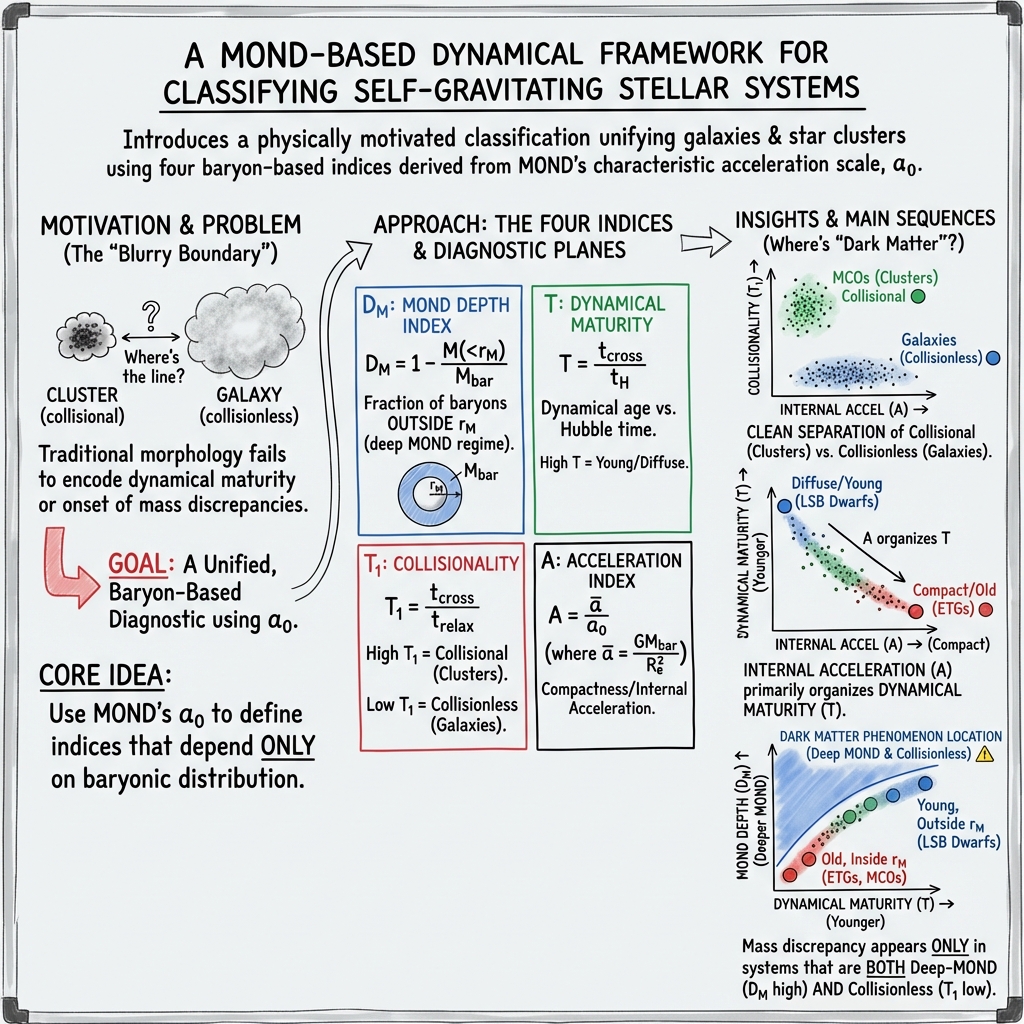
Abstract: Mass discrepancies in galaxies are empirically known to appear only below a characteristic acceleration scale a0. Here we show that this behaviour is not limited to galaxies: it extends continuously across the full hierarchy of self-gravitating stellar systems, from gas-rich dwarfs and spirals to massive early-type galaxies, and further down to compact stellar clusters. We introduce the Milgromian dynamics (MOND) depth index DM, together with dynamical maturity index T = tcross/tH, dynamical collisionality index T1 = tcross/trelax, with tcross being the crossing time, tH the Hubble time and trelax the median two-body relaxation time, and the MOND acceleration index A = abar/a0. We uncover a well-defined two-dimensional dividing surface in dynamical space. The "dark matter phenomenon" is found only in systems that are both in the deep-MOND regime (abar < a0) and collisionless (trelax > tH), while high-acceleration, collisional systems (abar > a0, trelax << tH), including globular clusters and UCDs, show no evidence for a mass discrepancy. This clean dynamical separation defines a new, physically motivated classification scheme for stellar systems, unifying galaxies and clusters under one framework. The observed division emerges naturally within the MOND framework and provides a useful diagnostic for examining how different gravitational paradigms account for the origin of the mass discrepancy.


Paper Prompts
Sign up for free to create and run prompts on this paper using GPT-5.
Top Community Prompts
Explain it Like I'm 14
A simple guide to “The MOND Depth Index and Dynamical Maturity Clock”
Overview: What is this paper about?
This paper introduces a new, simple way to sort and compare all kinds of star systems—big galaxies, tiny dwarf galaxies, and compact star clusters—using how strong gravity is inside them and how quickly they settle down over time. The authors use an idea called MOND (Modified Newtonian Dynamics), which says gravity behaves a bit differently when it is extremely weak, below a tiny acceleration scale called a₀. With this, they build a “dynamical clock” and a “depth index” to place galaxies and clusters on the same map and see patterns in how they form and age.
Main questions the paper asks
- Can we describe galaxies and star clusters with the same simple, physics-based measures instead of just using their shapes (like “spiral” or “elliptical”)?
- Is there a single number that tells how “deep” a system sits in the MOND (weak-gravity) regime and how mature it is dynamically?
- Do systems that show the “dark matter problem” (motions that look like mass is missing) share the same dynamical conditions?
- Can these measures reveal a clean boundary between galaxies and star clusters and explain why some systems are old and others are young?
How did they study it? (With simple analogies)
The authors define a few easy-to-compute “indices” from observed mass, size, and speeds—no dark matter needed, just the visible (baryonic) matter—and compare many real systems.
First, two time scales:
- Crossing time (t_cross): like “how long does it take a star to cross the system?” Shorter means quicker internal stirring.
- Relaxation time (t_relax): like “how long until stars’ gentle gravitational tugs have really mixed everything?” If this is longer than the age of the universe, stars don’t bump each other around much—this is “collisionless,” like a smooth crowd that doesn’t interact much.
They compare these to the Hubble time (t_H), the age of the universe (~14 billion years), to see how many “internal cycles” a system has had.
They also use MOND’s special acceleration a₀:
- When the average internal pull of gravity is weaker than a₀, systems act differently (this is where the “missing mass” behavior usually shows up).
Here are the four key indices they use, with plain-English meanings and quick analogies:
- MOND depth index (D_M): Measures what fraction of a system’s mass sits in the very weak-gravity (deep-MOND) zone. Analogy: Imagine a “gravity bubble” around the system—D_M tells how much mass lies outside that bubble where gravity is extra gentle. D_M near 1 means very spread-out and low-gravity; D_M near 0 means compact and strong-gravity.
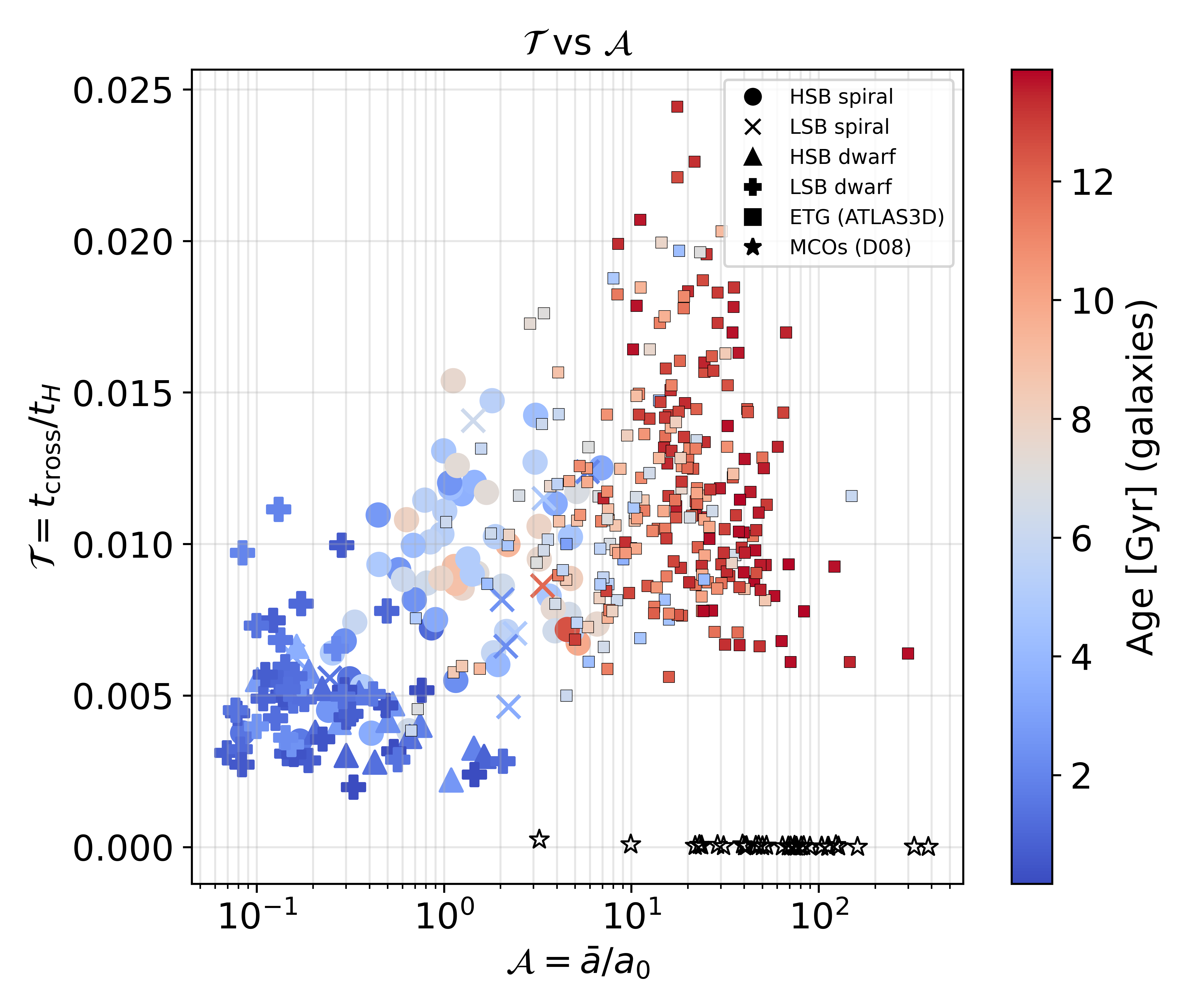
- Dynamical maturity index (T = t_cross / t_H): How many crossing-times fit into the universe’s age. Analogy: A “maturity clock.” Small T means it’s had lots of time to settle; large T means it’s still dynamically young.
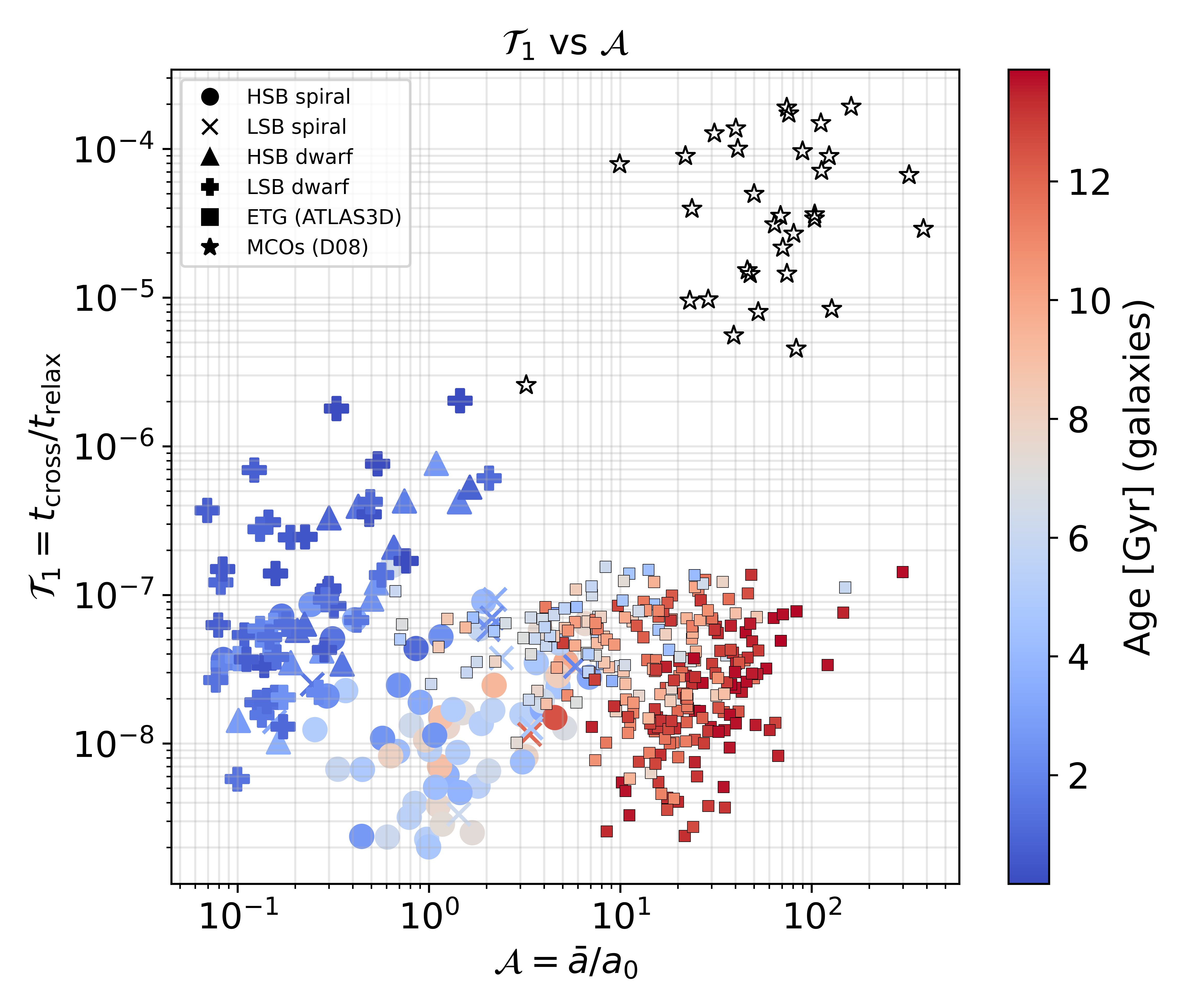
- Collisionality index (T₁ = t_cross / t_relax): Tells whether the system is “collisionless” (stars hardly affect each other individually) or “collisional” (star-by-star tugs matter over time). Analogy: A calm crowd (small T₁) versus a tightly packed, jostling crowd (large T₁).
- Acceleration index (A = average internal gravity / a₀): A compactness/acceleration measure. Analogy: How tight the system is packed—big A means tight and strong gravity; small A means diffuse and gentle gravity.
What data did they use?
- Early-type galaxies (big, often old ellipticals) from ATLAS³D.
- Spirals and dwarf galaxies (including very faint, spread-out ones) from the SPARC database.
- Compact star systems (globular clusters and ultra-compact dwarfs) from literature catalogs.
They calculated the four indices for each system and plotted them against each other to see patterns.
Main findings and why they matter
- A clean boundary between galaxies and star clusters:
- In the T₁–A plane, galaxies sit in the “collisionless” zone (their t_relax > t_H), while compact clusters are “collisional.” This recovers a classic physical split using simple, observed quantities.
- Where the “dark matter problem” shows up:
- The signs of “missing mass” only appear in systems that are both:
- in the deep-MOND regime (weak average gravity: A < 1), and
- collisionless (t_relax > t_H).
- High-acceleration, collisional systems like globular clusters and ultra-compact dwarfs do not show a mass discrepancy. This two-condition rule draws a sharp dividing surface in their “dynamical space.”
- The signs of “missing mass” only appear in systems that are both:
- A continuous sequence from clusters to galaxies:
- In the D_M–T and T–A plots, star clusters, dwarfs, spirals, and ellipticals fall along smooth, connected tracks. This suggests they’re not separate families but parts of a single, ordered “dynamical sequence.”
- A simple link to age (“downsizing” made intuitive):
- Systems that are compact and high-acceleration (low D_M, small T) are old and settled (like many ellipticals).
- Systems that are diffuse and low-acceleration (high D_M, larger T) are younger and more gas-rich (like many low-surface-brightness dwarfs).
- This matches the observed trend that big, dense galaxies formed stars early and quenched, while small, spread-out ones keep forming stars longer.
Why this matters:
- It offers a physics-based way (not just shapes or masses) to classify and compare all kinds of stellar systems.
- It shows that the “missing mass” behavior lines up with MOND’s low-acceleration rule plus being collisionless, giving a testable pattern across many systems.
What this could mean going forward
- A universal “map” for galaxies and clusters: These indices act like a galaxy version of the Hertzsprung–Russell diagram for stars—placing systems by their dynamical depth and maturity.
- A tool to test gravity ideas: Because the patterns depend on the a₀ scale from MOND, future data can check whether this framework keeps working across more systems (including very faint galaxies and those at earlier cosmic times).
- Practical classification: With just mass, size, and typical speeds, astronomers can estimate where a system sits on this map and predict whether it’s likely to show a mass discrepancy and how dynamically “old” it is.
In short, the paper proposes simple, observation-based measures that bring galaxies and star clusters under one roof, explain who looks “missing mass” and why, and connect structure (how compact or diffuse) to dynamical age and stellar history—all in a way that’s easy to apply and test.
Knowledge Gaps
Below is a single, concrete list of the paper’s key knowledge gaps, limitations, and unresolved questions that future work could address.
- Profile assumptions in D_M: The MOND depth index is computed with fixed profile choices (Hernquist for ETGs, exponential for disks), ignoring bulge–disk decompositions, non-Sérsic structures, gas thickness, and asymmetries; re-derive D_M using galaxy-specific mass maps (e.g., multi-component Sérsic/bulge+disk+gas) to quantify systematics.
- Gas components incompleteness: SPARC baryonic masses include H I+He but neglect molecular gas and hot/warm ionized phases; incorporate CO- and dust-based H2 estimates and ionized gas to reassess M_bar, r_M, and D_M.
- Inconsistent radius definitions: The indices mix R_e (spheroids) and R_d (disks) yet define ā using R_e; standardize on the 3D half-mass radius (or consistent projected half-light radius) across morphologies and test sensitivity of A and T to radius choice.
- Ambiguous characteristic radius for disks: t_cross = πR/V_c uses a “characteristic” radius without a fixed definition; evaluate impacts of using R_d, R_50, R_2.2, or the radius of peak rotation, and apply asymmetric-drift corrections where relevant.
- Gas pressure support in dwarfs: Many dwarfs are partially dispersion-supported; re-estimate V_c and t_cross with pressure-support corrections to avoid biasing T and A.
- Relaxation time realism: t_relax uses the equal-mass, single-component approximation; update t_relax using multi-mass (IMF), binaries, and remnants (including stellar-mass BH subsystems) to refine T_1 for MCOs and compact galaxies.
- MCO mass consistency: For MCOs the analysis uses M_dyn as a proxy for baryonic mass; homogenize to baryonic masses (or show that M_dyn ≈ M_bar) and quantify the bias from remnants and possible central BHs on A, t_cross, and T_1.
- External Field Effect (EFE) and environment: Indices are stated “primarily valid for non-satellites” and ignore EFE; extend the framework to include external accelerations from hosts/groups and recompute r_M, D_M, and A for satellites, group/cluster members, and UDGs.
- Environmental processing: Ram-pressure/tidal stripping alters gas fractions and mass distributions but is not modeled; test how environment-driven baryon loss moves systems in the (D_M, T, A, T_1) planes.
- Error propagation and statistical significance: No uncertainties or error bars are shown; propagate measurement errors in distance, radii, velocities, M/L, and gas masses to D_M, T, T_1, A and quantify scatter and the statistical significance of the “dividing surface.”
- Quantification of the “two-dimensional dividing surface”: The proposed separating surface is described qualitatively from 2D projections; fit and report a parametric surface in the 4D space with confidence intervals and identify outliers systematically.
- Sensitivity to a₀ and μ(x): Results assume a fixed a₀ and do not explore dependence on the MOND interpolation function; test robustness of the planes and the dividing surface to plausible a₀ shifts and to different μ(x) choices (AQUAL vs QUMOND implementations).
- Global vs local accelerations: D_M compresses the continuous acceleration field into a single mass-fraction metric; compare D_M to alternative, more local metrics (e.g., mass-weighted acceleration distribution, A at multiple radii) to see if the separation tightens.
- Time evolution and causality: D_M is proposed as a “clock,” but temporal evolution is not demonstrated; use MOND-based hydrodynamical/N-body simulations to track how (D_M, T, A, T_1) evolve through collapse, compaction, feedback, and quenching.
- High-redshift applicability: The analysis is local (z ≈ 0) and uses a fixed Hubble time; test redshift evolution with high-z samples (e.g., JWST) and assess whether the planes and the dividing surface persist when using t_H(z) and evolving baryon structure.
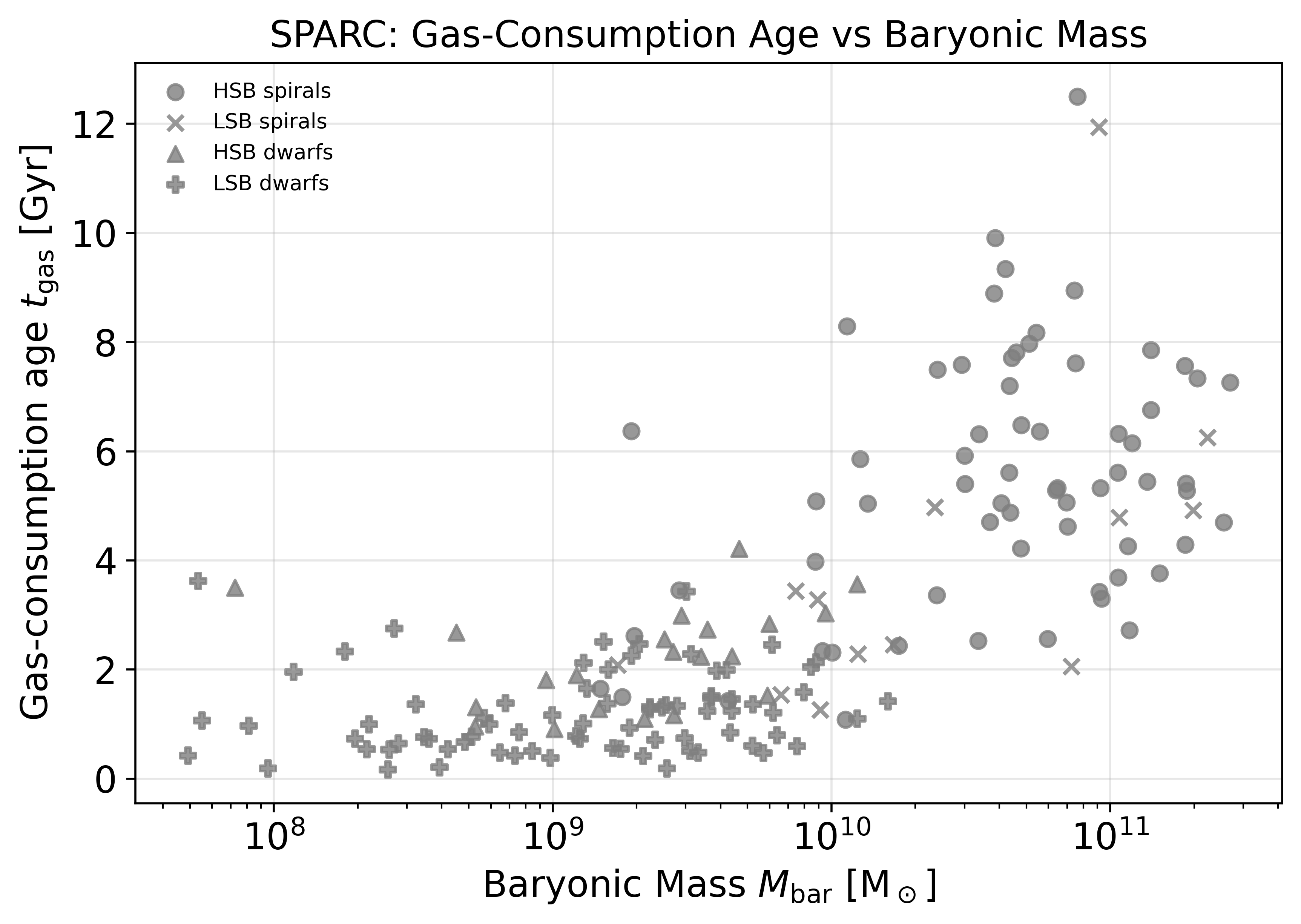
- Age calibration for disks: Gas-consumption “ages” (t_gas) are crude proxies; obtain homogeneous stellar-population ages (e.g., spectral fitting) and SFR-based depletion times to verify the age–D_M/T correlations across the full SPARC-like sample.
- Sample selection biases: SPARC preferentially contains systems with high-quality H I rotation curves; quantify how this selection and LSB threshold choices bias the coverage of surface brightness and acceleration regimes.
- Radial quenching and SFHs: The age–dynamics link is presented globally; test whether radial stellar-population gradients correlate with local acceleration regimes and with a radially resolved D_M surrogate.
- Applicability to non-equilibrium systems: Interacting/merging galaxies and starbursts are not treated; evaluate how transient non-equilibrium conditions perturb the indices and whether outliers systematically arise in these phases.
- Disks with bars/warps: Non-axisymmetry can bias V_c and inferred ā; incorporate bar/warp corrections or exclude strongly barred/warped systems to test robustness of the planes.
- ETG structure diversity: ETGs are modeled with a single Hernquist scale length; repeat with deprojected Sérsic fits (varying n), embedded disks, and central mass deficits to refine M(<r_M) and D_M.
- Tidal dwarfs and outliers: Known systems (e.g., tidal dwarfs, some satellites with high dispersions, cluster UDGs) are excluded or underrepresented; explicitly test whether they follow or violate the proposed dividing surface.
- Comparison with ΛCDM: The paper argues physical motivation in MOND but lacks a direct benchmark; build ΛCDM mock catalogs with realistic baryon–halo coupling to test whether analogous planes/dividing surfaces arise without a universal a₀.
- Consistency of index definitions across morphologies: A mixes Re-based definitions with disk parameters; audit and standardize index computations to avoid morphology-dependent systematics.
- Distance and M/L uncertainties: Variations in distances and stellar M/L (including IMF gradients) are not propagated; evaluate their impact on M_bar, r_M, A, and D_M, especially for ETGs where IMF variations are significant.
- Reproducibility and data products: The paper states data are included but does not supply code or full catalogs of derived indices; release computation code, priors (IMF, M/L), and per-object uncertainties for community validation.
- Cluster-scale extension: The framework is not tested for galaxy groups/clusters where MOND faces residual discrepancies; explicitly compute indices for BCGs, cluster galaxies, and cluster baryon distributions to examine the claimed universality.
- Choice of single-number “clock”: D_M depends on a sharp r_M threshold; explore continuous alternatives (e.g., integral over μ(g/a₀) or acceleration-weighted timescales) that may better capture intermediate regimes and reduce profile dependence.
- Robustness of morphological splits: The dwarf/spiral separation via T-type and LSB threshold may misclassify edge cases; test the sensitivity of results to alternative morphology and LSB criteria.
Practical Applications
Immediate Applications
The paper introduces four baryon-based dynamical indices—MOND depth index , dynamical maturity , collisionality , and acceleration index —and shows that galaxies and stellar clusters occupy well-defined loci in diagnostic planes built from these indices. The following use cases can be deployed now with existing data and infrastructure:
- Target selection and null-test design for gravity/kinematics studies
- Sectors: academia, observatories
- Potential tools/workflows:
- Use the paper’s “dividing surface” (mass discrepancy appears only for systems with and ) to prioritize:
- Deep-MOND, collisionless systems (high , low ) for testing mass discrepancies and rotation-curve fits.
- High-acceleration, collisional systems (low , high ; e.g., globular clusters/UCDs) as null tests where no discrepancy is expected.
- Apply to existing samples (SPARC, ATLAS3D, MaNGA/SAMI, PHANGS, H I surveys) to build shortlists for new spectroscopy/H I mapping.
- Assumptions/dependencies: reliable baryonic masses, radii, and kinematics; isolation (indices are calibrated for non-satellite systems); profile choices (Hernquist/exponential) approximate true mass distributions.
- Unified, physically motivated classification in archives and catalogs
- Sectors: academia, software/data infrastructure (e.g., CDS/VizieR, NED, SIMBAD)
- Potential tools/workflows:
- Add columns for , , , to public catalogs and institutional databases.
- Tag systems along the “dynamical HR diagram” spine to harmonize galaxies, UCDs, and clusters under a single physical scheme.
- Assumptions/dependencies: consistent radii definitions across surveys; propagated uncertainties for and ; adoption of a fiducial .
- Observation planning and telescope time allocation heuristics
- Sectors: observatories, space agencies, time-allocation committees
- Potential tools/workflows:
- Score proposals by expected discriminating power given a target’s location (e.g., “transition” objects near the dividing surface).
- Balance portfolios across the dynamical maturity sequence (from LSB dwarfs with high to ETGs/MCOs with low ).
- Assumptions/dependencies: indices computed consistently in proposal tools; sensitivity estimates mapped to required precision in , , , .
- Quality control and anomaly detection in survey pipelines
- Sectors: software, survey operations (LSST, DESI, HSC-SSP, Euclid, Roman)
- Potential tools/workflows:
- Flag objects that occupy implausible regions of the plane (e.g., extreme deep-MOND but very low without commensurate compactness), prompting data rechecks.
- Cross-validate derived stellar ages/gas fractions against position in the dynamical planes; inconsistencies can reveal reduction/calibration issues.
- Assumptions/dependencies: stable pipeline estimates of , , and ; environmental flags (satellites vs isolated).
- Education, outreach, and citizen science enhancements
- Sectors: education, museums, EdTech, citizen science (e.g., Galaxy Zoo)
- Potential tools/workflows:
- Interactive “galactic HR diagram” dashboards plotting to teach dynamical states and evolution.
- New labeling tasks that move beyond morphology to “dynamical maturity” and “MOND depth,” improving public understanding and engagement.
- Assumptions/dependencies: simplified index calculators with uncertainty visualizations; explanatory materials about limitations and environmental caveats.
- Open-source computation library and reproducible notebooks
- Sectors: academia, software
- Potential tools/workflows:
- A Python/R package that ingests standard catalog columns (e.g., , , /, /) and outputs , , , , with propagated uncertainties.
- Ready-to-run notebooks for SPARC, ATLAS3D, and MCO datasets to facilitate immediate reanalysis.
- Assumptions/dependencies: chosen interpolation profiles and value documented; support for batch processing and unit handling.
- Empirical feature engineering for machine learning
- Sectors: academia, data science
- Potential tools/workflows:
- Use as physically meaningful features to predict stellar ages, gas fractions, or kinematic outliers, improving interpretability over morphology-only inputs.
- Assumptions/dependencies: training labels (e.g., ages) must be homogeneous; indices computed with consistent definitions across the training set.
- Consensus support for “what is a galaxy?” in catalogs and communications
- Sectors: academia, policy in nomenclature/standards
- Potential tools/workflows:
- Adopt (collisionless versus collisional) plus as transparent, physics-based discriminants in classification notes and public-facing descriptions (e.g., UCDs vs dwarfs).
- Assumptions/dependencies: community agreement that two-body relaxation threshold () is an operational criterion; recognition of environmental exceptions.
Long-Term Applications
The framework suggests new instruments, surveys, standards, and theoretical programs that require further research, scaling, or development before deployment:
- Next-generation, targeted surveys around the “dividing surface”
- Sectors: observatories, space agencies (JWST, Roman, Euclid, SKA, ALMA), academia
- Potential tools/workflows:
- Design multiwavelength campaigns focused on systems near and to test the universality and sharpness of the separation.
- Measure low-surface-brightness structure and kinematics with sensitivity/IFU designs optimized for accurate and in diffuse regimes.
- Assumptions/dependencies: instrument sensitivity to faint outer disks/envelopes; robust treatment of environmental effects (e.g., satellites, external-field effects); consistent baryonic mass modeling.
- Standardization of a dynamical taxonomy for IAU-endorsed catalogs
- Sectors: policy/standards, archives
- Potential tools/workflows:
- Establish community guidelines to include , , , in future data releases and to report uncertainties in a standardized way.
- Assumptions/dependencies: broad community buy-in; cross-survey calibration of radii, masses, and kinematics; versioned conventions and profile choices.
- Real-time, on-the-fly classification and broker integration
- Sectors: survey operations (time-domain and spectroscopic surveys), software
- Potential tools/workflows:
- Embed index calculators in alert brokers/schedulers for dynamic follow-up (e.g., prioritize newly discovered LSB systems with high for H I or IFU observations).
- Assumptions/dependencies: sufficient metadata in real time (distance, , proxies); robust photometric-to-mass conversions at low S/N.
- MOND-informed (and DM-agnostic) forward models in galaxy formation simulations
- Sectors: academia (theory/simulation), HPC, software
- Potential tools/workflows:
- Implement these indices as diagnostics in hydrodynamical and semi-analytic models, comparing predicted occupancy of planes to observations.
- Develop MOND-compatible N-body/hydro codes that reproduce the observed sequences and test sensitivity to feedback and assembly histories.
- Assumptions/dependencies: availability of mature MOND solvers; baryonic physics uncertainties (feedback, IMF); careful comparison frameworks versus CDM predictions.
- Extension to groups and clusters; joint lensing–dynamics tests
- Sectors: academia, observatories
- Potential tools/workflows:
- Generalize the indices (or define analogs) for galaxy groups/clusters to probe the cluster-scale residuals in MOND and evaluate recent amendments.
- Combine weak/strong lensing with dynamical indices for consistency checks across scales.
- Assumptions/dependencies: theoretical extensions at cluster scales; precise baryonic mass maps (ICM, intracluster light); inclusion of external fields.
- High-redshift applications with JWST and future facilities
- Sectors: academia, observatories
- Potential tools/workflows:
- Track the evolution of populations in the dynamical planes over cosmic time; test whether early compact galaxies populate the low-, low- region as predicted.
- Assumptions/dependencies: accurate structural/kinematic measurements at high ; evolving incorporated; morphological k-corrections and mass-to-light uncertainties.
- Decision-support for mission design and instrument requirements
- Sectors: space agencies, instrumentation
- Potential tools/workflows:
- Translate required precision in into instrument specifications to distinguish regimes across the dividing surface with statistical confidence.
- Assumptions/dependencies: end-to-end sensitivity modeling; realistic observation time budgets for diffuse systems.
- Public-facing platforms and curricula built around a “Dynamical HR Diagram”
- Sectors: education, outreach, EdTech
- Potential tools/workflows:
- Develop curricula and museum exhibits that show galaxy evolution across , integrating with data portals that update as surveys release new data.
- Assumptions/dependencies: sustainable data pipelines; partnerships with observatories and education providers.
Cross-cutting assumptions and dependencies (affecting most applications)
- Physical assumptions:
- Universal MOND acceleration scale is adopted; results remain useful as empirical classifiers even if used in a DM framework, but MOND-specific predictions depend on .
- Indices are most reliable for isolated systems; satellites (e.g., MW dwarfs) can be affected by environmental processes and external fields.
- Data/modeling assumptions:
- Baryonic mass estimates rely on stellar mass-to-light ratios and gas mass measurements; structural profiles (Hernquist/exponential) approximate true distributions.
- Consistent definitions of radii (, , ) and kinematic measures (, ) across surveys are required.
- Hubble time and cosmological parameters must be consistently applied; uncertainties should be propagated into index errors.
- Feasibility and adoption:
- Community standards and pipeline integration will determine the pace of adoption in catalogs and survey operations.
- Instrumental sensitivity to LSB outskirts and accurate kinematics in diffuse systems are often the limiting factors.
Glossary
- Acceleration index (𝒜): A dimensionless measure of a system’s mean internal acceleration relative to the MOND scale, defined as 𝒜 = ǡ/a₀. "acceleration index, "
- ATLAS3D survey: An integral-field survey of nearby early-type galaxies used here for masses, radii, and ages. "ATLAS (ETGs)"
- Baryonic Tully--Fisher relation: An empirical relation linking a galaxy’s baryonic mass to its asymptotic rotation velocity. "the baryonic Tully--Fisher relation"
- Circular velocity: The rotation speed of material in a circular orbit at a given radius in a galaxy. "using the circular velocity "
- Collisionality index (𝒯₁): A dimensionless ratio of crossing time to two-body relaxation time that diagnoses whether a system is collisional. "dynamical collisionality index "
- Crossing time: The characteristic time for a star or gas parcel to traverse the system’s characteristic size. "The first fundamental quantity is the dynamical or crossing time"
- De Vaucouleurs T-type: A numerical morphological classification of galaxies used to distinguish spirals from dwarfs here. "de Vaucouleurs -type"
- Deep-MOND regime: The low-acceleration domain in MOND where internal accelerations are below a₀ and dynamics become scale-invariant. "deep-MOND regime ()"
- Downsizing phenomenon: The trend that more massive galaxies form and quench earlier than less massive ones. "The~downsizing phenomenon in which massive ETGs assemble early and quench rapidly is well established"
- Dynamical maturity index (𝒯): A dimensionless ratio comparing crossing time to the Hubble time, 𝒯 = t_cross/t_H. "dynamical maturity index "
- Early-type galaxies (ETGs): Elliptical and lenticular galaxies, typically pressure-supported and dynamically old. "early-type galaxies (ETGs)"
- Effective radius (R_e): The radius enclosing half of a galaxy’s total light, often used as a characteristic scale. "effective radius"
- Exponential disk: A disk mass profile whose surface density decreases exponentially with radius. "an exponential disk with scale length "
- Gas-consumption age (t_gas): A proxy timescale for star formation history estimated from gas fraction and a depletion law. "The gas-consumption age "
- Gas fraction (f_gas): The ratio of gas mass to total baryonic mass in a galaxy. "the global gas fraction"
- H I (neutral hydrogen): Atomic hydrogen traced via the 21 cm line, used to measure gas content and kinematics. "H\,{\sc i} measurements"
- Half-light radius: The radius that contains half of a system’s total luminosity. "half-light or effective radius"
- Half-mass radius (R_h): The radius enclosing half the total mass of a stellar system, used in relaxation estimates. "half-mass radius "
- Hernquist profile: A spherical density profile used to model early-type galaxies’ mass distributions. "a Hernquist profile"
- Hertzsprung–Russell (HR) diagram: A stellar classification diagram relating luminosity and temperature; used here by analogy for galaxies. "HertzsprungâRussell (HR) diagram"
- High-surface-brightness (HSB): Galaxies with relatively high central surface brightness. "high-surface-brightness (HSB) spirals"
- Hubble time (t_H): The inverse of the Hubble constant, representing the age of the Universe. "the Hubble time"
- Interpolation function μ(x): In MOND, the function that transitions between Newtonian and deep-MOND regimes in the modified Poisson equation. " an interpolation function"
- Lambda Cold Dark Matter (ΛCDM) framework: The standard cosmological model featuring dark energy (Λ) and cold dark matter. "the standard CDM framework"
- Line-of-sight velocity dispersion (σ): The spread in stellar velocities along the observer’s line of sight, used in pressure-supported systems. "line-of-sight velocity dispersion"
- Low-surface-brightness (LSB): Galaxies with low central surface brightness and typically diffuse stellar distributions. "low-surface-brightness (LSB) disks"
- Massive Compact Objects (MCOs): A class including globular clusters and UCDs with high densities and small sizes. "Massive Compact Objects (MCOs)"
- Median two-body relaxation time: The timescale over which stellar encounters significantly redistribute energies in a system. "the median two-body relaxation time"
- Milgromian dynamics (MOND): A modified-gravity framework introducing a characteristic acceleration scale a₀ for galactic dynamics. "Milgromian dynamics (MOND), originally proposed by \citet{1983ApJ...270..365M}"
- MOND acceleration constant (a₀): The fundamental acceleration scale in MOND delineating Newtonian from deep-MOND behaviour. "MOND acceleration constant "
- MOND depth index (D_M): A dimensionless structural index measuring what fraction of baryonic mass lies outside the MOND radius. "MOND depth index "
- MOND radius (r_M): The radius where the Newtonian acceleration GM/r² equals a₀, marking the onset of deep-MOND behaviour. "MOND radius "
- Newtonian regime: The high-acceleration domain where standard Newtonian gravity applies. "(Newtonian regime)"
- Poisson equation: The fundamental equation relating mass density to gravitational potential; modified in MOND. "modifies the Poisson equation"
- Pressure-supported (system): A system where random motions (velocity dispersion) provide support against gravity. "pressure-supported early-type galaxies (ETGs)"
- Radial-acceleration relation: An empirical correlation between observed accelerations and those predicted by baryons in galaxies. "the radial-acceleration relation"
- Relaxation time: The timescale for stellar encounters to alter orbits significantly; long in galaxies, shorter in clusters. "two-body relaxation times"
- Rotationally supported (disk): A system where ordered rotation provides the main support against gravity. "rotationally supported disks"
- Sersic index: A parameter describing the concentration of a galaxy’s light profile in the Sersic model. "Sersic index"
- SPARC database: A compilation of galaxy rotation curves and photometry used to study disk dynamics. "SPARC database"
- Tidal stripping: The removal of material from a galaxy due to gravitational forces from a larger body. "ram-pressure or tidal stripping"
- Ultra-compact dwarfs (UCDs): Dense, compact stellar systems bridging massive star clusters and dwarf galaxies. "ultra-compact dwarfs (UCDs)"
- Ultra-diffuse (galaxies): Very low surface-brightness, extended galaxies with large sizes relative to their luminosity. "ultra-diffuse or LSB systems"
- Virial equilibrium: The dynamical state where a system satisfies the virial theorem, typically after several crossing times. "virial equilibrium"
- Virial theorem: The relation 2K + W = 0 linking kinetic and potential energies in gravitational equilibrium. "virial theorem, \begin{equation} 2K + W = 0 , \end{equation}"
- Violent relaxation: A rapid collective process driving systems toward equilibrium without relying on two-body encounters. "violent relaxation"
- Ram-pressure stripping: The removal of gas from a galaxy due to pressure from an ambient medium during motion. "ram-pressure or tidal stripping"
- Space-time scale-invariant (form): A form of the MOND acceleration law in the deep-MOND limit exhibiting scale invariance. "the space-time scale-invariant form"
Collections
Sign up for free to add this paper to one or more collections.