- The paper introduces SLSim, a novel package that synthesizes realistic strong lensing populations and images through an integrated modular architecture.
- It combines astrophysical and variability modeling with survey-specific image simulation to accurately mimic LSST, Roman, and Euclid observations.
- Validation against observational data confirms that SLSim meets the scalability and precision needed for advanced cosmological and transient studies.
SLSim: A Comprehensive Framework for Simulating Strong Lensing Populations
Introduction and Motivation
SLSim ("SLSim: a strong lensing population simulation package" (2603.17138)) is an open-source, modular simulation environment that addresses the pressing need for large, realistic datasets necessary for strong lensing science in the era of deep imaging and time-domain surveys such as LSST, Euclid, and Roman. Strong gravitational lensing provides unique probes of cosmological parameters, the distribution of dark matter, and transient astrophysics, but exploiting upcoming lens-rich surveys demands accurate, scalable forward simulations that combine complex astrophysical models with survey-specific systematics and realistic noise. Existing solutions have not provided close integration of source and deflector population synthesis, image-level simulations, transient handling, and survey injection pipelines at sufficient scale and flexibility. SLSim is designed to fill this gap.
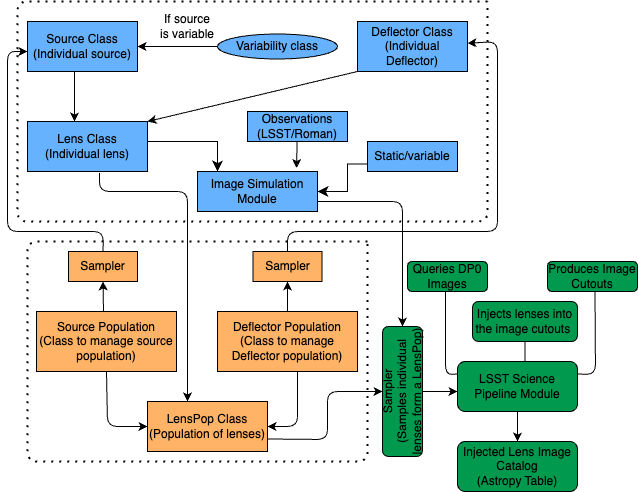
Figure 1: Modular architecture of SLSim, showing components for individual object handling, population management, and LSST science pipeline integration, enabling realistic and survey-informed strong lens image catalogs.
Software Architecture and Simulation Flow
SLSim organizes simulation logic into distinct classes and modules corresponding to source properties, deflector modeling, population synthesis, lens configuration calculation, and image simulation. At the catalog level, it enables the generation of statistically robust lens populations spanning static and transient scenarios, with detailed configuration for deflector types (e.g., galaxies, halos, clusters) and source types (extended galaxies, quasars, supernovae). The modular architecture allows replacement of astrophysical ingredient models and adaptation to new surveys.
Survey realism is achieved via dedicated modules for image simulation and survey integration. The image simulation module generates static and time-variable lens image series, incorporating user-supplied PSF, observational depth, zeropoint, and background parameters. The LSST pipeline module supports direct injection of simulated lenses into DP0.2 cutouts or synthetic backgrounds derived from the Rubin Operations Simulator (OpSim), ensuring that simulated images propagate through the same analysis chains as real survey data.
Astrophysical Modeling and Population Synthesis
Key modules implement robust astrophysical modeling for both sources and deflectors:
- Deflector Population: Supports elliptical and spiral galaxies, halo-based mass profiles (EPLSersic, NFWCluster, NFWHernquist), and cluster-scale lenses, with velocity dispersion sampling using SDSS-calibrated functions and abundance matching. It leverages external packages (skypy, SL-Hammocks) for population synthesis and halo model deflector assignment.
- Source Population: Handles extended galaxies, point sources (quasars, SNe), and hybrid hosts for variable point sources, using galaxy catalogs, empirical luminosity functions, and evolutionary models to ensure statistical consistency with observed properties.
- Variability and Light Curve Models: Includes physically-motivated lightcurve synthesis for quasars (reverberation, thin disk/lamppost models) and SNe (sncosmo), with time series handling for multi-epoch, multi-band simulated images.
The population-level approach employs a computationally-optimized pairing strategy: for each deflector, only nearby sources likely to yield detectable strong lensing are tested, reducing unnecessary lens equation solutions.
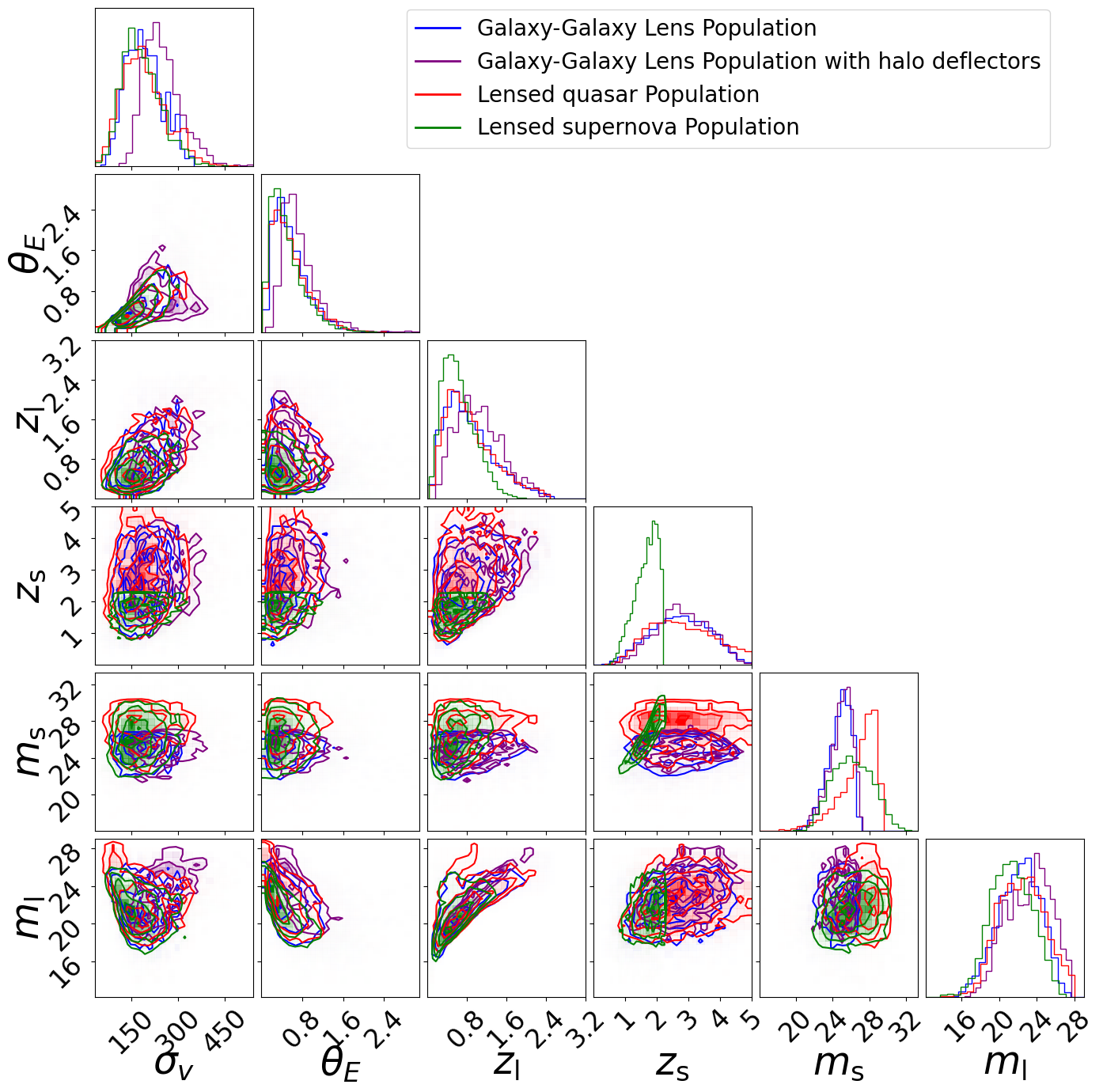
Figure 2: SLSim-generated lens populations for various categories—galaxy-galaxy, cluster, lensed quasar, and lensed supernovae—across large areas, with key parameters visualized.
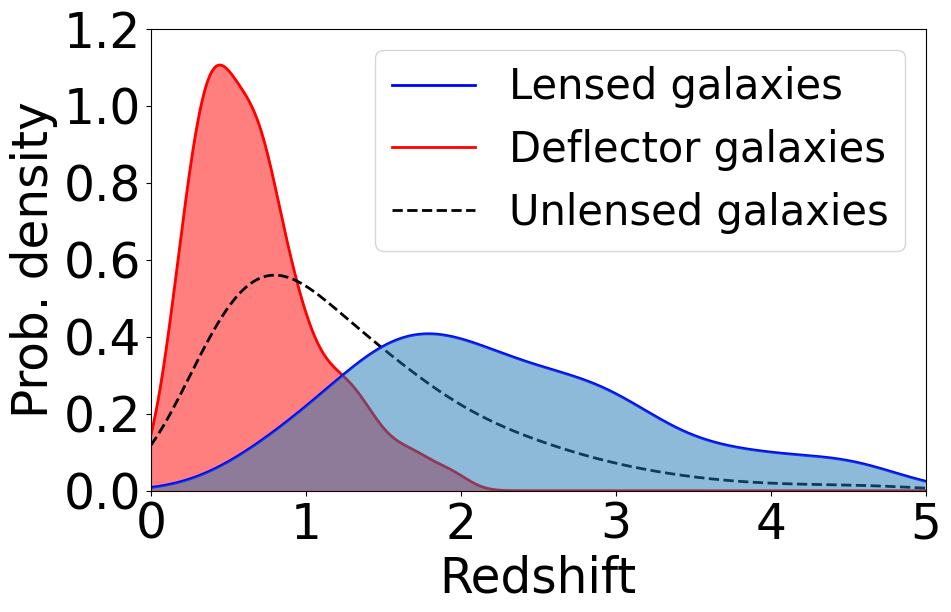
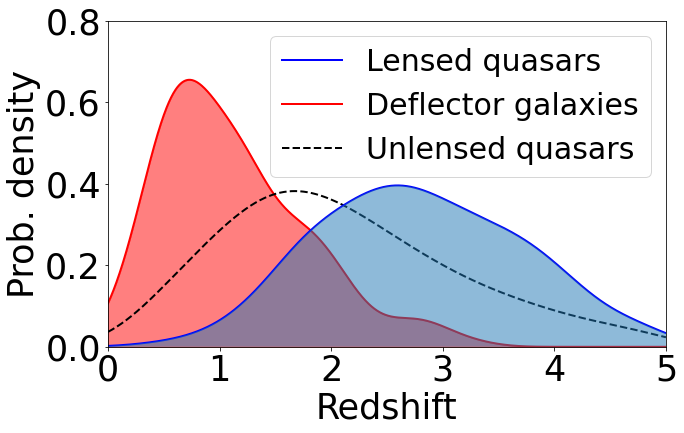
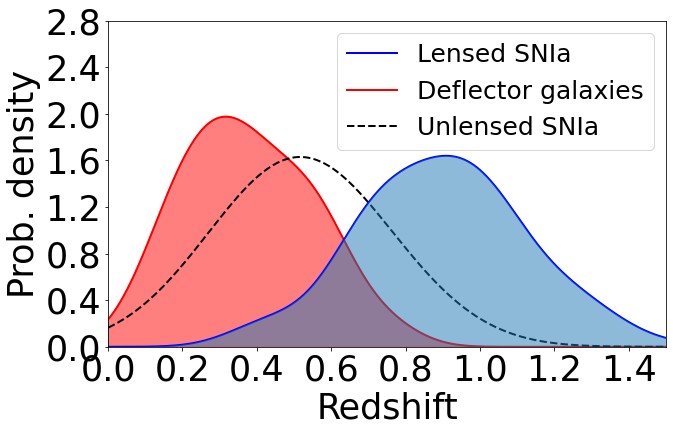
Figure 3: Redshift distributions for deflectors, lensed sources, and unlensed populations in simulated galaxy-galaxy, quasar, and supernova samples.
Image Level Simulation and Injection Pipelines
SLSim's image simulation capabilities are designed for realism and versatility:
- Static and Variable Lenses: Supports generation of high-fidelity images and time series, for both resolved host galaxies and unresolved point-like variable sources.
- Noise and Instrument Response: Users can specify instrument noise, PSF, background, and photometric calibration, enabling survey-specific matching.
- Data Injection: Through integration with the LSST Science Platform and OpSim-derived synthetic backgrounds, SLSim injects lenses into genuine survey images or representative simulations for both discovery and performance benchmarking.
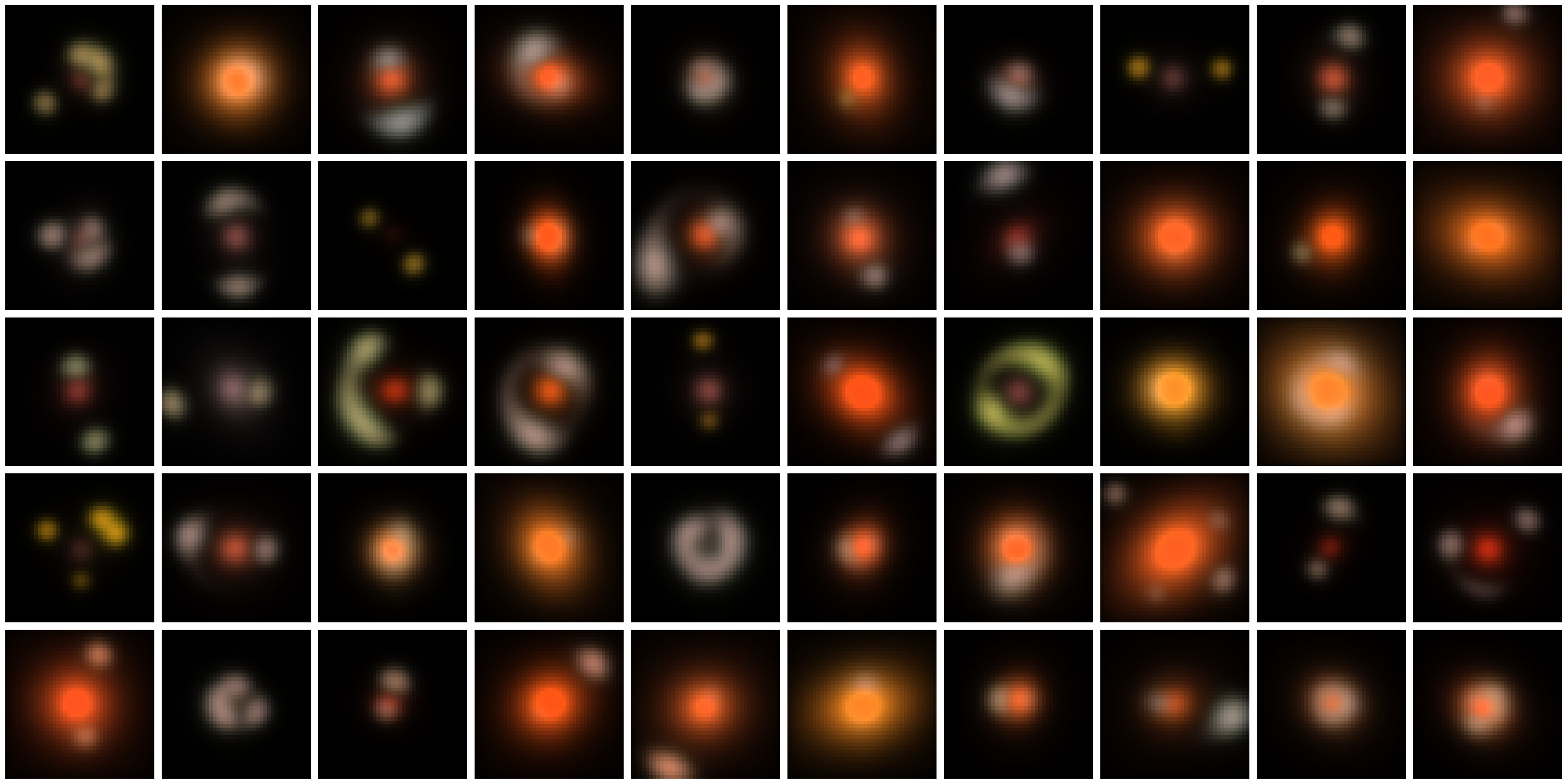
Figure 4: Galaxy-galaxy lens images simulated by SLSim, showing realistic arc morphologies in multi-band RGB composites.
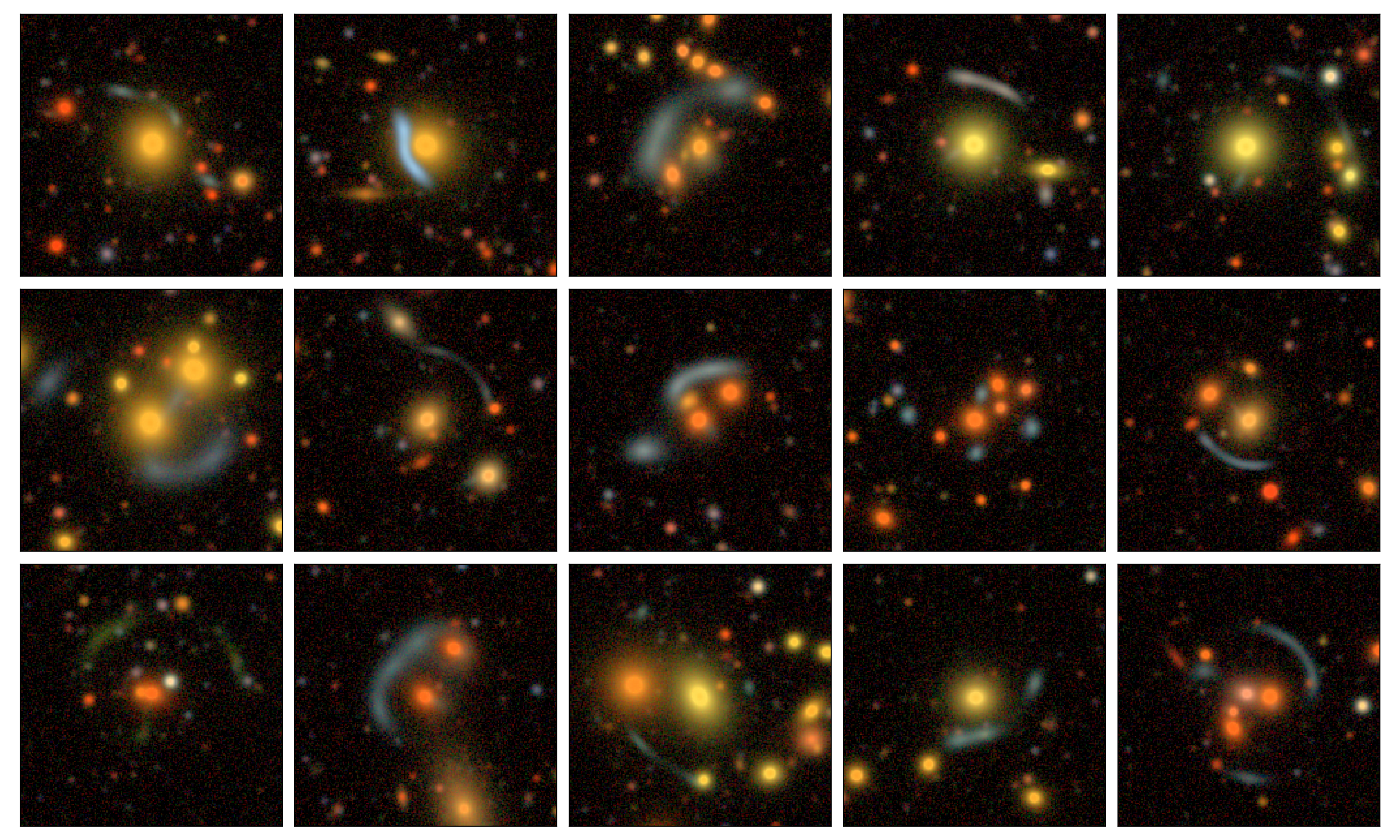
Figure 5: Examples of cluster-scale strong lensing systems created and injected into simulated LSST survey data.
Validation against external datasets and synthetic standards is central to SLSim's design:
- Population Consistency: SLSim-generated luminosity and velocity-dispersion functions, as well as redshift distributions, agree with theoretical Schechter functions and survey-calibrated measurements.
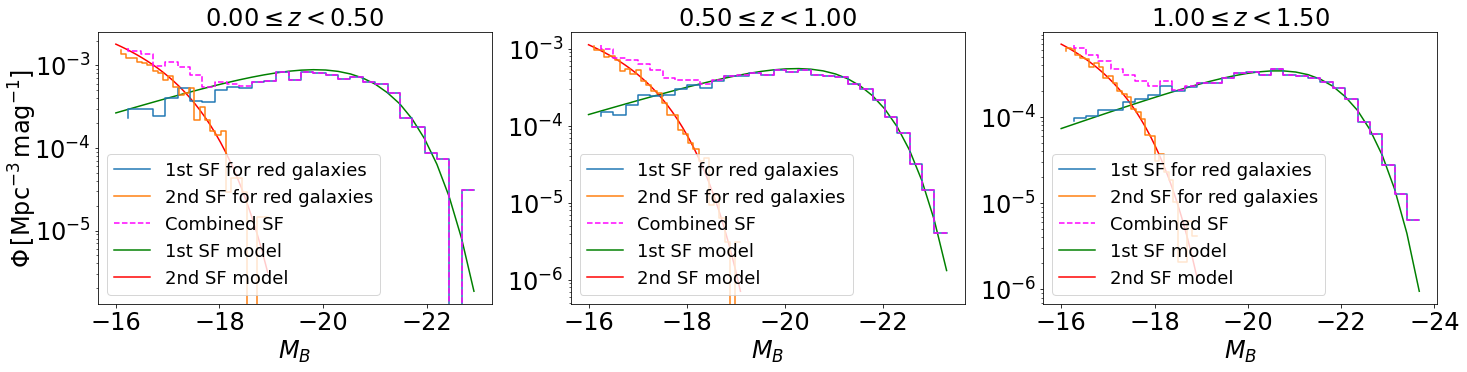
Figure 6: Elliptical galaxy luminosity function from SLSim compared to model predictions. SLSim tracks both giant and dwarf populations closely.
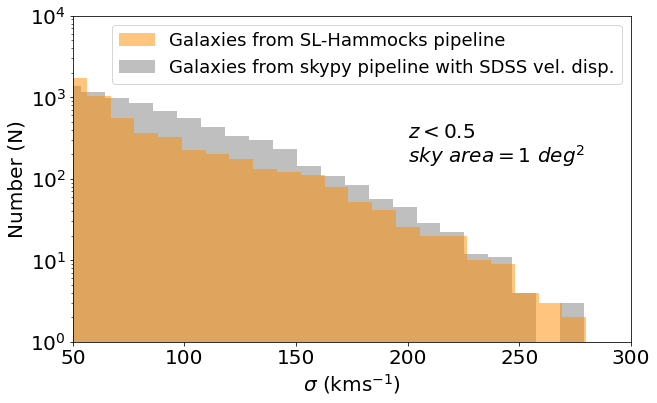
Figure 7: Velocity dispersion distributions for galaxies synthesized by skypy and SL-Hammocks pipelines, benchmarking against SDSS calibration.
- Image Fidelity: Galaxy and lens image simulations show pixel-level agreement with DP0.2 images across bands, and residuals demonstrate that SLSim's image modules reproduce LSST realistic data within noise limits.
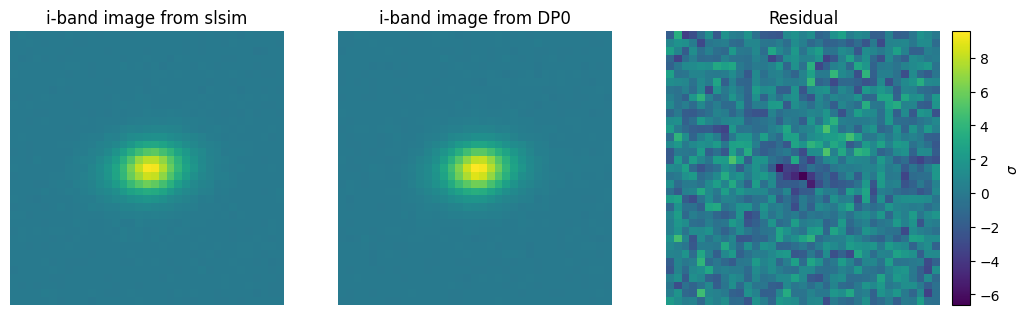
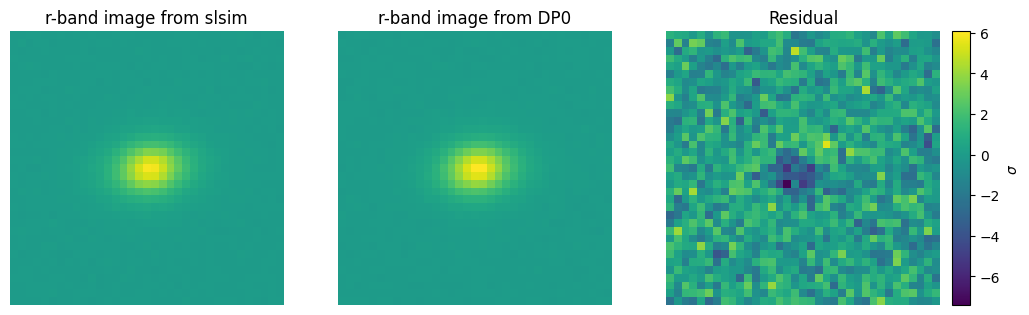
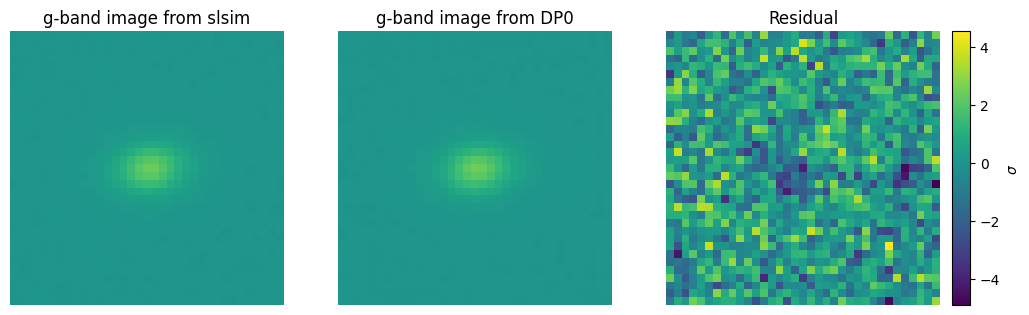
Figure 8: Detailed comparison between SLSim-simulated images and LSST DP0.2 images, with residuals visualized in units of image noise.
- Transient and Variability Modeling: SLSim successfully reproduces realistic variable lightcurves and microlensing signatures in quadruply-lensed AGN, enabling robust end-to-end tests of time-domain analysis chains.
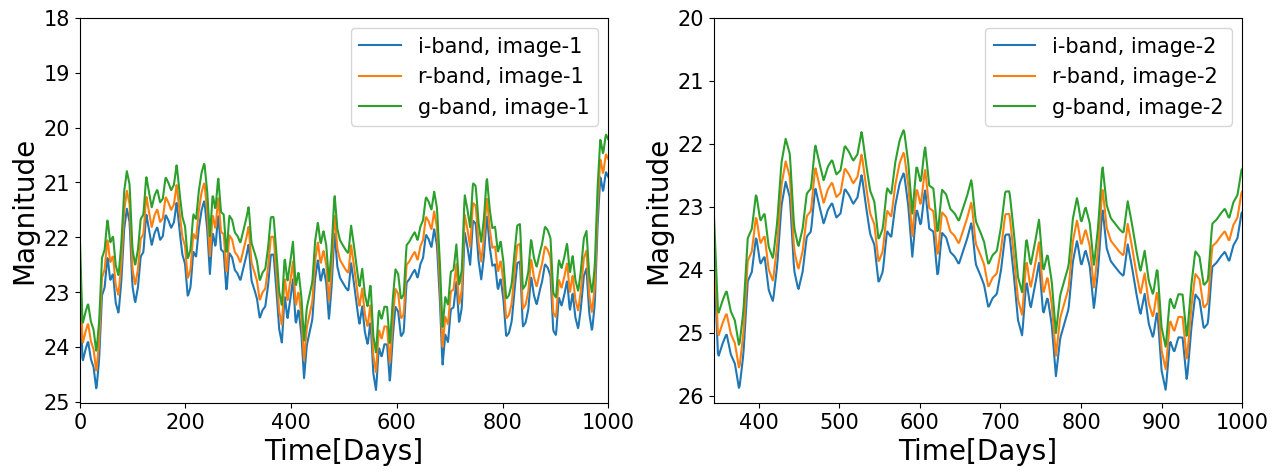
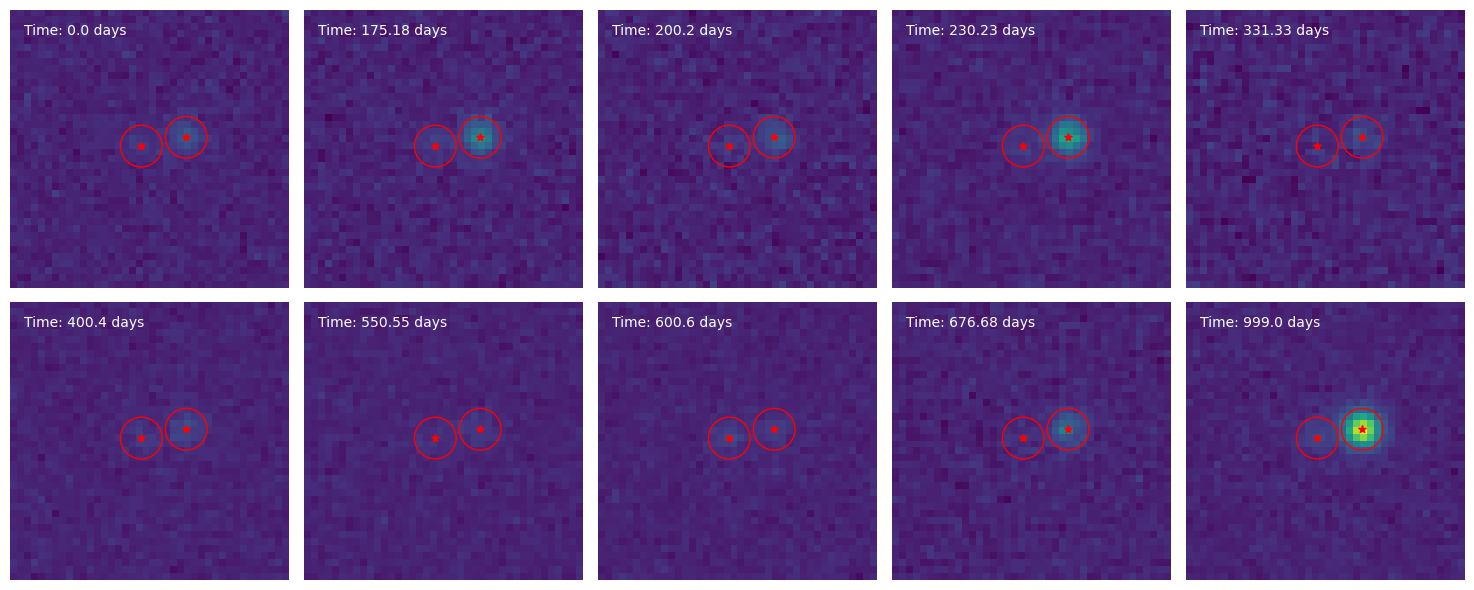
Figure 9: Top—quasar variable light curves for multiple images; Bottom—corresponding variable image series after injection into realistic backgrounds.
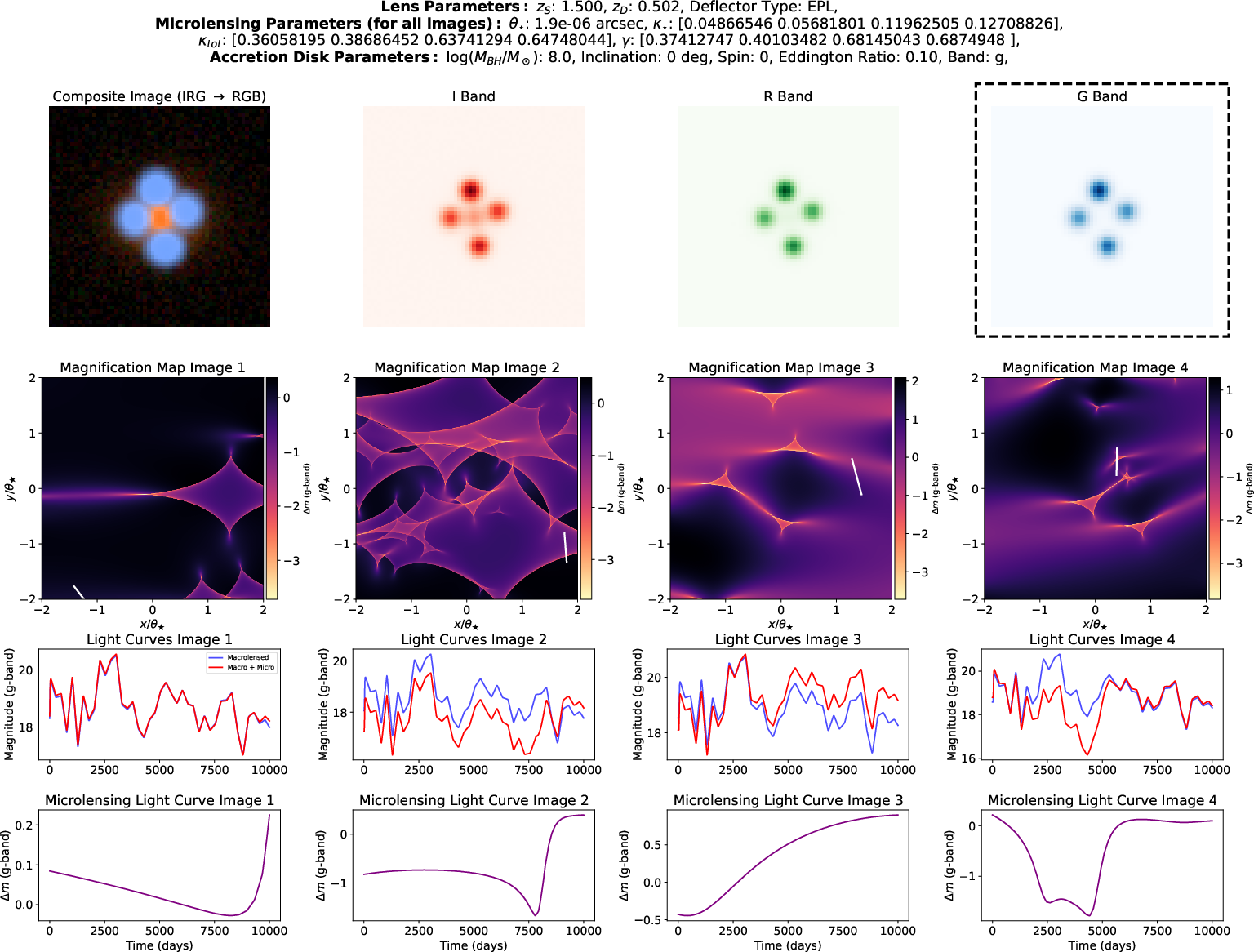
Figure 10: Simulated quadruply-lensed variable quasar with microlensing maps, showing both total and microlensed variability curves for individual images.
- Population Injection: Using OpSim and DP0.2, SLSim produces large catalogs of lenses for injecting into real or synthetic images, supporting both static and transient science in survey pipelines.
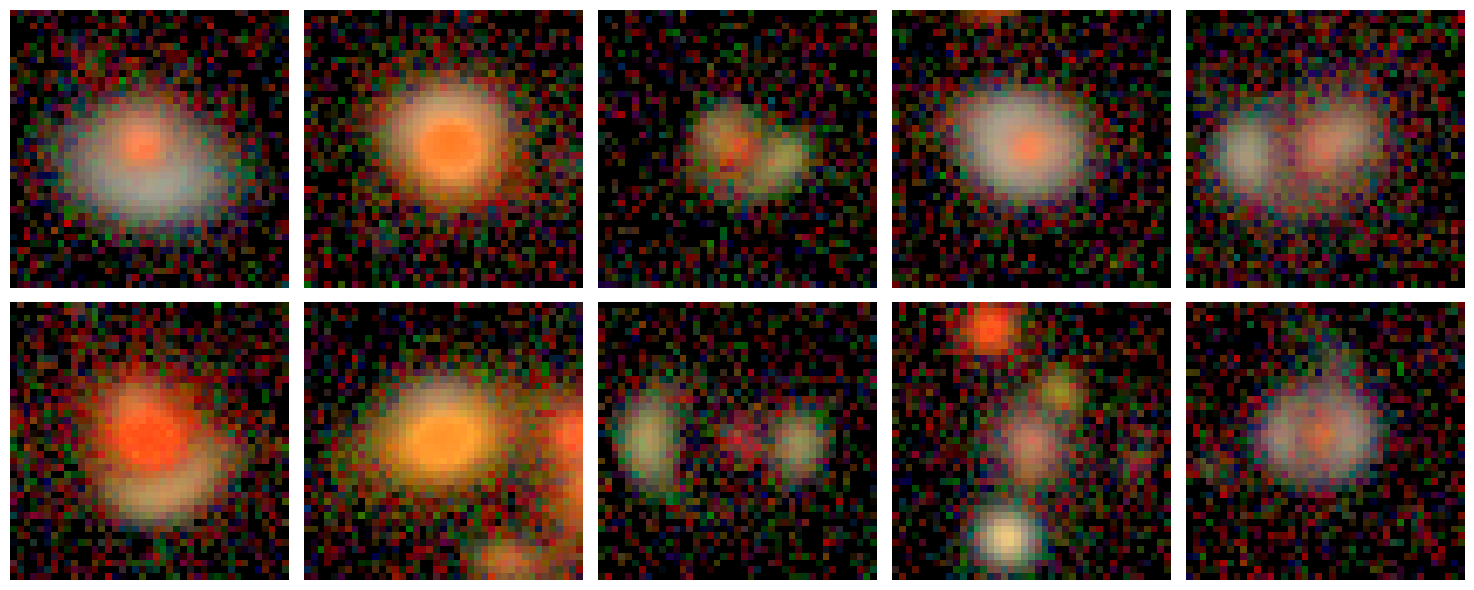
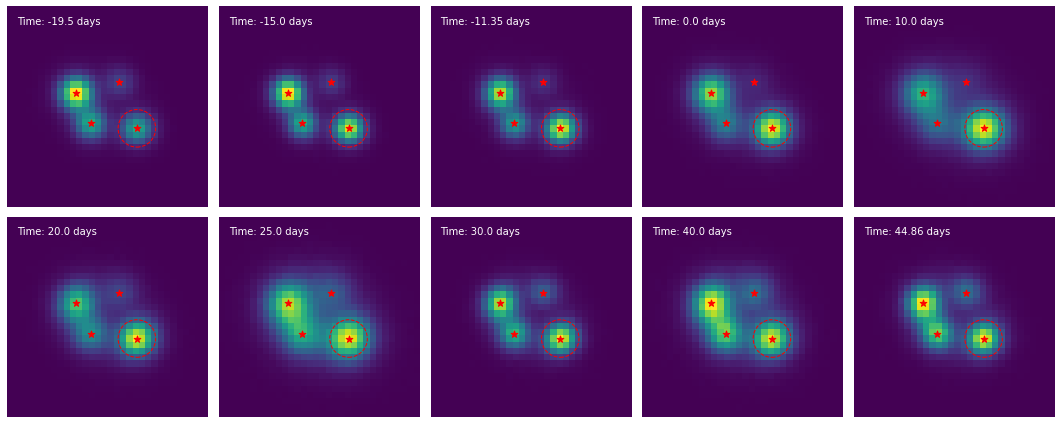
Figure 11: Left—examples of injected galaxy-galaxy lenses; Right—time series of a lensed supernova after injection in survey-like backgrounds.
Survey and Future Survey Support
SLSim targets the Rubin LSST by default, but its modular approach allows for adaptation to other survey configurations, with explicit support and delivered image simulation for the Roman Space Telescope.
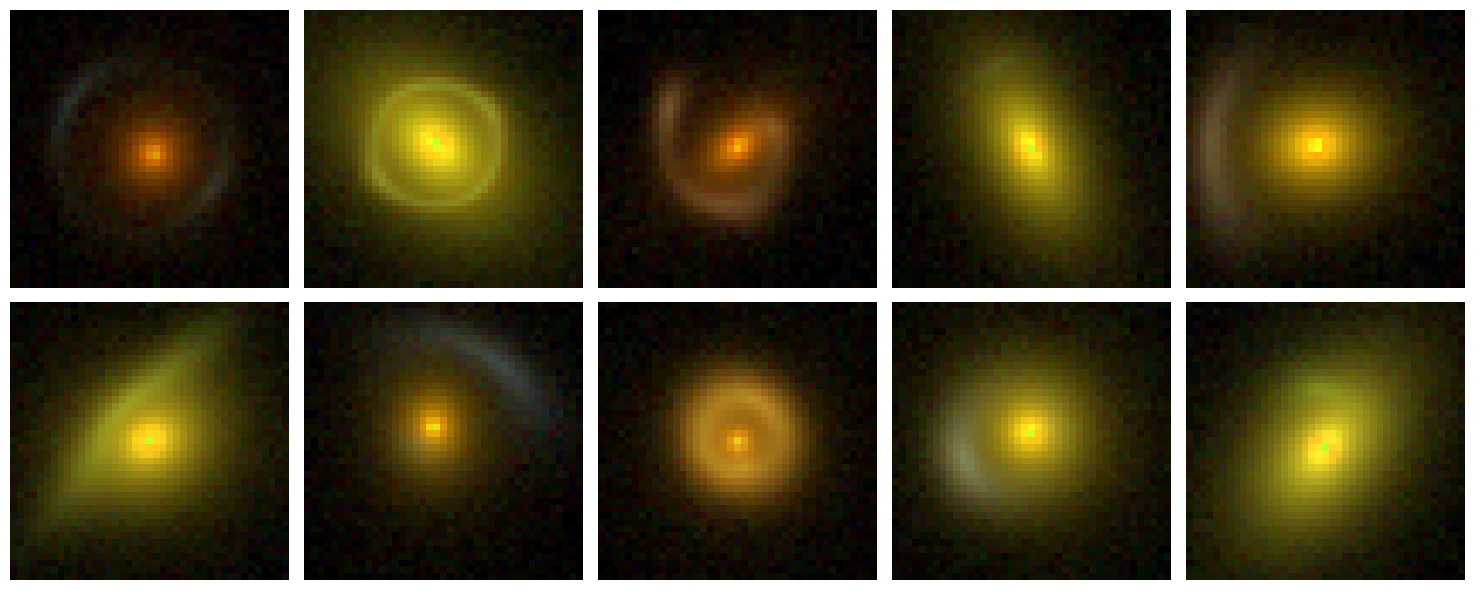
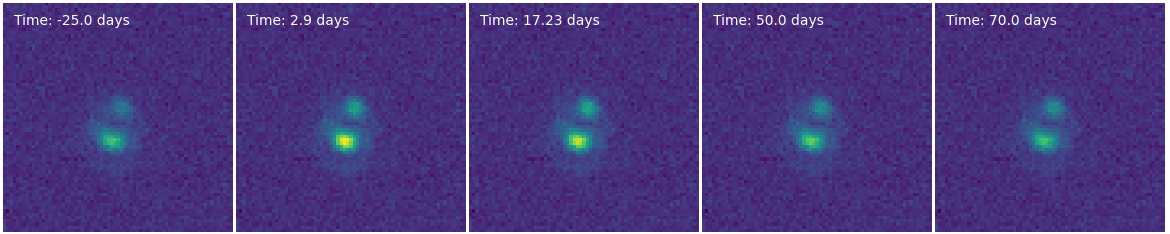
Figure 12: Simulated Roman Space Telescope strong lens images, including both static galaxy-galaxy and time-variable supernova lenses in Roman-specific bands.
Implications and Prospects
SLSim provides an essential infrastructure layer for the field of strong gravitational lensing, supporting:
- Mass-scale cosmographic constraints via time-delay cosmography, lensing rate statistics, and systematic bias calibration for the measurement of H0 and dark energy properties.
- Machine learning-based lens search pipelines, which require large synthetic datasets for training and validation, especially in high-imbalance regimes.
- Detailed assessment of lensing selection bias, including the impact of redshift, deflector mass, environment, and transient occurrence on detectability—essential for robust cosmological inference.
- End-to-end pipeline validation for both static and time-domain lensing science in current and future wide-field surveys.
- Flexibility to forecast rare lensing events and to explore the impact of survey design on the science yield.
The SLSim package further enables the community to directly contribute new ingredient models (for instance, improved AGN variability prescriptions, new mass profiles, or additional transient source classes), and to rapidly update or extend simulation components as survey requirements or astrophysical understanding evolve.
Conclusion
SLSim (2603.17138) presents a rigorously validated, open, and extensible platform for the simulation of strong lensing populations and images at survey scale. Its advanced architecture not only fulfills the projected simulation demands of future lens-rich time-domain surveys but also sets a new standard for reproducibility and realism in lensing data production. The flexibility of SLSim ensures its utility across survey platforms—Rubin, Roman, Euclid—and its comprehensive design provides a robust vehicle for synergizing lensing cosmology, machine learning detection, and time-domain astrophysics as the field proceeds into the multi-survey strong lensing era.

