- The paper introduces a novel application of the Open EFToI framework to integrate dissipative and stochastic effects in inflation, setting bounds on γ and cₛ.
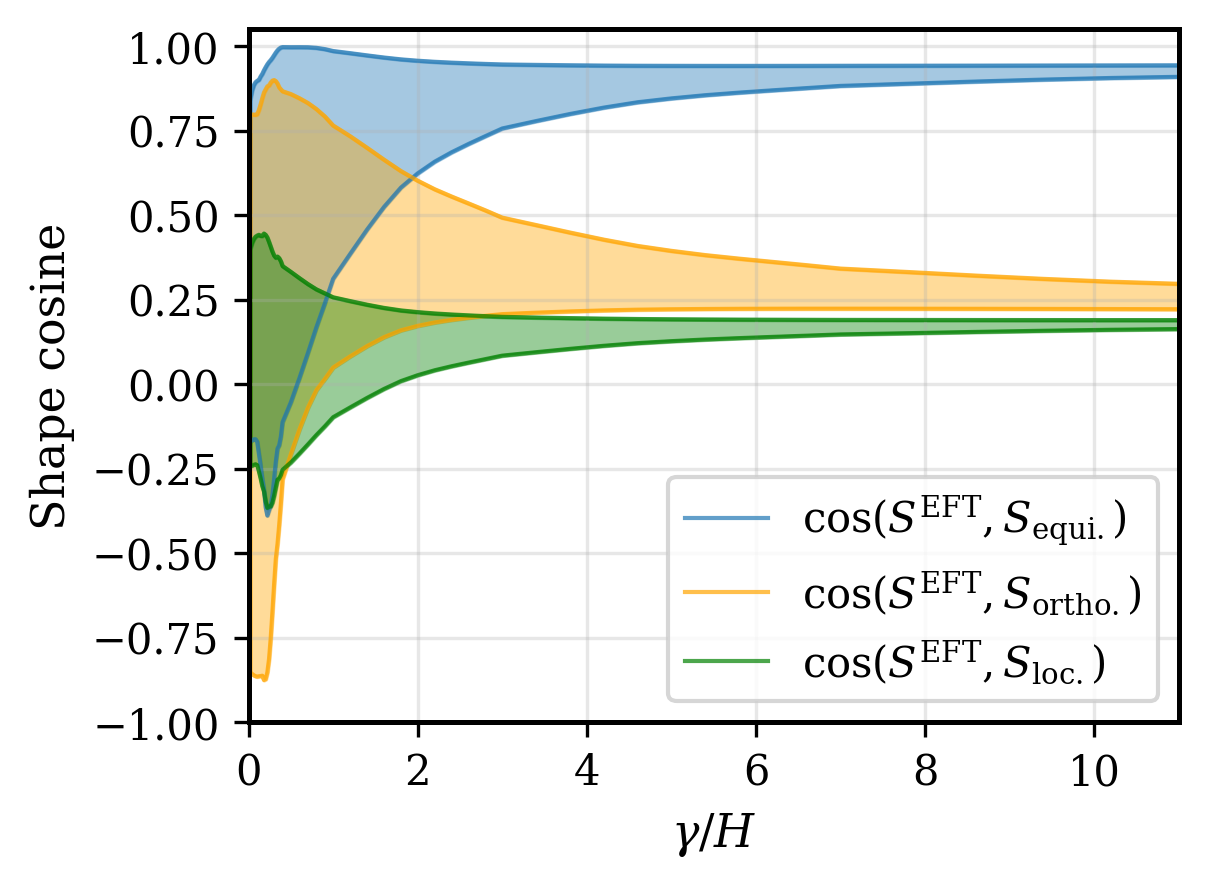
- It employs tree-level Feynman diagrams and modal bispectrum analysis to distinguish folded and equilateral non-Gaussianity shapes linked to different dissipation regimes.
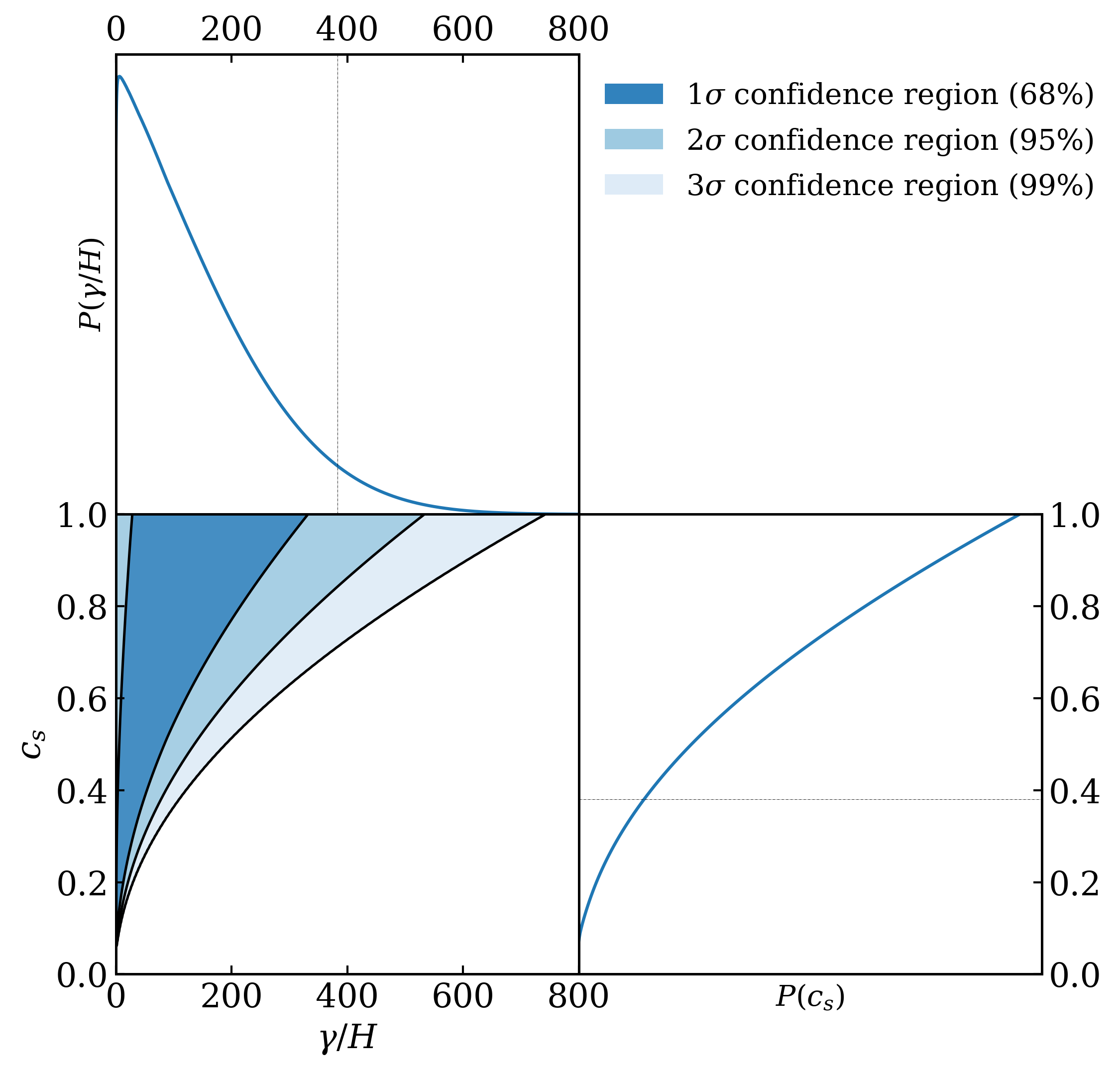
- Results indicate that too high dissipation (γ > 384H) or too low sound speed (cₛ < 0.38) is inconsistent with Planck data, refining the viable parameter space for inflation models.
Constraints on Early-Universe Dissipation from Primordial Non-Gaussianity
The paper "Primordial non-Gaussianity constraints on dissipative inflation" (2603.13473) applies the Open Effective Field Theory of Inflation (Open EFToI) framework to parametrize dissipative and stochastic dynamics during inflation. Unlike standard single-field slow-roll inflation, dissipative channels allow primordial perturbations to couple to environmental degrees of freedom, generating both dissipative damping and stochastic noise terms. Crucially, the construction preserves adiabaticity and scale invariance, maintaining consistency with CMB power spectra while producing distinctive bispectral non-Gaussian features. The theory is built by doubling the path integral via the Schwinger–Keldysh formalism, defining the adiabatic Goldstone boson π as the primary fluctuation—decoupled from metric perturbations under slow-roll hierarchies—whose action receives additional dissipative and noisy operators controlled by a dissipation scale γ and sound speed cs.
Phenomenology of Dissipative Bispectrum Shapes
The bispectrum from dissipative inflation is calculated via tree-level Feynman diagrams using the Open EFToI action. Dissipative operators induce enhancements in specific interaction channels, with notable regime dependence:
Modal Bispectrum Pipeline and Likelihood Evaluation
To confront theory with observation, the authors employ the Modal bispectrum estimator applied to Planck 2018 CMB datasets. The theoretical bispectrum is projected onto the observed CMB bispectrum via spherical harmonic transfer functions, obtaining a likelihood function for (γ,cs):
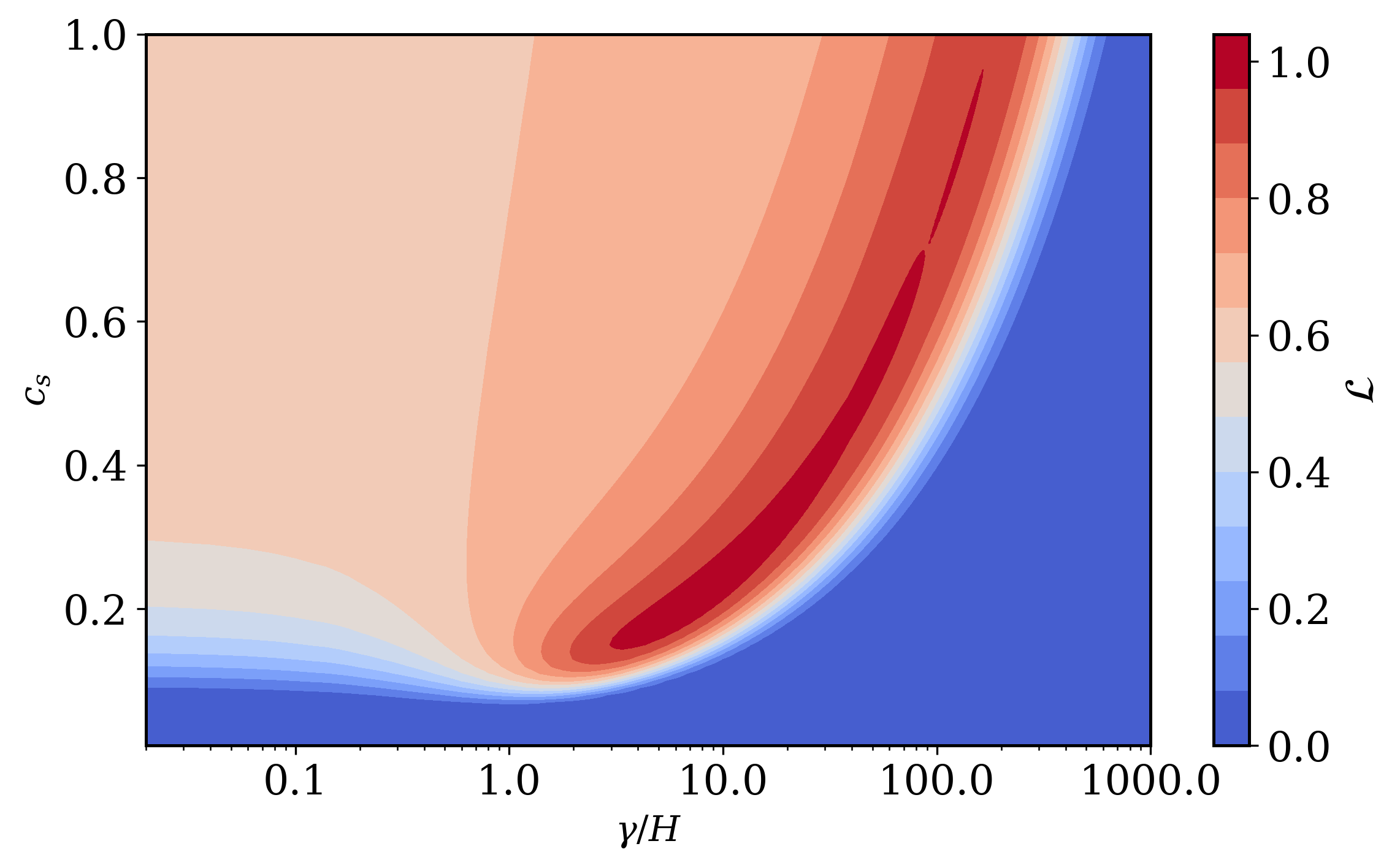
Figure 2: Likelihood in the (γ,cs) parameter plane, normalized at its maximum; likelihood is maximal for moderate γ and cs, disfavoring regions with excessive PNG amplitude.
Efficient evaluation requires a separable mode expansion, drastically reducing computational complexity from naive summation. The Bayesian posterior is then constructed assuming uniform priors across physically reasonable (γ,cs) ranges.
Numerical Results: Bounds and Signal-to-Noise
The marginalized posteriors yield strong constraints:
The signal-to-noise ratio (SNR) map highlights the regions where the Open EFToI shapes match observed CMB bispectra most strongly. SNR is maximal near γ≈H and cs≈1, consistent with a large negative folded component and a modest equilateral contribution. For high γ and low cs, SNR saturates at ∼1, indicating diminished overlap.
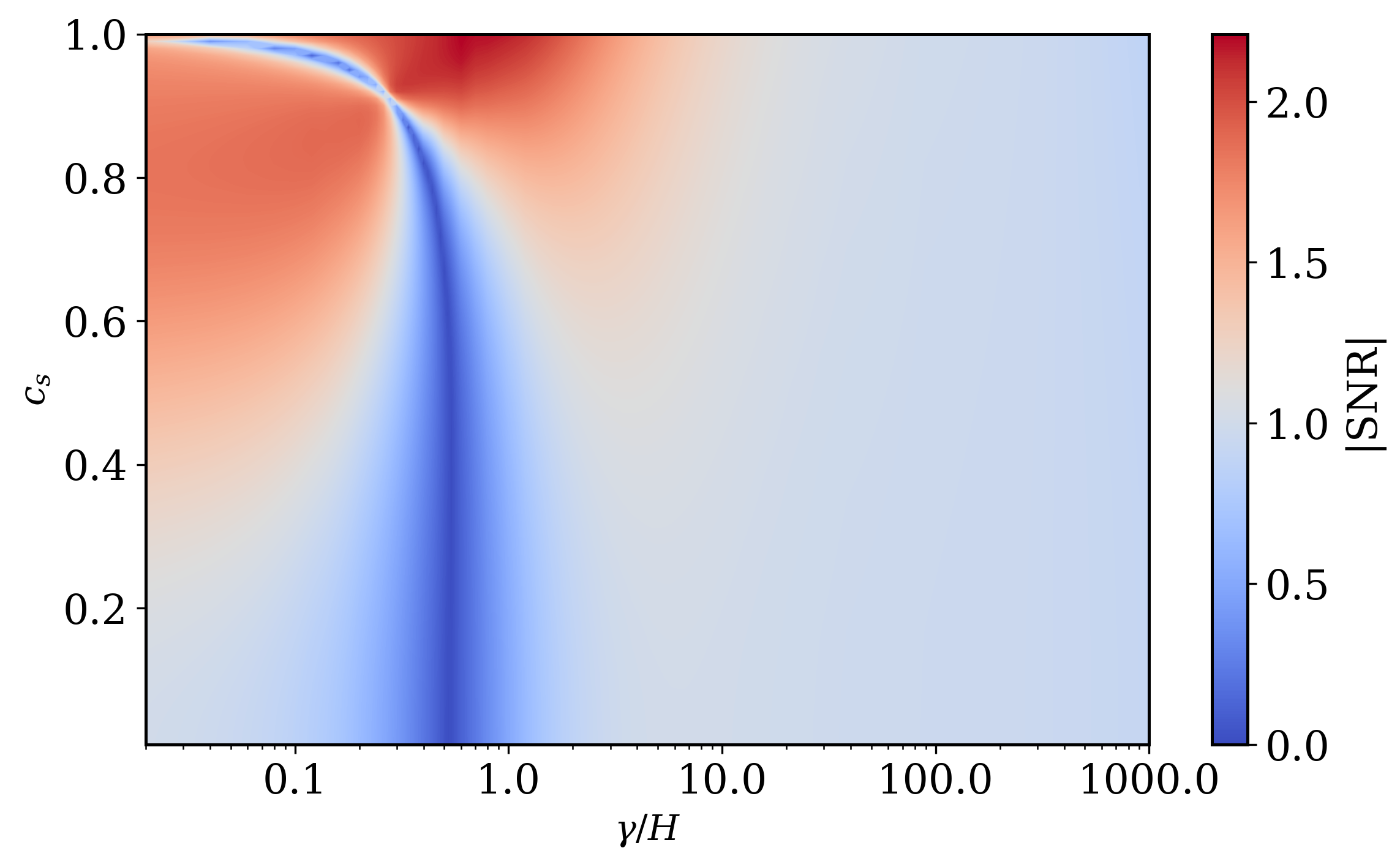
Figure 4: The SNR for the predicted bispectrum shape as a function of γ and cs, illustrating decreasing match with data in regimes of high dissipation and low sound speed.
Physical Interpretation and Implications
The results establish the first robust, model-independent bounds on dissipative dynamics during inflation inferred from bispectrum measurements. Crucially, the folded bispectrum signal at low γ—which cannot be mimicked by standard cold single-field models—offers a discriminant for stochastic/dissipative inflationary scenarios. The transition to equilateral dominance at high γ mirrors expectations from strong environmental decoherence, consistent with a damping of intermode correlations and a loss of quantum coherence in primordial fluctuations.
The practical implication is that either excessive dissipation (γ≫384H) or too low sound speed (cs<0.38) is inconsistent with weakly non-Gaussian Planck measurements. These constraints refine the viable space for non-minimal inflationary and warm inflation models, and provide targets for next-generation CMB and LSS surveys, as improved noise levels and access to smaller scales promise tighter constraints and the potential to resolve folded bispectrum features more finely.
Theoretical Outlook
On the theoretical front, the Open EFToI framework provides a unified approach for describing stochastic and dissipative modifications to primordial cosmology, transcending the limitations of model-dependent analyses. The modal pipeline's ability to constrain both bispectrum shape and amplitude, coupled with precise numerical bispectrum evaluation, lays a foundation for systematic discrimination among competing early-universe scenarios. Extensions to higher-order correlators (e.g., trispectrum), parity-violating non-Gaussianity, and signatures from multifield or collider scenarios (with stochastic sources) are immediate avenues.
Conclusion
This study delivers the first stringent, model-independent constraints on dissipation and stochasticity in inflation from non-Gaussianity measurements, leveraging the Open EFToI formalism and Modal bispectrum pipeline. The primary bounds, γ<384H and cs>0.38, delimit the parameter space for viable dissipative inflation, highlight the observational relevance of folded bispectrum signals, and suggest promising directions for future cosmological probes. These advances enhance the power of non-Gaussian statistics as a probe of microphysical inflationary dynamics and the classical-quantum transition in the early universe.