Number Theory in Quantum Physics: Minicharged Particles and the Prouhet-Tarry-Escott Problem
Abstract: In quantum gauge theories, anomaly cancellation severely restricts the allowed patterns of chiral charges. Here we show that, in a phenomenologically motivated framework for light minicharged particles, the anomaly cancellation conditions are equivalent to the degree $k=3$ Prouhet-Tarry-Escott problem in number theory. This correspondence immediately implies that the hidden sector must contain at least four minicharged states. For constructions based on minimal ideal solutions, the mass spectrum generically exhibits a near-degenerate doublet structure, so that the discovery of one minicharged particle would point to a partner state with the same minicharge and a nearby mass. Our results uncover an unexpected link between quantum consistency and number theory, with direct implications for model building and future searches.
Paper Prompts
Sign up for free to create and run prompts on this paper using GPT-5.
Top Community Prompts
Explain it Like I'm 14
Number Theory in Quantum Physics: Minicharged Particles and the Prouhet-Tarry-Escott Problem
Overview
This paper is about a cool idea that links math and tiny particles in physics. It talks about how certain mathematical rules (related to a math issue called the "Prouhet-Tarry-Escott Problem") can help physicists figure out some cool things about tiny particles with very small electric charges, called minicharged particles, in the universe.
Main Objectives
The scientists wanted to answer these big questions:
- How can we use a math problem, the Prouhet-Tarry-Escott Problem, in understanding tiny particles with minicharges?
- What are the rules these particles have to follow so that they make sense in the science of atoms and particles?
Research Methods
The scientists used advanced math ideas to look at how these minicharged particles could fit into our understanding of the universe. They used concepts from geometry and number theory—a type of math focused on numbers and their properties—to see how these particles can exist without causing any confusion in the theories that scientists use to understand particles.
Key Findings
- The researchers found that for these particles to fit in, at least four different states (or types) of minicharged particles must exist.
- When there's a certain type of balance, these particles clump together in pairs with similar properties. This pairing means if we find one particle, there is likely a 'partner' particle with similar characteristics nearby.
Importance
This is important because these particles, if they exist, could help us understand more about the universe, including dark matter, which is invisible and makes up most of the universe but doesn't interact with light like normal matter does.
Conclusion
The study shows that understanding the patterns of tiny particles involves not just physics, but also complex math. If scientists can understand these patterns better, it might help them spot these minicharged particles in experiments, providing new insights into unsolved mysteries of the universe, like dark matter.
Knowledge Gaps
Given the provided research paper, here are the knowledge gaps, limitations, and open questions that remain unresolved:
Knowledge Gaps and Limitations
- Experimental Testing of Theoretical Predictions:
The paper makes predictions regarding the existence of minicharged particles (mCPs) and their mass spectra, but lacks experimental data to validate these predictions. There is a need for dedicated experimental searches to confirm the presence of mCPs and the predicted doublet structure.
- Parameter Space Exploration:
The research provides a theoretical framework for mCPs with a four-state construction, but does not exhaustively explore the parameter space, particularly the effects of varying coupling constants, , and cutoff scale, , on the mass spectrum and experimental observability.
- Implications for Cosmology and Astrophysics:
While the paper discusses theoretical and cosmological implications, it does not delve deeply into how the proposed mCPs would affect cosmological observations, such as cosmic microwave background anisotropies or structure formation in the universe.
Open Questions
- Interpretation of Near-Degenerate Doublets:
The prediction of a near-degenerate doublet structure in the mass spectrum implies the existence of paired mCPs. How would the detection of such pairs, if feasible, refine our understanding of anomaly cancellation in chiral minicharged sectors?
- Impact of Additional Gauge Bosons:
With the introduction of a massive gauge boson from breaking, what potential production and decay channels might be observable in high-energy physics experiments? How could these channels alter search strategies for mCPs?
- Mixing and Coupling with Standard Model Particles:
The paper mentions potential kinetic mixing with Standard Model hypercharge. What are the constraints on such mixing from current particle physics experiments, and how could future experiments probe these interactions more effectively?
These unresolved gaps and questions highlight future areas of theoretical research and experimental investigation in the context of the paper's theoretical framework.
Practical Applications
Immediate Applications
Below are applications that can be deployed or piloted with existing tools and data, leveraging the paper’s core findings: the anomaly-cancellation/minicharge framework, its equivalence to the degree-3 Prouhet–Tarry–Escott (PTE) problem, and the predicted near-degenerate doublet spectrum of minicharged particles (mCPs).
- Dual-component signal modeling for mCP searches (sector: healthcare — n/a; education — n/a; software/data science; robotics — n/a; energy — n/a; finance — n/a; particle physics/experimental HEP)
- Use case: Update analysis pipelines at LHC (milliQan, FLArE at FPF), fixed-target, and neutrino experiments (SENSEI, Oscura, ArgoNeuT) to fit “two-nearby-masses, same minicharge” signal templates rather than single-state templates.
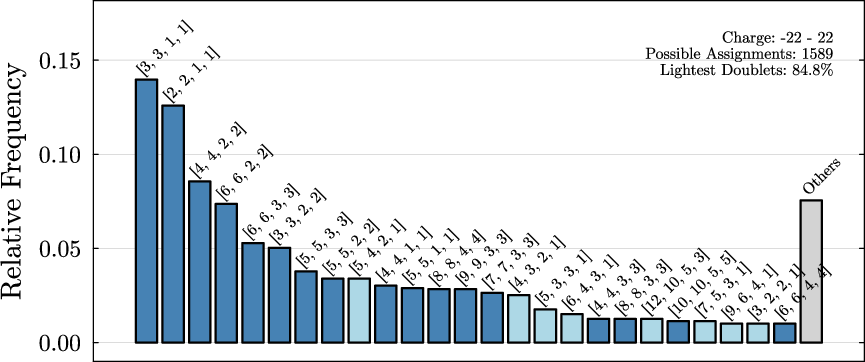
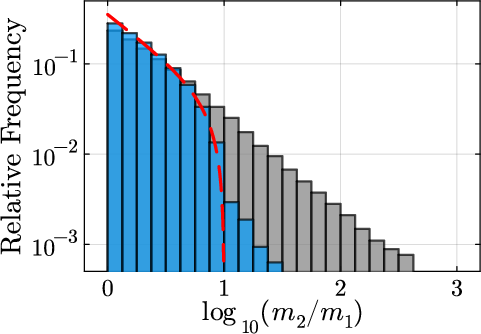
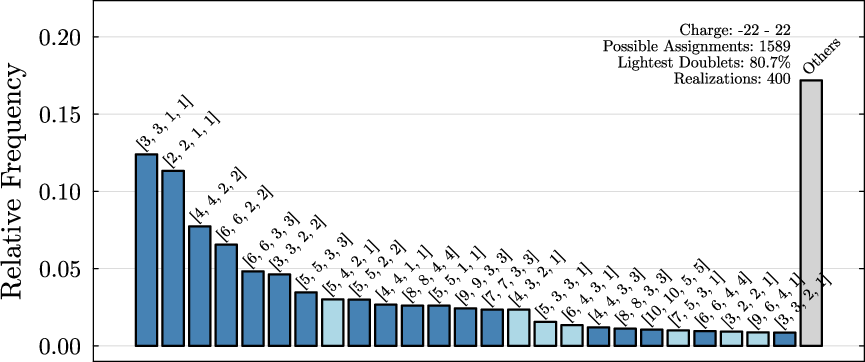
- Tools/workflows: Implement two-component likelihoods in event generators and analysis code; parameterize masses via the paper’s ε-hierarchy; adopt mass-splitting priors informed by Fig. distributions (e.g., using random O(1) coefficient ranges).
- Assumptions/dependencies: Unbroken U(1)H with kinetic mixing, chiral and spontaneously broken U(1)X; symmetric PTE solutions dominate; ability to resolve mass differences with current detector timing/energy resolution.
- Detector configuration and triggering optimized for mass-spectrum sensitivity (sector: robotics — n/a; energy — n/a; software; particle physics instrumentation)
- Use case: Configure timing, segmentation, and threshold settings to enhance semi-relativistic or non-relativistic mCP detection enabling time-of-flight or energy-loss-based mass inference; prioritize setups that can separate two near-degenerate states.
- Tools/workflows: Dedicated trigger paths for low-ionization tracks; calibration sequences for small charge depositions; controlled beam energies to tune production kinematics.
- Assumptions/dependencies: Practical access to timing resolutions at intensities/energies relevant to mCP production; near-degenerate doublet behavior holds in minimal ideal solutions.
- Reinterpretation of existing limits with multi-state spectra (sector: software/data science; particle physics)
- Use case: Reanalyze published limits (LHC, fixed-target, neutrino facilities, supernova constraints) allowing for four-state multiplicity and two-doublet spectra, which can change exclusion contours and production/decay channels (including an X-boson mediator).
- Tools/workflows: Public code to fold multi-state spectra into likelihoods; libraries for multi-state production/attenuation; propagation with in-medium effects; plugin modules for common frameworks (ROOT, Scikit-HEP).
- Assumptions/dependencies: The presence of a massive U(1)X gauge boson with possible kinetic mixing; sufficient statistics to distinguish double-component signals.
- Rapid model-building via PTE-based charge assignment libraries (sector: academia; software)
- Use case: Generate anomaly-free chiral U(1)X×U(1)H models of mCP sectors by enumerating degree-3 PTE solutions (including symmetric sets) to produce charge assignments, compute mass matrices Mij ∝ ε|ai−bj|, and predict spectra.
- Tools/workflows: Lightweight package that enumerates ideal/non-ideal PTE solutions, applies affine transformations, checks Landau pole constraints (e.g., αX ≲ 0.006 for ΣqX,i2=52 with GUT-scale cutoff), and outputs mass/interaction benchmarks for simulation.
- Assumptions/dependencies: Validity of the ε-suppression ansatz; choice of cutoff Mc and vd consistent with cosmology and lab bounds; vector-like U(1)H on Dirac pairs.
- Hungarian-algorithm-based spectrum estimators (sector: software/data science; academia)
- Use case: Adopt the assignment problem (Hungarian method) to quickly approximate mass hierarchies from charge differences in multi-state BSM sectors, enabling fast scans before full numerical SVD.
- Tools/workflows: Open-source module that takes charge sets (ai, bj), constructs edge weights eij=|ai−bj|, returns leading exponents for mCP masses, and flags doublet structures.
- Assumptions/dependencies: Hierarchical regime ε ≪ 1; minimal mixing-induced cancellations; suitable rounding from continuous to discrete exponents.
- Search strategy add-ons for X-boson production/decay (sector: particle physics/experimental HEP)
- Use case: Include X→mCP mCP channels in fixed-target and collider simulations when U(1)X mixes with hypercharge; design “double-resonance” templates if two mCP masses sit nearby.
- Tools/workflows: Update MC generators (e.g., MadGraph plugins) with U(1)X kinetics; emulate in-detector signatures of low-ionization pairs; scan αX and mixing parameters around current bounds.
- Assumptions/dependencies: Non-negligible kinetic mixing for U(1)X; X mass within facility reach; consistent anomaly-free completion (possibly U(1)B−L) without coupling to RH neutrinos in mCP sector.
- Curriculum and outreach modules linking number theory and quantum anomalies (sector: education)
- Use case: Develop short courses and problem sets connecting the PTE problem to anomaly cancellation and hierarchical mass generation; use symmetric solutions to teach degeneracy and block-diagonalization concepts.
- Tools/workflows: Interactive notebooks (Python/Julia) demonstrating charge generation, Hungarian matching, and spectrum plots; graduate-level seminars and hackathons.
- Assumptions/dependencies: Availability of educators and students; focus on minimal ideal solutions for clarity.
- Funding and programmatic guidance for intensity-frontier upgrades (sector: policy)
- Use case: Inform calls and review panels that multi-state, near-degenerate targets require enhanced timing and low-threshold detection; justify instrument R&D aimed at mass spectroscopy of rare low-ionization signals.
- Tools/workflows: Strategy documents that incorporate the model’s four-state minimum and doublet predictions, motivating precise mass-sensitive capabilities at LANL and other facilities.
- Assumptions/dependencies: Community consensus on priority; feasibility within budget and facility constraints.
Long-Term Applications
Below are applications that require further research, scaling, technology development, or discovery of mCPs to realize their full potential.
- End-to-end “doublet-aware” event generators and global fit frameworks (sector: software/data science; particle physics)
- Use case: Build a full pipeline that ingests PTE-derived models, simulates production/propagation/detection across facilities, and performs global fits considering four-state spectra and X-boson channels.
- Tools/products: Modular simulator linking charge enumeration → mass matrix → spectrum → generator → detector response → Bayesian fits; standard interfaces to HEP tools and data lakes.
- Assumptions/dependencies: Validity of the two-doublet predominance in minimal solutions; measurable mixing to hypercharge; robust detector response models for low-ionization signals.
- Cosmology and astrophysics re-analysis with multi-state mCPs (sector: academia; software/data science)
- Use case: Recompute dark radiation, CMB, and supernova bounds allowing for four mCP states and an X mediator, with altered production, cooling, and trapping behaviors.
- Tools/workflows: Numerical cosmology codes (Boltzmann solvers) modified to incorporate multi-state scattering and transport; supernova Monte Carlo with X→mCP decays.
- Assumptions/dependencies: Reliable microphysics for mCP interactions in hot/dense media; constraints on ε, αX, and kinetic mixing consistent with BBN/CMB.
- Precision instrument development for low-ionization mass spectroscopy (sector: industry; particle physics instrumentation)
- Use case: R&D for detectors that combine ultralow thresholds with fine time resolution to resolve mCP doublets and extract masses directly (e.g., advanced Skipper CCDs, novel scintillators, precision ToF).
- Tools/products: Next-gen low-noise sensors; timing layers tailored to slow, minimally ionizing tracks; calibration standards and test-beam programs.
- Assumptions/dependencies: Material advances reducing readout noise; stable operation under high rates; co-development with facility beamlines.
- Discovery-driven roadmap: “Find one, expect a partner” (sector: policy; particle physics)
- Use case: Plan staged experiments and analyses anticipating that any mCP discovery is accompanied by a same-minicharge partner near in mass; design follow-up runs to map the spectrum.
- Tools/workflows: Adaptive run plans and triggers; cross-facility coordination to scan specific mass ranges; data sharing protocols for multi-state interpretation.
- Assumptions/dependencies: Actual mCP discovery; sufficient statistical power to resolve doublets; theoretical stability of near-degeneracy under parameter variations.
- Generalization beyond U(1)H×U(1)X and to other anomaly structures (sector: academia)
- Use case: Extend the number-theory/anomaly-cancellation correspondence to other multi-U(1) or non-Abelian contexts; explore higher-degree PTE analogs and non-ideal solutions for richer spectra.
- Tools/workflows: Mathematical searches for PTE solutions at k>3; symbolic solvers for anomaly systems; machine-assisted discovery of charge patterns yielding targeted mass textures.
- Assumptions/dependencies: Existence of tractable correspondences for broader symmetry groups; computational viability of large combinatorial searches.
- Robust Landau-pole–safe coupling design for scalable models (sector: academia; software)
- Use case: Automated checks ensuring αX stays perturbative up to Mc given ΣqX,i2 for chosen PTE solutions; recommend safe parameter ranges for extended models or higher-charge states.
- Tools/workflows: RG-running modules integrated into model-builders; guardrails that flag problematic sums of squared charges; scenario comparison dashboards.
- Assumptions/dependencies: Dominance of one-loop running; accurate thresholds for decoupling; reliable Mc choices (e.g., GUT or Planck scale).
- Education: cross-disciplinary programs and micro-credentials (sector: education)
- Use case: Formalize number-theory–inspired BSM model building into graduate curricula; offer micro-credentials combining combinatorics, RG flows, anomaly cancellation, and detector phenomenology.
- Tools/workflows: Project-based courses with code deliverables; collaborative repositories; mentorship networks linking math and physics departments.
- Assumptions/dependencies: Institutional support and faculty bandwidth; sustained student interest.
- HPC-accelerated scans over charge space and spectra (sector: software/data science; industry)
- Use case: Large-scale enumeration of PTE solutions with affine transformations and constraint filters; fast SVD-based spectral predictions with realistic O(1) coefficient distributions; automated ranking for experimental relevance.
- Tools/products: GPU/cluster workflows; open datasets of vetted models and expected spectra; APIs for experiment teams to query viable benchmarks.
- Assumptions/dependencies: Access to compute resources; agreed-upon priors for coefficients and ε; standardized interfaces with experimental software.
- Integrated X-mediator program across colliders and fixed targets (sector: policy; particle physics)
- Use case: Coordinate searches for kinetically mixed U(1)X bosons that feed mCP pair production; harmonize sensitivity goals across facilities to jointly probe αX, mixing ε, and mX ranges.
- Tools/workflows: Common benchmark sets; shared simulation stacks; combined statistical analyses.
- Assumptions/dependencies: Non-negligible kinetic mixing; manageable backgrounds; complementarity of detector capabilities.
- Public engagement and STEM pipeline initiatives (sector: education; policy)
- Use case: Leverage the “number theory meets quantum anomalies” narrative to attract students to STEM and showcase cross-disciplinary problem solving.
- Tools/workflows: Public lectures, interactive web demos, competitions on combinatorial optimization related to PTE and mass textures.
- Assumptions/dependencies: Outreach support; accessible materials translating advanced concepts for general audiences.
These applications rely on core assumptions from the paper: an unbroken, vector-like U(1)H; a chiral U(1)X spontaneously broken at low energies; minimal ideal (degree-3) PTE solutions dominating charge assignments; hierarchical mass generation controlled by ε=vd/Mc; and the practical ability of experiments to resolve near-degenerate mass spectra.
Glossary
Anomaly cancellation: Refers to a condition in quantum field theory where certain inconsistencies that arise in the calculations of quantum anomalies are resolved or canceled. Example: "For constructions based on minimal ideal solutions, the anomaly cancellation conditions are equivalent to the degree Prouhet-Tarry-Escott problem in number theory."
Chiral charges: Describes charges related to chiral symmetry, where particles can have different properties depending on their handedness (left-handed vs right-handed). Example: "anomaly cancellation severely restricts the allowed patterns of chiral charges."
Minicharged particles (mCPs): Hypothetical particles possessing a charge much smaller than the fundamental electronic charge. Example: "a phenomenologically motivated framework for light minicharged particles (mCPs) provides a concrete realization of this connection between fundamental physics and mathematics."
Prouhet-Tarry-Escott problem: A problem in number theory involving finding two equal sums of powers of integers up to a certain degree. Example: "the anomaly cancellation conditions are equivalent to a classic question in number theory, the degree Prouhet-Tarry-Escott (PTE) problem."
Quantum gauge theories: Theories that describe how elementary particles interact via gauge fields with quantized properties. Example: "In quantum gauge theories, this connection becomes especially sharp because discrete charge assignments are constrained by anomaly cancellation."
Spontaneously broken: Refers to the phenomenon where a symmetrical state results in an asymmetrical one due to conditions changing, often related to breaking symmetry in particle physics. Example: "A small mass is then generated when is spontaneously broken."
String theory: A theoretical framework in which point particles are replaced by one-dimensional objects called strings, potentially unifying quantum mechanics and general relativity. Example: "the deep interplay between string theory and mathematics, this theme has repeatedly guided progress in fundamental physics."
U(1) gauge symmetry: A type of symmetry featured in gauge theories involving the unitary group U(1), often associated with electromagnetic interactions. Example: "A simple realization introduces a hidden Abelian gauge symmetry that kinetically mixes with hypercharge."
Vector-like: Refers to particles in gauge theories where the interaction is unchanged when substituting particles with their antiparticles. Example: "The charges are vector-like on each massive Dirac pair."
Collections
Sign up for free to add this paper to one or more collections.