- The paper presents a framework for selecting optimal two-block partitions to accelerate mixing by minimizing the KL divergence and Frobenius norm relative to stationarity.
- It leverages explicit reductions to low-dimensional projection chains and a difference-of-submodular decomposition to drive efficient combinatorial optimization.
- Empirical results on models like Curie–Weiss illustrate that optimized group-averaged kernels significantly improve convergence rates compared to standard non-averaged kernels.
Optimal Two-Block Averaging Kernels for Accelerated Mixing in Finite Markov Chains
This paper systematically investigates the problem of optimally selecting two-block partitions to enhance mixing characteristics of finite Markov chains under group-averaging transformations. Let P be a π-stationary kernel on the state space X, and let G=GS denote the Gibbs kernel associated with the two-block partition X=S⊔S′. The core objective is to select S so as to minimize the distance from the group-averaged kernel (in forms GSP, PGS, or GSPGS) to stationarity, with respect to either the Kullback-Leibler (KL) divergence or the Frobenius norm. The study reveals explicit connections to projection chains, inherent submodular structures, and combinatorial optimization.
Theoretical Insights: KL Divergence and Frobenius Norm
The principal theoretical findings rest on two axes: explicit reductions to low-dimensional projection chains and the exploitation of combinatorial structure encoded by Cheeger-type functionals and submodular decompositions.
KL Divergence Decay and Projection Chains
The KL divergence from stationarity of the group-averaged kernel (GPG)l is exactly that of the induced k-state projection chain P with stationary distribution π, for any partition into k orbits. For k=2, corresponding to two-block partitions, the convergence rate is determined by the log-Sobolev constant of P2. This enables explicit upper bounds on the decay rate of the KL divergence, tightly linking block selection to the spectral structure of the projected chain. Notably, the same decay rate extends to GP and PG by data-processing inequalities.
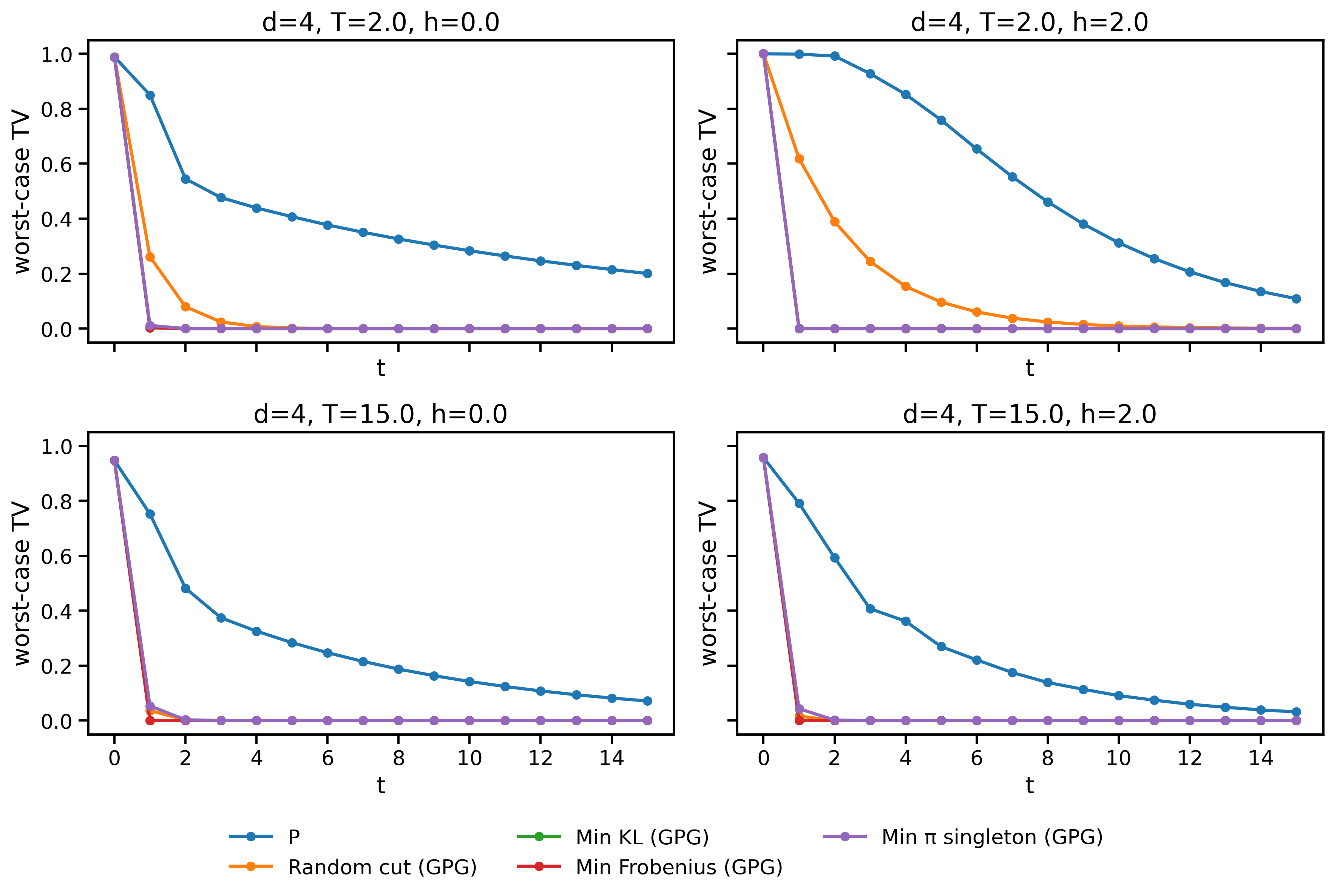
Figure 1: Plot of worst-case total variation distance for GSPGS chosen amongst different partitioning criteria.
Frobenius Norm and Cheeger-Type Functionals
For the Frobenius norm, the optimization of the group-averaged kernel reduces to maximizing a Cheeger-type functional g(S) involving the cross-block mass of P2:
g(S)=π(S)π(S′)1x∈S,y∈S′∑π(x)P2(x,y).
The squared Frobenius distance for GSP is $1-g(S)$; for GSPGS, the analogous formula applies with P in place of P2. Importantly, cutting along a Cheeger partition (minimizer of the isoperimetric ratio) is the worst-case for the Frobenius objective, revealing a surprising anti-alignment of partitioning strategies for this metric compared to traditional conductance or bottleneck arguments.
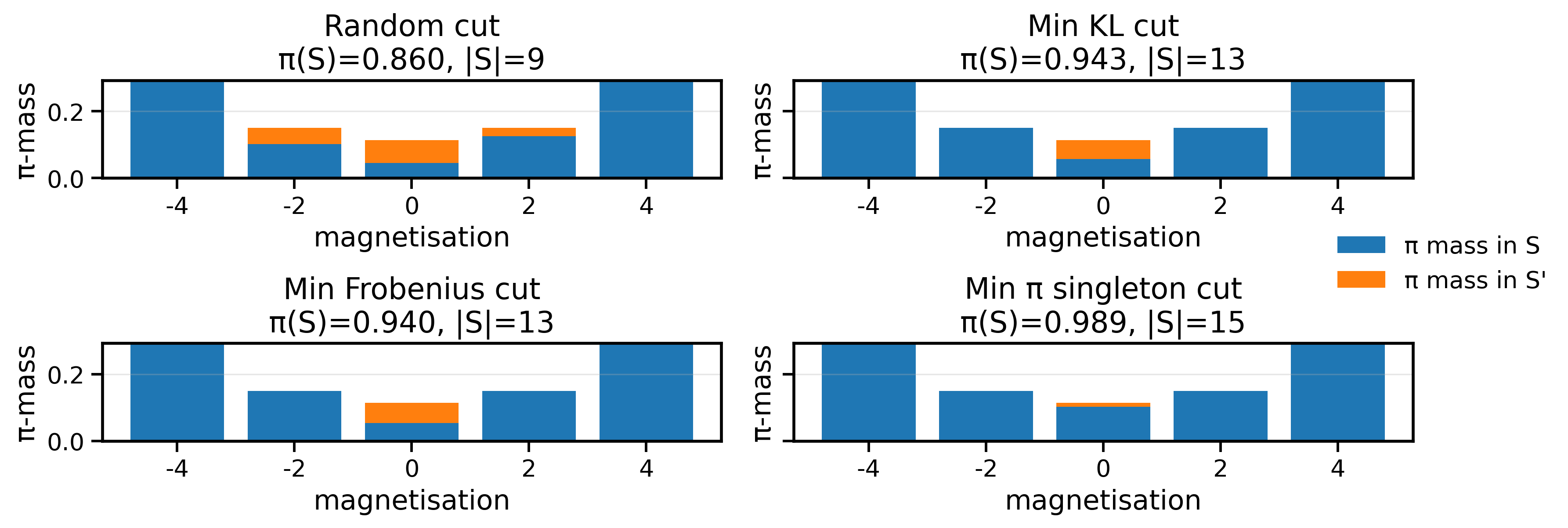
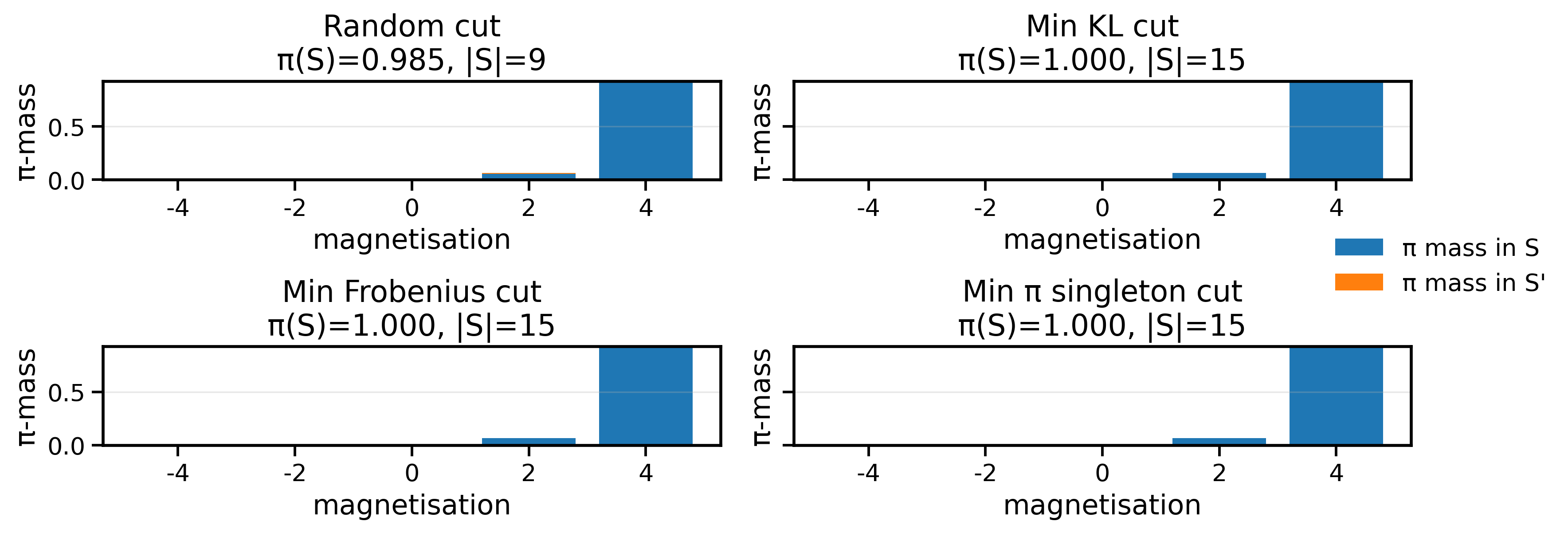
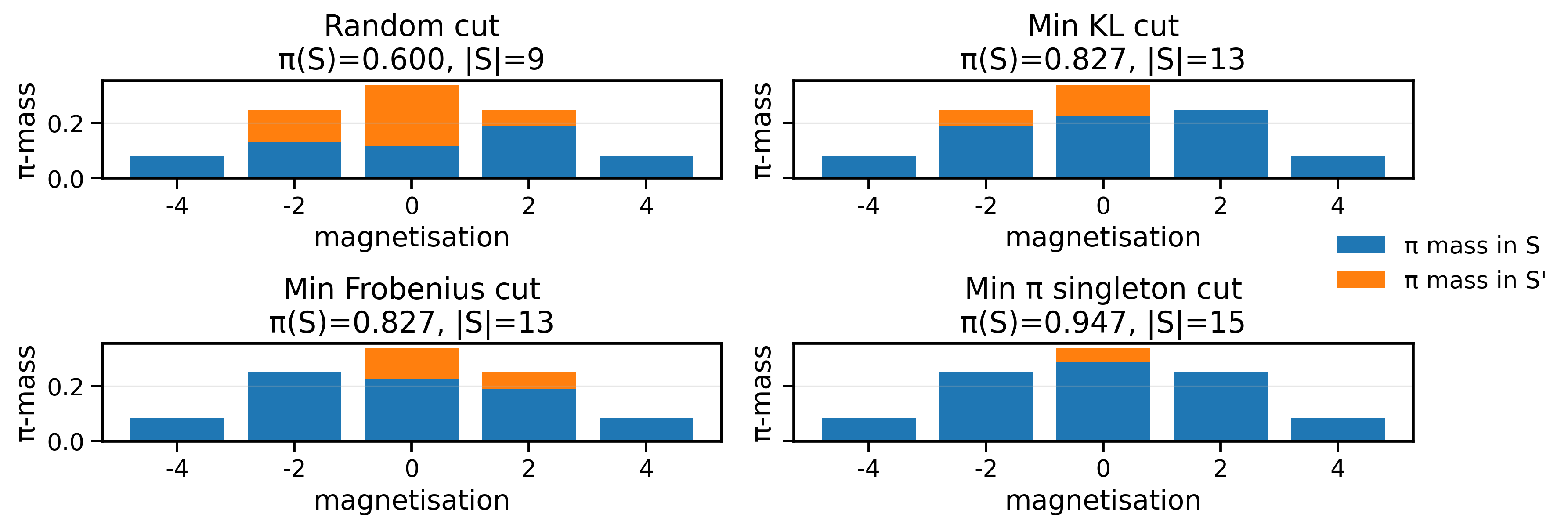
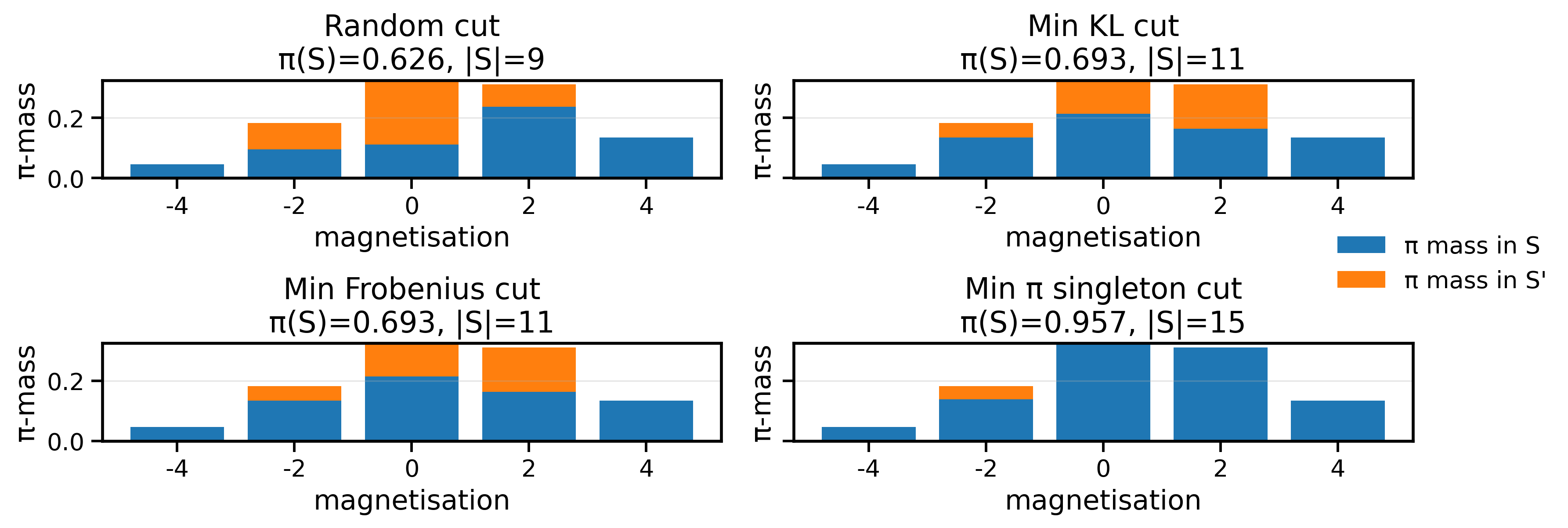
Figure 2: Visualisation of block statistics under T=2, h=0 on the Curie–Weiss test case.
Combinatorial Structure and Algorithmic Approximations
A major algorithmic contribution is the demonstration that these partition selection objectives admit difference-of-submodular decomposition—treating T(S) and U(S) for the KL divergence, and analogous terms for the Frobenius case, where T and U are supermodular. This enables practical optimization via submodular minimization and modular-majorization/minorization (MM), as well as greedy coordinate descent when optimizing over pairs (V,S) for kernels of the form GVPGS.
A significant technical insight is that singleton sets often achieve a guaranteed 21-approximation for the optimal Frobenius norm, reducing the search to a linear sweep in the state space. Modular lower and upper bounds for the relevant sub/supermodular components yield computationally feasible surrogates for descent procedures.
Multiblock Extensions and Dimensional Dependence
Extension to the multiblock setting (k>2) demonstrates that both group-averaged kernels GP and GPG achieve squared-Frobenius distance to stationarity of O(k). For "lazy" kernels, this contrasts with a lower bound of Ω(n), highlighting the substantial mixing acceleration afforded by even modest group-averaging. The theoretical findings are illustrated with examples on the hypercube, demonstrating that even poorly-aligned Cheeger-type partitions confer nontrivial benefits over non-averaged kernels.
Numerical Experiments
Empirical validation is conducted on the Curie–Weiss model under Glauber dynamics, in both high- and low-temperature regimes, with and without external fields. The experiments measure worst-case total variation distance and analyze the set statistics of optimal partitions under various metrics, including KL divergence, Frobenius norm, and stationary singleton mass.
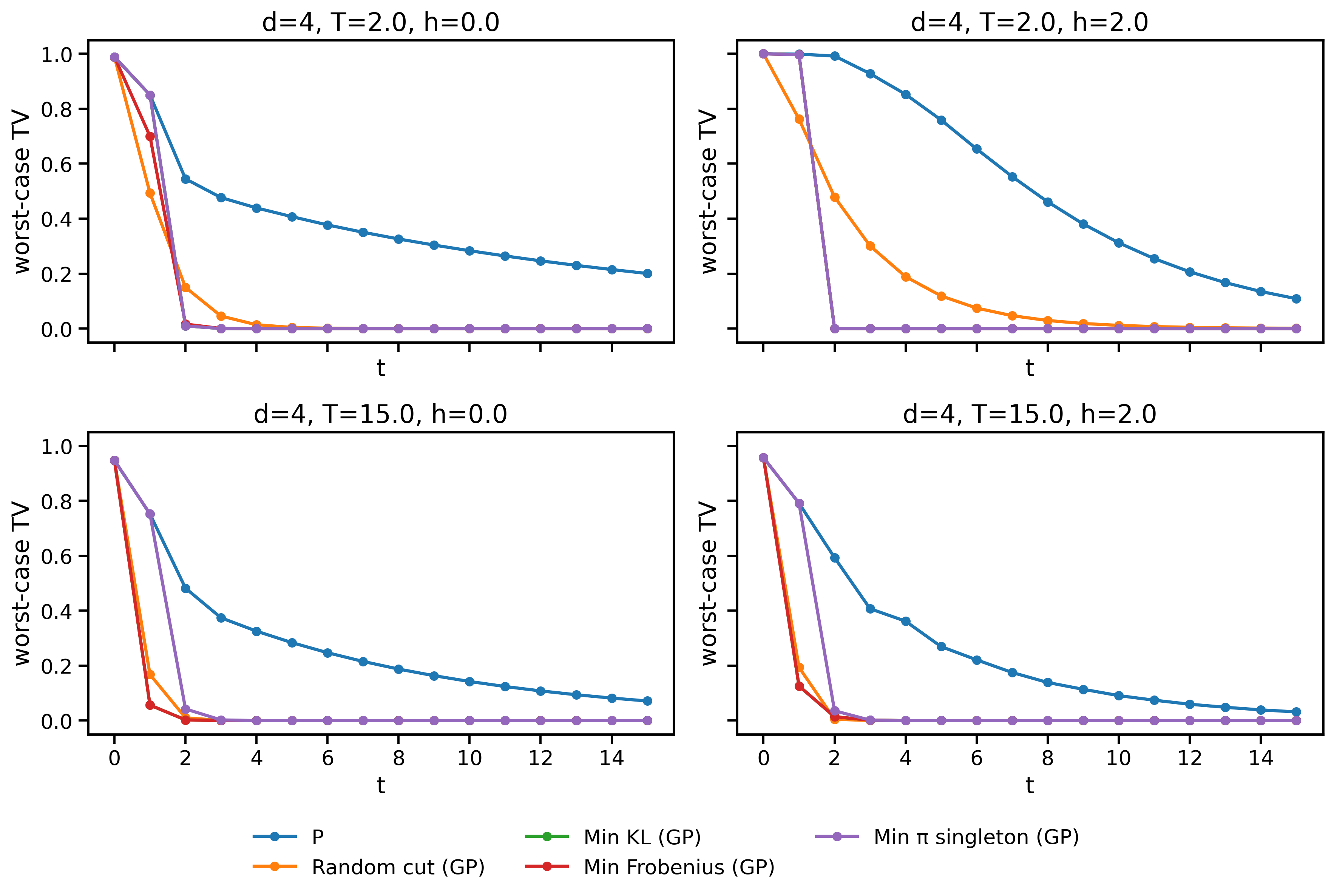
Figure 3: Plot of worst-case total variation distance for GSP constructed using different objective criteria.
Strong empirical agreement is observed between partitions minimizing the KL divergence and the Frobenius norm, corroborating the theoretical reductions. Furthermore, inhomogeneous or multimodal stationary distributions strengthen the practical advantage of the approximation algorithms, with the MM procedure reliably converging to optimal or near-optimal partitions in skewed scenarios. Approximation quality degrades gracefully in high-entropy (high-temperature) regimes, which aligns with the theoretical structure of the objectives.
Algorithmic Variants
The manuscript rigorously benchmarks several algorithmic instantiations:
- Exact brute-force search: For small state spaces, this provides ground-truth partitions.
- Modular-modular (MM) majorization minimization: Used for both KL and Frobenius objectives, exhibits robust convergence and substantial improvement over random search.
- Coordinate descent in difference-of-submodular (DS) variables: Alternating minimization in both block arguments V and S for two-sided kernels.
Convergence rates and hit probabilities are systematically compared to uniform random selection, showing orders of magnitude improvement.
Structural Results and Limitations
The paper contains new results on the impossibility of exact stationarity for group-averaged positive-definite, reversible kernels unless P or G is already stationarity. This analysis invokes Sylvester's equation and spectral considerations.
Lastly, a recursive formulation is provided for constructing blockwise partitions through sequential isolation of singleton orbits, further reducing the optimization cost.
Conclusion
This work presents the first substantive framework for optimizing partitions in two-block group-averaged Markov chain transformations with provably accelerated mixing under KL and Frobenius criteria. By leveraging explicit reductions to projection chains, submodularity theory, and combinatorial techniques, the authors provide both theoretical bounds and scalable approximation algorithms. The findings clarify the nuanced relationship between Cheeger-type cuts and mixing speedup, notably identifying settings where traditional isoperimetric intuition is reversed for certain objectives. The results suggest promising avenues for adaptive Markov chain design and optimization in both canonical and structured state spaces.
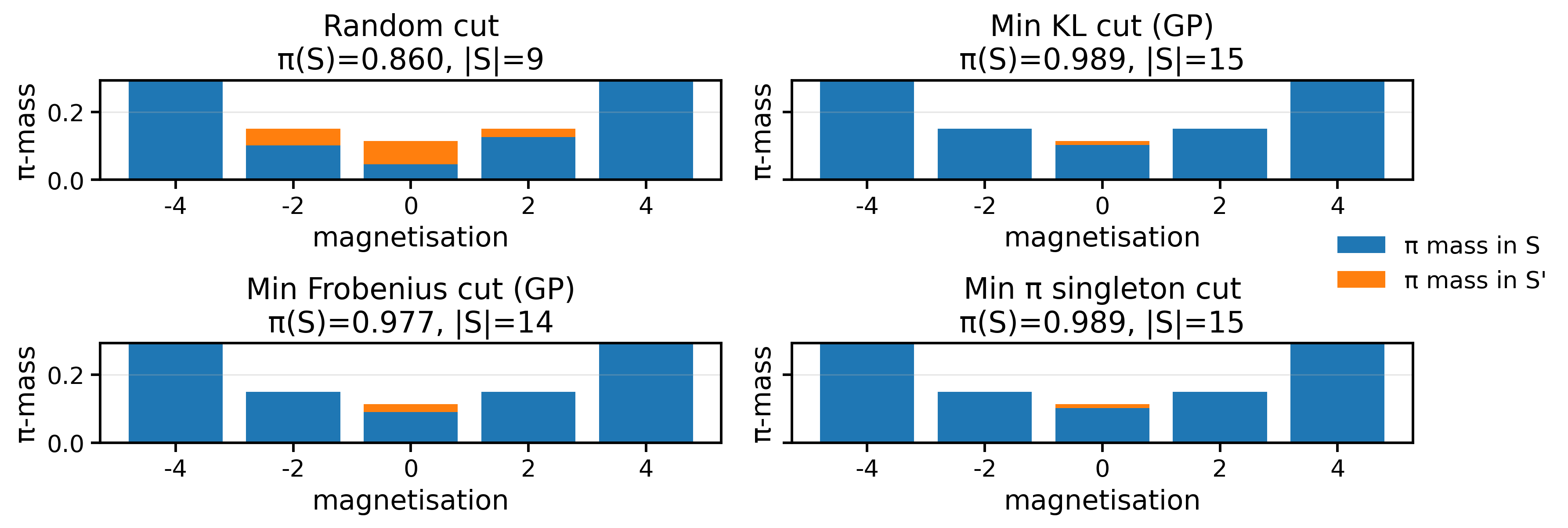
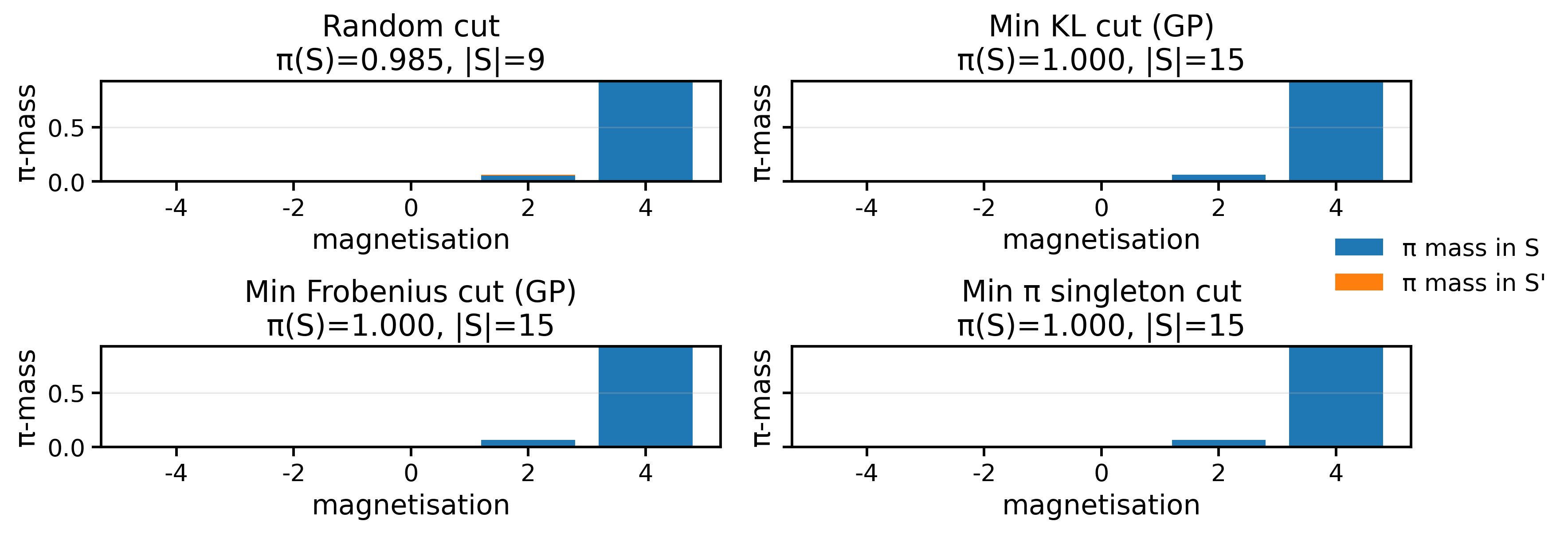
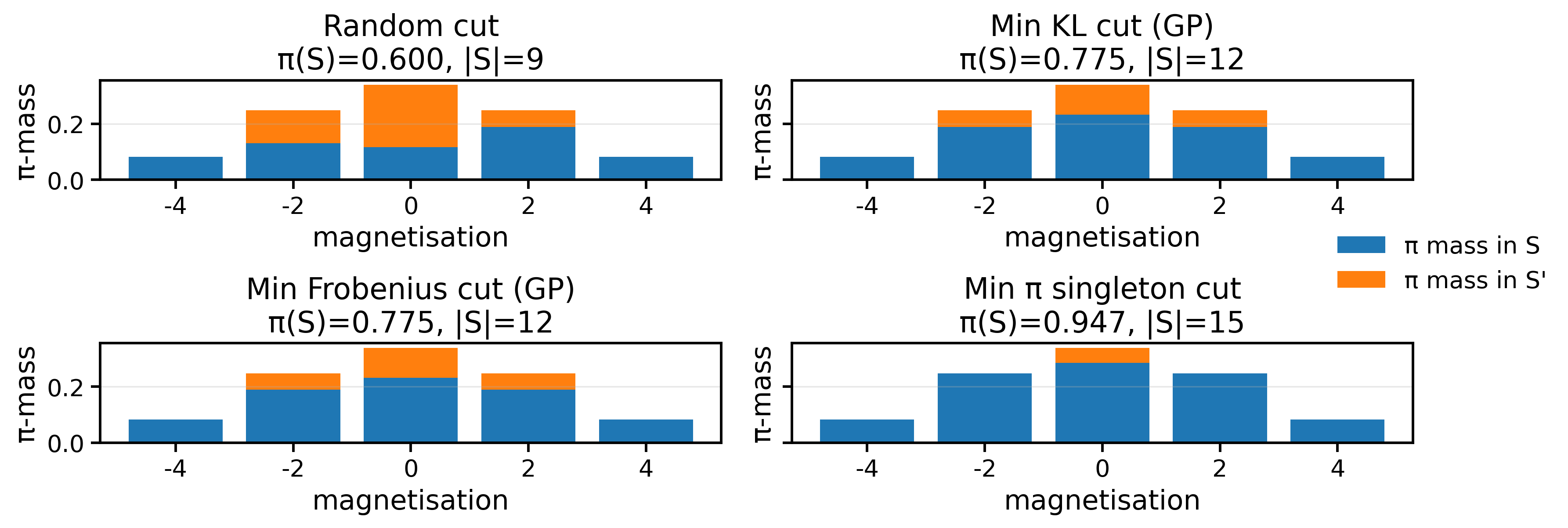
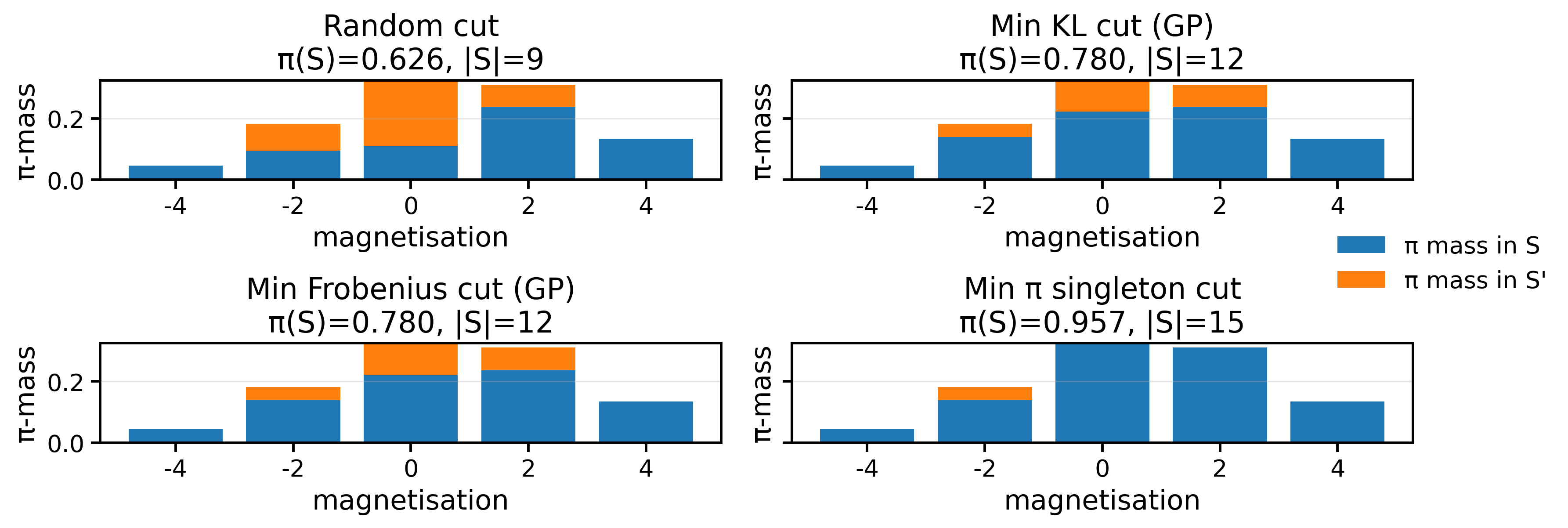
Figure 4: Visualisation of block statistics for GSP under T=2, h=0 in the Curie–Weiss model.
References
Key theoretical and algorithmic advances in this paper rest on the structural properties of group-averaged Markov chains and submodular optimization (2603.10318), with perspective links to recent work on reversible and non-reversible kernel tuning, adaptive MCMC, and group-induced Markov structures (Choi et al., 15 Dec 2025, Choi et al., 3 Sep 2025).

