- The paper identifies that the discrepancy between operational and algebraic correlations is bounded by measurement invasiveness, establishing a novel metric in quantum uncertainty relations.
- It unifies multiple quasi-probability frameworks and demonstrates that these correlations coincide only for dichotomic observables, clarifying the role of measurement outcomes.
- The study extends the analysis to generic quantum measurements, offering quantitative tools with practical implications for quantum foundations, computation, and state tomography.
Detailed Summary and Analysis of "On the operational and algebraic quantum correlations" (2603.04332)
Operational and Algebraic Quantum Correlations: Foundations and Distinctions
The paper rigorously investigates the intrinsic ambiguity in defining correlation functions in quantum theory, focusing on the discrepancy between operational correlations (defined via explicit measurement protocols) and algebraic correlations (expectation values of operator products). The core distinction is rooted in measurement invasiveness, a quantifiable disturbance to quantum states triggered by the measurement process, as opposed to mere epistemic updates.
A key result is that the difference between operational and algebraic quantum correlations is bounded above by the measurement's invasiveness. Explicitly, the trace-norm distance between pre- and post-measurement states under non-selective implementation defines the invasiveness, offering an operational metric that correlates directly with the disturbance operator in quantum uncertainty relations.
Quantitative Bounds: Upper and Lower Limits on Correlation Discrepancy
The manuscript establishes strong upper bounds for the difference between operational and algebraic correlations:
∣⟨A→B⟩ρop−⟨A∘αB⟩ρ∣≤∥A∘αB∥InvA(ρ),
where InvA(ρ) is the invasiveness metric. When α∈[0,1], a simplified bound emerges:
∣⟨A→B⟩ρop−⟨A∘αB⟩ρ∣≤∥A∥∥B∥InvA(ρ).
In addition, lower bounds on discrepancies between operational and algebraic (quasi-)joint probability distributions are formulated, revealing a new form of quantum uncertainty relation. Notably, these bounds are demonstrated to be tight in the qubit system, confirming the practical efficacy and necessity of the bounds.
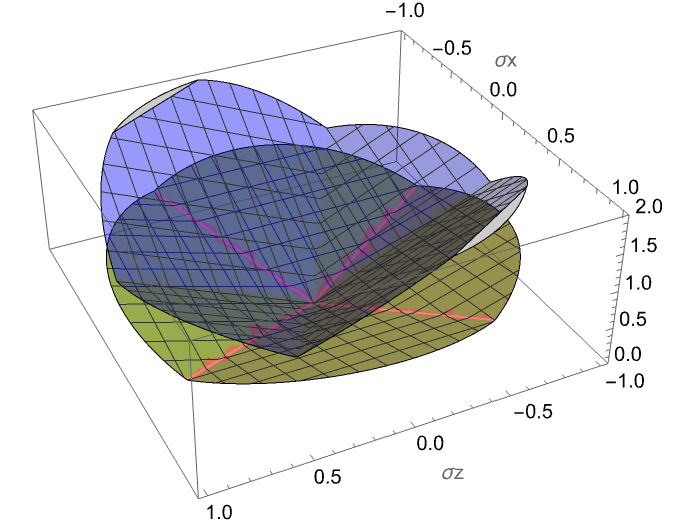
Figure 1: Application of the derived inequality to a qubit system for θ=3π, illustrating the difference between operational probabilities and the bounds imposed by measurement invasiveness.
The Quantum/Quasi-Classical Representation Framework
The discussion leverages the general framework of quantum/quasi-classical representations, recasting quasi-joint probability distributions (QJPs) and quantization of multi-variable functions as dual operations. QJPs unify approaches such as Kirkwood-Dirac (KD), Margenau-Hill, Wigner-Weyl, and Born-Jordan, extending the Born rule and functional calculus to tuples of noncommuting observables.
This framework enables rigorous comparison between operational procedures and algebraic expectations. For two-point correlations, all quantizations of f(a,b)=ab are restricted to symmetric forms A∘αB, and the real part of such algebraic correlations is representation-independent. However, for higher-order correlations (e.g., three-point), this invariance fails, highlighting the nonclassical distinctions intrinsic to quantum measurement.
Structural Origin of Equivalence: Leggett-Garg Inequality and Dichotomic Observables
As an application, the quantum violation of the Leggett-Garg (LG) inequality is analyzed. The LG inequality, like Bell's but in the temporal domain, tests noninvasive realism using sequential projective measurements and operational correlations. The analysis proves that operational and algebraic correlations coincide only for dichotomic observables, establishing a structural equivalence condition.
The equivalence among operational correlation, algebraic correlation, quasi-probabilities, weak values, and weak measurements is shown to be a direct consequence of the restriction to bivalent measurement outcomes. This result clarifies why various protocols yield consistent LG violations and why the quantum/non-classical structure only collapses in this special case.
Extension to General Measurements and Joint Probability Distributions
The work generalizes the operational/algebraic dichotomy to generic quantum measurements (beyond projective scenarios), providing composite bounds that involve not only invasiveness but also terms quantifying the non-repeatability of measurement outcomes. This establishes a robust operational foundation for commonly used algebraic constructs and their associated quasi-probabilities.
The paper also discusses the relationship between the support of a QJP and the spectrum of observables, revealing scenarios where quasi-conditional expectations are not well-defined due to nonzero QJP values outside the observable spectrum. This phenomenon encapsulates quantum nonclassicality within QJP support properties.
Implications and Future Directions
The results operationalize algebraic quantum concepts, providing quantitative tools for distinguishing correlation functions in fundamental quantum analysis. The upper and lower bounds, both tight and physically interpretable, have significant implications for quantum foundations, quantum information theory, and quantum computation, particularly in scenarios involving sequential or weak measurements.
Further extensions to generic measurements, non-projective scenarios, and higher-order correlations are warranted, as are applications to non-classicality signatures in quantum metrology, state tomography, and contextuality experiments. The formal duality between quasi-classicalization and quantization could serve as a basis for new quantum-classical hybrid simulation methods and for elucidating the structure of quantum stochastic processes.
Conclusion
The paper meticulously clarifies the structural and operational origins of ambiguity in quantum correlation function definitions, deriving rigorous quantitative bounds based on measurement invasiveness and disturbance. The equivalence of operational and algebraic approaches is shown to hold exclusively for dichotomic observables, illuminating the foundations of LG inequality violations. The theoretical framework and bounds established provide a robust operational justification for algebraic quantum concepts, with broad implications for quantum foundations and practical quantum technologies.