Will a Large Complex System be a Maxwell Demon?
Abstract: Emerging evidence suggests that physical systems operating as Maxwell demons, in which some subsystem of a larger system extracts heat energy from its environment in an apparent local violation of the second law, are commonplace throughout biology. Should these findings surprise us, or is Maxwell demon behavior inevitable in sufficiently large complex systems? In this Letter we pose the question of how likely it is that a random stochastic system with many degrees of freedom will operate as a Maxwell demon, considering null models for both continuous and discrete random dynamics. Our results show the probability of a finding a demon decreases at least exponentially, and in some cases double-exponentially, with the number of degrees of freedom, ultimately suggesting that large complex demons can only arise through a process of selection.
Paper Prompts
Sign up for free to create and run prompts on this paper using GPT-5.
Top Community Prompts
Explain it Like I'm 14
Overview
This paper asks a simple but deep question: in a big, complicated system with many interacting parts, is it common for one part to act like a “Maxwell’s demon”—a special kind of trickster that seems to pull heat energy from its surroundings, looking like it’s breaking the usual rules of thermodynamics? The authors show that, in random systems, this “demon” behavior becomes extremely rare as the number of parts grows.
What were they trying to find out?
Put simply: If you build a complex system by connecting lots of parts randomly, how likely is it that at least one part will look like it’s absorbing heat from the environment (a key sign of a Maxwell’s demon)? Is this something we should expect to happen often in large systems—like those in biology—or is it so unlikely that, when we see it, we should suspect it was “selected for” or designed?
How did they study it?
The authors create mathematical “toy worlds” that capture two common kinds of randomness in physical systems and then ask, “Does any part act like a demon?”
- Continuous model: Imagine each part of the system is like a knob that can slide smoothly, being constantly jiggled by thermal noise (random shaking from temperature). This is modeled with “Langevin dynamics,” which is a standard way to describe how things move under steady pushes plus random bumps.
- Discrete model: Imagine each part is a simple switch with only two positions, 0 or 1, and only one switch flips at a time. This is modeled with a “master equation,” which tracks jump-like changes between states.
In both models, the authors:
- Wire the parts together randomly.
- Let the system reach a steady state.
- Calculate the heat flow for each part.
- Ask: Does any part have a positive heat flow (meaning it’s absorbing heat from the environment)? If yes, they count that as a “demon.”
Key idea in plain language: For a part to act like a demon, certain random influences in the system have to line up just right—like two random arrows pointing in nearly the same direction. As the number of parts grows, the “space” of possibilities gets bigger and bigger, and random arrows almost never line up. That’s why demon behavior gets rarer in bigger systems.
They used both:
- Math (to get general formulas and limits), and
- Computer simulations (to check the math and see real numbers).
What did they find?
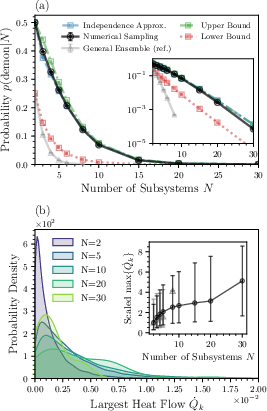
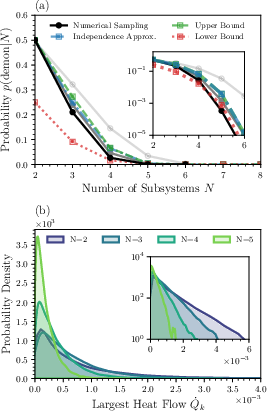
- For very small systems with 2 parts, demon behavior is fairly common—about a 50% chance.
- As the number of parts increases:
- In the continuous model (smooth, noisy knobs), the chance of finding any demon falls almost exponentially with . In everyday terms, the probability shrinks very fast as you add more parts.
- In the discrete model (binary switches), the chance falls even faster—“double-exponentially”—which is like shrinking so quickly that it becomes practically zero after only a few extra parts.
- In the continuous model, there’s an interesting twist: even though demons get rarer with larger , when they do appear, the strongest demon in the system tends to be more powerful (it absorbs more heat). So: rarer, but sometimes stronger.
- In the discrete model, that twist doesn’t hold; demons don’t tend to get stronger with size.
Why is this important? It means that if you see demon-like behavior in a large, complicated real-world system—like a cell—it probably didn’t show up by accident. It’s more likely the result of selection, design, or tuning.
Why does this happen?
It comes down to chance alignments in high dimensions. Demon behavior requires certain random patterns to line up. In low dimensions (few parts), that’s not so rare. But in high dimensions (many parts), random directions almost never match. In the continuous model, the number of ways things must line up grows with , making demons exponentially rare. In the discrete model, the number of possible patterns explodes even faster, making demons double‑exponentially rare.
What’s the big takeaway?
- Demon-like behavior in large random systems is extremely unlikely.
- Therefore, when we observe a Maxwell’s demon in nature—especially in complex biological systems—it’s a strong hint that the system has been shaped (by evolution or design) to use information in a special way.
- For engineers and scientists designing tiny machines or analyzing biological networks, this suggests:
- Don’t expect demon behavior to appear by accident in big systems.
- If you want it, you probably have to design or select for it.
- In some continuous systems, if a demon does arise, it might perform strongly, but you’ll rarely get one by chance.
In short, Maxwell’s demons don’t typically pop out of large random systems. If you find one, it’s probably not luck—it’s selection.
Knowledge Gaps
Knowledge gaps, limitations, and open questions
Below is a single, concise list of what remains missing, uncertain, or unexplored in the paper, framed to be actionable for future research:
- Quantify demon probabilities under stricter demon definitions (e.g., forbidding ensemble-averaged or trajectory-level energy exchange), and derive scaling with to compare against the current permissive upper bounds.
- Characterize how the choice of subsystem partition (coarse-graining) affects demon detection: develop partition-invariant criteria or worst-/best-case bounds over all partitions for a fixed physical system.
- Extend continuous-model results beyond small off-diagonal coupling (): derive non-perturbative or higher-order asymptotics for and heterogeneous diagonal terms.
- Analyze underdamped dynamics with inertia (non-overdamped Langevin) and multiplicative/colored noise: determine whether exponential suppression of demon probability persists.
- Investigate non-linear drift (random nonlinear dynamical systems) rather than linear Langevin dynamics: establish scaling of when drift Jacobians depend on state or are non-Gaussian.
- Replace diagonal diffusion/multipartite assumptions with correlated noise and non-bipartite coupling (non-diagonal diffusion tensors): derive the modified alignment conditions and their impact on demon probabilities.
- Develop analytic results (not just numerical) for heterogeneous mobilities, temperatures, and diagonal force terms in the continuous model; quantify sensitivity of scaling to heterogeneity.
- Formalize the correlation structure among “subsystem demon events” beyond independence and disjoint-event bounds: compute covariance, number of simultaneous positive heat flows, and tighten bounds using large-deviation theory.
- Provide a rigorous proof of double-exponential suppression for the discrete model beyond linear-response (), and identify conditions (rate distributions, network structure) under which this scaling holds or fails.
- Systematically vary ensembles for random matrices and rates (heavy-tailed, sparse, structured, modular, spatially local, constrained by detailed balance or near-detailed-balance) to map how depends on connectivity, sparsity, and distribution tails.
- Quantify the effect of network topology (degree distribution, modularity, hierarchy, community structure) on demon probability and strength in both continuous and discrete settings.
- Analyze periodically driven/stochastic pump settings (non-equilibrium time-periodic steady states): compute demon probabilities under time-dependent protocols and relate to pump parameters.
- Generalize to multi-reservoir systems with : determine how temperature heterogeneity changes demon probability and whether demons gain performance advantages in thermal-gradient settings.
- Develop extreme-value theory for the largest positive heat flow conditional on demon status: derive asymptotic tail forms and scaling with for both continuous and discrete ensembles to explain observed trends.
- Define and analyze demon “strength” metrics beyond largest heat flow (e.g., average power, efficiency, information-to-work conversion ratio), and characterize their distributions with .
- Study transient demons (non-stationary regimes): compute demon probabilities during relaxation or under ramps/pulses and compare scaling with steady-state results.
- Bridge to trajectory-level thermodynamics: quantify the distribution of pathwise positive heat absorption events and their relation to steady-state demon criteria.
- Examine robustness of the random-vector alignment mapping when isotropy fails (anisotropic covariances, structured interactions): formalize modified alignment inequalities and their probabilities.
- Introduce rare-event sampling/importance-sampling methods to estimate superexponentially small probabilities for larger in the discrete model without prohibitive brute-force enumeration.
- Provide empirical validation: design measurement/inference protocols to detect local heat and information flows in biological or synthetic systems, estimate observed demon frequencies, and compare to model predictions.
- Address identifiability and measurement bias: quantify how partial observability, coarse time resolution, and model misspecification affect inferred demon probabilities and strengthen inference methods.
- Explore feedback-controlled architectures and information-processing topologies: determine whether particular control schemes (e.g., hierarchical or centralized feedback) mitigate suppression at large .
- Relate demon probability suppression to thermodynamic uncertainty relations: derive bounds linking dissipation/precision constraints to the likelihood of positive local heat flows.
- Quantify the gap between permissive and strict demon definitions by computing multiplicative or exponential differences in probabilities across definitions as grows.
- Integrate selection models: formalize evolutionary/design-selection processes that could produce demons despite suppression, estimate required selection strengths, and generate testable predictions for biological systems.
- Extend to hybrid continuous–discrete systems (piecewise-linear dynamics, switching processes) and non-Markovian memory kernels to assess generality of suppression.
- Clarify operational detectability: propose standardized experimental criteria for labeling a subsystem as a demon (heat and information flow thresholds, confidence intervals), and evaluate false positives/negatives.
- Investigate constraints from conservation laws and symmetries (e.g., angular momentum, gauge-like invariants) on demon probability in physically realistic models.
- Tighten upper and lower bounds with combinatorial/random-matrix tools (e.g., concentration inequalities, spectral constraints) to reduce gaps between theory and numerics for moderate .
Practical Applications
Immediate Applications
Below are practical uses that can be deployed now, drawing directly from the paper’s probabilistic bounds, modeling frameworks, and design implications.
- Industry (energy, hardware, materials): device claims vetting and model auditing
- Use case: Rapid falsification/triage of “passive noise energy harvesting” or “spontaneous Maxwell-demon-like” device claims.
- Workflow:
- Identify the device’s effective degrees of freedom N and whether dynamics are better approximated by continuous linear Langevin or discrete master equation models.
- Estimate or measure the interaction matrix A (continuous) or transition rates w (discrete), check multipartite conditions (diagonal diffusion; single-degree transitions).
- Compute the upper/lower bounds or the independence approximation for demon probability via the regularized incomplete beta function referenced in the paper.
- If observed demon frequency is inconsistent with the exponential/double-exponential suppressions, flag modeling errors or non-multipartite coupling.
- Tools/products: “Demon Likelihood Estimator” (a small library that ingests A or w, N, and returns p(demon) bounds).
- Assumptions/dependencies: steady state; same-temperature thermal reservoir(s); multipartite structure; valid identification of N; measured heat/information flows.
- Academia (biophysics, synthetic chemistry, nanotechnology): hypothesis testing for selection in biological or synthetic systems
- Use case: Determine whether observed local heat absorption (positive subsystem heat flow) implies functional selection rather than chance in complex biomolecular assemblies.
- Workflow:
- Classify dynamics (continuous vs discrete) and estimate N for the subsystem network.
- Compute p1 and system-level bounds for demon occurrence; treat paper’s probabilities as upper bounds if stricter demon definitions apply.
- Use the probability as a “surprise metric” (a p-value-style argument) to support hypotheses of selected or designed coupling.
- Tools/products: Jupyter notebook template to calculate p1, bounds, and independence approximation; experimental protocols to infer subsystem heat/information flows from time series.
- Assumptions/dependencies: reliable inference of heat flows and information flows; steady-state operation; multipartite conditions; adequate sampling.
- Software and modeling (simulation validation, scientific computing): unit tests for thermodynamic consistency
- Use case: Add demon-probability scaling checks to stochastic simulation pipelines; if demons arise too frequently in large random models, flag mis-specification.
- Workflow:
- During model QA, generate random ensembles of A or w consistent with intended physics; estimate p(demon|N) via bounds.
- Compare simulated demon occurrence rates to the exponential/double-exponential expectations.
- Diagnose violations (e.g., hidden couplings, non-diagonal diffusion, non-steady-state effects).
- Tools/products: CI plug-ins that run ensemble tests and report deviations; diagnostic dashboards.
- Assumptions/dependencies: proper randomization of off-diagonal interactions; correct noise statistics; positive-eigenvalue stability for Langevin.
- Education and training (physics, engineering curricula)
- Use case: Short modules demonstrating why demon-like behavior is exponentially unlikely in high-dimensional random systems and how information flow rectifies apparent second-law violations.
- Workflow: Reproduce the paper’s bounds and simple Monte Carlo experiments for various N; connect to geometric intuition about random vector alignment in high dimensions.
- Tools/products: classroom labs; interactive visualizations of p(demon|N) scaling.
- Assumptions/dependencies: none beyond curricular integration.
- R&D portfolio management (research strategy across sectors)
- Use case: Prioritize targeted design/selection methods over random search when developing nanoscale information engines, supramolecular pumps, or feedback-driven devices.
- Workflow: Use scaling results to quantify the futility of “serendipitous discovery” for large-N systems; budget for optimization/selection pipelines.
- Tools/products: decision memos referencing exponential/double-exponential suppression as forward-looking evidence.
- Assumptions/dependencies: relevant projects fit multipartite steady-state contexts; team capacity for iterative design.
Long-Term Applications
These applications require further research, scaling, or technology development but are naturally motivated by the paper’s findings and design insights.
- Healthcare/biotech (molecular machines, synthetic biology): computationally guided design of information engines
- Use case: Engineer protein assemblies or supramolecular machines with deliberate coupling architectures that create the necessary information flows for controlled local heat uptake.
- Emerging products/workflows:
- CAD tools that optimize interaction matrices to “align” the cross-couplings (maximize U·V − |U|2 in the paper’s continuous model) subject to biophysical constraints.
- Closed-loop experimental design harnessing measured covariance C and force matrix A to iteratively improve demon-like performance.
- Assumptions/dependencies: precise structural and kinetic control; robust measurement of subsystem heat flows; possible multi-reservoir environments for performance gains.
- Energy and microelectronics (CMOS, sensors): information-to-energy conversion devices with feedback
- Use case: Develop micro/nanoscale feedback controllers that harvest energy from fluctuations via information processing, acknowledging inefficiency scaling at large N.
- Emerging products/workflows:
- On-chip “information engines” integrated with low-noise sensors and fast controllers for niche energy scavenging or signal amplification.
- Architecture guidelines that quantify efficiency losses with scaling and emphasize modular (small-N) demons for practical deployment.
- Assumptions/dependencies: high-speed, low-power feedback; accurate state estimation; thermodynamically consistent controller design; limitations from sub-extensive scaling in CMOS.
- Robotics and autonomous systems (swarm control, sensing): noise-leveraging control protocols
- Use case: Design coordinated feedback between robot subsystems to exploit environmental fluctuations for micro-actuation or sensing gains.
- Emerging products/workflows: swarm-control algorithms that inject structured information exchange; small-team modules (low N) tailored to maximize conditional heat-extraction performance.
- Assumptions/dependencies: reliable communication channels; well-characterized stochastic environment; controller synthesis with thermodynamic accounting.
- Finance and economics (quantitative analytics, regulation): information-thermodynamics perspectives on arbitrage
- Use case: Model markets as high-dimensional stochastic systems to argue that spontaneous “free-lunch” arbitrage via random chance becomes vanishingly likely as system complexity grows.
- Emerging products/workflows: anomaly detection tools that interpret arbitrage-like signals as products of deliberate strategy (selection) rather than chance; risk models that incorporate information flows.
- Assumptions/dependencies: valid mapping from market microstructure to multipartite stochastic thermodynamics; appropriate proxies for information flow and subsystem heat analogs.
- Policy and standards (claims assessment, research governance): evidence-based criteria for extraordinary energy claims
- Use case: Establish guidelines that require explicit demonstration of feedback/information processing mechanisms in devices claiming local second-law violations or “Maxwell-demon-like” behavior.
- Emerging products/workflows: standards documents citing exponential/double-exponential suppression; review checklists for grant proposals and patents.
- Assumptions/dependencies: ability to verify steady-state conditions, multipartite dynamics, and measurable information flows.
- Scientific software (thermodynamic inference tooling): integrated libraries for demon detection and design
- Use case: Build open-source toolboxes that estimate demon probabilities, infer information flows, and optimize interaction structures to achieve targeted subsystem heat flows.
- Emerging products/workflows:
- APIs for computing p1 and system-level bounds using the regularized incomplete beta function; Monte Carlo modules; optimization objectives derived from the paper’s alignment criteria.
- Pipelines that couple experimental time-series analysis (heat/information inference) to design iteration.
- Assumptions/dependencies: high-quality data; validated inference methods; compatibility with diverse model classes (continuous/discrete; near/far-from-equilibrium).
- Fundamental science (evolutionary inference): quantitative tests for selection in complex biological networks
- Use case: Incorporate demon-probability suppression into evolutionary models to detect selected information-processing motifs in cells and organisms.
- Emerging products/workflows: comparative analyses across species or conditions to identify subsystems where demon-like behavior is statistically too unlikely to be random.
- Assumptions/dependencies: mapping biological interactions to multipartite models; reliable estimation of N; careful handling of reservoir heterogeneity and non-steady-state dynamics.
Across all applications, the following cross-cutting assumptions and dependencies impact feasibility:
- Multipartite structure: independent subsystem heat exchange (diagonal diffusion for continuous; single-degree transitions for discrete) is required.
- Steady-state and equal-temperature reservoirs are assumed; multi-temperature reservoirs may change performance trade-offs.
- The paper’s demon definition is permissive (at least one subsystem with positive heat flow), so calculated probabilities are upper bounds for stricter definitions.
- Continuous-case analytic results use equal mobilities, equal positive diagonal terms, and small off-diagonal couplings; discrete-case analytics use small log-variance; numerical evidence suggests qualitative robustness beyond these limits.
- Accurate measurement or inference of subsystem heat and information flows is essential to deploy testing and design workflows.
Glossary
- Bipartite system: A system composed of exactly two interacting subsystems or degrees of freedom. "For a bipartite system () only at most one heat flow can be positive,"
- Boltzmann's constant: A fundamental constant that relates temperature to energy in statistical mechanics, usually denoted . "for Boltzmann's constant and Dirac-delta function ."
- Covariance matrix: A matrix capturing the variances and covariances of a multivariate probability distribution. "The probability distribution that solves these stochastic differential equations is a multivariate Gaussian distribution with covariance matrix "
- Dirac-delta function: A generalized function that is zero everywhere except at a single point, where it is infinite, and integrates to one; used to represent idealized time correlations. "Dirac-delta function ."
- Diffusion tensor: A matrix describing how different degrees of freedom diffuse; diagonal here indicates independent diffusion per subsystem. "for continuous systems this means the diffusion tensor is diagonal"
- Eigenvalues: Scalars characterizing the action of a linear transformation on its eigenvectors; positivity here ensures stability and a unique steady state. "So long as the eigenvalues of the matrix are all positive,"
- Entropy production rate: The rate at which thermodynamic entropy is generated, often linked to dissipated heat divided by temperature. "the entropy production rate , equal to the total rate of heat dissipated to external reservoirs by all subsystems, is nonnegative"
- Far-from-equilibrium: A regime where a system is strongly driven and significantly departs from thermal equilibrium. "spanning both near-equilibrium and far-from-equilibrium regimes."
- Gaussian white noise: Random fluctuations with a normal distribution, zero mean, and delta-correlated in time. "zero-mean Gaussian white noise"
- Hamming distance: The number of positions at which two binary strings differ; used to constrain allowed transitions. "Hamming distance of 1"
- Hypercube: An N-dimensional generalization of a cube; here, the discrete state space with vertices. "The state space is then an -dimensional hypercube with states."
- Information flow: The rate at which a subsystem’s dynamics change the shared information (correlations) among degrees of freedom. "the information flow is the rate at which the dynamics of the 'th subsystem change the total correlation"
- Isotropic random vectors: Random vectors whose distributions are rotationally invariant, having no preferred direction. "which are both independent and isotropic random vectors in "
- Langevin dynamics: Stochastic differential equations modeling systems subject to deterministic forces and thermal noise. "overdamped linear Langevin equations"
- Linear response limit: An approximation regime where perturbations are small enough that responses are linear in the perturbation. "we take the linear response limit to make progress,"
- Log-normal distribution: A probability distribution of a random variable whose logarithm is normally distributed. "drawn independently from a log-normal distribution"
- Master equation dynamics: Stochastic dynamics describing transitions between discrete states via a rate matrix. "discrete master equation dynamics"
- Maxwell demon: A subsystem that appears to locally violate the second law by extracting heat, compensated by information flow. "Here we define a Maxwell demon to be any multipartite system which features at least one subsystem with a positive heat flow"
- Mobility tensor: A matrix relating applied forces to velocities for each degree of freedom; diagonal indicates independent mobilities. "mobility tensor (assumed to be diagonal)"
- Mutual information: A measure of the amount of information one random variable contains about another. "(a multivariate generalization of the mutual information)"
- Near-equilibrium: A regime where the system’s behavior is close to thermal equilibrium, enabling linear approximations. "spanning both near-equilibrium and far-from-equilibrium regimes."
- Near-independent approximation: An estimate assuming approximate independence of events, adjusted for global constraints. "The near-independent approximation~\eqref{eq:independentapprox} best fits the numerical sampling results,"
- Nonequilibrium steady state: A stationary state with constant macroscopic flows maintained by external driving. "we focus our attention on nonequilibrium steady states."
- Overdamped: A regime where inertial effects are negligible compared to friction, simplifying dynamics. "overdamped linear Langevin equations"
- Regularized incomplete beta function: A special function used to express probabilities involving beta distributions. "where is the regularized incomplete beta function."
- Stochastic thermodynamics: A framework extending thermodynamics to small systems with fluctuations and stochastic dynamics. "Stochastic thermodynamics of multipartite systems.---"
- Thermal reservoir: An idealized environment at fixed temperature that exchanges heat with the system. "in contact with a thermal reservoir at temperature ."
- Thermodynamic resource: A quantity, such as information, that can be traded for work or heat in thermodynamic processes. "since this information is itself a thermodynamic resource"
- Total correlation: A multivariate measure of overall statistical dependence among variables, generalizing mutual information. "total correlation (a multivariate generalization of the mutual information)"
- Work reservoirs: External sources or sinks that exchange mechanical or generalized work with subsystems. "external work reservoirs"
Collections
Sign up for free to add this paper to one or more collections.

