When Do Habits Matter? The Empirical Content of Dynamic Hedonic Models
Abstract: Hedonic models value goods through their characteristics but are typically interpreted under time-separable preferences. This assumption is restrictive: when some attributes are habit forming, observed prices reflect both contemporaneous utility and continuation values from past consumption. I develop a nonparametric revealed preference framework for dynamic hedonic valuation, deriving necessary and sufficient conditions for rationalisability over characteristics. The framework separates restrictions imposed by the hedonic price system from those imposed by intertemporal choice and provides diagnostics that quantify the severity of violations along each margin. Applied to household scanner data, I show that most failures of static hedonic valuation reflect violations of the hedonic price structure; conditional on satisfying this structure, allowing for habit formation improves behavioural fit. This alters the mapping from prices to willingness-to-pay and the implied welfare interpretation.
Paper Prompts
Sign up for free to create and run prompts on this paper using GPT-5.
Top Community Prompts
Explain it Like I'm 14
Overview
This paper asks a simple question with big consequences: when people get used to (or crave) certain product ingredients like sugar, caffeine, or nicotine, how should we interpret prices and buying choices? Most studies assume what you like today doesn’t affect what you like tomorrow (time-separable preferences). But many attributes are habit-forming. The paper builds a new way to check whether prices and purchases can be explained by a “characteristics-based” view of products that also allows habits to matter over time.
What questions does the paper ask?
- Can we still make sense of prices as paying for product attributes (like sugar, fiber, or taste) when some of those attributes are habit-forming?
- If not, is the problem with the way we translate goods into attributes (the “characteristics” setup), or with how people choose over time (because habits change what they want)?
- When does allowing for habits actually change what we conclude about how much people are willing to pay (WTP) for attributes, and about welfare (who’s better or worse off)?
How did the researcher approach the problem?
Key idea in everyday language
Think of a product (say, a cereal) as a recipe made of attributes: sweetness, crunchiness, calories, fiber, etc. A “hedonic model” says the price tag is really a bundle of prices for these ingredients. Usually, we act like what you eat today doesn’t change what you want tomorrow. But if sugar or caffeine builds a habit, then today’s choice can change tomorrow’s cravings.
The paper develops a “revealed preference” check—like a logic test—that looks only at what you bought and the prices you faced. It asks: could a sensible, forward-looking shopper who forms habits have made these choices?
A simple example
Two cereals differ in:
- Taste (non-habit-forming)
- Sugar intensity (habit-forming)
If you eat high-sugar cereal today, you might want more sugar tomorrow. The method checks whether observed prices and choices can be explained by valuing “taste now” and “sugar now” plus the future effect that today’s sugar has on tomorrow’s preferences.
How the test works (two-stage check)
The paper shows we should separate two things:
- Structural check (about the price system)
- Do observed cereal prices look like they’re built from the values of their attributes? In other words, if cereals are recipes of attributes, do the price tags line up with those recipes? If not, then talking about “how much people pay for sugar” doesn’t make economic sense—because the attribute-based interpretation of price breaks down.
- Behavioral check (about choices over time)
- If prices can be explained by attribute values, are the shopper’s choices over time consistent with someone who:
- gets value from current attributes,
- and whose past consumption of habit-forming attributes changes how they value future consumption (e.g., sugar cravings or fatigue)?
The author turns these into clear, math-based conditions (think of them as a checklist) that can be tested with data. These conditions are “nonparametric,” meaning they don’t assume a specific formula for preferences—they just require basic economic logic (like not wasting money and valuing more over less when possible). The paper also provides “distance” measures that tell you how far the data are from passing the test, which is useful for diagnosis rather than a simple pass/fail.
What did the study find?
Using household scanner data on ready-to-eat cereals:
- Moving from “goods” (UPC-level products) to “characteristics” (like nutrients and flavor indicators) makes the model more disciplined. It asks prices to follow the recipe of attributes. Because that’s a strong requirement, the characteristics model “passes” less often than a goods-based model in a simple pass/fail sense.
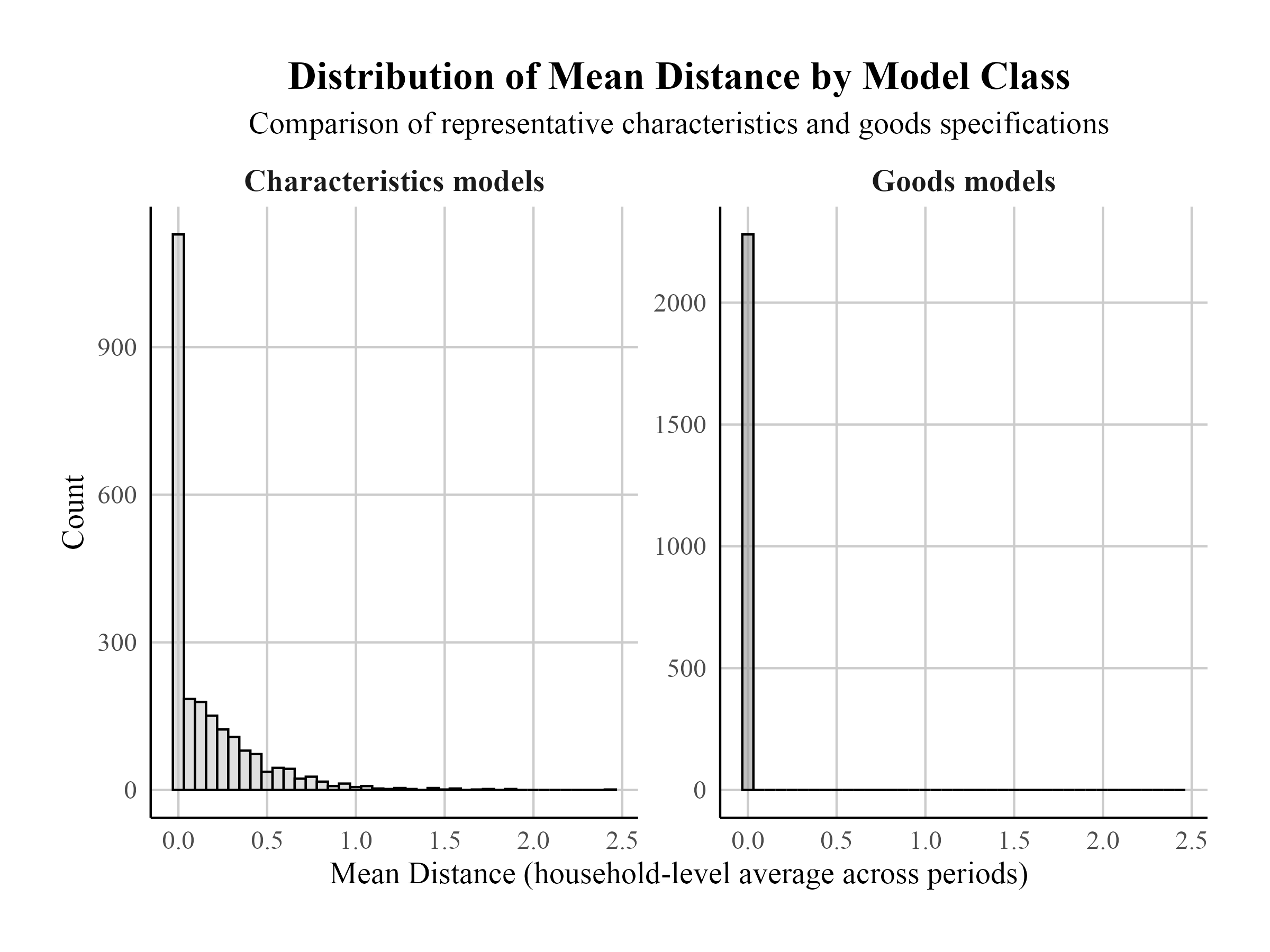
- However, most failures come from the structural side (the way prices line up with attribute recipes), not from people’s behavior over time. And even then, the violations are usually small: the prices are close to what the attribute model would require.
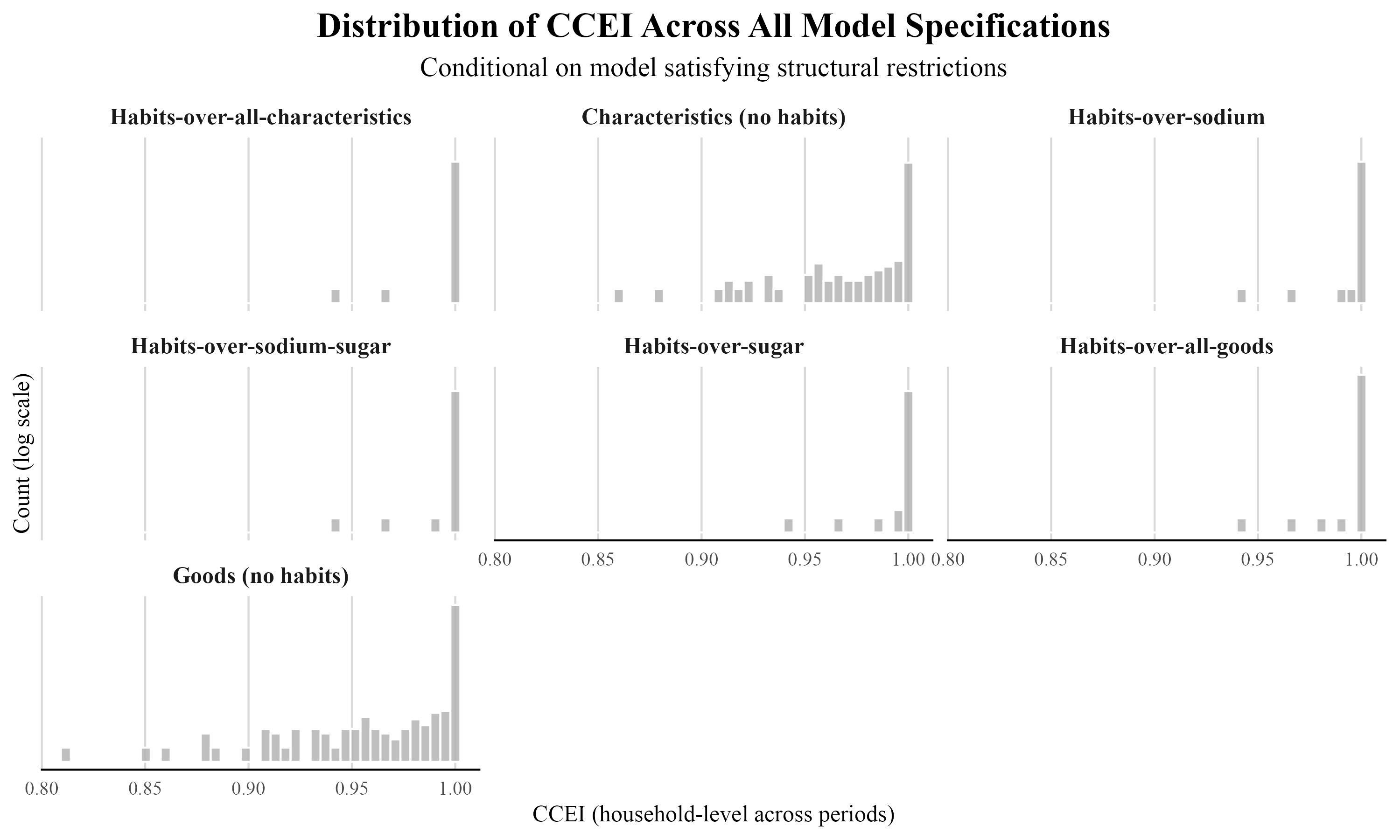
- Once the price system is consistent with attributes (the structural check passes), allowing for habits (e.g., sugar influencing future tastes) makes the model fit behavior over time better than a static model that ignores habits. In short, habits help explain purchase patterns.
- This matters for willingness-to-pay (WTP): with habits, the observed price of a good reflects both “enjoyment now” and the “future effect” of today’s consumption. If you ignore habits, you can mismeasure how much someone truly values an attribute and misread the welfare effects.
Why does this matter?
For research and policy
- If the price system can’t be explained by attributes, then “hedonic WTP” for attributes (like “$X for an extra gram of sugar”) isn’t well-defined. You shouldn’t use it for policy (e.g., sugar taxes, alcohol rules, tobacco regulation, environmental standards).
- If the price system is fine but habits are present, using a static model (ignoring habits) will misinterpret what people value and how policies affect them.
- The paper gives a practical diagnostic: first check if prices are structurally consistent with the attribute recipe; if yes, then check if behavior over time fits better when habits are allowed. It also quantifies how big the problems are when the checks fail.
Big picture
This work helps economists know when it’s safe to translate prices into values of product attributes, and when habits change that story. It’s especially important in markets where attributes are known to be habit-forming (sugar, caffeine, nicotine). The result is better, more reliable welfare and policy analysis—grounded in what people actually buy and how today’s choices shape tomorrow’s wants.
Knowledge Gaps
Knowledge gaps, limitations, and open questions
Below is a single, consolidated list of gaps the paper leaves unresolved; each point is framed to guide concrete follow-on research.
- Structural technology (A) is assumed known, linear, and time-invariant; there is no empirical procedure to test, estimate, or robustify the analysis to misspecification, time variation (product reformulations), or measurement error in characteristics.
- Nonlinear goods-to-characteristics mappings are deferred to an appendix; there is no implementable RP test, rank-like diagnostic, or computational routine for the nonlinear case where marginal products vary with demand.
- The analyst-defined partition of characteristics into habit-forming vs non-habit-forming dimensions is taken as given; the paper provides no data-driven model selection/test to determine which attributes exhibit state dependence or how many lags to include.
- Only a one-lag habit structure is implemented; identification, testable implications, and computational scalability for multi-lag or flexible distributed-lag habits are not developed empirically.
- The discount factor β is treated as a feasibility parameter searched over a grid; there is no identification result, estimator, or inference for β, nor a strategy to separate discounting from habit strength.
- Preferences are assumed concave and superdifferentiable; the framework does not address non-convexities (e.g., thresholds, satiation, binge dynamics) or discrete choice environments common in UPC-level data.
- Quasi-hyperbolic or time-inconsistent discounting is not considered; there are no RP conditions or diagnostics for dynamic inconsistency in characteristics space.
- The model is single-consumer and partial-equilibrium; there is no link to market-clearing hedonic price schedules, supply-side behavior, or equilibrium feedback when attributes are habit-forming.
- Heterogeneity across consumers (e.g., in β or habit strength) is not modeled; aggregation tests, identification with panel heterogeneity, and pooling strategies are left open.
- The paper’s “missing prices” solution relies on existence of imputed prices for non-purchased goods, which is very permissive; there is no use of external posted prices/bounds, nor sensitivity analysis showing how permissiveness affects conclusions.
- The decomposition into contemporaneous and lagged shadow prices is set-identified; the paper does not propose additional exogenous variation (e.g., targeted promotions, experiments) or instruments to separately identify these components.
- The necessary rank condition is structural-only and period-by-period; there is no counterpart sufficient condition that is computationally light, nor guidance on how to tighten the diagnostic with minimal additional assumptions.
- Distance-based diagnostics are proposed but their statistical properties (sampling variability, confidence regions, power) are not developed; there is no inference procedure or guidance on critical values for “material” violations.
- The framework cannot distinguish empirically between habits and other sources of persistence (learning, taste shocks, switching costs) without extra structure; no strategy is provided to disentangle these mechanisms in revealed preference.
- Inventory/stockpiling dynamics are discussed as conceptually distinct but not jointly modeled; there is no integrated RP framework to simultaneously allow storage and habits and test which mechanism explains the data.
- The lifecycle budget setup assumes a present-value constraint and quasi-linearity in an outside good; there is no treatment of liquidity constraints, interest rate heterogeneity, or income shocks that could alter intertemporal feasibility conditions.
- Scanner data constraints (sparse intertemporal price/budget variation) limit behavioral power; the paper does not implement in settings with richer variation (e.g., experimental price rotations) to demonstrate sharper behavioral content.
- Robustness to time aggregation and binning choices is not reported; there is no sensitivity analysis showing how periodization affects dynamic RP conclusions.
- The structural/behavioral failure decomposition is diagnostic but not prescriptive; there is no guidance on model repair (e.g., minimal changes to A vs. preference structure) beyond generic distance metrics.
- Welfare interpretation is highlighted but not operationalized; there is no procedure to translate diagnostic wedges into corrected willingness-to-pay or welfare bounds, nor to quantify the welfare bias from ignoring habits.
- Policy analysis (e.g., nutrient taxes) is not integrated with supply-side pass-through, dynamic firm pricing, or equilibrium adjustments; a full dynamic hedonic policy-counterfactual framework remains to be developed.
- External validity is untested; results are from ready-to-eat cereal with relatively modest habits; application to markets with stronger addictive attributes (caffeine, nicotine, alcohol) and cross-attribute interactions is not provided.
- Cross-attribute habit interactions (e.g., complementarities between sugar and caffeine) are allowed in principle but not identified or tested; empirical strategies to detect and quantify cross-attribute reinforcement are absent.
- Price endogeneity and targeted promotions are not addressed; without instruments or store-level posted price controls, RP violations may be confounded by consumer-specific price discrimination or couponing.
- The empirical strategy treats the characteristics matrix as complete; unobserved attributes (e.g., taste/brand reputation) could violate the rank condition—there is no approach to include latent characteristics or bounds to account for them.
- Computational scalability may remain challenging with large T and K despite the quadratic constraint reduction; there is no complexity analysis, warm-start strategy, or decomposition algorithm for large panels.
- No guidance is provided for integrating statistical noise (measurement error in prices/quantities/characteristics) into the RP tests (e.g., stochastic RP or perturbation-based inference).
- The missing empirical section in the provided text truncates the analysis; robustness across markets, time, and household subgroups—and sensitivity to characteristic definitions—remains to be documented.
Practical Applications
Immediate Applications
Below are actionable use cases that can be deployed with today’s data and tooling, leveraging the paper’s nonparametric tests, rank checks, and missing-price variant to assess when hedonic valuation is economically coherent in the presence of habit-forming characteristics.
Industry (CPG/Retail, AdTech, Market Research)
- Dynamic hedonic QC before demand modeling and WTP reporting
- What: Insert the structural rank test and the dynamic Afriat feasibility check (with missing-price option) as a pre-estimation gate in SKU/attribute-level demand analyses. Automatically flag when observed prices cannot be represented by characteristic shadow prices given the maintained goods-to-characteristics matrix A, and quantify how much budget/price perturbation is needed to rationalize behavior if feasible.
- Sectors: CPG, retail analytics, market research.
- Tools/workflows: Linear programming feasibility routines over a grid of discount factors β; period-by-period rank checks (Proposition NC); diagnostic reports that separate “price-system failures” from “behavioral (intertemporal) failures.”
- Assumptions/dependencies: A known, time-invariant linear characteristics mapping A (e.g., nutritional content per UPC); quasi-linearity in an outside good; adequate within-household price/quantity variation; one-lag habits unless extended.
- Pricing and promotion design for habit-forming attributes
- What: Use the dynamic hedonic shadow-price interpretation to quantify the intertemporal wedge between contemporaneous valuation and continuation value (e.g., for sugar/salt/caffeine). Adjust promotion cadence and price discrimination rules across products sharing the same underlying habit-forming characteristic, not just by brand.
- Sectors: CPG, retail pricing.
- Tools/workflows: SKU clustering by attribute-intensity; scenario analysis comparing static vs dynamic WTP; rule-based promotion throttling for high-intensity variants to avoid locking in unfavorable future valuations.
- Assumptions/dependencies: Stability of A across SKUs/time; correctly identifying which attributes are habit-forming; sufficient purchase frequency to estimate dynamics.
- Product reformulation and portfolio steering at the attribute level
- What: Identify when persistence operates at the attribute (e.g., sugar) rather than at the good level; prioritize reformulation (e.g., sugar reduction) in SKUs where the dynamic wedge implies large future valuation distortions or welfare concerns.
- Sectors: CPG, food & beverage R&D.
- Tools/workflows: Attribute-level habit diagnostics; rank-feasibility checks to ensure a valid hedonic interpretation before relying on attribute-WTP comparisons.
- Assumptions/dependencies: Reliable attribute measurement; stable A; heterogeneity handled by household-level panels or segments.
- Audience/segment targeting based on attribute-level habit signals
- What: Treat persistence in demand for specific attributes (e.g., high caffeine) as a state variable; tailor offers, reminders, and recommendations dynamically.
- Sectors: AdTech, CRM, personalization platforms.
- Tools/workflows: Stateful recommendation policies exploiting attribute-level lagged consumption; guardrails to avoid exploiting mismeasured static WTP.
- Assumptions/dependencies: Sufficient user-level time series; compliance with privacy/consent norms; separation from stockpiling dynamics where relevant.
Policy and Public Sector
- Pre-analysis diagnostic for hedonic-based welfare evaluations
- What: Before using hedonic gradients for WTP in policy (e.g., sugar taxes, sodium standards), run the paper’s structural and behavioral tests to determine if static hedonic WTP is economically defensible or materially biased by habits.
- Sectors: Public health, consumer protection, taxation.
- Tools/workflows: Standardized “go/no-go” checklist: (1) rank test; (2) missing-price dynamic Afriat feasibility; (3) distance-based diagnostics to quantify severity of violations; (4) sensitivity to the choice of habit-forming attribute set.
- Assumptions/dependencies: Access to scanner or administrative microdata; consensus on which attributes plausibly generate habits; explicit acknowledgement of partial identification with missing prices.
- Regulatory impact assessment with dynamic WTP adjustments
- What: In cost–benefit analyses (e.g., soda taxes), report both static and dynamic (habit-adjusted) WTP ranges, highlighting wedges where ignoring habits changes welfare conclusions or policy rankings.
- Sectors: Treasury, health ministries, city/state tax authorities.
- Tools/workflows: Dual-reporting templates; parameter grids over β; minimal-perturbation metrics to communicate robustness.
- Assumptions/dependencies: External validation of β range; mitigation of confounds like stockpiling; communication guidance for partial identification.
- Hedonic quality adjustments in official statistics
- What: Use the rank condition and dynamic feasibility as a diagnostic when applying hedonic adjustments to price indices in categories with habit-forming attributes (e.g., beverages, tobacco).
- Sectors: National statistical agencies.
- Tools/workflows: Lightweight rank screening; flagging categories where hedonic adjustments may misstate quality changes due to habits.
- Assumptions/dependencies: Consistent attribute measurement across time; awareness that tests provide necessary/sufficient conditions but not uniqueness of preference representations.
Academia and Methods
- Replicable diagnostic layer for empirical IO and hedonic papers
- What: Include the two-stage structural vs behavioral check prior to recovering hedonic WTP; publish distance-based diagnostics to quantify the magnitude of violations.
- Sectors: Academia (IO, applied micro, environmental, health).
- Tools/workflows: Open-source R/Python/Stata modules implementing: (i) rank test; (ii) LP-based Afriat feasibility with missing prices; (iii) β-grid search; (iv) minimal budget/price perturbation metrics; (v) reporting templates.
- Assumptions/dependencies: Data with product–attribute mapping; clarity on time aggregation and its effects on persistence.
- Distinguishing habit-based persistence from inventory behavior
- What: Use the model’s emphasis on attribute-based state dependence to design tests that separate habit formation from stockpiling under time separability.
- Sectors: Applied micro, IO, behavioral economics.
- Tools/workflows: Joint modeling pipeline where inventory models and dynamic hedonic RP tests are run side-by-side; decision rules for model selection.
- Assumptions/dependencies: Observables on promotions and storage feasibility; careful time aggregation to avoid confounding.
Daily Life and Practitioner Tools
- Analyst-facing dashboards to triage hedonic validity
- What: A lightweight app that ingests transaction data plus attribute tables and returns: (1) pass/fail on rank and Afriat tests; (2) estimated dynamic wedges; (3) suggested attribute partitions and sensitivity checks.
- Sectors: Consulting, data science teams.
- Tools/workflows: Web dashboards backed by LP solvers; versioned A matrices; reproducible pipelines.
- Assumptions/dependencies: Reasonable computational resources; stable attribute taxonomies.
Long-Term Applications
These use cases require further research, scaling, richer data, or productization beyond the immediate diagnostics.
Industry (CPG/Retail, Platforms)
- Dynamic pricing engines with attribute-level habit states
- What: Incorporate estimated habit states at the attribute level into real-time pricing and promotion algorithms that jointly optimize current revenue and future demand via habit dynamics.
- Sectors: CPG, retail media networks, marketplaces.
- Tools/products: Reinforcement-learning or MPC controllers constrained by the dynamic hedonic RP feasibility region; guardrail modules that enforce hedonic price-system consistency.
- Dependencies: High-frequency panel data; robust separation of habits from inventory and seasonality; governance to prevent exploitative designs.
- Cross-category portfolio management driven by shared habit attributes
- What: Manage cannibalization and cross-selling by tracking shared habit-forming attributes (e.g., sugar across beverages and snacks) rather than just brand families.
- Sectors: Multicategory CPGs, large retailers.
- Tools/products: Unified attribute graph and cross-category state tracking; long-horizon optimization for reformulation and shelf-space allocation.
- Dependencies: Harmonized attribute ontology; longitudinal, multi-category panels; causal validation.
- Personalization that adapts to “attribute cravings” responsibly
- What: Recommendation systems that predict and manage user-level attribute cravings (e.g., caffeine) across product sets, with constraints to avoid reinforcing unhealthy consumption.
- Sectors: E-commerce, food delivery, wellness apps.
- Tools/products: Preference-evolution models and safety constraints informed by dynamic RP; transparency features for users.
- Dependencies: Consent-based personal data; ethical policies; regulatory compliance.
Policy and Public Sector
- Policy simulators for sin taxes and standards with dynamic welfare
- What: Simulation platforms that forecast long-run consumption and welfare responses to sugar/sodium/nicotine policies accounting for attribute-level habits and the resulting price–valuation wedges.
- Sectors: Public health, fiscal policy.
- Tools/products: Scenario engines integrating nonparametric feasibility with structural counterfactual modules; reporting of set-identified welfare bounds.
- Dependencies: Rich panel data; validated mappings from diagnostics to model primitives; stakeholder buy-in for uncertainty communication.
- Dynamic hedonic adjustments in official indices
- What: Redesign hedonic quality adjustments to account for attributes that induce state dependence (e.g., nicotine pouches) so measured inflation reflects true quality and welfare.
- Sectors: Statistical agencies.
- Tools/products: Methodological standards, test batteries, and audit trails embedding dynamic hedonic diagnostics.
- Dependencies: Agency-wide methodological change; longitudinal product–attribute datasets.
Academia and Methods
- Generalizing beyond one-lag and linear technologies
- What: Extend the tests and diagnostics to multi-lag habits, nonlinear goods-to-attributes technologies, and richer intertemporal constraints (e.g., liquidity, durable stocks).
- Sectors: Academic research; methods R&D.
- Tools/products: New RP characterizations with tractable reductions (e.g., quadratic constraint sets); scalable solvers for large T, K, J.
- Dependencies: Theoretical advances; computational innovation; empirical validation.
- Heterogeneous-agent dynamic hedonic models
- What: Aggregation of individual RP tests to population-level diagnostics; identification of distributional effects of policy under attribute-level habits.
- Sectors: IO, public finance, health economics.
- Tools/products: Panel clustering, partial identification at scale, hybrid RP–structural estimators.
- Dependencies: Large panels; identification under heterogeneity and time aggregation.
- Educational technology and behavioral design
- What: Apply attribute-level habit modeling to features that induce engagement habits (e.g., notifications, gamification), evaluating long-run learning vs. habit reinforcement.
- Sectors: EdTech, behavioral science.
- Tools/products: Dynamic evaluation frameworks; guidelines for ethical design based on RP diagnostics.
- Dependencies: Fine-grained usage data; careful definition of “attributes” in digital products.
Daily Life and Consumer Apps
- Nutrition and wellness assistants that adapt to habit-forming nutrients
- What: Consumer apps that track intake of habit-forming attributes (sugar, caffeine) and anticipate how yesterday’s choices shift today’s cravings, adjusting suggestions over time.
- Sectors: Digital health.
- Tools/products: Habit-aware recommendation engines; personalized forecasts of valuation shifts; “de-habituation” nudges.
- Dependencies: Accurate logging; behavioral validation; privacy-preserving personalization.
Notes on feasibility and interpretation across applications:
- The hedonic interpretation requires that observed prices lie in the span implied by the goods-to-characteristics mapping (structural feasibility). If this fails, hedonic WTP is undefined under the maintained technology.
- Even when structurally feasible, ignoring habits can bias WTP because current prices embed continuation values (the “dynamic wedge”). Report both static and dynamic views when possible.
- The tests are sharp but reduced-form: pass/fail does not uniquely identify primitives (e.g., exact β or utility), and results depend on time/product aggregation and the partition of habit-forming attributes.
- Missing-price implementations provide partial-identification style conclusions: they can often falsify or support coherence without imputing absent prices, but they will not uniquely pin down all shadow prices.
Glossary
- Afriat test: A revealed-preference procedure to check whether observed choices are consistent with utility maximisation, adapted here to dynamic, attribute-based settings. "Interpreting the Afriat test requires care."
- Afriat-type RP characterisation: A set of Afriat-style revealed-preference conditions that provide necessary and sufficient criteria for dynamic rationalisability. "I derive a dynamic Afriat-type RP characterisation that extends static characteristics-based rationalisability..."
- Complementary slackness: An optimisation condition implying that inequality constraints bind exactly for goods consumed in positive amounts. "By complementary slackness, the first-order conditions bind on the support of consumption..."
- Continuation values: The future utility effects of past consumption that are internalised in current prices. "observed prices reflect both contemporaneous utility and continuation values from past consumption."
- Cyclical monotonicity: A property of observed marginal valuations ensuring no profitable cycles and equivalent to concavity of utility. "Condition (B1) imposes cyclical monotonicity on the shadow prices."
- Distance-based diagnostics: Quantitative measures of how far data are from satisfying the model’s structural or behavioural restrictions. "develop computationally tractable, distance-based diagnostics that quantify how close the data are to satisfying each margin"
- Dynamic hedonic valuation: Attribute-based valuation when preferences depend on past consumption (habits), so prices reflect both current utility and future effects. "a nonparametric revealed preference framework for dynamic hedonic valuation"
- Exponential discounting: A time-preference model where future utility is discounted at a constant rate per period. "a lifecycle problem with exponential discounting."
- Goods-to-characteristics technology: The mapping from observed product quantities to underlying attributes used to interpret prices and choices. "structural feasibility of the hedonic price system given the maintained goods-to-characteristics technology"
- Habit formation: Intertemporal dependence where past consumption of certain attributes shifts current or future marginal utility. "Some attributes are habit forming, so current consumption affects future marginal utility."
- Habits-over-characteristics model: A framework in which habits attach to specific attributes rather than goods, and choices are rationalised in characteristics space. "I refer to this environment as the habits-over-characteristics model."
- Hedonic price schedule: The function relating product attributes to market prices whose gradient recovers marginal WTP. "recovers WTP from the gradient of the hedonic price schedule."
- Hedonic price system: The structure of observed prices implied by attribute-based valuation, including restrictions necessary for a coherent interpretation. "separates restrictions imposed by the hedonic price system from those imposed by intertemporal choice"
- Hedonic representation: Expressing goods’ prices as shadow values on characteristics consistent with the maintained mapping. "do observed within-period price vectors admit a hedonic representation?"
- Industrial organisation (IO): The field studying firm behaviour and market structure; here, a common application area for hedonic models. "Hedonic models are central in empirical industrial organisation and applied micro; see, e.g.,"
- Lifecycle problem: An optimisation framework where a consumer maximises discounted lifetime utility subject to a single present-value budget constraint. "By a lifecycle problem I mean that the consumer chooses the entire consumption path to maximise lifetime utility subject to a single present-value budget constraint under exponential discounting."
- Missing price problem: The empirical challenge that prices are observed only for purchased goods, requiring existence-based tests or imputations. "prices are recorded only for goods that are actually purchased, giving rise to a missing price problem."
- Nonparametric revealed preference: RP analysis that imposes no functional-form assumptions, testing consistency directly from prices and quantities. "I develop a nonparametric revealed preference framework for dynamic hedonic valuation"
- Quasi-linearity: A utility specification linear in an outside good, simplifying demand analysis within narrow product categories. "I assume quasi-linearity in an outside good y_t with unit price"
- Rank condition (necessary): A structural diagnostic requiring observed price vectors to lie in the span implied by the goods-to-characteristics mapping. "a necessary rank condition that can be checked period by period."
- Rational addiction: A forward-looking, utility-maximising model of addictive consumption, here characterised nonparametrically at the attribute level. "provides the first nonparametric RP characterisation of rational addiction operating at the level of product characteristics rather than goods."
- Rationalisability: The existence of a utility function and discount factor that make observed prices and choices consistent with optimisation. "necessary and sufficient conditions for rationalisability over characteristics."
- Scanner panel: Transaction-level data captured at checkout that track household purchases over time. "I implement the RP test in a scanner panel of cereal purchases"
- Set identification: Identification where parameters are pinned down to a set rather than a unique point. "the decomposition into contemporaneous and habit components is thus generically set-identified."
- Shadow prices: Implied marginal valuations of characteristics that rationalise observed choices and prices over time. "shadow prices that measure the consumer's discounted marginal valuations of characteristics"
- State dependence: Preference persistence arising because past consumption directly shifts current or future marginal utility. "habit formation in my setting operates through state dependence in utility over characteristics"
- Time-separable preferences: Preferences additive over time, implying no intertemporal dependence in utility from attributes. "almost universally treats preferences as time separable."
- Willingness-to-pay (WTP): The monetary value a consumer assigns to a marginal change in an attribute, often used for welfare analysis. "Whether hedonic willingness-to-pay (WTP) is well-defined in the presence of habit formation matters because it is routinely used for welfare analysis and policy evaluation."
Collections
Sign up for free to add this paper to one or more collections.