One Sum To Rule Them All: A Second Order Master Rate Sum Rule for Charm Decays
Abstract: We show that within the Standard Model any system of hadronic weak charm decays related by $U$-spin satisfies the following rate sum rule: (sum of CF and DCS CKM-free rates) divided by (sum of SCS CKM-free rates) = 1, which holds up to second order in $U$-spin breaking. We test this sum rule against available data and find that it is well satisfied in all cases. For systems in which some decay rates have not yet been measured, we use this sum rule to predict the missing rates.
Paper Prompts
Sign up for free to create and run prompts on this paper using GPT-5.
Top Community Prompts
Explain it Like I'm 14
Overview
This paper is about a clever “balance rule” for the decay rates of charm particles (like the D meson). The authors show that, inside the Standard Model of particle physics, many different charm decays obey a simple sum rule: when you group certain types of decays and add up their “CKM-free” rates (a way to remove a well-understood weak-interaction factor), a specific ratio comes out to be 1, with only very small corrections. They test this idea with real data and use it to predict some rates that have not yet been measured.
What questions did the paper ask?
In simple terms, the paper asks:
- Can we find a robust, model-independent relation (a “sum rule”) among charm decay rates that remains accurate even when a certain symmetry is not perfect?
- Can this rule be universal (work across many decay channels), and can it help predict missing measurements?
- Does existing data support the idea that second-order sum rules (which are designed to be more stable) match the real world better than more basic, first-order ones?
How did the researchers approach it?
Key ideas explained simply
- Flavor symmetry and U-spin:
- Quarks come in different “flavors” (types), like down (d) and strange (s).
- U-spin is a symmetry that treats d and s quarks as if they could be swapped.
- In reality, d and s aren’t identical (they have different masses), so this symmetry is only approximate. The “breaking” of the symmetry comes mainly from the mass difference Δm = m_s − m_d.
- Sum rules:
- A “sum rule” is a statement that certain combinations of decay rates add up or relate to each other in a simple way.
- The trick is to build sum rules that cancel out the biggest symmetry-breaking effects, so the rule stays accurate even when the symmetry isn’t perfect.
- Second order:
- “Second order” here means that any error in the sum rule only shows up at the level of small squared effects (think: not just a small difference, but a small difference times itself).
- That makes the sum rule more stable and useful: first-order errors (the biggest ones) are designed to cancel out.
- CKM-free rates:
- Real decay rates depend on the CKM matrix (a set of numbers telling how strongly quarks change type under the weak force, related to the Cabibbo angle).
- To focus on the strong-interaction physics (and the symmetry), the authors divide out the CKM factors and work with “CKM-free” rates. This is like removing a known filter so you can compare the raw signals.
- CF, SCS, DCS:
- These are labels for how strongly a decay is affected by the Cabibbo angle:
- CF (Cabibbo-favored): strongest, most likely decays.
- SCS (singly Cabibbo-suppressed): less likely.
- DCS (doubly Cabibbo-suppressed): rarest.
The Shmushkevich counting trick (in everyday terms)
- Imagine you’re counting outcomes of a game where several pieces can take different positions, but some pieces are identical.
- The Shmushkevich method says: if you sum over all the ways the other pieces can be arranged, then the total only depends on the type of the one piece you kept fixed, not exactly which position it had.
- In physics language: when you sum over certain “labels” (quantum numbers) for all but one multiplet, the total becomes equal across the remaining labels.
- The authors use this symmetry-friendly counting trick to build sum rules among rates that are guaranteed in the perfect-symmetry limit—and then they show these same combinations stay accurate up to second order when the symmetry is slightly broken.
What did they find?
The core result is a universal “master sum rule” for charm decays related by U-spin. Using CKM-free rates, they show:
- The ratio of two summed groups is approximately 1 up to second-order corrections:
- Why this is powerful:
- It doesn’t rely on a model of how quarks turn into hadrons (the messy “hadronization” part).
- It uses symmetry arguments and careful counting to cancel leading (first-order) symmetry-breaking effects.
- It applies broadly across many charm decay systems.
- Testing with data:
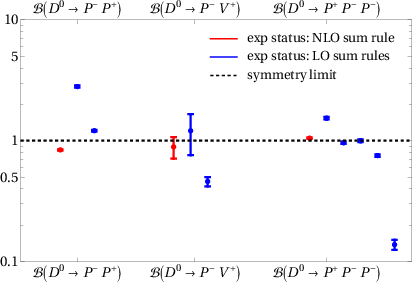
- The authors compare the master sum rule to available measurements in many charm decay systems and find it is well satisfied.
- In some familiar cases, simple first-order symmetry relations fail badly (for example, a rate ratio might be as far from 1 as 2.8), but the second-order sum rule comes much closer (like ~0.84), showing it’s much more reliable.
- When some decay rates are not yet measured, the master sum rule lets them predict the missing values (or at least set strong limits).
Why is this important?
- Reliable checks of the Standard Model:
- These sum rules are clean tests that don’t depend on complicated modeling. If experiments ever find strong violations (beyond the expected small second-order corrections), it could point to new physics (something beyond the Standard Model) or to unexpectedly large symmetry breaking in the strong force.
- Better understanding of symmetry breaking:
- By focusing on “second-order safe” combinations, the paper shows how to separate big, obvious effects from small, subtle ones—making the predictions more trustworthy.
- Practical impact for experiments:
- The sum rule helps fill in missing data by predicting unmeasured branching fractions.
- It guides which measurements to prioritize and how to cross-check results across different decay channels.
- Broader toolkit:
- The authors provide general methods (combining symmetry arguments with the Shmushkevich counting trick) that can be used for other flavor symmetries and processes, not just charm decays.
In short: the paper presents a strong, universal balancing rule for charm decays that stays accurate even when a key symmetry is only approximate. It passes real-world tests, helps predict missing measurements, and offers a robust way to probe both the strong force and potential new physics.
Knowledge Gaps
Knowledge gaps, limitations, and open questions
The following points summarize what remains missing, uncertain, or unexplored, highlighting concrete directions for future work:
- Quantification of the expansion parameter: No estimate is provided for the effective energy scale Λ controlling the -spin-breaking expansion (and hence the size of ), nor a data-driven strategy to determine Λ for different charm decay systems.
- Analyticity assumptions: The method assumes observables are analytic in quark masses near the symmetric point; the domains of validity and potential breakdowns due to thresholds, resonances, or non-analytic kinematic effects are not assessed.
- CKM-free observables in realistic weak Hamiltonians: The construction relies on “CKM-free” rates and the assumption that a single irrep dominates the weak Hamiltonian; there is no systematic treatment for cases where multiple CKM structures and/or multiple irreps contribute (e.g., SCS channels with interfering CKM factors), nor an error budget for the CKM division.
- Electromagnetic (EM) and charge constraints: Although the symmetry argument is claimed to generalize to arbitrary breaking sources, the paper does not provide a systematic prescription to construct and test sum rules in weak isospin or -spin systems where forbids certain conjugate channels, or to include EM corrections quantitatively.
- Scope limited to observables ∝ |A|²: The Shmushkevich-based construction is confined to observables proportional to squared amplitudes; extensions to CP asymmetries, interference-sensitive observables, and differential/angular distributions are not developed.
- Identical multiplets beyond the special case: The handling of identical irreps in the final state is only worked out for the case where the irrep used in the master equation has multiplicity ; a general combinatorial framework for (including corrected symmetry/multiplicity factors for integrated rates) is missing.
- Completeness of sum rules: It is acknowledged that Shmushkevich master equations do not guarantee a complete set of linearly independent symmetry-limit sum rules; a systematic method to derive all independent second-order rate sum rules for arbitrary systems is deferred to a future publication.
- Kinematic and phase-space effects: The paper highlights large kinematic distortions (e.g., phase-space factors) but does not provide a quantitative scheme to incorporate or correct for kinematic breaking in the second-order sum rules, nor to separate kinematic from dynamical -spin breaking.
- Error estimation and statistical testing: There is no framework to estimate the size of the residual corrections, propagate experimental uncertainties (including correlations), or perform rigorous consistency tests of the sum rules across multiple systems.
- Breadth of empirical validation: Claims of good agreement are qualitative; comprehensive tests across a broader range of charm decays (multi-body, baryonic modes, neutral-meson mixing effects) and identification of outliers or tensions are not presented.
- Generalization beyond charm: Despite the formal generality, systematic applications and tests to bottom or strange decays, or to strong processes, are not explored.
- Final-state interactions (FSI) and rescattering: The impact of FSI on the decomposition, the effective energy scale, and higher-order breaking terms is not quantified.
- Precise definition of CKM-free rates: The paper references a formal definition (Eqs. referenced but not shown in the provided text) without detailing normalization choices, treatment of neutral-meson mixing (e.g., –), or CPV effects in constructing CKM-free quantities.
- Mapping quark-level breaking to hadron-level inputs: There is no quantitative bridge from to hadron-level masses/decay constants/lattice-QCD inputs, nor an assessment of scheme dependence in quark-mass definitions.
- Diagnostic criteria for breakdown: No practical criterion is offered to diagnose when second-order relations fail (e.g., due to large breaking or non-analytic behavior) or to identify the dominant physical sources of deviations in data.
- Channels with missing or forbidden conjugates: Beyond brief comments, there is no general construction for handling systems where conjugate channels are kinematically or charge forbidden (e.g., via inclusion of singlets), with worked-out weak-decay examples.
- Resonant substructure in multi-body decays: Guidance is lacking on how to classify quasi-two-body resonant contributions under , aggregate over subchannels, and test sum rules in the presence of significant resonance dynamics.
- Beyond second order: While higher-order amplitude relations exist in the literature, the paper does not outline how to derive and test third-order (or resummed) rate sum rules, or when they might be necessary.
- Quantitative EM isospin breaking in charm: No estimates are provided for expected deviations due to EM isospin breaking (e.g., charged vs. neutral kaons/pions) within charm decays to benchmark the second-order sum rules.
- Cross-family consistency checks: The tension between reported large SU(3)F breaking in B decays and smaller breaking compatible with second-order relations is noted but not reconciled; comparative analyses across families (D vs. B) are absent.
Practical Applications
Immediate Applications
Below is a concise set of actionable use cases that can be deployed with current data and tooling. Each item notes relevant sectors and feasibility assumptions.
- Charm-decay rate prediction and completion (academia; HEP experiments)
- Use the master second-order sum rule to predict or bound unmeasured CKM-free rates within any U-spin–related charm-decay family (CF/DCS/SCS), and to cross-check reported branching fractions.
- Workflow: ingest PDG averages and experiment-specific branching ratios, divide out CKM factors to form CKM-free rates, apply the sum rule “(CF + DCS) / (SCS) ≈ 1”, propagate uncertainties, report missing-rate intervals.
- Tools/products: a lightweight Python package or Jupyter notebook for CKM-free normalization, family selection, and prediction; integration with HEPData/PDG tables.
- Assumptions/dependencies: dominance of a single U-spin irrep in the weak Hamiltonian for the chosen system; completeness of the U-spin family under d↔s exchange; reliable CKM inputs; manageable phase-space/kinematic differences; analytic behavior near the symmetry point; second-order breaking not pathologically large.
- Data-quality and consistency audits for charm analyses (software; academia; HEP experiments)
- Use the second-order sum rule as a physics-informed QA check: flag datasets or efficiency corrections that drive (CF + DCS)/SCS far from unity across related channels.
- Workflow: pre-fit and post-fit validation steps add the sum-rule residual and its uncertainty to analysis dashboards; identify outlier channels and potential systematic mis-modeling.
- Tools/products: analysis “lint” plugin (e.g., for ROOT/RooFit/EOS) that computes sum-rule residuals; a CI step in collaboration pipelines (LHCb, Belle II, BESIII).
- Assumptions/dependencies: correct treatment of CKM factors; channel completeness; consistent treatment of identical multiplets and phase-space; well-estimated efficiencies.
- Prioritization of measurements in experimental programs (policy; academia; HEP experiments)
- Use the rule to rank unmeasured SCS (or CF/DCS) channels whose determination would close high-impact U-spin families and improve global constraints, thereby informing run-planning and resource allocation.
- Workflow: an internal planning tool that scores channels by leverage on the sum-rule closure and uncertainty reduction.
- Assumptions/dependencies: stable detector performance projections; feasibility of reconstructing targeted modes; collaboration agreement on prioritization metrics.
- Constraint-enhanced global fits of charm amplitudes (academia; software)
- Introduce second-order sum-rule constraints as soft penalties in global amplitude fits to reduce hadronic-parameter degeneracies and stabilize solutions when first-order relations are badly broken.
- Workflow: add a quadratic penalty term to fit likelihoods enforcing the symmetric combinations from Shmushkevich’s construction; compare fit stability and uncertainty budgets.
- Tools/products: fit-constraint modules for common HEP frameworks (e.g., GooFit, EOS, flavio) with SU(2)F-aware options.
- Assumptions/dependencies: robust uncertainty quantification for U-spin breaking; transparent weighting so constraints don’t bias genuine anomalies.
- Generator and model tuning (software; HEP experiments)
- Include CKM-free second-order constraints in tuning EvtGen/Pythia charm decay models (including rescattering/hadronization parameters), improving data–MC agreement in U-spin families even when first-order relations fail.
- Workflow: augment generator tuning objectives with sum-rule residuals; cross-check tunes across CF/DCS/SCS groups.
- Assumptions/dependencies: generators expose relevant parameters; consistent treatment of kinematics and identical multiplets; sufficient statistics.
- SU(2)F–aware inclusive cross-section checks in strong processes (academia; nuclear/particle physics)
- Apply the Shmushkevich method to isospin or V-spin in strong scattering to verify that inclusive observables summed over all but one m-quantum number are m-independent in the symmetry limit; use as a sanity check on existing scattering datasets.
- Tools/products: scripts to compute inclusive sums and compare across m values.
- Assumptions/dependencies: near-symmetric kinematics and negligible EM/QED breaking for the symmetry in question; accessible final-state multiplicities and phase-space integrals.
- Instructional materials and training (education)
- Develop course modules and interactive notebooks illustrating the symmetry argument (second-order persistence under a↔b exchange) and the Shmushkevich method, linked to real charm-decay data exercises.
- Assumptions/dependencies: curated datasets; didactic examples with clear CKM normalization.
Long-Term Applications
The following ideas require additional research, scaling, or ecosystem development before routine deployment.
- Model-independent diagnostics for new physics in charm (academia; HEP experiments)
- Use systematic deviations from the master second-order sum rule across many U-spin systems as a robust, symmetry-based anomaly indicator complementary to CP-violation and mixing measurements.
- Workflow: aggregate multi-channel residuals into an anomaly score; correlate with other observables in global new-physics fits.
- Assumptions/dependencies: broad coverage of charm modes; well-understood SM breaking scales and kinematic effects; control of experimental systematics.
- Flavor-symmetry–aware machine learning (software; HEP experiments; education)
- Embed SU(2)F constraints and symmetric combinations in ML loss functions (physics-informed learning), improving sample efficiency and generalization in amplitude analyses and event classification.
- Tools/products: differentiable sum-rule layers for PyTorch/JAX; examples in physics ML benchmarks.
- Assumptions/dependencies: differentiable CKM-free normalization; careful treatment of correlated systematics; adoption in collaborations.
- Comprehensive SU(2)F/SU(3)F sum-rule libraries (software; academia)
- Build an open-source framework that automates construction and application of higher-order rate and amplitude sum rules (including handling identical multiplets and combinatorics) for charm and beyond (B decays, strange decays, hadronic scattering).
- Assumptions/dependencies: validated group-theory backends; community governance; sustained maintenance.
- Lattice QCD calibration and interplay (academia)
- Use empirical satisfaction levels of second-order sum rules to infer effective U-spin breaking scales and benchmark lattice determinations of hadronic matrix elements in charm decays.
- Workflow: joint fit of lattice results and experimental CKM-free rates under symmetry constraints.
- Assumptions/dependencies: precise lattice computations at physical quark masses; consistent matching to experimental observables.
- Event-generator architecture upgrades (software; HEP experiments)
- Incorporate amplitude-level implementations of second-order SU(2)F constraints into decay modules, ensuring symmetry-consistent parameterizations and improved hadronization modeling.
- Assumptions/dependencies: re-design of generator components; validation against extensive datasets; efficient handling of identical-particle combinatorics.
- Precision CKM and charm mixing fits (academia)
- Leverage reduced hadronic uncertainties from second-order constraints to enhance determinations of CKM elements and charm mixing/CPV parameters, once a broad set of channels is consistently modeled.
- Assumptions/dependencies: comprehensive global fits; consensus on treatment of symmetry breaking and kinematics.
- Extension to other sectors and symmetries (academia; nuclear/particle physics)
- Generalize methods to SU(3)F and mixed-symmetry systems (including EM/QED breaking), and to strong/weak processes in baryonic channels and heavy-ion contexts, providing inclusive-sum diagnostics and second-order relations in broader datasets.
- Assumptions/dependencies: theoretical development of higher-order breaking terms; experimental access to complete channel families.
- Advanced computational group-theory tooling (software; academia)
- Develop efficient algorithms (potentially leveraging quantum or specialized linear-algebra hardware) for Clebsch–Gordan bookkeeping and automated derivation of higher-order amplitude/rate sum rules at scale.
- Assumptions/dependencies: maturing hardware/software stacks; collaboration between HEP phenomenologists and computational physicists.
Notes on overarching assumptions and dependencies:
- CKM-free observables require accurate CKM inputs and isolation of the dominant SU(2)F irrep in the weak Hamiltonian.
- The symmetry argument relies on analyticity near the symmetric point and completeness of the U-spin–related channel set under d↔s exchange.
- Second-order persistence holds when symmetric combinations are used; large kinematic differences, EM effects, or unexpected dynamics may inflate effective breaking beyond nominal expectations.
- Handling identical multiplets in integrated observables must carefully apply symmetry and multiplicity factors; simplified cancellations occur when the Shmushkevich equation is written for an irrep with multiplicity one in the system.
Glossary
- amplitudes-squared: Squared magnitudes of quantum-mechanical amplitudes that determine probabilities/rates of processes. "observables proportional to amplitudes-squared."
- branching fraction: The probability that an unstable particle decays into a specific final state, relative to all decays. "we use the master sum rule in Eq.~\eqref{eq:master-intro} to set limits on the unmeasured branching fractions."
- Cabibbo-favored (CF): Charm-decay channels enhanced by the Cabibbo angle, carrying the largest CKM factor in a given -spin set. "Here, CF, SCS, and DCS denote Cabibbo-favored, singly Cabibbo-suppressed, and doubly Cabibbo-suppressed channels, respectively."
- CKM factors: Elements or products of the Cabibbo–Kobayashi–Maskawa quark-mixing matrix that weight weak amplitudes. "CKM factors generally spoil Eq.~\eqref{eq:sigma_conj_condition}."
- CKM-free rates: Decay rates with the CKM factors divided out to isolate hadronic dynamics and symmetry relations. "CKM-free rates refer to rates where the respective CKM factors are divided out"
- CKM-normalized rates: Rates rescaled by dividing out CKM factors; often denoted with a hat, such as . "ratios of CKM-normalized rates, "
- Clebsch--Gordan coefficients: Group-theory coefficients that couple angular momenta (or isospin/flavor irreps) in quantum mechanics. "The key technical inputs of the derivation are the orthogonality and completeness of Clebsch--Gordan coefficients"
- combinatorial factors: Multiplicity factors arising from counting identical-particle assignments or permutations in summed/integrated observables. "translating momentum-labeled sum rules into relations among integrated physical observables can, in general, introduce combinatorial factors."
- conjugate channel: The -related channel obtained by exchanging the two flavors in all external states and the Hamiltonian. "an -conjugate channel "
- direct CP asymmetries: Differences in decay rates of a process and its CP-conjugate that originate directly from the decay amplitude (not mixing). "the direct CP asymmetries of and "
- differential cross sections: Cross sections resolved as functions of kinematic variables (e.g., angles, energies) before phase-space integration. "differential or integrated cross sections"
- doubly Cabibbo-suppressed (DCS): Charm-decay channels suppressed by two powers of the Cabibbo angle, carrying the smallest CKM factor in a -spin set. "Here, CF, SCS, and DCS denote Cabibbo-favored, singly Cabibbo-suppressed, and doubly Cabibbo-suppressed channels, respectively."
- effective Hamiltonian: A reduced operator description that encapsulates short-distance weak interactions relevant for hadronic processes. "when a single irrep dominates the effective Hamiltonian"
- flavor symmetry: An approximate symmetry relating quark flavors (e.g., isospin, -spin, -spin) used to derive relations among processes. "approximate flavor symmetries of QCD"
- hadronization: The nonperturbative process by which quarks and gluons form hadrons. "independent of a model of hadronization"
- inclusive cross sections: Cross sections summed over a specified set of final states or quantum numbers, not fully exclusive in the final state. "exclusive and inclusive hadronic cross sections"
- inclusive observable: An observable formed by fixing one quantum number and summing over the others across channels in a symmetry-related set. "We refer to as an inclusive observable"
- integrated observables: Physical quantities obtained after integrating over final-state phase space (e.g., total rates/cross sections). "In the presence of identical irreps in the final state, i.e.,~irreps that correspond to the same particle multiplet, translating momentum-labeled sum rules into relations among integrated physical observables can, in general, introduce combinatorial factors."
- irrep (irreducible representation): An indivisible representation of a symmetry group that classifies states/operators under that symmetry. "when a single irrep dominates the effective Hamiltonian"
- isospin: An flavor symmetry relating up and down quarks, often used to classify hadronic processes. "including isospin, -spin, and -spin."
- kinematic effects: Effects arising from phase space and momentum distributions rather than underlying dynamics, which can distort simple symmetry predictions. "large deviations at the level of rates can arise from kinematic effects even when the underlying amplitude-level breaking is moderate."
- : The characteristic energy scale of Quantum Chromodynamics where the coupling becomes strong. "It is common to take the relevant scale to be of order "
- Lund model: A phenomenological model of string fragmentation used to describe hadronization. "A qualitative understanding of this effect can be obtained in the Lund model"
- -quantum numbers (QNs): The magnetic (third-component) quantum numbers labeling the states within an multiplet. "Each process in the system can be labeled by listing -quantum numbers (QNs)"
- master sum rule: A universal relation among CKM-free rates in a symmetry-related set that holds up to specified order in symmetry breaking. "we show that the following master sum rule is universal for arbitrary systems of weak charm decays"
- multiplet: A set of particles or states that form an irrep of a symmetry group and are transformed into each other by the symmetry. "identical multiplets"
- multiplicities: The counts of how many particles occupy each component of a given multiplet in a final state. "one specifies multiplicities for each irrep "
- phase space factor: A kinematic factor from the available final-state momentum configurations that influences decay rates. "phase space factor that scales like the momenta of the outgoing kaon to the third power"
- representation theory (of ): The mathematical framework describing how states and operators transform under the symmetry group. "in the general language of representation theory."
- : A generic flavor symmetry (e.g., isospin, -spin, -spin) relating two quark flavors. "any flavor symmetry"
- : The flavor symmetry relating the light quarks , often approximately realized in hadron physics. "SU(3) breaking"
- sum rule: A linear relation among observables (e.g., rates) implied by a symmetry, often tested against data. "rate sum rule"
- symmetric point: The point in parameter space where the symmetric limit holds (e.g., equal quark masses). "the symmetric point "
- symmetry breaking: Deviation from an exact symmetry due to parameters like quark-mass differences or electromagnetic effects. "symmetry breaking is controlled by the quark-mass difference"
- symmetry factor: The factor that corrects for overcounting due to identical particles when integrating over phase space. "the corresponding symmetry factor is"
- symmetry-limit: The idealized scenario where the symmetry is exact and symmetry-breaking parameters are set to zero. "symmetry-limit sum rules"
- Standard Model (SM): The quantum field theory describing known elementary particles and their interactions (excluding gravity). "within the Standard Model any system of hadronic weak charm decays related by -spin satisfies the following rate sum rule:"
- Shmushkevich method: A group-theoretic technique that yields symmetry-limit relations among cross sections/rates by summing over quantum numbers. "The Shmushkevich method"
- Shmushkevich master equation: The core result of the Shmushkevich method stating that certain inclusive observables are independent of the fixed -quantum number in the symmetry limit. "The Shmushkevich master equation ... states that, in the exact symmetry limit, is independent of "
- : The gauge symmetry of electromagnetism; charge conservation under this symmetry can forbid some -related channels. "forbidden by "
- -spin: An flavor symmetry interchanging and quarks; used to relate and constrain charm decays. "In the case of -spin, symmetry breaking is controlled by the quark-mass difference"
- -spin: An flavor symmetry interchanging and quarks. "including isospin, -spin, and -spin."
- quark-mass difference: The mass difference between two quark flavors that controls symmetry breaking. "symmetry breaking is controlled by the quark-mass difference"
- singly Cabibbo-suppressed (SCS): Charm-decay channels suppressed by one power of the Cabibbo angle, with intermediate CKM weight. "Here, CF, SCS, and DCS denote Cabibbo-favored, singly Cabibbo-suppressed, and doubly Cabibbo-suppressed channels, respectively."
Collections
Sign up for free to add this paper to one or more collections.