A diffusion approximation for systems with frequent weak resetting
Abstract: We develop a diffusion approximation for systems subject to fast random resetting by small amplitudes. Equivalently, this describes systems with frequent but small catastrophes. We demonstrate the validity of the approximation by computing the stationary distribution and mean first-passage times of simple one-dimensional systems. The approximation captures dynamically induced correlations in multi-particle systems, and it can be used to generalise the conditionally independent and identically distributed structure recently found in systems with full resetting. Finally, we show that resetting can induce cycles and patterns, which can be characterised using the diffusion approximation.
Paper Prompts
Sign up for free to create and run prompts on this paper using GPT-5.
Top Community Prompts
Explain it Like I'm 14
What this paper is about
This paper studies systems that occasionally “reset” — they jump back toward where they started. Think of:
- A searcher who keeps returning close to home to try again.
- A population that sometimes suffers a mild “catastrophe,” losing a small fraction of individuals.
- Many particles that all get nudged closer to the center at the same random times.
The authors focus on the special case where resets are very frequent but very small. They show how to replace this rapid sequence of tiny jolts by a smoother kind of randomness, so the system can be described by a simpler, continuous model.
The main questions
In simple words, the paper asks:
- If a system gets lots of tiny resets, can we approximate this by smooth random noise instead of modeling each reset one by one?
- Does this approximation predict what the system looks like in the long run, and how long it takes to reach certain goals (like finding a target)?
- In many-particle systems, do simultaneous resets create hidden connections (correlations) between particles that otherwise move independently?
- Can random, small catastrophes produce regular cycles or spatial patterns, even when the basic system would not show them?
How they approached it
Imagine riding a bike over a road with many very small bumps. Instead of tracking each bump, you can describe the ride as a smooth vibration. That’s the core idea here.
- Frequent small resets are like those tiny bumps. The authors “smear out” their effect into a smooth random wiggle (called “Gaussian noise”).
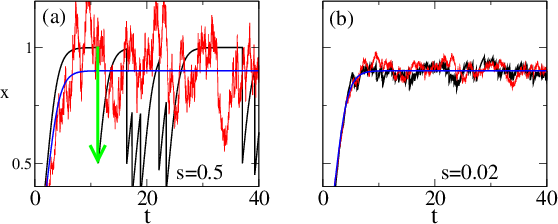
- They start from the full, exact description of the system (which keeps track of every reset) and use a standard math trick (called a Kramers–Moyal expansion) to show that, when resets are very small but very frequent, the system behaves like it follows a “stochastic differential equation” (an SDE). An SDE is a recipe that says: the system moves with a certain push (the drift) plus a random wiggle (the noise).
- In this SDE:
- The average effect of the resets shows up as a steady push downward (like a gentle braking).
- The random timing of resets shows up as extra noise whose strength scales like the square root of “how often times how strong” each reset is.
They then test this approximation in several settings:
- A simple one-dimensional system (like a population that grows but suffers small, frequent losses).
- A search problem (a random walker trying to reach a target with partial resets).
- Many particles that all reset together.
- A population model built from individual births and deaths plus catastrophes.
- Predator–prey dynamics and a spatial plankton–herbivore model, looking for cycles and patterns.
What they found (and why it matters)
- Frequent small resets ≈ smooth noise
- The diffusion (smooth) approximation accurately reproduces:
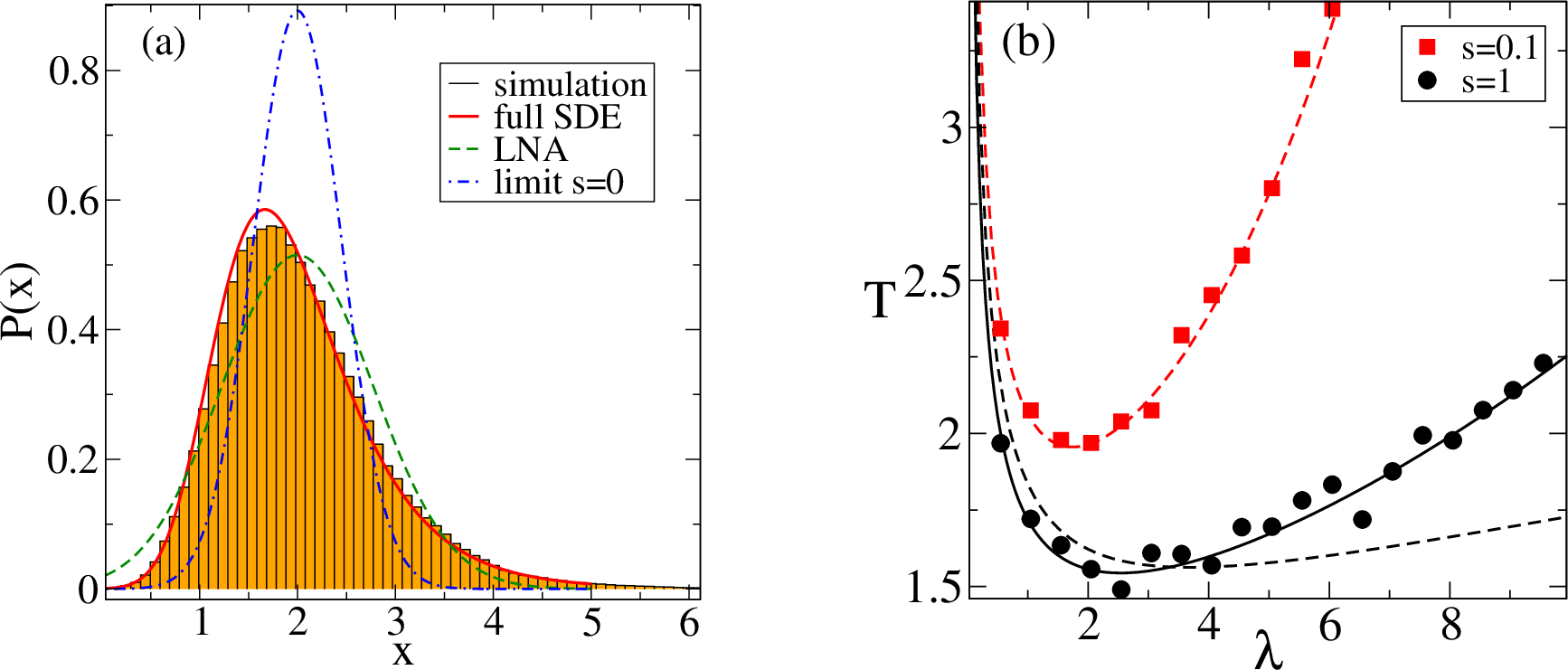
- The stationary distribution (the long-run spread of possible states).
- Mean first-passage times (e.g., how long it takes a searcher to reach a target).
- Even when the exact solutions are hard, the approximation stays simple and useful.
- The diffusion (smooth) approximation accurately reproduces:
- Optimal search with partial resets
- In a classic “reset to start” search problem, there is a best reset rate that minimizes the average search time.
- The diffusion approximation (for small partial resets) captures this effect and predicts the optimal behavior well.
- Hidden correlations in many-particle systems
- If many particles move independently but are all reset at the same random times, they become correlated (their behaviors are linked), even without directly interacting.
- In the approximation, this shows up as a single “common noise” term affecting all particles at once — like one school bell making every student stop at the same time.
- This generalizes a known structure from full resets to the more realistic case of partial, frequent small resets.
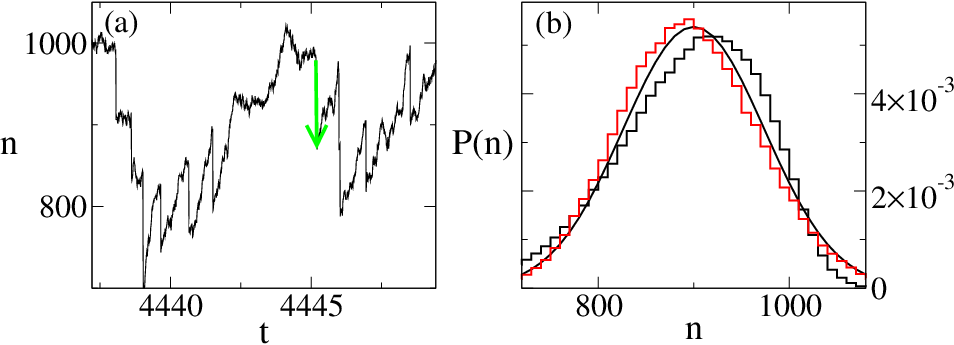
- Individual-based population with catastrophes
- The authors combine two noise sources:
- Intrinsic noise: randomness from individual births and deaths.
- Extrinsic noise: randomness from the timing and size of catastrophes.
- Their approximation matches simulations well and separates the two noise sources cleanly, showing how each contributes to the overall variability.
- The authors combine two noise sources:
- Resetting-induced cycles and patterns
- Even if the “no-reset” version of a system settles calmly to a steady state, frequent small catastrophes can create:
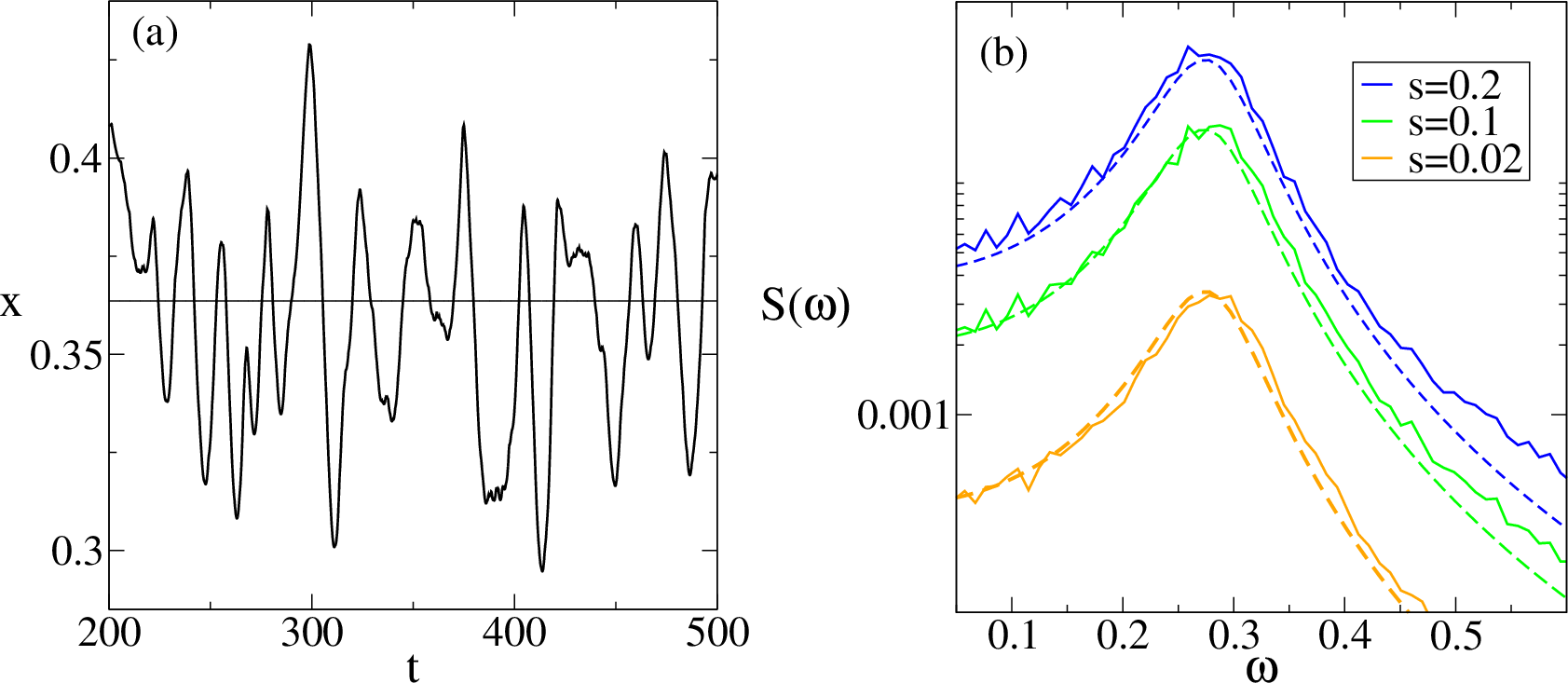
- Quasi-cycles: ongoing oscillations driven by the noise from resets.
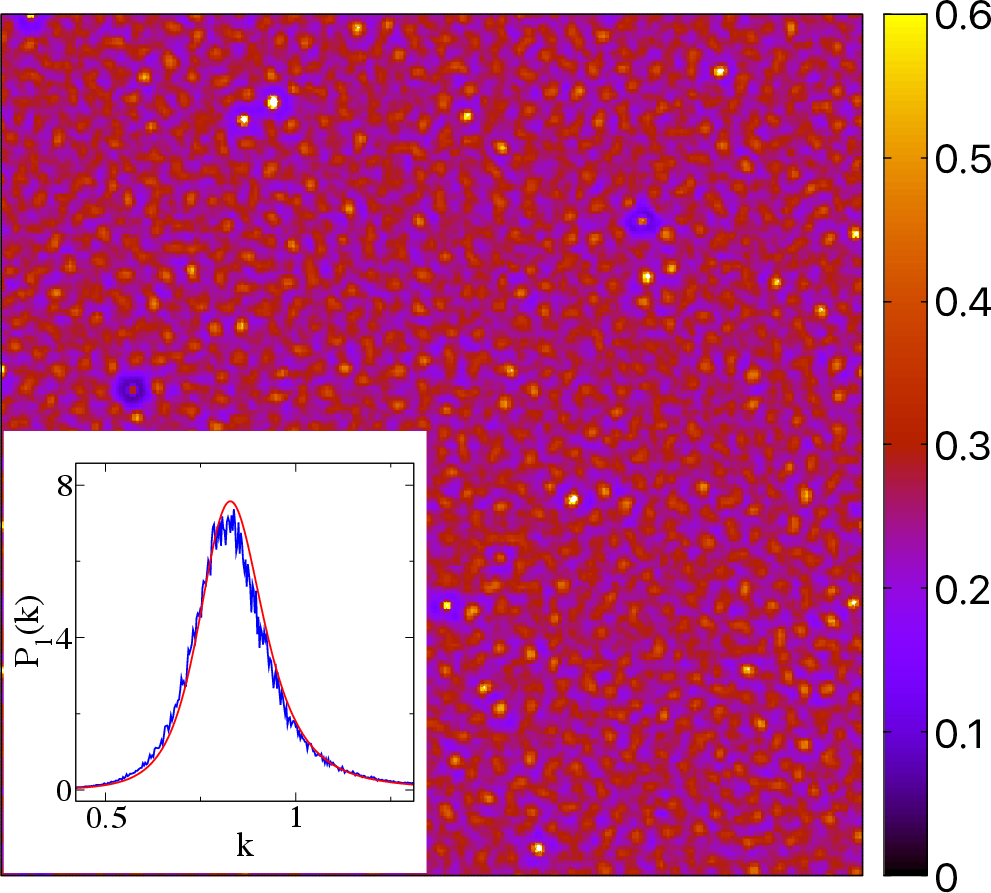
- Quasi-patterns: spatial patterns (like patches or stripes) that arise from the same effect.
- The approximation not only predicts that these appear but also quantifies their size and where they’re strongest.
- Even if the “no-reset” version of a system settles calmly to a steady state, frequent small catastrophes can create:
Why this is useful
- It turns a complicated “lots of tiny jumps” system into a simpler “smooth randomness” system. That makes it much easier to analyze and understand.
- It works across different fields: physics (particles), ecology (populations), search problems, and more.
- It clarifies when and how shared external events (like resets or shocks) create collective behavior in systems whose parts don’t directly interact.
- It suggests new experiments: because the approximation predicts clear signatures (like optimal reset rates or noise-driven cycles), these can be tested in labs (for example, with trapped particles) or observed in nature (like in population data).
Takeaway
When resets are frequent and small, you can replace the messy details of every jolt by a neat, smooth-noise description. This diffusion approximation is accurate, powerful, and reveals new phenomena — like emergent correlations, optimal search strategies, and noise-driven cycles or patterns — that might otherwise be hard to see or calculate.
Knowledge Gaps
Knowledge gaps, limitations, and open questions
The following list summarizes what remains missing, uncertain, or unexplored in the paper and suggests concrete directions for future work:
- Regime of validity and error bounds: No rigorous quantification of the approximation error of the diffusion limit (e.g., strong/weak error) as a function of , , drift , and ; derive bounds and next-order corrections to the SDE/Fokker–Planck truncation.
- Moderate/large reset sizes: The theory targets ; develop controlled expansions or alternative approximations for intermediate and connect smoothly to the (full-reset) regime.
- State-dependent reset rate and amplitude: While and are mentioned, a full derivation and validation of the effective SDE when and vary strongly with (including additional drift terms from spatial derivatives) is not provided.
- Non-Poissonian resetting: The diffusion approximation is developed for Poisson resets; extend to general renewal processes (e.g., heavy-tailed inter-reset times) and determine whether colored or non-Markovian effective noise arises.
- Distributed reset sizes: The End Matters note an extension, but a systematic treatment (including benchmarks) for nontrivial reset-size distributions (variance, skewness) and their impact on drift/noise terms and higher Kramers–Moyal coefficients is missing.
- Boundary and constraint handling: The mapping to an SDE with multiplicative noise does not address absorbing/reflecting boundaries or positivity constraints (e.g., in populations); clarify boundary conditions and positivity-preserving schemes in the diffusion limit.
- Tail behavior and rare events: Diffusive approximations can misrepresent large deviations generated by rare but finite-amplitude resets; quantify how stationary tails and first-passage-time tails differ between the jump process and the SDE.
- Stochastic-calculus interpretation: The SDE is stated in Itô form; provide a derivation clarifying why Itô is the correct interpretation here and assess if alternative interpretations (e.g., Stratonovich) produce different “spurious” drift terms in practical implementations.
- Vector-valued processes: Generalization to multi-dimensional single-particle systems with vector and direction-dependent resets is not analyzed; derive the full noise covariance and drift structure for vector .
- Interacting multi-particle dynamics: The multi-particle section assumes independent motion between resets; investigate how interactions (e.g., exclusion, coupling through potentials) modify the common-noise-induced correlations and CIID-like structure.
- Heterogeneous/synched reset structures: Only perfect global synchrony (simultaneous resets of all particles) and constant are considered; study partial synchrony, subgroup resets, and particle-dependent or state-dependent reset rates, and their effect on correlation structure.
- Full correlation structure under partial resetting: Beyond one illustrative correlator, a general characterization (e.g., joint generating function, spacing distributions, extremal statistics) of multi-particle correlations in the partial-reset regime remains open.
- Optimal search with partial resetting: For the first-passage problem, obtain closed-form or systematic approximations for the optimal reset intensity when $0
- Individual-based populations: Extinction metrics (mean time to extinction, quasi-stationary lifetimes) under frequent weak catastrophes are not analyzed; derive scaling laws in and test against simulations.
- Inference and identifiability: No methodology is given to infer (and ) from time-series data under the diffusion approximation; develop parameter estimation and identifiability analyses using, e.g., spectra, moments, or likelihoods.
- Resetting-induced cycles: Only linearized spectra are presented; derive amplitude equations, nonlinear saturation, and phase diagrams for noise-induced oscillations, including how peak frequency and amplitude depend on away from the linear regime.
- Resetting-induced patterns: For the spatial model, provide analytic onset conditions (dispersion relation criteria) and phase diagrams for pattern formation versus ; analyze pattern selection and robustness beyond linear-noise approximations.
- Spatial structure of catastrophes: Resets are independent by patch; explore spatially correlated (regional/global) catastrophes and spatiotemporally structured reset fields, and quantify their impact on coherence and pattern wavelength.
- Multi-species resetting: Only prey/plankton are reset in examples; examine simultaneous or differential resetting across species and the resulting changes in cycle/pattern properties and stability.
- Numerical schemes and positivity: Practical SDE simulation with multiplicative noise may break positivity; design and benchmark integrators that preserve constraints and accurately capture common-noise effects.
- Connection to non-Gaussian limits: If reset-size distributions are heavy-tailed or if event clustering is strong, the Gaussian limit may fail; assess conditions under which stable Lévy limits (or jump-diffusion limits) supersede the diffusion approximation.
- Time-dependent or history-dependent resetting: The framework does not treat nonstationary or history-dependent reset rules; extend the approximation to these cases and characterize resulting effective noises.
- Experimental tests: While plausibly testable, concrete experimental protocols and observables (e.g., scaling of spectral peak amplitude ∝√(λs), correlation diagnostics in multi-particle setups) are not detailed; design and propose such tests with error bars and required regimes.
Practical Applications
Below we translate the paper’s diffusion-approximation results for frequent weak resetting into practical, real-world applications. Each bullet specifies a concrete use case, its sector(s), and dependencies/assumptions that affect feasibility.
Immediate Applications
- Reset-aware simulation shortcuts for systems with frequent small shocks
- Sectors: software, operations research, physics/chemistry, ecology
- Application: Replace explicit “shot-noise” resets with the effective SDE dot x = ξ + f(x) − λ g(x) + √(λ s) g(x) η to simulate faster and analyze stationary distributions and first-passage times without modeling each discrete reset.
- Tools/workflows: Extend existing SDE solvers (e.g., in Python/Julia/Matlab) with a “resetting diffusion approximation” module; plug into Monte Carlo and agent-based simulators.
- Assumptions/dependencies: Small reset amplitude s ≪ 1 and high reset frequency r = λ/s; Poisson resets; known f(x), g(x), λ; validity of Itô interpretation.
- Optimal restart tuning in search and exploration procedures
- Sectors: robotics (search), logistics, software (algorithmic restarts), operations research
- Application: Use the approximate backward Fokker–Planck to compute mean first-passage times and choose near-optimal partial reset rate λ for minimizing search time (extending classic “optimal resetting” to partial resets).
- Tools/products: “ResetTune” library that recommends partial-reset configurations (λ, s, g) for searchers and restartable algorithms.
- Assumptions/dependencies: Random walk or drift-diffusion dynamics; partial resets modeled as x → x + s(x0 − x); small s; stationary target/location assumptions hold.
- Rapid analytics for resilience engineering with frequent small resets
- Sectors: cloud computing, microservices, networking
- Application: Model circuit breakers, autoscaling, and queue purges (frequent small state resets) with the diffusion approximation to forecast latency distributions and outage probabilities.
- Tools/workflows: Integrate SDE-based service-level forecaster into SRE dashboards; use stationary-distribution formulas for steady-state SLAs.
- Assumptions/dependencies: Reset events are frequent but small; resets act similarly across service instances (common extrinsic noise).
- Multi-agent correlation risk assessment under simultaneous resets
- Sectors: manufacturing (batch processes), finance (portfolio-wide rebalancing), experiments with trapped particles
- Application: Use common-noise SDE for multi-particle/asset dynamics to quantify emergent correlations caused by simultaneous partial resets; anticipate co-fluctuations in nominally independent units.
- Tools/products: “Correlation-from-Resets” diagnostic that estimates cross-moment inflation due to common resetting schedules.
- Assumptions/dependencies: Simultaneous resets impose a shared extrinsic noise η; proportional reset g(x) = x or known g; independence between entities between resets.
- Catastrophe-aware population modeling for harvest/culling and conservation
- Sectors: ecology, fisheries, wildlife management
- Application: Use the individual-based diffusion approximation to assess quasi-stationary distributions under frequent small culls (catastrophes), balancing demographic dynamics and intervention frequency.
- Tools/workflows: Lightweight policy simulator for cull schedules; linear-noise approximation for quick scenario planning.
- Assumptions/dependencies: Large population scale (Ω ≫ 1), small s, Poisson catastrophe arrival; quasi-stationary analysis when extinction is absorbing but rare on policy horizons.
- Forecasting reset-induced cycles in predator–prey systems
- Sectors: ecology, environmental monitoring
- Application: Predict quasi-cycles induced by extrinsic resets (e.g., periodic small harvests) using spectra S(ω) with amplitude scaling √(λ s), helping interpret oscillations not explained by intrinsic noise.
- Tools/products: “CycleScope” spectral analysis toolkit for time series under interventions.
- Assumptions/dependencies: Deterministic system stable at s = 0; small s; extrinsic noise dominates; accurate Jacobian around fixed point.
- Detection and control of reset-induced spatial patterns (patchiness)
- Sectors: marine ecology (plankton–herbivore), agriculture, environmental management
- Application: Predict and diagnose patchiness caused by frequent small local resets with spatial SDEs; choose intervention scales to suppress or leverage patterns.
- Tools/workflows: “PatternFinder” computing k-spectrum of fluctuations; GIS-linked spatial planners for local reset scheduling.
- Assumptions/dependencies: Discrete patches with independent local resets; diffusion approximation valid; parameters near homogeneous fixed point at s = 0.
- Experimental design and parameter inference for resetting systems
- Sectors: experimental physics (colloidal traps), biophysics
- Application: Fit λ and s from stationary distributions or spectra using the SDE approximation; plan experiments (reset timing and amplitudes) to elicit measurable signatures (e.g., correlations, cycles).
- Tools/workflows: SDE-based likelihoods for inference; experiment planners optimizing reset schedules.
- Assumptions/dependencies: Resetting protocol close to frequent small partial resets; accurate mapping of trap control to g(x).
- Operations research: queueing and inventory under frequent small batch adjustments
- Sectors: logistics, supply chain
- Application: Model restocking or purge events as partial resets to analyze steady-state performance and first-passage times (e.g., stockouts) more tractably.
- Tools/workflows: Incorporate extrinsic reset noise into diffusion approximations of queue/inventory processes.
- Assumptions/dependencies: High frequency, low amplitude adjustments; independence of internal arrival/service noise and extrinsic resets.
- Practical guidance for personal search and learning strategies
- Sectors: daily life, education
- Application: Use partial resets (brief task restarts) and tune their frequency to minimize time-to-solution or maintain focus, guided by mean first-passage time analyses.
- Tools/workflows: Habit-building apps implementing adaptive micro-restarts; time-management templates with calibrated reset rates.
- Assumptions/dependencies: Task dynamics approximable as drift-diffusion; partial resets do not incur large overhead.
Long-Term Applications
- Policy optimization for intervention schedules that avoid unintended cycles/patterns
- Sectors: ecology, public health, energy
- Application: Design small, frequent interventions (culling, localized restrictions, load-shedding) while constraining reset-induced cycles or spatial patchiness predicted by the diffusion approximation.
- Tools/products: Regulatory decision-support platform with spectral and spatial diagnostics.
- Assumptions/dependencies: Reliable mapping of interventions to g(x), λ; monitoring infrastructure to validate predicted patterns.
- Batch-reset design and scaling laws
- Sectors: manufacturing, finance, experimental physics
- Application: Extend to “batch resetting” protocols to tune the strength of emergent correlations; derive scaling rules for safe batch sizes and frequencies.
- Tools/workflows: Batch reset planners that optimize correlation-risk vs. throughput.
- Assumptions/dependencies: Further theory beyond frequent weak resets; empirical calibration for non-infinitesimal batches.
- Non-Poisson and state-dependent reset processes
- Sectors: control engineering, cyber-physical systems
- Application: Generalize the diffusion approximation to renewal or heavy-tailed resets and to λ(x), g(x) dependent on system state, enabling more realistic controllers.
- Tools/workflows: Extended SDE libraries with renewal-process drivers; hybrid control simulation stacks.
- Assumptions/dependencies: New derivations and validations; identification of regimes where Gaussian approximation still holds.
- Closed-loop controllers that modulate reset schedules using real-time spectra
- Sectors: smart grids, autonomous systems
- Application: Use online estimation of reset-induced cycle amplitudes to adjust λ and s in real time, keeping systems near desired operating points.
- Tools/products: “Reset-in-the-loop” controllers with spectral feedback.
- Assumptions/dependencies: Fast, robust spectral estimation; convexity or monotonicity of control-response.
- Toolchains for parameter estimation and hypothesis testing under extrinsic reset noise
- Sectors: academia (physics, ecology, chemistry), R&D
- Application: Standardize inference of λ, s, and g(x) from time series via diffusion models; provide goodness-of-fit tests for reset-induced phenomena vs. intrinsic noise.
- Tools/workflows: Statistical packages with likelihoods and diagnostics for reset-driven SDEs.
- Assumptions/dependencies: Adequate data volume; correct model specification and observability.
- Integration with machine learning for policy design under reset-induced dynamics
- Sectors: operations research, urban systems, logistics
- Application: Use ML surrogates trained on diffusion-approximation simulations to optimize intervention schedules (e.g., micro-purges, throttling) at scale.
- Tools/products: Digital twins that incorporate extrinsic-reset diffusion layers; reinforcement learning with reset-aware environment models.
- Assumptions/dependencies: High-fidelity simulation-to-real mapping; robustness to covariate shifts.
- Synthetic biology and chemical reaction networks with externally driven resets
- Sectors: biotech, pharmaceuticals
- Application: Engineer protocols that induce frequent small population/concentration resets (e.g., inducible expression toggles) and predict emergent cycles/patterns via diffusion approximations.
- Tools/workflows: Lab automation scripts that implement reset schedules; model-guided design of toggling intensity and cadence.
- Assumptions/dependencies: Valid extrinsic-Gaussian approximation in biochemical contexts; safe operational windows.
- Financial risk management for frequent small rebalancing and haircuts
- Sectors: finance
- Application: Model portfolio dynamics under systematic small rebalancing/haircuts as partial resets; quantify correlation buildup and tail risk through common-noise effects.
- Tools/products: Reset-aware portfolio simulators; correlation stress-testing modules.
- Assumptions/dependencies: Appropriate mapping of financial operations to g(x) and common-noise regime; calibration to market microstructure.
- Standards and best practices for experimental validation in resetting physics
- Sectors: metrology, experimental physics
- Application: Develop benchmarking protocols to test diffusion-approximation predictions (stationary distributions, first-passage times, correlation scaling) in colloidal traps and beyond.
- Tools/workflows: Shared datasets and open-source analysis pipelines compliant with reset-diffusion models.
- Assumptions/dependencies: Availability of high-resolution control over reset amplitude/frequency; reproducibility.
- Regulatory frameworks for resilience interventions that consider extrinsic-noise-induced phenomena
- Sectors: energy, telecommunications, environmental policy
- Application: Codify guidelines acknowledging that frequent small interventions can create correlations, cycles, or patchiness; embed diffusion-based analyses in approval and review processes.
- Tools/workflows: Policy review templates with reset-diffusion checklists and scenario analyses.
- Assumptions/dependencies: Institutional adoption; stakeholder education; access to modeling expertise.
Notes on general assumptions across applications:
- Frequent weak resetting: s is small and r = λ/s is large; the Gaussian approximation smears discrete shocks into extrinsic noise of strength √(λ s).
- Reset timing is typically Poisson; extensions to non-Poisson require additional theory.
- Multiplicative noise enters via g(x); choose g(x) consistent with physical reset mechanisms (e.g., proportional resets g(x) = x).
- The approximation is most reliable when single-event impacts are small compared to the characteristic scales of the underlying dynamics and when system sizes are large (for individual-based models).
- Correlations in multi-agent systems arise from shared extrinsic noise (simultaneous resets); if resets are not synchronized, common-noise effects weaken.
Glossary
- backward Fokker--Planck equation: The adjoint form of the Fokker–Planck equation used to compute observables like first-passage times by evolving backward in time. Example: "the corresponding backward Fokker--Planck equation."
- batch resetting: A reset protocol where many particles are reset simultaneously in a single event. Example: "multi-particle systems with batch resetting"
- chemical Langevin equation: A stochastic differential equation approximating discrete reaction dynamics with continuous Gaussian noise. Example: "The so-called `chemical Langevin equation' can then be derived"
- conditional independent and identically distributed (CIID): A property where variables are i.i.d. when conditioned on a shared history (e.g., reset times). Example: "an interesting `conditional independent and identically distributed' structure (CIID)."
- diffusion approximation: An approximation replacing frequent small jumps with effective Gaussian noise, yielding an SDE. Example: "We develop a diffusion approximation for systems subject to fast random resetting by small amplitudes."
- extrinsic noise: Fluctuations arising from external events acting on the system (e.g., resets), not from internal dynamics. Example: "extrinsic noise in systems with frequent small random resets or catastrophes"
- Fokker--Planck equation: A partial differential equation governing the time evolution of a probability density for diffusion processes. Example: "we find the following Fokker--Planck equation"
- Fourier transform: A transformation to frequency space used to analyze oscillations and spectra of linearized systems. Example: "We then carry out a Fourier transform, and obtain the power spectra of the fluctuations about the fixed point."
- Gaussian white noise: A zero-mean, delta-correlated stochastic process with Gaussian distribution of increments. Example: "Gaussian white noise variables,"
- Gillespie algorithm: An exact stochastic simulation method for reaction networks with discrete events and random timing. Example: "can be simulated using the Gillespie algorithm"
- impulsive dynamical systems: Systems with dynamics that include instantaneous jumps or impulses at discrete times. Example: "impulsive dynamical systems"
- intrinsic noise: Fluctuations generated by the system’s own stochastic mechanisms (e.g., births/deaths), not external forcing. Example: "It is well-known that intrinsic noise can generate quasi-cycles or patterns"
- Itô stochastic differential equation: An SDE interpreted in the Itô sense, where stochastic integrals are non-anticipative. Example: "This describes the It^o stochastic differential equation"
- Jacobian: The matrix of first derivatives of a vector field, used to linearize dynamics around fixed points. Example: "the entries of the Jacobian at the fixed point."
- Kolmogorov equation: A general evolution equation (master/forward form) for the probability distribution of a stochastic process. Example: "Kolmogorov equation for the distribution of at time ,"
- Kramers--Moyal expansion: A series expansion of the master equation in jump moments, leading to Fokker–Planck-type approximations. Example: "Carrying out a Kramers--Moyal expansion in "
- lattice Laplacian: The discrete Laplace operator on a spatial grid, modeling diffusion between neighboring sites. Example: "with the lattice Laplacian."
- Levin--Segel model: A reaction–diffusion model for plankton–herbivore dynamics exhibiting pattern formation. Example: "the Levin--Segel model of plankton-herbivore dynamics"
- linear-noise approximation: A Gaussian approximation around a deterministic fixed point where noise amplitudes are linearized. Example: "We can also carry out a linear-noise approximation"
- Lotka--Volterra system: A classical predator–prey dynamical system used to model interacting populations. Example: "We first look at a nonspatial two-species Lotka--Volterra system"
- master equation: An evolution equation for the probability distribution over discrete states with transition rates. Example: "We can write down the master equation for this system."
- mean first passage time: The expected time for a stochastic process to reach a specified target state for the first time. Example: "mean first passage time to reach the origin."
- non-Poissonian resetting: Resetting events whose inter-arrival times are not exponentially distributed. Example: "Poissonian and non-Poissonian resetting,"
- Poissonian resetting: Resetting events occurring as a Poisson process with exponentially distributed waiting times. Example: "Poissonian and non-Poissonian resetting,"
- power spectrum: The distribution of fluctuation power across frequencies in a time series. Example: "Power spectra of the predator time series"
- propagator: The transition probability (kernel) describing evolution from one state to another over time. Example: "single-particle propagator."
- quasi-cycles: Noise-sustained oscillations around a stable fixed point without deterministic limit cycles. Example: "quasi-cycles and quasi-patterns."
- quasi-patterns: Noise-induced spatial patterns around a stable homogeneous state. Example: "quasi-cycles and quasi-patterns."
- quasi-stationary distribution: The stationary distribution conditioned on not having reached an absorbing state (e.g., extinction). Example: "The quasi-stationary distribution of can be estimated analytically"
- shot noise: Fluctuations from discrete, random events (shocks) occurring in time. Example: "akin to shot noise."
- stationary distribution: A probability distribution that remains constant over time under the dynamics. Example: "The stationary distribution can be obtained with standard methods"
- stochastic differential equation (SDE): A differential equation including random noise terms to model stochastic dynamics. Example: "approximation as a stochastic differential equation (SDE) is possible for small ."
- stochastic resetting: Randomly returning a process to a reference state (fully or partially) at random times. Example: "Stochastic resetting can be interpreted as a series of discrete shocks, akin to shot noise."
- wavenumber: Spatial frequency (inverse length scale) characterizing periodic patterns or modes. Example: "as a function of the wavenumber ."
Collections
Sign up for free to add this paper to one or more collections.