- The paper introduces a Rust-accelerated Monte Carlo framework that enhances computational throughput for simulating Ising spin systems.
- It implements a comprehensive toolkit including single-spin-flip, cluster algorithms, and parallel tempering to ensure precise sampling near criticality.
- Results validate its accuracy against analytical benchmarks, demonstrating performance superiority over Python/NumPy approaches through optimized parallelism.
peapods: A Rust-Accelerated Monte Carlo Framework for Ising Spin Systems
Overview
The "peapods" package presents a substantive advance in the simulation of Ising spin systems, leveraging a hybrid Rust/Python architecture to combine high computational throughput with a flexible, ergonomic interface. The framework accommodates general coupling schemes on arbitrary-dimensional periodic hypercubic lattices. The Rust backend yields pronounced performance gains via memory safety, on-the-fly neighbor computation, and optimized parallelism with Rayon. All mainstream Monte Carlo and cluster algorithms are supported, as well as parallel tempering for enhanced ergodicity in complex energy landscapes. Core validation is performed via finite-size scaling of the Binder cumulant, affirming consistency with known analytical benchmarks for the two-dimensional Ising universality class.
Model and Coupling Flexibility
The package models the classical Ising Hamiltonian over hypercubic lattices:
H=−⟨i,j⟩∑Jijσiσj,
with arbitrary user-defined coupling constants Jij. Predefined distributions encompass homogeneous ferromagnetic, bimodal (±J Edwards–Anderson), and Gaussian disorder, with seamless extensibility to custom couplings via direct array input. Systems with R temperature replicas are natively supported; this is critical for advanced sampling schemes and for extracting temperature-resolved observables.
Single-spin-flip Monte Carlo algorithms, including Metropolis and Gibbs (heat bath), are efficiently realized, with analytic optimizations avoiding computational bottlenecks such as redundant exponential evaluations. Cluster algorithms (Swendsen–Wang and Wolff) are implemented with full support for bond activation based on local satisfaction, union-find data structures, and probabilistic cluster flipping, thus ensuring correct sampling near criticality and efficient decorrelation.
Parallel tempering is integrated at the system core: configuration exchanges between neighboring temperature replicas are performed using an in-place swap via a system_ids permutation vector, eliminating extraneous array copies and cache fragmentation. This feature is especially consequential for sampling in rugged free energy landscapes and for studies involving spin glasses.
Implementation Details and Parallelism
The Rust-based core achieves both memory efficiency and computational speed by:
- Storing all spin and coupling information in contiguous memory,
- Computing neighbors on-the-fly using modular arithmetic and row-major strides, thereby circumventing the need for expensive neighbor tables,
- Allocating buffers and PRNGs per replica and per thread for safe parallelism.
Rayon is employed to parallelize over temperature replicas, including MC sweeps and energy/conformation measurements. Only parallel tempering itself remains inherently sequential, but as argued, this operation is negligible in overall runtime scaling.
Validation: Consistency with Critical Phenomena
The implementation is validated computationally by studying the Binder cumulant UL across system sizes in the standard 2D ferromagnetic Ising model. As expected, UL curves for different lattice sizes cross at the exact Onsager temperature Tc≈2.269, with all numerical curves intersecting near U≈0.61. This confirms that the sampling and observable computations are faithful to theoretical prediction.
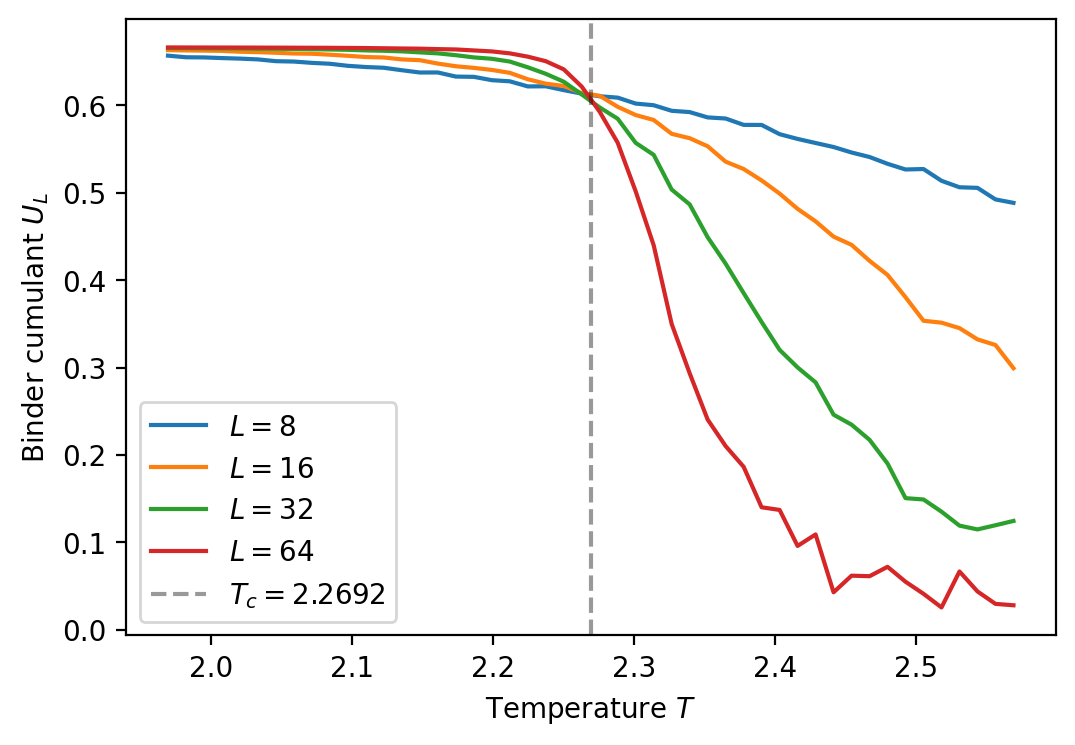
Figure 1: Binder cumulant UL vs. temperature for several lattice sizes, showcasing precise crossing at the known 2D Ising critical point Tc≈2.269 and the universal Binder cumulant value Jij0.
Performance metrics, while not quantified in the body of the paper, are discussed by noting substantial performance superiority over canonical Python/NumPy implementations across all update schemes. Key bottlenecks of existing approaches are mitigated:
- All inner loops are eliminated from the Python layer,
- Temporary allocations are minimized,
- Random number generation utilizes Xoshiro256**, outpacing default NumPy generators,
- Cluster update bottlenecks due to Python-level iteration are fully removed.
These elements collectively enable scalable, efficient simulation on commodity desktop or server hardware.
Usability and Extensibility
The package provides an idiomatic Python API via PyO3, maintaining simplicity for interactive workflows and data analysis routines. Installation is simplified through PyPI with broad platform support, and users can readily construct high-dimensional, disordered, or multi-temperature simulation stacks with minimal code.
Outlook and Future Directions
The authors enumerate concrete next steps, such as:
- Support for generalized discrete (Potts, Jij1 clock) and continuous (O(Jij2)) spin models,
- Arbitrary lattice geometries via user-defined topologies,
- Advanced cluster moves (KBD, Houdayer, Jörg) for tackling frustration and disordered systems with nontrivial topologies or degeneracies.
If realized, these extensions would further solidify peapods as a foundational tool for computational statistical mechanics and disordered system studies.
Conclusion
peapods sets a robust standard for high-performance, reproducible Monte Carlo simulation of Ising systems, combining algorithmic versatility, state-of-the-art parallelism, and seamless Python integration. Its validation against exact benchmarks and the roadmap for future development position it as a core resource for the statistical mechanics and computational physics communities.