- The paper presents a resurgent transseries framework that systematically generates all exponential contributions for non-BPS monopoles and dyons, bridging the gap between analytic and numerical methods.
- It employs a recursive construction of fluctuation series and matching techniques that connect small‐r Taylor expansions with large‐r asymptotics, yielding closed analytic forms for the field solutions.
- Key numerical validations confirm the method’s precision, accurately reproducing monopole mass and profile functions, and suggesting broader applicability to non-supersymmetric soliton systems.
Resurgent Transseries Construction for Non-BPS Monopoles and Dyons
Introduction and Motivation
This work presents a detailed resurgent transseries construction for non-BPS 't Hooft-Polyakov monopoles and dyons in SU(2) Yang-Mills-Higgs theory. While the @@@@1@@@@ limit (β→0) yields analytic solutions and tractable semiclassical quantization, the more general non-BPS regime (β>0) has proven resistant to analytic methods due to the complexity and stiffness of the underlying nonlinear ODEs. Previous analyses of non-BPS monopoles relied on either direct numerics or asymptotic expansions near the BPS point [forgacs]. This paper advances the analytic understanding by leveraging the resurgent asymptotic framework of Costin, thereby explicitly constructing all higher exponential contributions in terms of the leading fluctuation solutions and providing a systematic, global description of both monopole and dyon solutions, including their matching from the origin to the far field region.
Theoretical Framework and Transseries Methodology
The SU(2) Yang-Mills-Higgs model under consideration, with action:
S=∫d4x(−4e21FμνaFaμν+21(DμΦa)(DμΦa)−8γ(ΦaΦa−v2)2),
supports nontrivial solitonic monopole and dyonic solutions characterized by a dimensionless parameter β=MH/MW. For monopoles, spherically symmetric static ansätze reduce the field equations to coupled ODEs for W(r) and H(r), which become analytically solvable only in the BPS limit via first-order equations. Away from this limit, these equations are of second order and highly nonlinear.
The central analytic device in this work is the construction of solutions as a resurgent transseries, i.e., an infinite sum over exponentially suppressed sectors, each multiplied by fluctuation (often divergent) series:
W(r)=k=1∑∞e−krwk(r),H(r)=1−k=1∑∞e−krhk(r),
for the β=1 case, with an analogous but more intricate structure for general β and for dyons. Each wk(r) and hk(r) is recursively built from the previously determined wj(r),hj(r) with j<k, and the process systematically incorporates the coupled nonlinearities and all factorial divergences.
Leading and Higher Order Transseries Structure
At leading exponential order (O(e−r)), the equations reduce to homogeneous, linear ODEs for w1(r) and h1(r), whose solutions involve modified Bessel functions (with imaginary index) and simple power laws, respectively. Asymptotic expansions display clear resurgent duality, with large-n factorial divergence controlling the large-r behavior.
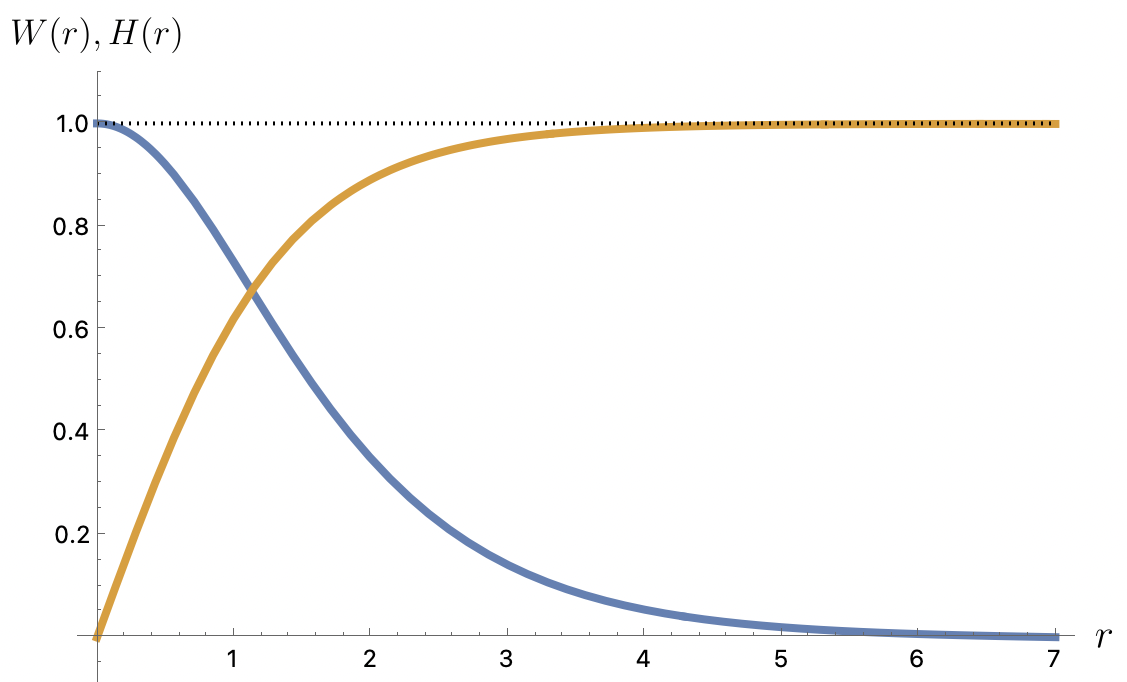
Figure 1: Numerical solutions for W(r) (blue) and H(r) (orange) generated from the origin using explicit Runge-Kutta and implicit Euler methods; essential for matching small-r series to far-field transseries.
At second and higher order in the transseries, the ODEs become inhomogeneous, with source terms depending on products and nonlinear combinations of lower-order solutions. The structure of the differential operators at order k closely mirrors that of k=1, enabling explicit solutions via variation of parameters. The full recursive structure ensures that all transseries terms are computable in closed analytic form in terms of the two leading transseries parameters, σw and σh.
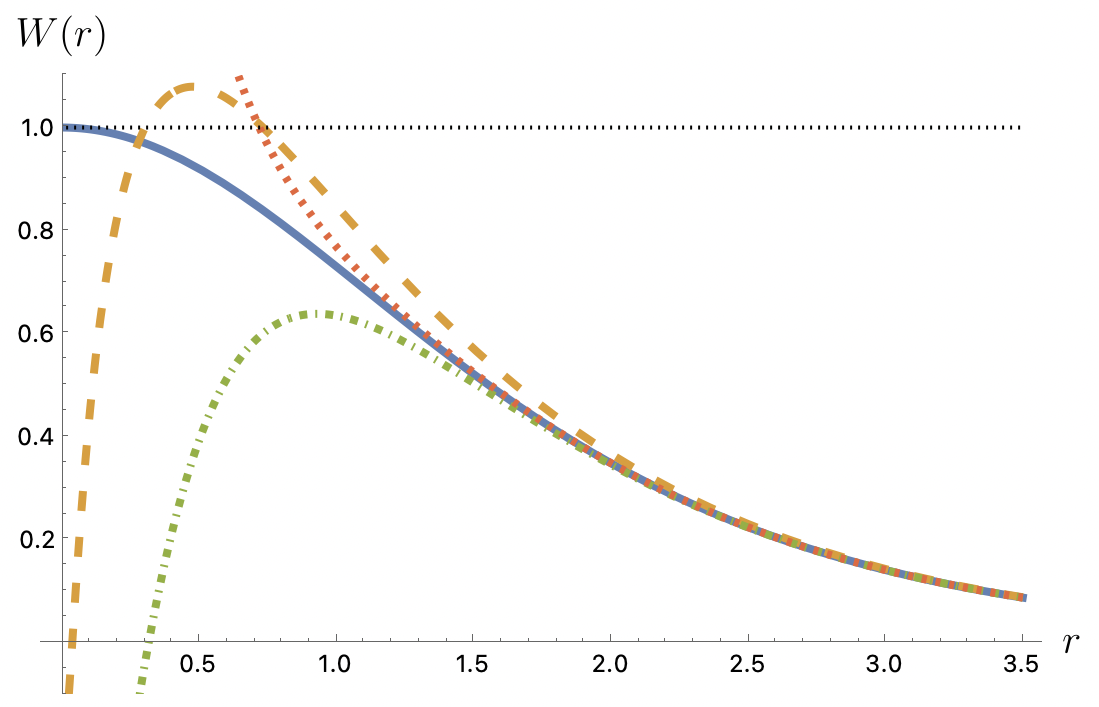
Figure 2: W(r) solutions for σh=1.905, σw=3.336, contrasting numerical (blue) with 1st, 2nd, 3rd transseries orders; convergence to numerics improves rapidly with additional orders for small r.
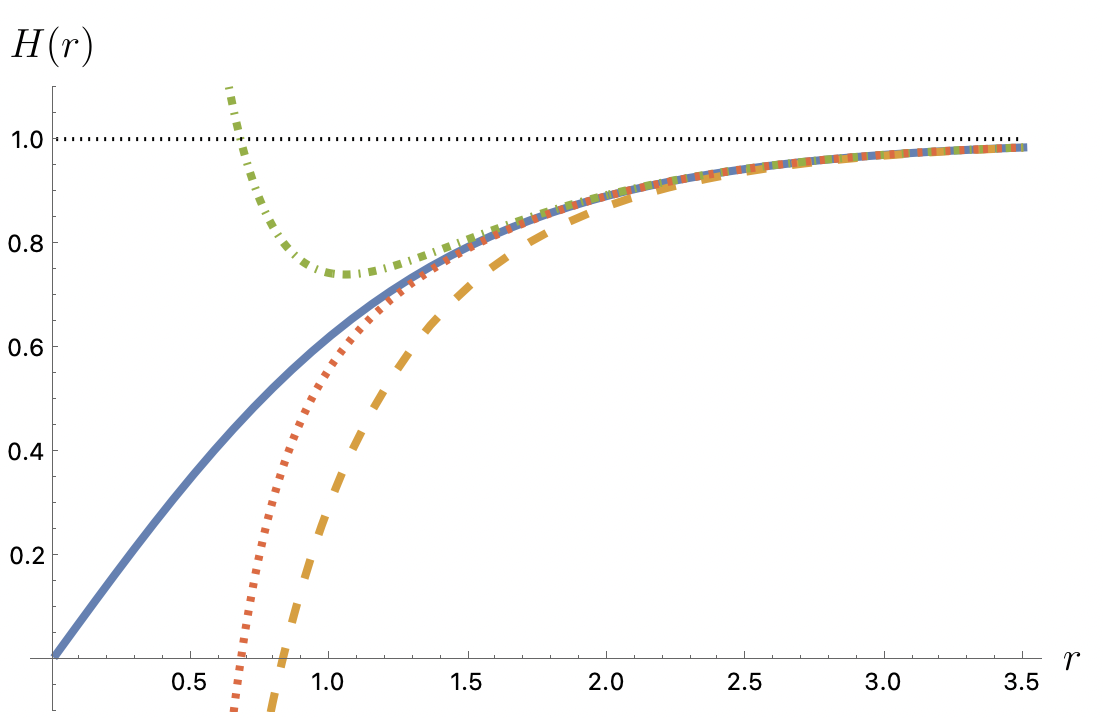
Figure 3: H(r) solutions for σh=1.905, σw=3.336, confirming the same conclusion as Figure 2 in the Higgs sector.
Quantitative Matching and Numerical Validation
A key strength of the analytic transseries construction is its ability to interpolate between small-r (origin) Taylor expansions and large-r asymptotics. The matching procedure determines the expansion coefficients a,b in the Taylor series, and fixes the transseries parameters σh,σw with high numerical precision: for β=1, σh=1.905, σw=3.336, in agreement with prior numerics [forgacs]. Increasing the number of transseries terms extends the regime of precise agreement with full numerical solutions, confirming the global validity of the method.
Further, the approach facilitates accurate computation of physical observables such as the monopole mass. The reconstructed interpolating functions yield a rescaled monopole mass E~=1.237(7) for β=1, again consistent with previous numerical estimates [Bogomolny:1976ab, forgacs].
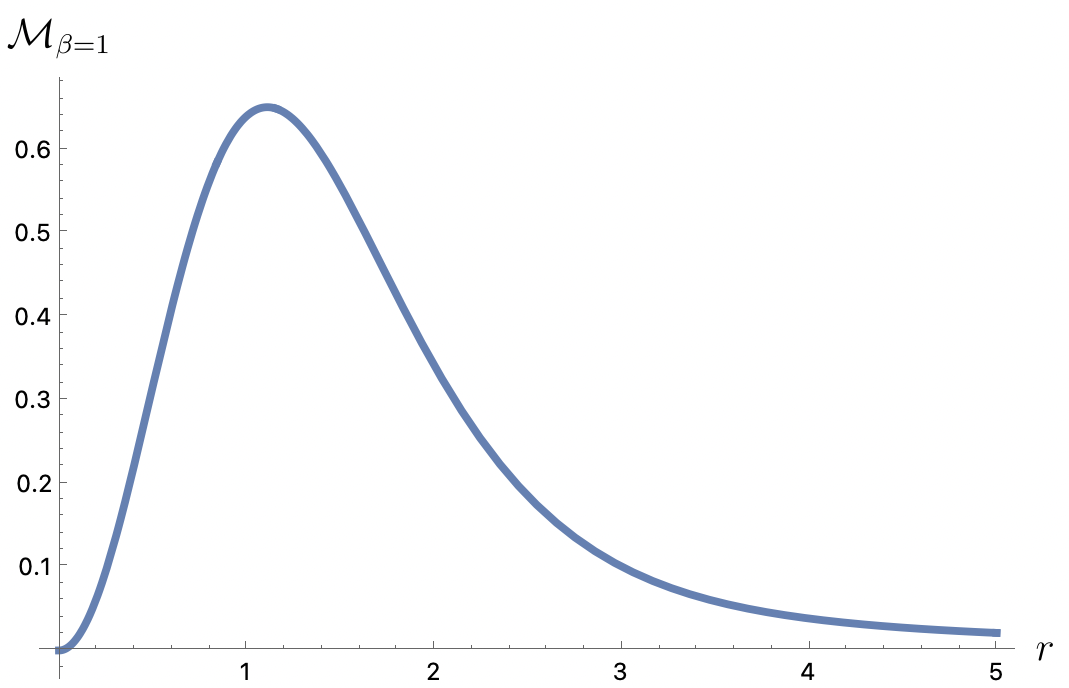
Figure 4: Numerically evaluated integrand of the monopole mass Mβ for β=1, showing reliable agreement with established results and confirming the quantitative validity of the transseries interpolation.
Extension to General β and Dyons
For general β=1, the method extends straightforwardly. The transseries now involve double exponentials e−kr and e−ℓβr, leading to a two-parameter family with β-dependent recursion and matching conditions. The resurgent structure remains, with fluctuation sectors again determined by leading order solutions.
Applying the framework to dyonic solutions (Julia-Zee dyons) adds a third profile function J(r) and further enriches the transseries structure. The treatment carefully accounts for the additional exponential scales introduced by the dyon mass parameter κ, and the leading order equations reduce to generalized Whittaker differential equations, with analytic solutions in terms of confluent hypergeometric functions.
Theoretical and Practical Implications
This analytic construction demonstrates the utility of resurgent transseries techniques for solving physically relevant, but analytically intractable, nonlinear field equations beyond special or supersymmetric limits. The explicit construction of fluctuation sectors provides a rigorous path to semiclassical quantization and sets the stage for systematic computation of quantum corrections even for truly non-BPS objects, extending the Mirzakhani-Mariño-Resurgence paradigm from quantum mechanics and matrix models to topological solitons in field theory [Marino:2012zq, Aniceto:2018bis].
The formalism's applicability extends beyond monopoles and dyons—similar recursive transseries methods will be effective in other coupled soliton systems (e.g., kinks, vortices, false vacuum transitions), as well as in stability and fluctuation analyses of classical solutions, potentially exploiting Borel summability and resurgence for precision QFT computations.
Conclusion
The resurgent transseries approach offers a complete and systematic analytic solution to the non-BPS monopole and dyon field equations in SU(2) Yang-Mills-Higgs theory, with strong numerical corroboration. All fluctuation terms at each exponential order are generated recursively from the leading order solutions. The analytic structure elucidates both the classical moduli and the semiclassical fluctuation content, and points toward new directions for analytic control in non-supersymmetric soliton physics and their quantum corrections.
Future work may consider the extension of resurgent analyses to zero-mode and quantum fluctuation spectra in monopole backgrounds, generalizations to multi-soliton configurations, and systematic connection problem solutions bridging small- and large-field regimes. The results also suggest fertile ground for exploring resurgent phenomena in other domains of mathematical physics and nonlinear dynamics.
(2602.17583)

