- The paper demonstrates that dislocation loop proliferation yields a universal energy scale (≈25) independent of elastic moduli and chemical specifics.
- It employs a gauge-field formalism to balance elastic energy with configurational entropy, establishing a melting threshold for defect-driven transitions.
- The framework unifies melting, glass transition, and fragility by linking topological defect dynamics to macroscopic material behavior.
Introduction
The melting transition of crystalline solids is an outstanding and intensely debated issue in condensed matter physics. Despite a century of theoretical proposals—including vibrational instability (Lindemann), elastic shear instability (Born), and empirical rules relating melting temperature and thermal properties—a fully microscopic, universal criterion for melting applicable across chemical families has remained elusive. The present work rigorously analyzes the role of dislocation loops as fundamental topological excitations driving three-dimensional crystal melting and uncovers a geometric universality underlying the onset of melting. The framework not only matches quantitative universalities empirically observed in viscosity and relaxation data but also rationalizes the origin of the widely known 2/3 rule relating glass-transition and melting temperatures.
Dislocation Loop Proliferation and Melting: Universal Energy Scale
The core of this study is the dislocation-mediated melting theory, where the free energy balance of individual dislocation loops plays the central role. At the melting point, configurational entropy completely compensates the elastic and core energies associated with dislocation loops, leading to their proliferation and the loss of crystalline order.
The paper establishes an exact equality (at melting, Floop(R,Tm)=0) between the loop energy Eloop and the product of the melting temperature Tm with the entropy Sloop, yielding the ratio:
E∗≡kBTmEloop=a2πRlnz,
where R is the minimal stable dislocation loop radius, a is a lattice parameter, and z is the number of local configurational choices per segment. Importantly, this expression is entirely independent of elastic moduli, core energies, or chemistry-dependent features; only geometry and local connectivity enter.
For typical atomic values (R=1nm, a=0.3nm, z∼3--$12$), this yields:
E∗≈25.1.
The study demonstrates that this universal geometric ratio provides a microscopic explanation for the empirically observed energy scale E/kBTm≈24.6 extracted from viscosity/relaxation data at the idealized (cooperativity-free) melting point in a wide range of materials [Lunkenheimer et al., Phys. Rev. B 113, 054108 (2026)].
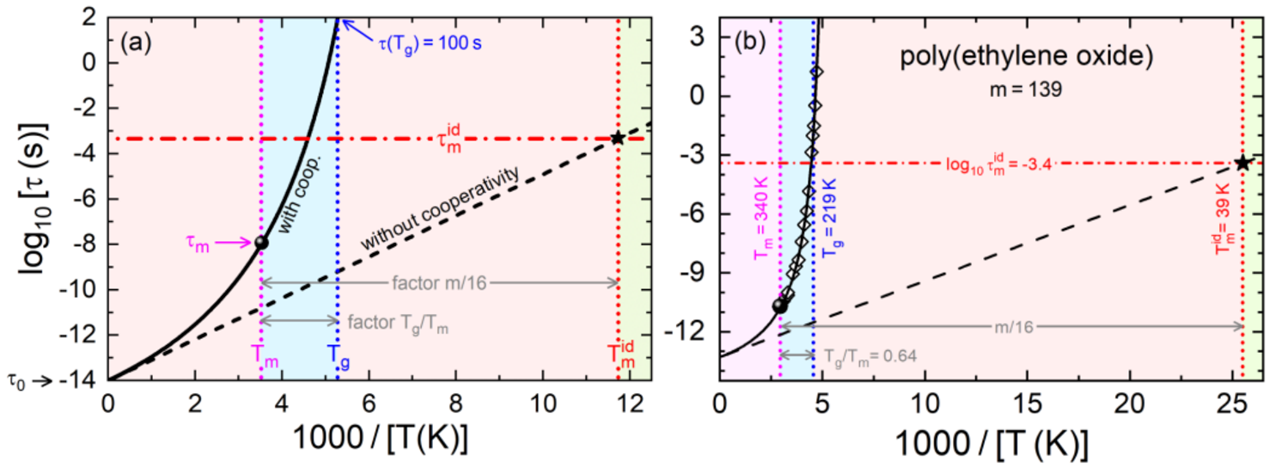
Figure 1: Schematic construction illustrating the extraction of the universal energy ratio from the Arrhenius extrapolation of relaxation time/viscosity data at the cooperativity-free melting point.
Molecular dynamics simulations and gauge-field elasticity theory indicate that dislocation segments and loops proliferate as melting is approached. Dislocation loops represent the topological excitations responsible for the transition. The mechanism is illustrated schematically:
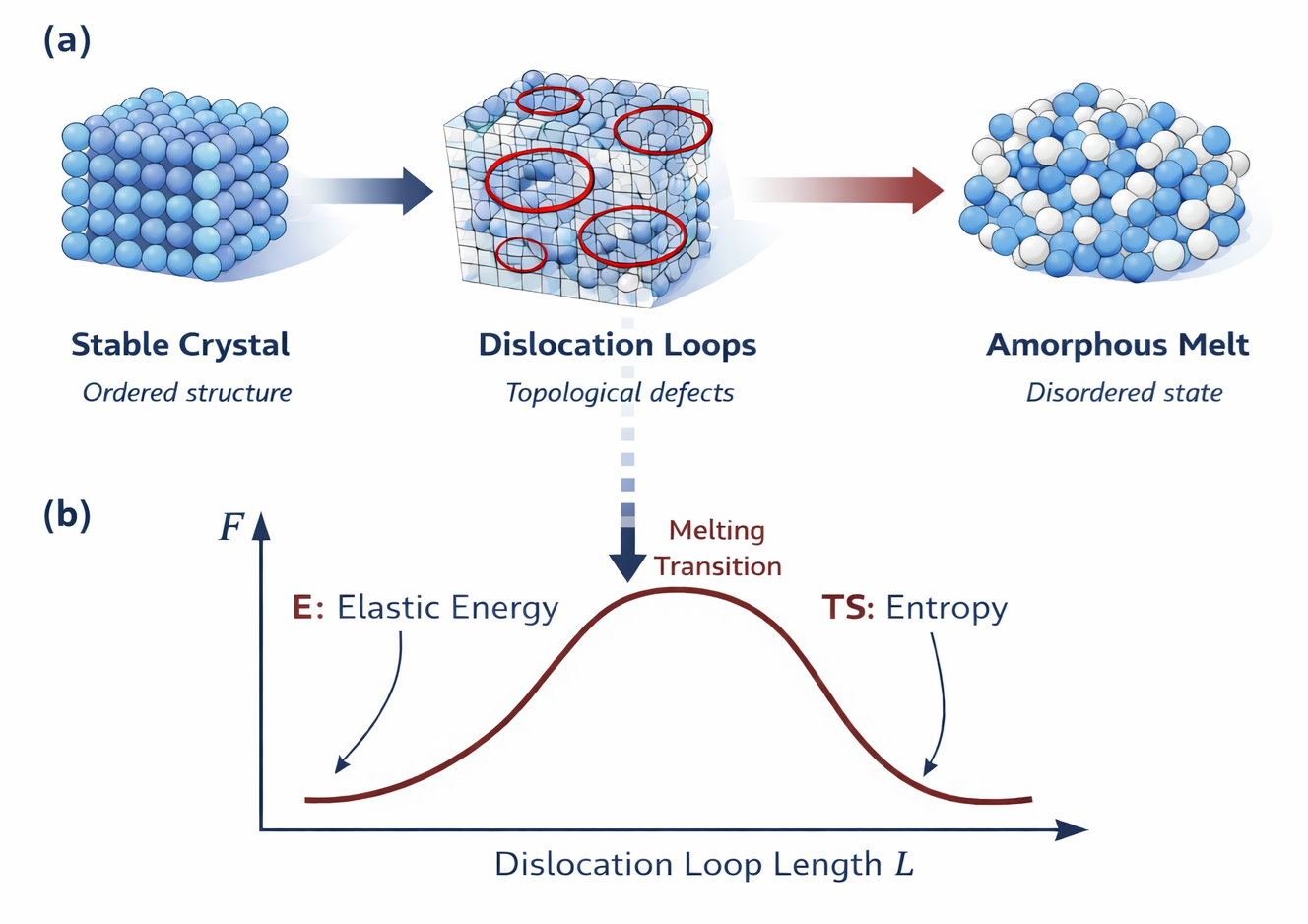
Figure 2: Fundamental mechanism of three-dimensional crystal melting mediated by the proliferation of dislocation loops, which destabilize long-range order.
The essence of the transition is that, when the entropic gain in forming a dislocation loop (growing as 2πRlnz/a) compensates its elastic and core energy, dislocations proliferate, leading to a rapid loss of crystalline order and mechanical rigidity.
Connection to Dynamical Universality and the Glass Transition
The paper links its findings with recent phenomenological and empirical studies identifying a universal, dimensionless activation barrier for viscous flow at the melting point, extracted from idealized Arrhenius extrapolations over a broad material set. The derived geometric constant (E∗≈25.1) matches the empirical universal value (∼24.6) within uncertainties, bridging purely dynamical and purely topological/statistical mechanical approaches.
Crucially, the framework also provides a topological and entropic rationale for the empirical 2/3 rule relating the glass transition temperature Tg and the melting temperature Tm:
TmTg≈lnzglasslnzcrystal≈0.7.
Here, the increase of local configurational entropy (higher z) in the disordered glass phase lowers the threshold temperature for loop proliferation, aligning with widespread experimental observations.
Fragility, Elasticity, and Cooperativity
The relationship between fragility index, elastic moduli, and interaction steepness is established in direct connection to the loop energetics. Within isotropic elasticity, the fragility index m—a measure of super-Arrhenius temperature dependence of relaxation—scales monotonically with the Poisson ratio ν (and hence the repulsion steepness), diverging as ν→0.5. This is captured quantitatively:
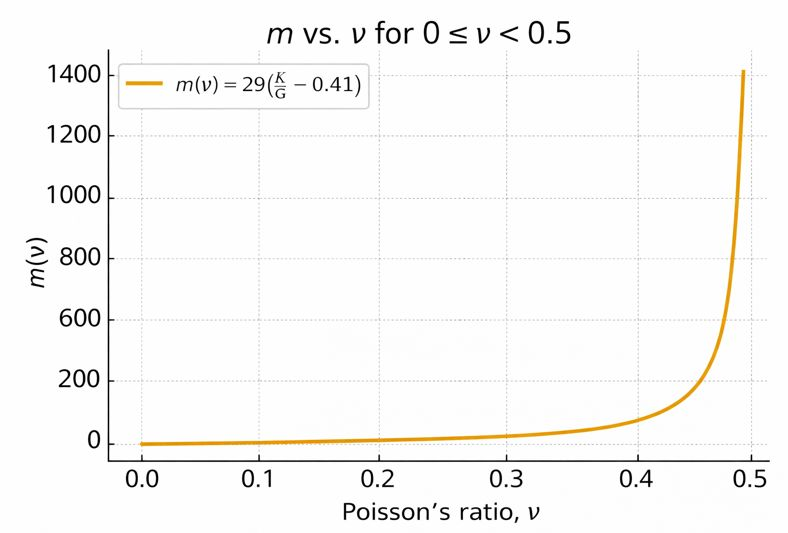
Figure 3: The fragility index m as a monotonic function of the Poisson ratio ν, reflecting the effective interaction steepness and divergence at the incompressible limit.
Steep repulsive potentials (large m, large λ, ν→0.5) correspond to higher energetic barriers for cooperative rearrangement and greater fragility, consistent with hard-sphere and random close-packing scenarios at the jamming threshold.
Theoretical and Practical Implications
The identification of a universal, purely geometric energy scale at melting provides a conceptual unification between thermodynamic/topological defect theories and dynamical/viscosity-based empirical rules. Its independence from chemical specifics suggests a robust, material-agnostic description of melting, with direct implications for:
- Predictive modeling of melting points for new/alloyed materials, by focusing on local geometry and coordination.
- Understanding the limits of stability in supercooled and ultrastable glasses, where defect-mediated melting is suppressed.
- Rationalizing the universal viscosity and relaxation properties observed at melting and the glass transition across broad classes of materials.
Collective elastic effects between dislocation loops, loop-loop interactions, and the potential for elastic loop clustering or condensation near melting are recognized as possible extensions and open questions.
Conclusion
This work rigorously demonstrates that the melting of three-dimensional crystals is governed by a universal, geometry-controlled ratio of the dislocation loop energy to thermal energy (Eloop/kBTm≈25). This finding explains and unifies empirical universalities in melting and glass transition phenomena through topological entropy arguments, linking defect proliferation, dynamical viscosity scaling, and the well-known 2/3 rule. The framework opens pathways for first-principles prediction of melting phenomena based on local geometry—independent of material specifics—and motivates further investigation into collective dislocation dynamics at the melting threshold.
Reference: "Hidden universality in dislocation-loops mediated three-dimensional crystal melting" (2602.16390).

