Joint Orientation and Weight Optimization for Robust Watertight Surface Reconstruction via Dirichlet-Regularized Winding Fields
Published 14 Feb 2026 in cs.CV | (2602.13801v1)
Abstract: We propose Dirichlet Winding Reconstruction (DiWR), a robust method for reconstructing watertight surfaces from unoriented point clouds with non-uniform sampling, noise, and outliers. Our method uses the generalized winding number (GWN) field as the target implicit representation and jointly optimizes point orientations, per-point area weights, and confidence coefficients in a single pipeline. The optimization minimizes the Dirichlet energy of the induced winding field together with additional GWN-based constraints, allowing DiWR to compensate for non-uniform sampling, reduce the impact of noise, and downweight outliers during reconstruction, with no reliance on separate preprocessing. We evaluate DiWR on point clouds from 3D Gaussian Splatting, a computer-vision pipeline, and corrupted graphics benchmarks. Experiments show that DiWR produces plausible watertight surfaces on these challenging inputs and outperforms both traditional multi-stage pipelines and recent joint orientation-reconstruction methods.
The paper introduces DiWR, a method that jointly optimizes point orientations, area weights, and confidence coefficients to achieve robust watertight reconstruction from corrupted point clouds.
It employs a Dirichlet-regularized generalized winding number field and an alternating optimization strategy to effectively mitigate non-uniform sampling, noise, and outliers.
Empirical evaluations show that DiWR outperforms traditional pipelines, achieving lower Chamfer Distance and higher Normal Consistency while suppressing spurious artifacts.
Joint Orientation and Weight Optimization for Robust Watertight Surface Reconstruction via Dirichlet-Regularized Winding Fields
Problem Statement and Motivation
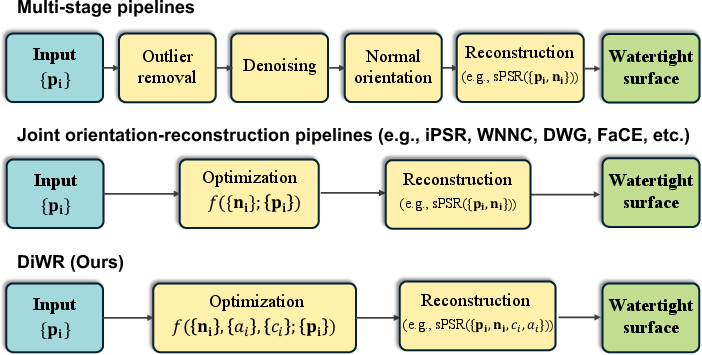
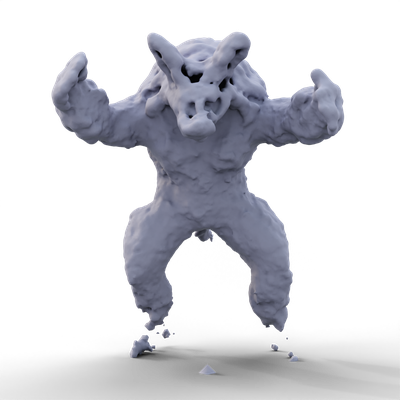
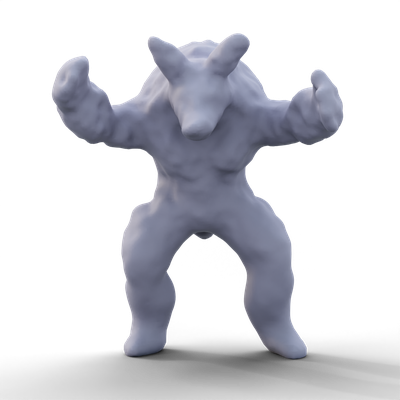
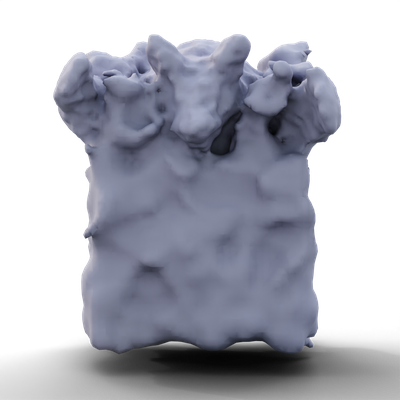
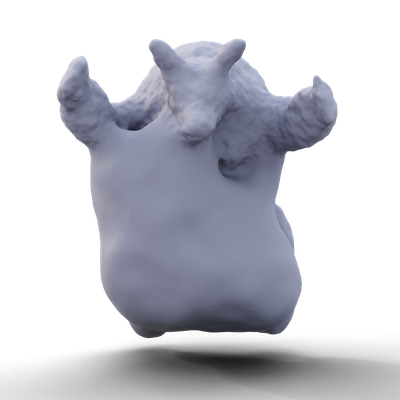
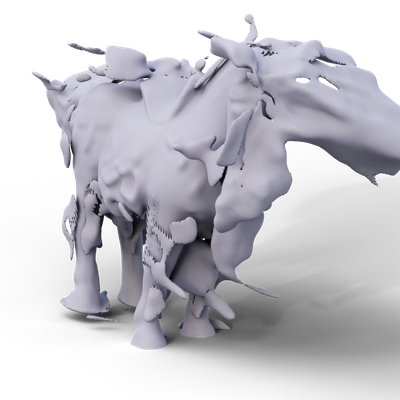
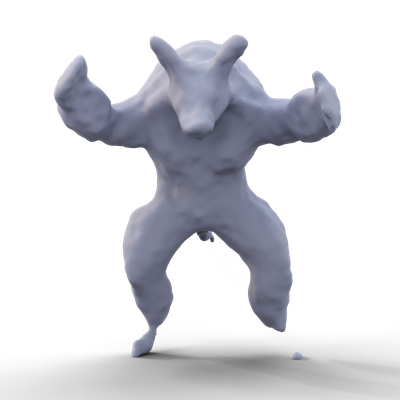
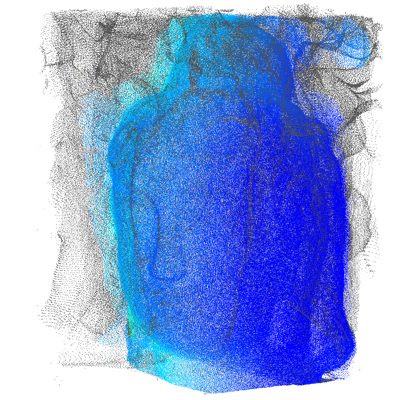
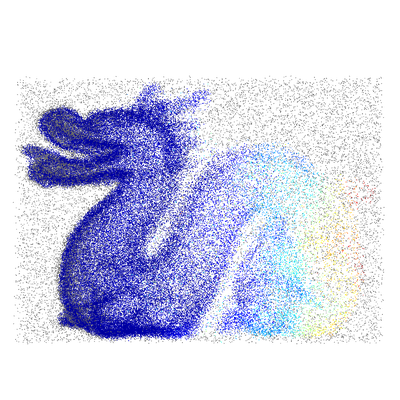
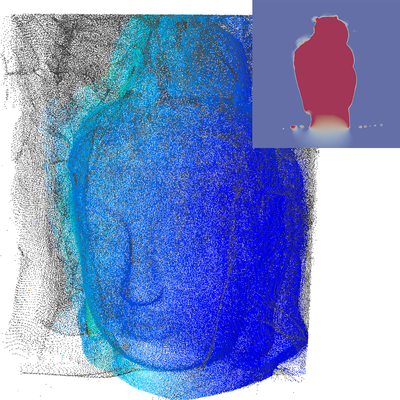
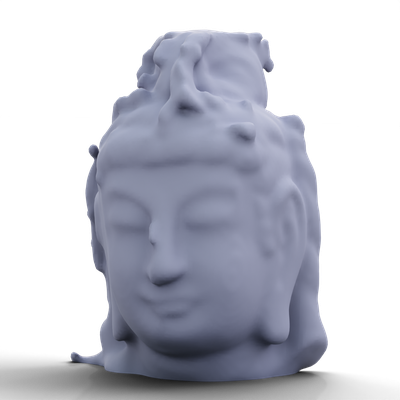
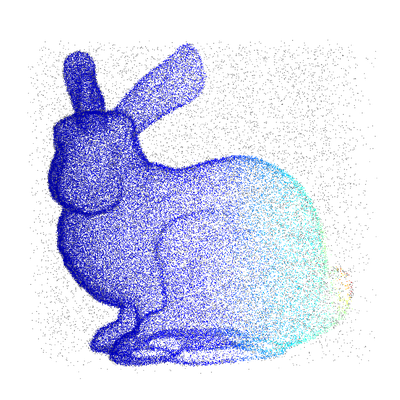
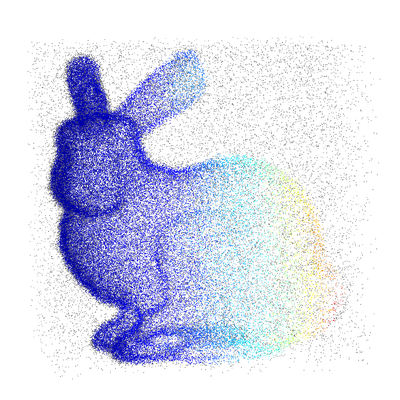
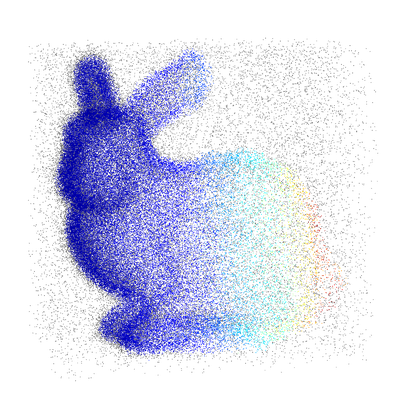
Point cloud based surface reconstruction remains non-trivial in the presence of non-uniform sampling, noise, and a considerable proportion of outliers, particularly when input normals are unavailable or unreliable. Classical multi-stage approaches decompose the task into separate pipelines for outlier removal, denoising, normal estimation, and final surface reconstruction, but these suffer from error propagation and are not robust under severe input corruption (Figure 1).
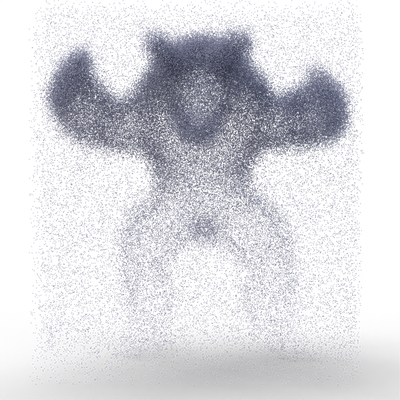
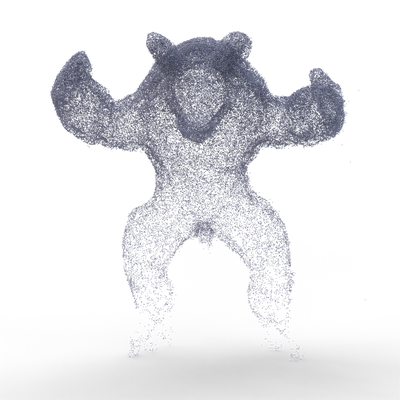
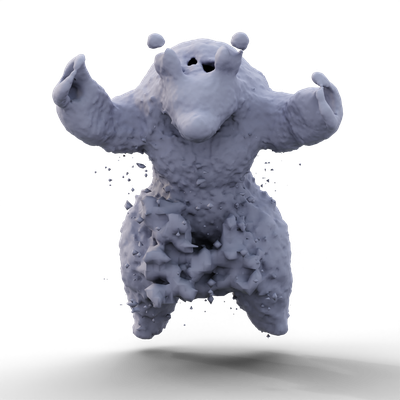
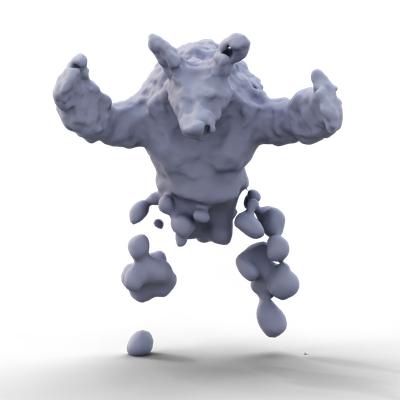
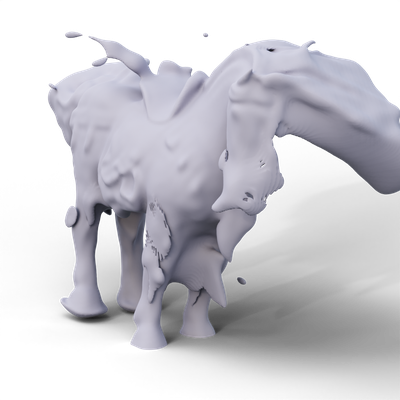
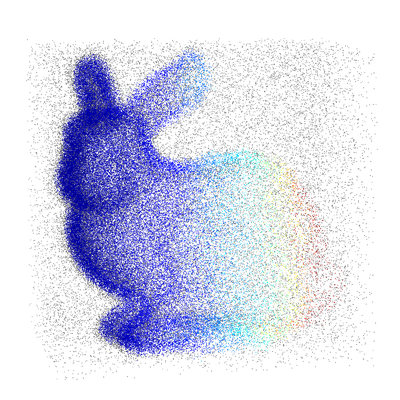
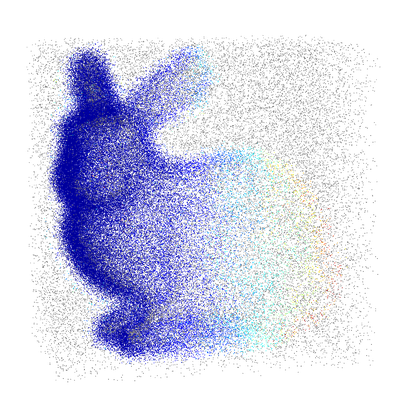
Figure 1: Illustration and qualitative comparison between classical pipelines, recent unified methods, and the proposed DiWR under increasing corruption levels.
Unified frameworks that couple normal orientation and implicit surface estimation have improved robustness but typically assume equal point reliability and adequate sampling, rendering them sensitive to strong noise, outlier contamination, and spatial density variation. The need for a method that performs robustly without reliance on preprocessing motivates the presented Dirichlet Winding Reconstruction (DiWR).
Methodology
Dirichlet-Regularized Generalized Winding Number Fields
The approach adopts the generalized winding number (GWN) as an implicit field; it encodes inside-outside information and aligns gradients with global normal orientation. The field is discretized on unoriented point sets and parameterized by unknowns: point orientations {ni}, per-point area weights {ai}, and per-point confidence coefficients {ci}. The field is:
wθ(q)=i=1∑naici4π∥pi−q∥3(pi−q)⋅ni
The optimization objective consists of minimizing the Dirichlet energy of wθ, enforcing surface points to the level set w=0.5, stabilizing the total represented area, and driving confidence coefficients towards binary assignments to isolate outliers.
Alternating Optimization Strategy
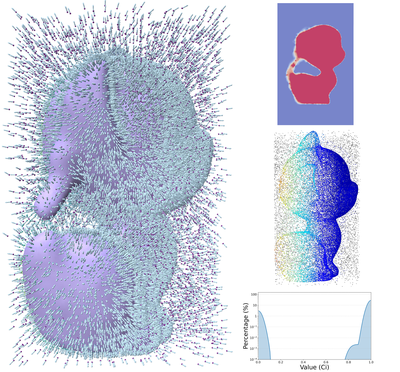
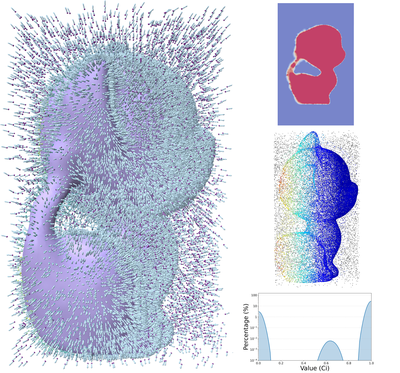
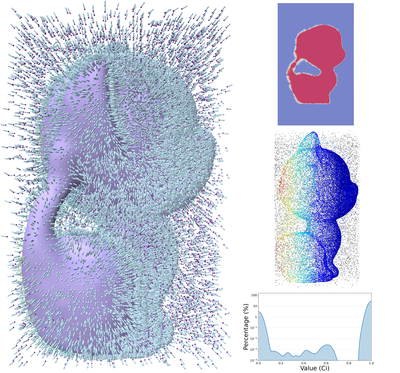
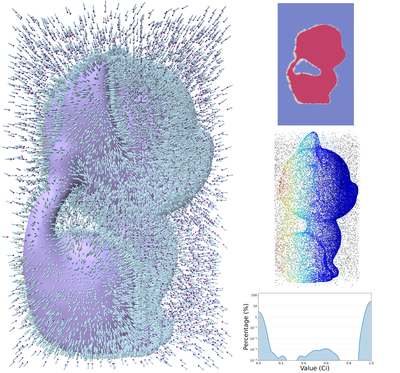
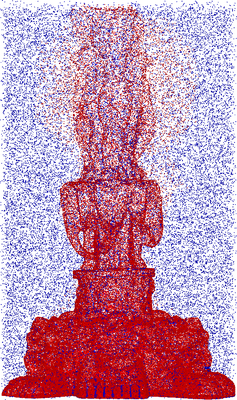
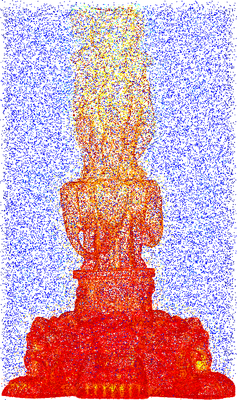
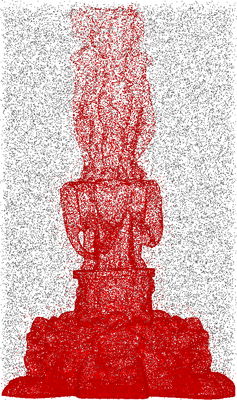
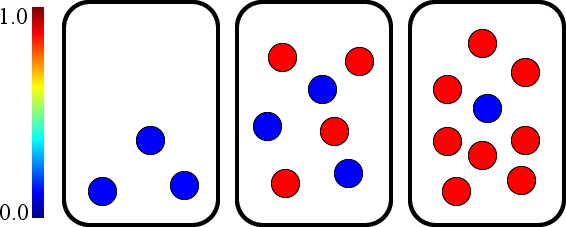
The variables are optimized in a staged manner, alternating between orientation updates (utilizing Diffusing Winding Gradients (DWG) [liu2025diffusing]), area-weight updates, and confidence coefficient optimization using RMSProp on the GPU. Each stage includes specialized regularization: area weights compensate for sampling non-uniformity (Figure 2); the confidence coefficients are driven by GWN statistics and density stratification (Figures 4 and 5), effectively identifying and down-weighting both interior and exterior outliers.
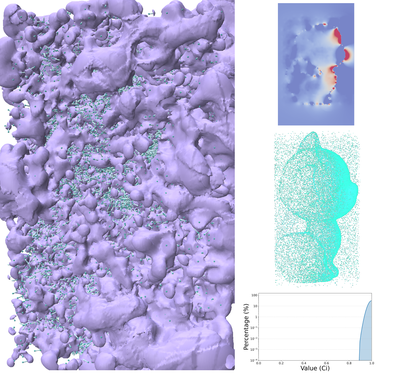
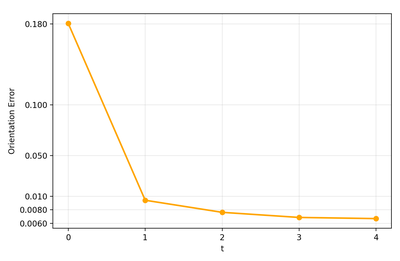
Figure 3: Overview of the DiWR optimization pipeline, depicting the joint update cycles and convergence statistics.
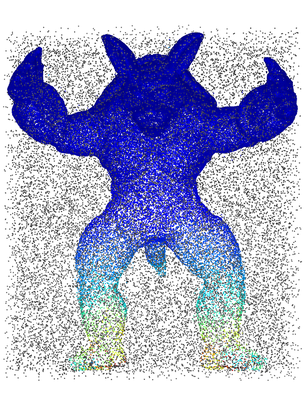
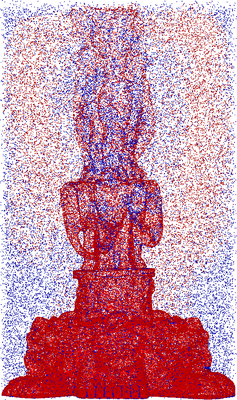
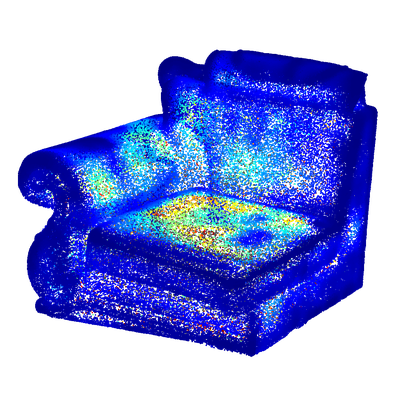
Figure 2: Area-weight optimization adapting to density variation and suppressing outliers.
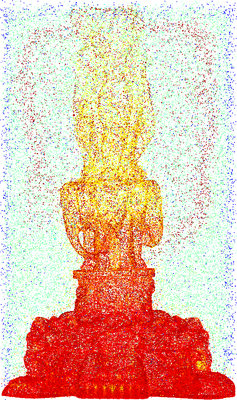
Figure 4: Example of confidence coefficient initialization and optimization stages.
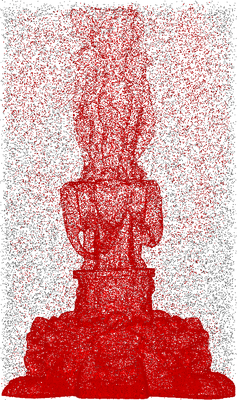
Figure 5: Density stratification procedure producing a smooth, density-aware initialization for confidence coefficients.
The final reconstruction stage passes only high-confidence, correctly oriented, and adaptively weighted inliers to Screened Poisson Surface Reconstruction (sPSR), optionally utilizing the learned weights.
Empirical Evaluation
Datasets
Evaluation is performed on three distinct categories:
Point sets from 3DGS (multi-view Gaussian Splatting).
Computer vision pipeline outputs (VGGT).
Synthetic benchmarks with injected noise, non-uniformity, and outliers.
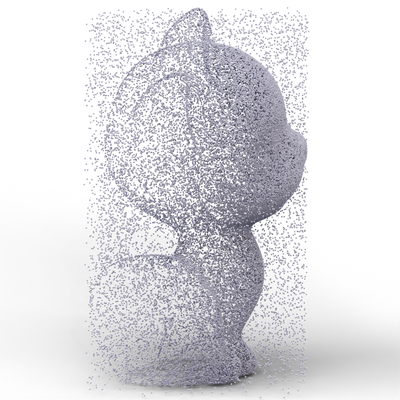
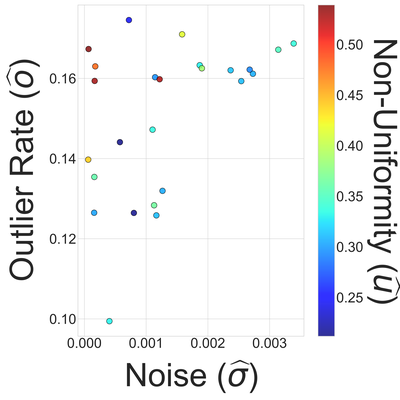
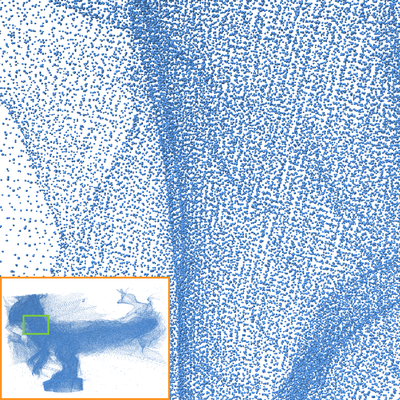
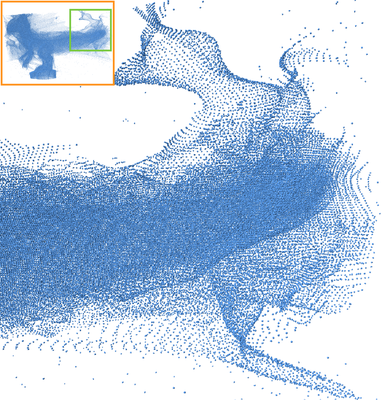
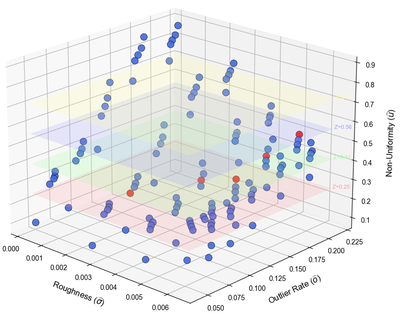
The test suite spans strong variation in local noise (σ), non-uniformity (u), and outlier rate (o) (Figure 6).
Figure 6: Distribution of test models in quality-measure space (σ,o,u) with typical imperfections illustrated.
Comparative Analysis
Quantitative experiments (Table 1) demonstrate that DiWR uniformly surpasses prior methods across categories. Notably:
For 3DGS and graphics benchmarks, DiWR consistently yields lower Chamfer Distance and higher Normal Consistency than both traditional multi-stage pipelines and joint orientation-reconstruction baselines, with or without preprocessing.
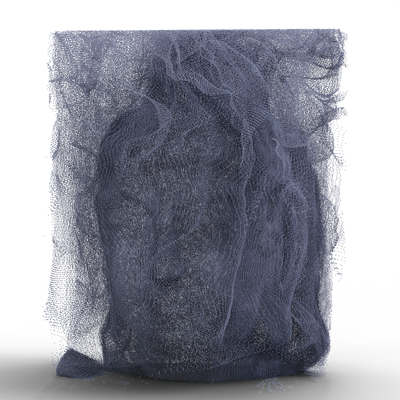
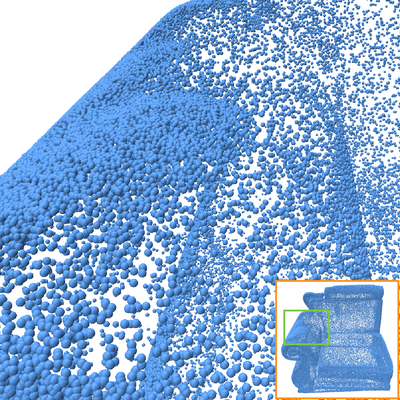
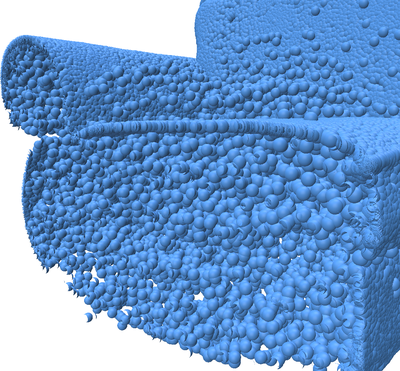
DiWR suppresses artifacts from locally coherent but globally inconsistent structures (e.g., spurious near-surface sheets) more effectively than all baseline methods (Figure 7, Figure 8).
Area-weight adaptation maintains accuracy in the presence of spatial sampling non-uniformity, preventing dense regions from dominating (Figure 2).
Figure 7: Qualitative results comparing DiWR to baselines on 3DGS, VGGT, and synthetic corrupted benchmarks.
Figure 8: Suppression of dense spurious sheet artifacts by DiWR.
Stress tests (Figure 9, Figure 10) indicate DiWR maintains plausible watertight reconstruction for a substantially wider range of sampling variation, noise, and outlier ratios than competitors, with baseline performance degrading sharply.
Figure 9: Stress tests under increasing noise, outliers, and non-uniformity.
Figure 10: Results on representative stress-test cases demonstrate DiWR stability under compounded corruption.
Additional experiments (Figures 11–13) validate these findings on 3DGS, VGGT, and benchmark suites, with DiWR reconstructing coherent geometry even where neural implicit methods and learning-based filtering fail or require significant preprocessing.
Theoretical and Practical Implications
The paper empirically establishes that robust, watertight reconstruction from unoriented and corrupted point clouds is achievable in a unified optimization framework when per-point orientation, area weighting, and confidence are coupled and solved jointly. Theoretical implications extend to adapting GWN-based methods for non-ideal inputs, showing that the Dirichlet regularization and weight/confidence adaptation are critical for suppressing bias due to non-uniform sampling and isolating outliers.
Practically, DiWR obviates the need for fragile, independent preprocessing stages, resulting in improved reliability and reducing manual parameter tuning. The scalability (full GPU implementation) and stability on >100,000 point sets imply feasibility for diverse graphics, vision, and digital heritage pipelines.
Limitations and Future Work
While DiWR robustly reconstructs watertight manifolds under challenging input conditions, it inherits the GWN’s structural limitations, particularly difficulty in handling open surfaces or extreme undersampling. The current formulation does not explicitly preserve sharp geometric features; future work may incorporate feature-preserving constraints or hybrid volumetric-sparse regularization. Extension to point sets representing non-manifold or open geometries remains non-trivial.
Conclusion
This work establishes Dirichlet-regularized GWN field optimization—joint in orientation, area, and confidence—as the state-of-the-art approach for robust, watertight surface reconstruction from unoriented and severely corrupted point clouds. Results validate strong performance relative to both unified and decomposed baselines, with significant improvements in resilience to sampling pathology, noise, and outliers (2602.13801).