- The paper introduces a novel gauge-invariant 2-form connection in OSFT, leveraging star products and integration structure to construct higher holonomies.
- It demonstrates that the constructed 2-form connection transforms as a bona fide gauge field, yielding a strictly invariant 3-form curvature and observable holonomies.
- Practical implications include identifying the 2-form connection with the Kalb-Ramond B-field in closed string backgrounds, bridging open and closed string dynamics.
Higher Connections in Open String Field Theory: Construction, Properties, and Implications
Introduction and Motivation
The paper "Higher Connection in Open String Field Theory" (2602.13627) introduces a novel gauge-invariant 2-form connection within the space of classical solutions to bosonic open string field theory (OSFT). By leveraging the open string star product and integration structure, the work formalizes new observables—higher holonomies and 3-form curvatures—that are invariant under the infinite-dimensional gauge algebra intrinsic to OSFT. The construction is inspired by analogies with the Berry phase in quantum mechanics and recent advances in higher Berry phases in condensed matter and quantum field theory, notably extending these concepts to the string-theoretic context. Furthermore, the paper proposes an interpretation of this 2-form connection as the Kalb-Ramond B-field in certain closed string backgrounds and elucidates its role in sigma models whose target spaces are moduli spaces of conformal boundary conditions.
OSFT: Algebraic Structure and Geometric Interpretation
Bosonic OSFT is formulated as a cubic action over a non-commutative, graded star algebra A, equipped with the BRST differential Q and a trace-like integration functional, all defined in terms of the worldsheet boundary CFT data. The associativity of the star product and the concentration of integration at ghost number 3 underpin the consistent construction of the action, equations of motion, and gauge invariance. The physical degrees of freedom, parameterized by Ψ∈A (ghost number 1), are subject to the equation QΨ+Ψ∗Ψ=0, analogous to non-abelian Chern-Simons theory in its algebraic structure.
A typical element of the algebra is prepared via a path integral on a half-disk or, after conformal mapping, on a half-infinite strip (sliver frame), with operator insertions configuring the boundary conditions and defining the open string configuration.
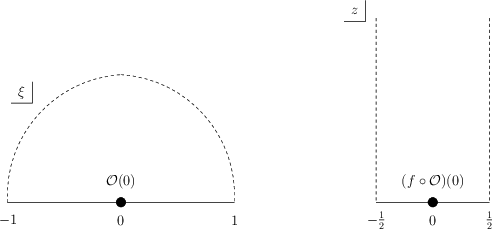
Figure 1: A typical element of A is constructed from a path integral on the unit half-disk, shown in the sliver frame, encoding open string boundary data.
The star product is realized geometrically by gluing these strips, producing new string fields and encoding the non-commutative product structure—an essential tool for the ensuing higher connection.
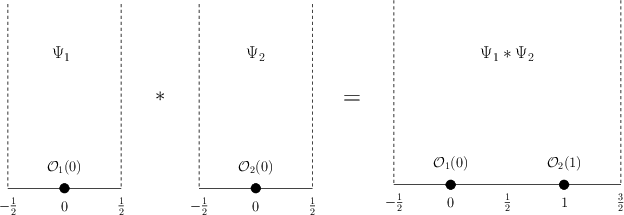
Figure 2: The sliver frame realization of the star product Ψ1∗Ψ2 via gluing two half-infinite strips, producing a composite string field.
Given a smooth family of classical solutions Ψ(λ) parameterized by coordinates λi in a moduli space X, the paper defines a 2-form connection:
Bij(λ)=∫Ψ∗∂λi∂Ψ∗∂λj∂Ψ−(i↔j)
This anti-symmetric tensor field transforms under OSFT gauge transformations δΨ=Qϵ+Ψ∗ϵ−ϵ∗Ψ as a bona fide 2-form connection, with gauge parameter η(ϵ) derived from the star algebra structure. The associated 3-form curvature,
Hijk=∂iBjk+∂jBki+∂kBij
is strictly gauge-invariant, as are the holonomies around 2-cycles in X, providing new classes of observables dependent not solely on individual string backgrounds but generically on families thereof.
The authors prove independence of Bij (modulo gauge ambiguity) from the reference boundary condition, aligning with its interpretation as a closed string background field—a clear reflection of the open/closed duality in string theory.
The analysis focuses on marginal deformations of boundary conditions that yield families of OSFT solutions. The explicit perturbative expansion of Ψ(λ) in marginal couplings allows the computation of the 2-form connection and its curvature—at leading order, the 3-form curvature is proportional to the anti-symmetric OPE coefficient fijk of the boundary marginal operators. The higher-order terms, systematically derived, involve integrated correlation functions and highlight how star algebra encodes closed string background data.
The paper argues for interpreting Bij as the Kalb-Ramond field when X corresponds to a moduli space of D-instanton boundary conditions—a bold proposal supported by OSFT field redefinitions and gauge invariance properties.
Connection to Higher Berry Phases and Gerbes
Drawing a parallel to the Berry phase and its higher-form generalizations in quantum mechanics and condensed matter, the 2-form connection in OSFT mimics a higher Berry connection over moduli spaces. This analogy extends to the construction of connections on gerbes and the quantization of higher holonomies—hinting at deeper geometric and topological structures within string field configurations.
The paper further examines sigma models whose target spaces are boundary conformal manifolds X, with metrics and B-fields extracted from boundary correlators. Examples include free boson theory and Wess-Zumino-Witten models, where the moduli space of boundary conditions and the associated 2-form connection reconstruct the original CFT, demonstrating the sufficiency of boundary data for encoding bulk physics in certain cases.
Implications and Future Directions
Formally, the work expands the set of gauge-invariant observables in OSFT to include higher-form connections and their holonomies, offering new tools for probing closed string backgrounds and moduli spaces. The identification of the 2-form connection with the Kalb-Ramond B-field in specific instances provides a concrete mechanism for closed string data emergence from the open string sector.
Practically, these constructions suggest that moduli spaces of boundary conditions and the OSFT star algebra capture more than just open string dynamics—they encode geometric aspects of the closed string background and may serve as a foundation for generalized stringy geometry.
Potential directions include testing the identification of Bij with B-fields in explicit models, generalizing to superstring field theory and closed string field formulations, and leveraging higher holonomies to diagnose singularities in moduli spaces (e.g., via flux integrals analogous to Berry curvature detection of level crossings).
Conclusion
The paper introduces a rigorous, algebraically robust 2-form connection in OSFT, invariant under its gauge structure and closely linked to closed string geometric data. The construction provides both new physical observables and a pathway toward understanding the emergence of closed string backgrounds from open string field configurations. These results bridge formal advances in quantum field theory, conformal field theory, and condensed matter physics, and open avenues for further analysis of stringy geometry and gauge-invariant structures in field-theoretic models.