- The paper introduces a unified T-matrix formalism that integrates EELS and CL to model electron-beam induced optical phenomena.
- It employs a cylindrical wave basis along with dual local and global T-matrix expansions to tackle complex multi-scatterer geometries.
- The framework enables efficient simulation of spectral responses in nanoparticle clusters, periodic arrays, and extended photonic systems.
Introduction and Motivation
Electron-beam spectroscopies, specifically Electron Energy Loss Spectroscopy (EELS) and Cathodoluminescence (CL), provide pivotal access to both radiative and non-radiative electromagnetic excitations with unprecedented spatial, energy, and temporal resolution. Modeling electron-induced optical responses in nanoscale and structured photonic systems represents a significant computational and theoretical challenge due to complex geometries, material compositions, and the multiple scattering phenomena inherent to nanophotonic arrays.
The paper proposes a unifying T-matrix-based computational framework for electron-driven light–matter interactions in photonic nanostructures, subsuming both EELS and CL within a single formalism. This framework extends the T-matrix approach—well-established for light scattering—to include fast-electron excitation, thus enabling efficient, modular, and physically interpretable analysis of electron-induced optical processes in nanophotonics (2602.12743).
The core development is the recasting of the electron field into the cylindrical wave basis (CWB), naturally suited for electrons traversing straight-line trajectories. The field produced by a relativistic electron is shown to be a singular, transverse-magnetic (TM) cylindrical wave with azimuthal index m=0 and longitudinal wavevector kz=ω/v. This choice avoids the inefficiency of plane-wave expansions in such scattering scenarios and establishes a direct pathway to T-matrix-based multiple scattering calculations.
For a system of N scatterers—arbitrary in shape and arrangement—the interaction is handled in two paradigms:
- Local T-matrix expansion: Each scatterer’s fields are expanded about its own center in the spherical wave basis (SWB), valid outside each circumscribing sphere.
- Global T-matrix expansion: Fields are recentered to a single origin encompassing all scatterers, suitable for non-overlapping configurations.
This duality in basis choice and the seamless basis transformation (cylindrical ↔ spherical) enables optimal numerical conditioning and computational efficiency, especially for extended systems or clusters.
The multiple scattering problem is formulated via block-diagonal and translation-coupled T-matrices, where multiple-scattering events are recursively encoded in the matrix structure. Periodic systems (e.g., infinite chains and arrays) are accommodated via lattice sums and Ewald-converged coupling terms, as detailed in the formalism.
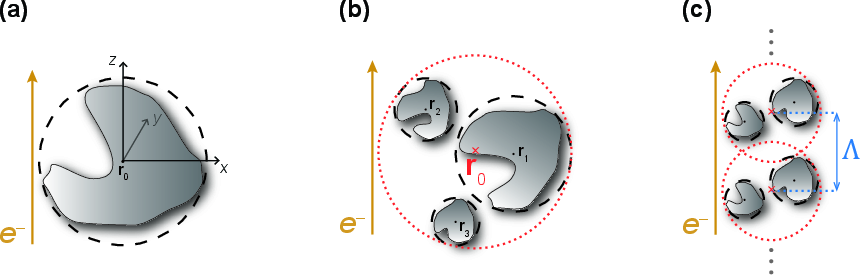
Figure 1: Configurations for scatterer clusters and the validity of local and global spherical field expansions subjected to electron excitation.
Experimental Observables: EELS and CL
The connection to experimental results is achieved by expressing:
- CL probability as the far-field radiated power, computable from the expansion coefficients of the scattered field in the SWB or CWB.
- EEL probability as the total energy lost by the electron, directly linked to the interaction integral of the scattered field along the electron trajectory.
Unified analytic expressions for both quantities are derived for arbitrary scatterer ensembles and excitation conditions—crucially, both observables are expressible as quadratic or bilinear forms in the expansion coefficients (incident/scattered) and the material-geometry-dependent T-matrix.
Numerical Implementation and Key Examples
The formalism is implemented as an extension to the open-source electromagnetic scattering package treams, with a dedicated module for electron beam excitation, enabling users to model complex photonic systems under electron illumination with a Pythonic API.
Three canonical systems are analyzed numerically to illustrate the framework’s generality:
(1) Single Scatterers
CL and EEL spectra for various canonical geometries (dielectric sphere, metallic cylinder, elliptical nanodisk) are evaluated. Key features such as electric/magnetic multipole resonances, surface plasmon polariton (SPP) excitation, and radiative vs non-radiative decay channels are reproduced and quantified. Notably, the T-matrix need only be computed once per scatterer, enabling rapid parametric or configurational studies.
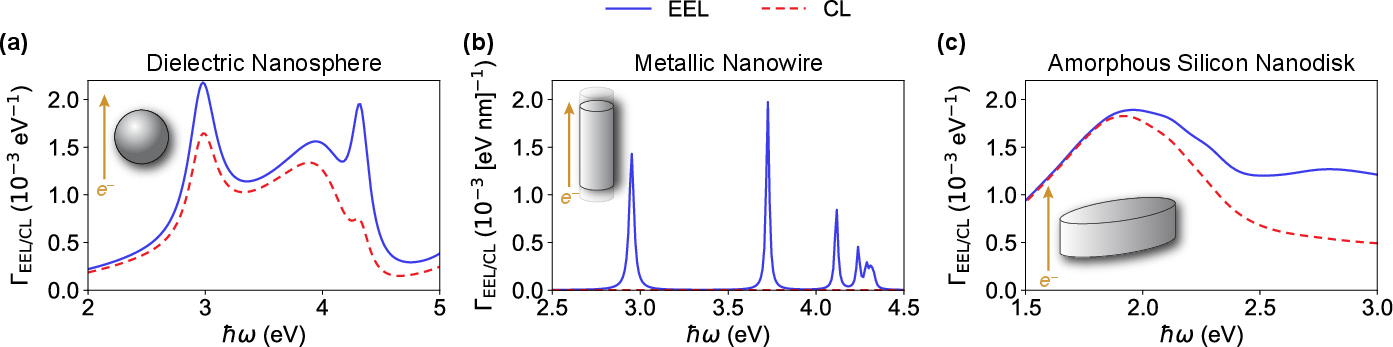
Figure 2: EEL (blue) and CL (red) spectra for (a) dielectric nanosphere, (b) metallic nanowire, and (c) amorphous silicon nanodisk, revealing distinctive multipolar and SPP features.
(2) Finite and Infinite Periodic Chains
Chains of elliptical Si nanodisks, both finite and infinite, are studied under electron-beam excitation parallel to the chain. Emergent lattice resonances, multipolar mode hybridization, and the transition to Smith–Purcell radiative regimes in the infinite limit are systematically analyzed. The simulations reveal substantial sharpening of collective resonances and the suppression of far-field radiation in the infinite chain, a key result directly attributable to lattice symmetry and momentum conservation properties.
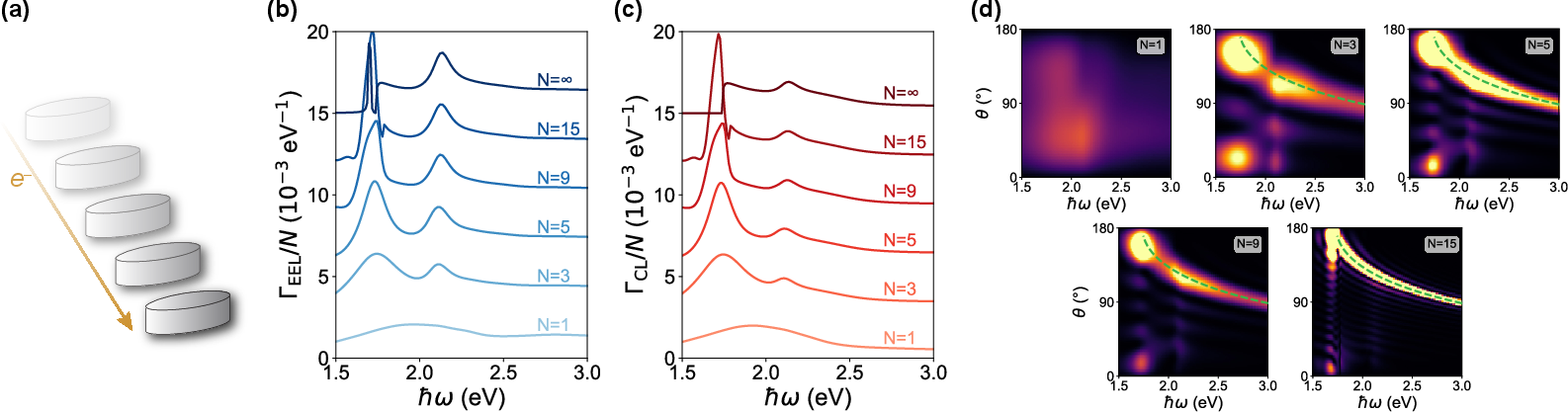
Figure 3: (a) Configuration of a nanodisk chain with electron excitation; (b,c) Evolution of EEL and CL spectra per particle as the chain length increases, revealing collective modes; (d) Directional CL emission maps illustrating the approach to the Smith–Purcell limit as the array grows.
(3) Finite 2D Arrays of Nanospheres
The framework is applied to clusters of aluminum nanospheres in 2D arrangements. The impact of finite cluster size and proximity on EEL and CL spectra is demonstrated, including mode splitting due to plasmonic hybridization and the near-field limited excitation of high-order modes by the electron beam. Notably, lattice effects appear only for nanoparticles in close proximity to the electron path; distant particles contribute minimally due to the electron field’s rapid evanescence.
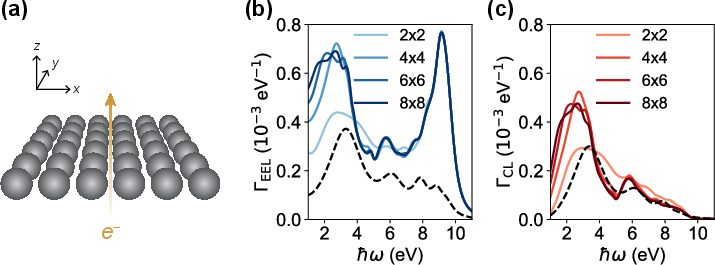
Figure 4: (a) Schematic of aluminum nanosphere array with transverse electron excitation; (b,c) CL and EEL spectra for different cluster sizes, showing mode hybridization and size-dependent resonance splitting.
Implications and Future Perspectives
The established T-matrix framework elevates EELS and CL simulation from individual or low-symmetry scatterers to modular, multi-scale, and periodic photonic architectures with high numerical efficiency. Its extensibility to arbitrary geometries and access to both local (near-field) and global (far-field) observables renders it suitable for:
- Large-scale parametric sweeps and optimization in meta-optics, nanoantenna design, and quantum emitter engineering.
- Interfacing with data-driven T-matrix databases and high-throughput materials discovery paradigms.
- Extension to time-resolved (ultrafast) or nonlinear electron–photon interaction regimes.
The code's open availability, modularity, and compatibility with external T-matrix solvers and repositories (e.g., for non-canonical geometries) further promote collaborative and reproducible research in electron-driven nanophotonics. The formalism also establishes analytic and computational baselines for cross-validating time-domain and domain-decomposition Maxwell solvers, providing a definitive reference for resolving discrepancies in experimental interpretation.
Conclusion
This work establishes a comprehensive, analytically rigorous, and computationally efficient T-matrix formalism for modeling electron-induced optical spectroscopy in arbitrary nanostructures. The unification of EELS and CL in this formalism, the efficient handling of multi-particle and periodic systems, and the integration into a publicly available simulation infrastructure, collectively pave the way for advanced simulation, interpretation, and rational design of electron-driven nanophotonic platforms (2602.12743).