"Sorry, I Didn't Catch That": How Speech Models Miss What Matters Most
Abstract: Despite speech recognition systems achieving low word error rates on standard benchmarks, they often fail on short, high-stakes utterances in real-world deployments. Here, we study this failure mode in a high-stakes task: the transcription of U.S. street names as spoken by U.S. participants. We evaluate 15 models from OpenAI, Deepgram, Google, and Microsoft on recordings from linguistically diverse U.S. speakers and find an average transcription error rate of 44%. We quantify the downstream impact of failed transcriptions by geographic locations and show that mis-transcriptions systematically cause errors for all speakers, but that routing distance errors are twice as large for non-English primary speakers compared to English primary speakers. To mitigate this harm, we introduce a synthetic data generation approach that produces diverse pronunciations of named entities using open-source text-to-speech models. Fine-tuning with less than 1,000 synthetic samples improves street name transcription accuracy by nearly 60% (relative to base models) for non-English primary speakers. Our results highlight a critical gap between benchmark performance and real-world reliability in speech systems and demonstrate a simple, scalable path to reducing high-stakes transcription errors.
Paper Prompts
Sign up for free to create and run prompts on this paper using GPT-5.
Top Community Prompts
Explain it Like I'm 14
Overview
This paper looks at how well speech-to-text systems (the kind that turn your voice into written words) handle a simple but important job: correctly hearing street names. Even though these systems often score well on standard tests, the authors found they make lots of mistakes on short, high‑stakes phrases like “I’m on Cesar Chavez Boulevard.” Those mistakes can send taxis or emergency help to the wrong place.
What were the researchers trying to find out?
The authors focused on a few clear questions:
- Can today’s top speech models reliably transcribe street names spoken by people in the U.S.?
- Do these models make more mistakes for people whose primary language isn’t only English?
- What real-world problems (like delays and extra costs) do these errors cause?
- Is there a simple way to improve accuracy on street names without needing tons of new real recordings?
How did they do it?
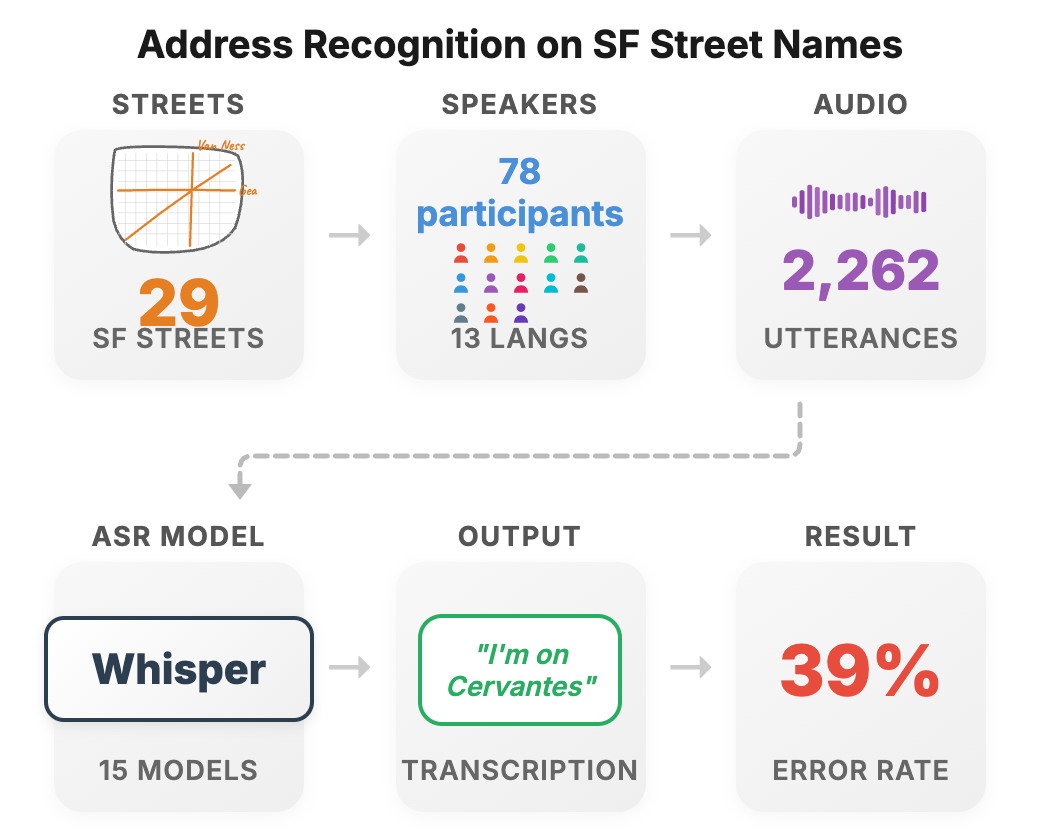
The team built and used two new datasets of real people saying street names and then tested 15 popular speech models.
- SF Streets dataset: 78 U.S.-based participants recorded 2,262 short clips like “I’m on [street name]” for 29 well-known San Francisco boulevards.
- US Streets dataset: 97 participants (all non‑English primary speakers) recorded 3,600 clips across 12 major U.S. cities.
They measured “transcription error rate” for street names. Instead of strict spelling, they checked whether the model’s output sounded like the correct street name. For example, “Ceasar” would count as correct for “Cesar” because it sounds the same.
They also checked real-world impact:
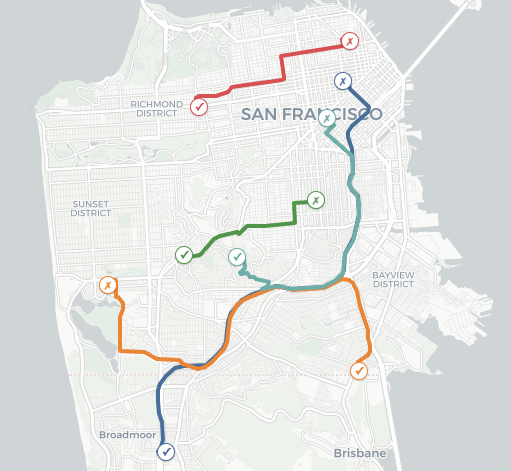
- They used Google Maps to see how far off the wrong transcribed street name would send someone from the intended destination. This gives a sense of actual misrouting distance, time, and cost.
They tried adding context/prompts to models:
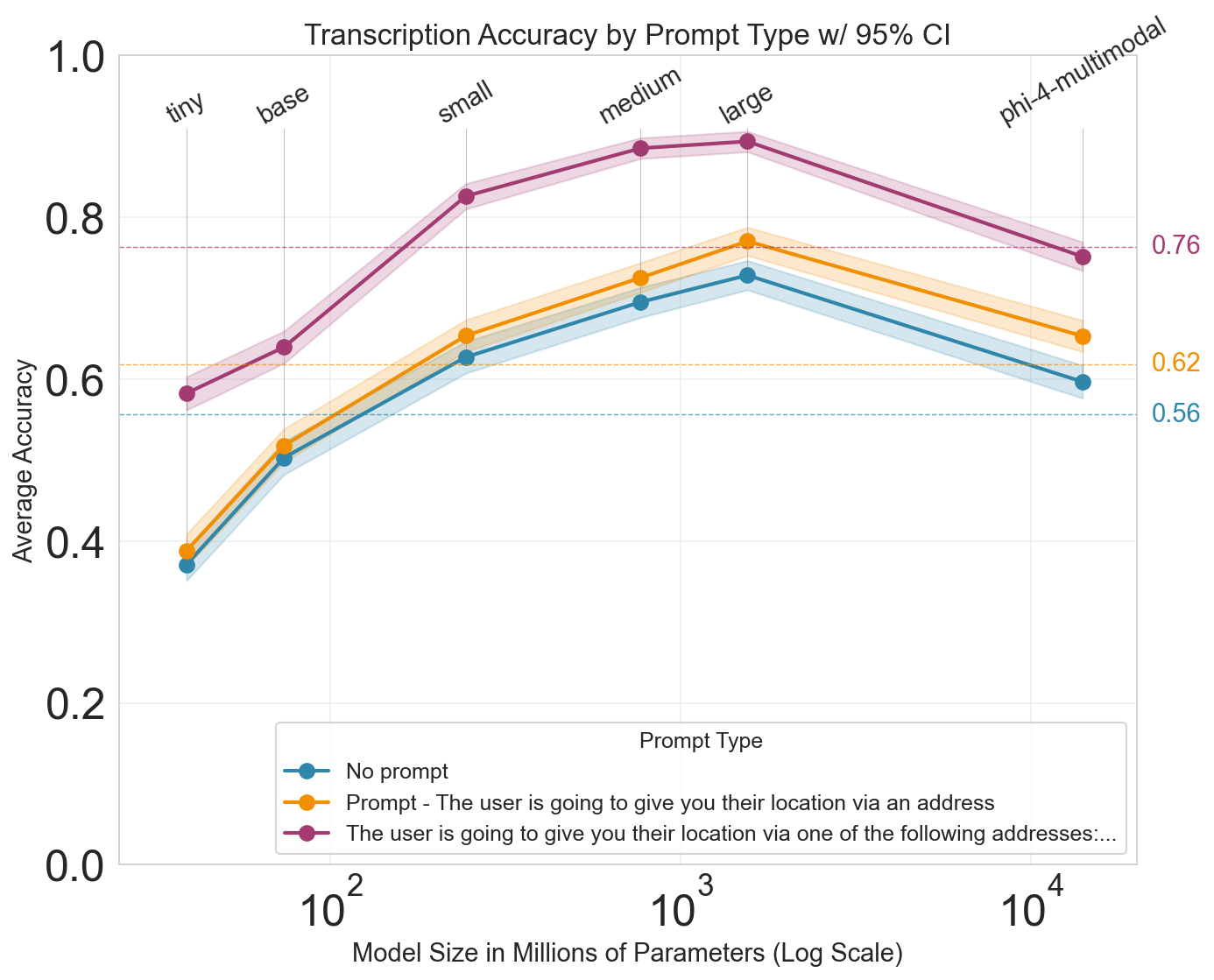
- Light context: “The user is going to give you their location via an address.”
- Full vocabulary list: giving the model all 29 target street names up front (a best‑case test).
Finally, they tested a way to fix things using synthetic (computer-generated) data:
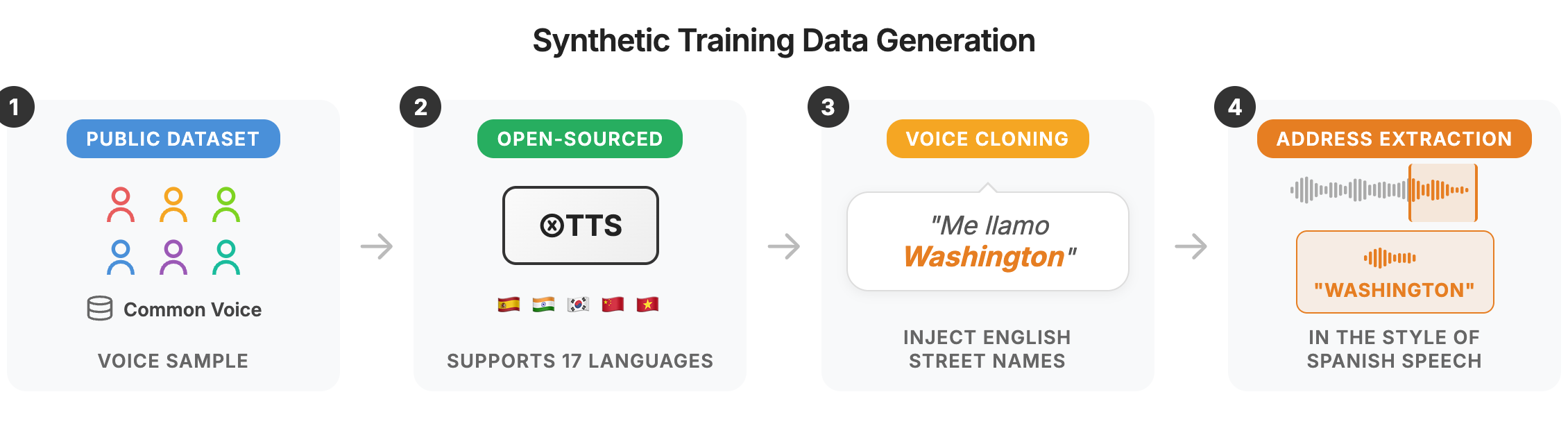
- They used an open-source text‑to‑speech system (XTTS) and a public dataset (Common Voice) to make fake audio of English street names pronounced with different speaking styles.
- How it works in plain terms: have the voice model speak in another language (like Spanish or Italian) but include the English street name in the sentence. This transfers the rhythm and sounds of the other language onto the English word. Then they cut out the street name audio and use these clips to fine‑tune a speech model.
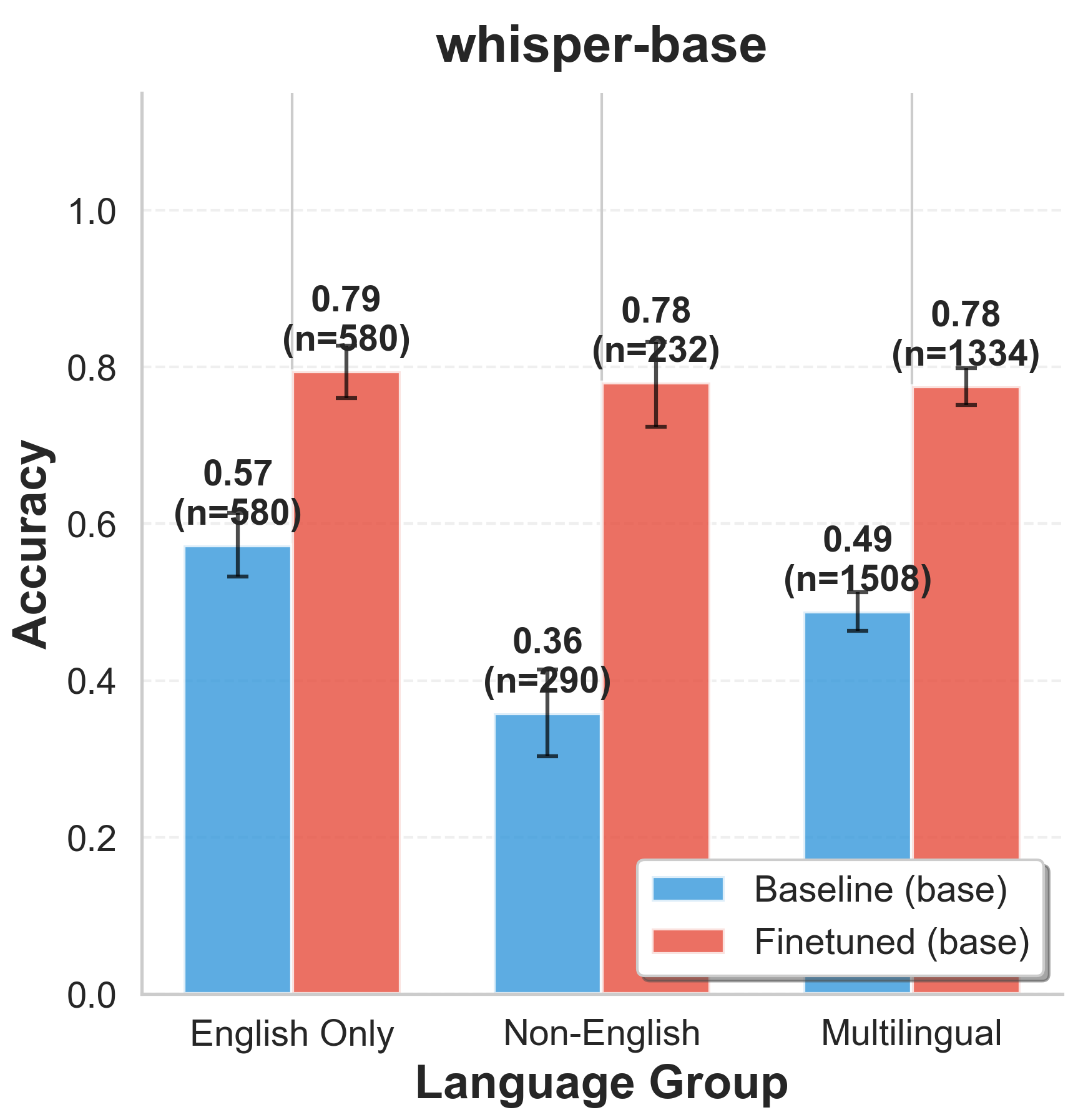
- They fine‑tuned Whisper‑base (a popular open model) using fewer than 1,000 synthetic samples.
What did they discover?
Here are the main results and why they matter:
- High error rates on street names:
- Across 15 models from major providers (OpenAI, Deepgram, Google, Microsoft), the average street name transcription error rate was about 44%. In simple terms, almost every other street name was wrong.
- Even big, powerful models that run slower and use more memory didn’t fully fix this. For example, a large model had low overall word error rate (about 14%) but still failed on street names about 27% of the time.
- Context didn’t help much:
- Adding simple prompts barely improved results.
- Even giving the model the exact list of possible street names only raised average accuracy to about 76%. That means the hard part is hearing and choosing the right, similar‑sounding name.
- Unequal performance across speakers:
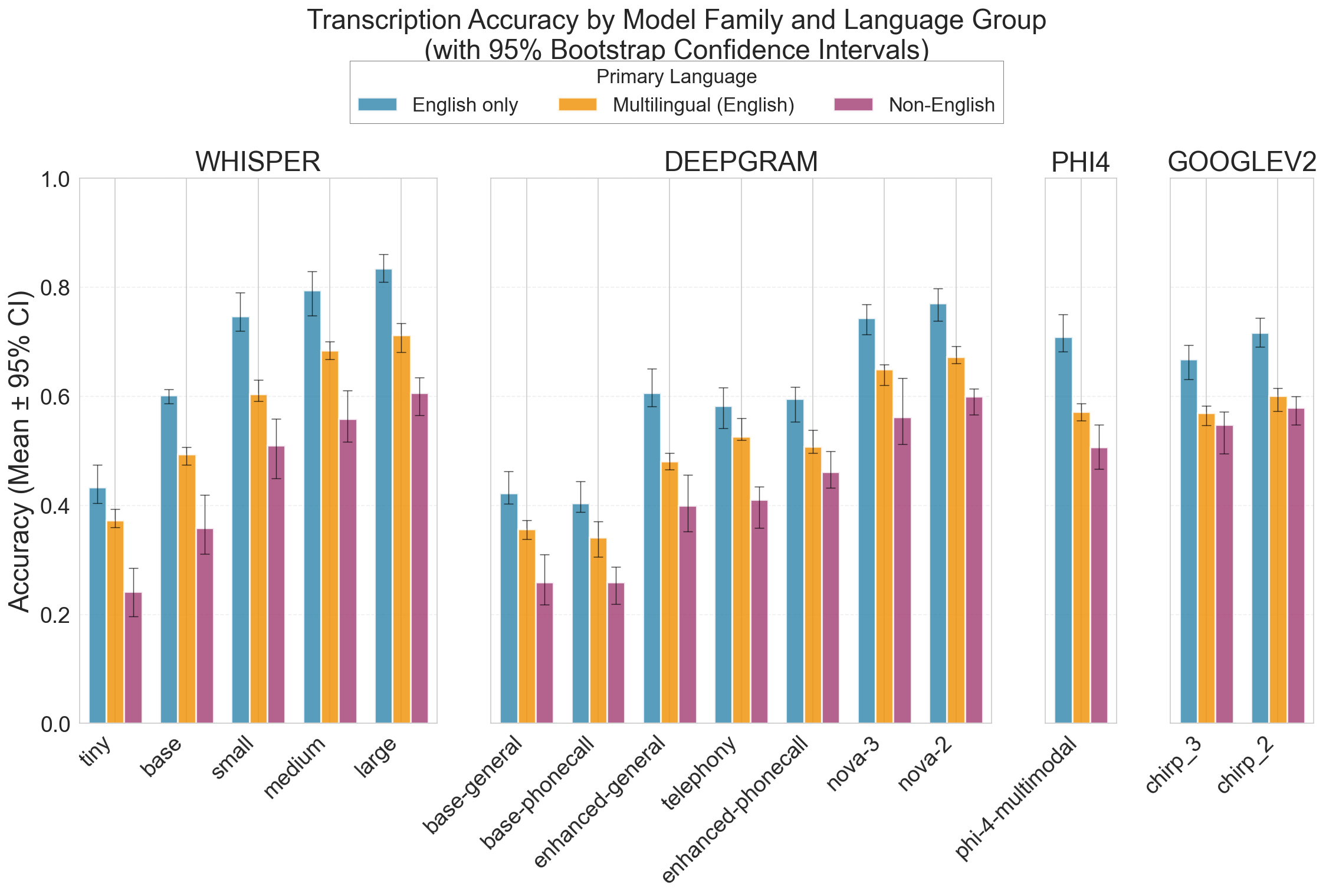
- Accuracy was much lower for people whose primary language isn’t only English. On average, English‑primary speakers had about 64% accuracy, while non‑English‑primary speakers had about 46%.
- This matters for fairness: people with different language backgrounds get worse results.
- Real-world costs and delays:
- Misheard street names caused larger routing errors for non‑English‑primary speakers—about 2.4 miles off vs. 1.26 miles for English‑primary speakers.
- In a city like San Francisco, the authors estimate these errors could add up to roughly 43,000 hours of delay per year and about $2.1 million in extra costs. That’s a lot of wasted time and money, especially for services used by elderly and disabled riders.
- A practical fix using synthetic data:
- Fine‑tuning with fewer than 1,000 computer‑generated samples improved street name accuracy by nearly 60% (relative improvement) for non‑English‑primary speakers.
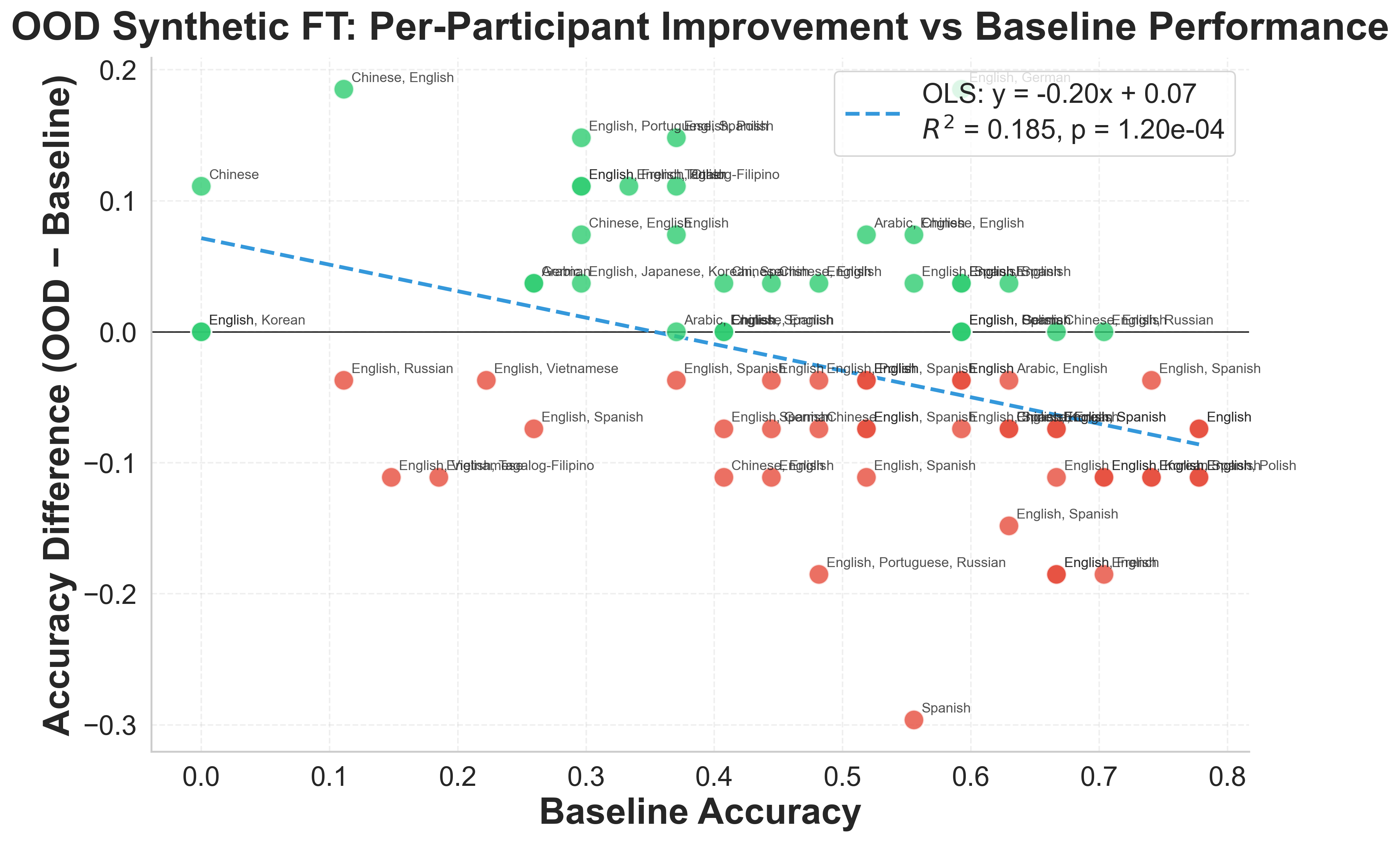
- Improvements also carried over to voices and languages not directly used in training, suggesting the method helps models become better at handling diverse pronunciations in general.
- Training with synthetic data from multiple languages worked best, but even single‑language synthetic training gave meaningful gains.
- Community resources:
- The authors released both datasets (SF Streets and US Streets) so others can test and improve models on this real‑world task.
Why does this matter?
Street names are “named entities”—unique words like people’s names, place names, or hospitals. They’re often unusual, borrowed from other languages, and pronounced in many ways. When speech systems miss these key words, they miss what matters most: where to send help, where to pick up a passenger, or how to get someone to the right destination.
This study shows:
- Standard scores like word error rate can look good but still hide critical failures on short, important phrases.
- Errors are not equal across groups—non‑English‑primary speakers are more affected.
- There’s a simple, scalable way to reduce these mistakes using synthetic data, open tools, and fewer than 1,000 training samples.
In everyday terms: if apps and call centers rely on speech models, we need to test what really matters (like street names), make sure they work fairly for everyone, and use practical fixes to reduce harmful errors. This can save time, money, and, in urgent cases, could even help save lives by getting help to the right place faster.
Knowledge Gaps
Unresolved Knowledge Gaps, Limitations, and Open Questions
Below is a consolidated list of what remains missing, uncertain, or unexplored in the paper, phrased to guide concrete follow-up research:
- Dataset scope is narrow: the core evaluation centers on 29 San Francisco boulevards and templated utterances (“I’m on [STREET NAME]”); expand to larger, more diverse named entities (e.g., numbered streets, highways, intersections, hospitals, businesses), longer utterances, and free-form speech.
- Limited acoustic realism: recordings were not systematically collected under telephony constraints; evaluate with codec compression (e.g., G.711/G.729), background noise, far-field microphones, reverberation, and bandwidth limitations typical of call centers.
- Streaming and real-time constraints untested: measure end-to-end latency, streaming decoding behavior, endpointing, barge-in, and partial hypotheses handling—especially for large models—in realistic pipelines.
- Metric subjectivity and reproducibility: “transcription error rate” relies on a small, manually curated alias list (n=12) and manual phonetic judgments; formalize a phonetic similarity metric (e.g., G2P + phonetic distance) and report inter-annotator agreement, guidelines, and code.
- Lack of contextual biasing baselines: modern APIs support phrase hints, phrase boosts, contextual biasing, shallow-fusion with gazetteers, and constrained grammars; benchmark these against fine-tuning to quantify practical gains in production settings.
- Decoder/lexicon-based approaches untested: compare end-to-end fine-tuning with integrating pronunciation dictionaries (multiple variants), WFST/grammar constraints, and constrained beam search for named entities.
- Multiword and ambiguous entities: assess recognition for multiword street names (e.g., “Cesar Chavez”), homophones, near-homophones, and entities with overlapping pronunciations (e.g., “Arguello” vs similar-sounding candidates).
- Code-switching beyond isolated words: the synthetic pipeline injects single English words into foreign-language sentences; evaluate phrase-level and sentence-level code-switching and multiword entity pronunciations.
- Generalization breadth: beyond 12 U.S. cities and two datasets, test across more cities, rural areas, and non-U.S. locales with diverse toponyms and naming conventions.
- Fairness granularity: “primary language” is a coarse proxy; analyze per-language/dialect performance (e.g., Spanish, Mandarin, AAVE, Chicano English), accent severity, speech rate, and confounders (mic type, noise) using controlled designs.
- Pronunciation origin effects: the paper suggests 33% of streets have non-English origins but does not link origin to error rates; systematically correlate etymology, orthography-to-phonology irregularity, and training frequency with errors.
- Human pronunciation validity checks are subjective: provide criteria, expert-reviewed ratings, and inter-rater reliability for “discernibly pronounced appropriately” judgments.
- Training/evaluation leakage and overfitting: clarify splits and procedures to ensure synthetic fine-tuning does not inadvertently overfit to evaluation sets; provide held-out named entities and speakers for robust tests.
- Hyperparameter and data scaling laws: characterize how gains scale with the number of synthetic samples, language mix, and speaker diversity; report variance and confidence intervals across multiple random seeds.
- Cross-model generality: improvements are shown primarily for Whisper variants; evaluate reproducibility across other ASR families (e.g., Conformer-Transducers, RNN-Ts, CTC-transformers) and proprietary APIs with model-specific adaptation hooks.
- Alignment/segmentation pipeline details: the synthetic data requires extracting entity audio from TTS outputs; specify and benchmark forced alignment or segmentation methods and their error rates at scale.
- TTS accent “suppression” is anecdotal: rigorously study whether TTS voice cloning normalizes accents when generating English, across models and languages; quantify accent transfer fidelity and its impact on ASR gains.
- Multi-entity utterances left unexplored: evaluate full addresses (house number + street + city), cross streets (“at X and Y”), and landmarks; measure interactions between entities (e.g., LLM context helping/hurting).
- Calibration and abstention: analyze ASR confidence calibration for named entities; test whether calibrated confidence can reliably trigger human confirmation or disambiguation prompts.
- Interactive mitigation strategies: evaluate human-in-the-loop designs (e.g., top-k candidates, disambiguation via spelling, confirmation) and measure task completion time and error reduction versus automation-only pipelines.
- Economic impact modeling sensitivity: the SF taxi-based cost estimates rely on simplifying assumptions (e.g., weekday volume share, uniform speeds); conduct sensitivity analyses and replicate for other cities and service types (e.g., paratransit, emergency dispatch).
- Error taxonomy: distinguish and quantify recognition errors (acoustic/phonetic), selection errors (confusing similar candidates), and language-model biases; provide phoneme- or grapheme-level confusion analyses to guide targeted fixes.
- Gazetteer integration with geospatial priors: test ASR+gazetteer systems that leverage spatial constraints (e.g., bounding polygons, nearest-neighbor matching) and measure improvements in end-to-end geolocation accuracy.
- Robustness to adversarial or rare names: stress-test with low-frequency, unusual, or intentionally confusing street names; examine error modes and recovery strategies.
- Standardized benchmark and metrics: propose and release a community benchmark with agreed-upon named-entity accuracy metrics, phonetic matching protocols, and public leaderboards to move beyond WER.
- OOD generalization mechanics: the paper observes gains for worst-off users with OOD synthetic training but not average gains; investigate mechanisms (representation shifts, phonetic coverage) and devise principled OOD selection strategies.
- Language selection strategy: authors note higher gains from some synthetic languages (e.g., Russian, Arabic, German) without a causal account; develop phonetic-coverage metrics to choose language sets that maximize transfer.
- Compare fine-tuning to contextual decoding at deployment: quantify trade-offs (latency, memory, cost) and robustness of fine-tuned models vs on-the-fly phrase biasing or constrained grammars in realistic, resource-limited environments.
- Telephony-optimized models vs telephony audio: some evaluated APIs are tuned for phone audio, yet the study uses general microphone recordings; verify fairness of comparisons by re-encoding the dataset to telephony codecs and re-evaluating.
- Confidence in GPT-based etymology labels: the origin classification uses GPT-4.1; validate label accuracy against human experts or curated sources before correlating with performance.
- Release completeness and comparability: the public dataset differs from the analyzed set (participant pool changed); quantify any distribution shifts and verify that reported conclusions replicate on the public release.
- Privacy and ethics of accented data synthesis: beyond a brief dual-use note, assess whether synthetic accent generation introduces biases or stereotypes and establish safeguards and evaluation criteria.
- Cross-domain transferability: test whether the proposed synthetic training pipeline transfers to other named-entity categories (e.g., hospital names, business names) and to languages other than English for locale-specific deployments.
Practical Applications
Immediate Applications
Below are concrete, deployable use cases that leverage the paper’s findings, datasets, and synthetic data pipeline. Each bullet names the sector, the application, and key assumptions or dependencies.
- Transportation and Mobility (ride-hailing, taxi dispatch)
- Deploy “street-name aware” ASR post-processing: integrate per-city street lexicons, phonetic aliases, and map-API fuzzy matching to correct transcriptions before routing.
- Assumptions/dependencies: access to municipal street lists; integration with geocoding APIs (e.g., Google Maps); low-latency constraints; ongoing alias maintenance.
- Introduce double-confirmation workflows in IVR: after transcription, present top-3 candidate streets (“did you mean…”) with short driver-distance estimates for selection.
- Assumptions/dependencies: UI/voice UX changes; call-center IVR support; tolerance for minor interaction cost; human-in-the-loop fallback policy.
- Fine-tune existing Whisper models per city using the paper’s XTTS + Common Voice synthetic pipeline to boost named-entity accuracy for diverse speakers.
- Assumptions/dependencies: model licensing permitting fine-tuning; limited compute; access to XTTS and Common Voice; internal MLOps; monitoring of domain shift (e.g., telephony audio quality).
- Emergency Communications and Public Safety (ECCs, 911 centers)
- Add named-entity reliability checks for address capture: when confidence is low or named entity detected, trigger human verification or structured spelling capture (letter-by-letter).
- Assumptions/dependencies: confidence scoring from ASR; policy allowances for human escalation; low overhead in emergency flows.
- Adopt the paper’s “transcription error rate” metric in acceptance tests for vendor ASR systems; require passing thresholds on local street benchmarks (SF Streets / US Streets).
- Assumptions/dependencies: procurement authority; benchmark integration into evaluation; periodic re-testing.
- Logistics and Last-Mile Delivery (courier services, food delivery)
- Address-entry guardrails in support calls: augment ASR with street-name lexicons, aliases, and map verification to lower misrouted deliveries.
- Assumptions/dependencies: map-API integration; per-city vocabulary; operational monitoring of savings.
- Driver app voice input: deploy on-device candidate selection workflows with near-real-time geocoding checks.
- Assumptions/dependencies: mobile app changes; on-device ASR capacity; connectivity for geocoding.
- Mapping and Navigation (software vendors, in-car systems)
- Build a named-entity resolver layer: weighted grammar/FSTs, phonetic alias lists, and “perfect context” prompts (city-specific vocab) to bias ASR toward in-vocabulary streets.
- Assumptions/dependencies: vendor ASR that supports prompts or decoding grammars; ongoing vocabulary updates; latency budgets.
- Add equity-aware error analytics dashboards: monitor routing distance error by primary language group and trigger mitigations (e.g., confirmation prompts).
- Assumptions/dependencies: access to demographic proxies; privacy-safe aggregation; governance for fairness monitoring.
- Contact Centers and IVR (telephony)
- Design low-friction fallback flows: if street name confidence is low, switch to structured capture (spelling, landmark cross-check), or transfer to an agent.
- Assumptions/dependencies: IVR scripting; agent availability; adherence to accessibility standards for LEP users.
- A/B test the synthetic fine-tuned ASR vs. baseline for street-name tasks; roll out where performance gains justify cost.
- Assumptions/dependencies: experimentation infrastructure; KPI definitions (routing error, call duration, transfer rate).
- Software and MLOps (ASR product teams)
- Package the paper’s synthetic augmentation pipeline as an internal tool: “City-ASR Booster” for named entities (streets, hospitals, schools).
- Assumptions/dependencies: legal use of datasets; reproducible pipeline; small-scale fine-tuning compute; model evaluation harness.
- Incorporate the paper’s metric and datasets in CI: fail builds if named-entity accuracy regresses for target cities.
- Assumptions/dependencies: CI/CD integration; acceptance thresholds; dataset versioning.
- Academia and Research
- Use SF Streets and US Streets benchmarks to study named-entity failures in ASR and fairness across language groups; publish mitigation comparisons.
- Assumptions/dependencies: dataset access; IRB considerations for future data collection; standard evaluation code.
- Investigate why WER can mask named-entity failures; propose composite ASR metrics (WER + named-entity transcription error rate + routing distance error).
- Assumptions/dependencies: agreement on evaluation protocols; cross-institution collaboration.
- Policy and Governance
- Update procurement and certification requirements: mandate named-entity accuracy thresholds and human-in-the-loop safeguards for high-stakes voice routing (ECCs, paratransit).
- Assumptions/dependencies: regulatory authority; stakeholder buy-in; clarity on acceptable delays vs. safety.
- Require equity monitoring: periodic audit of error rates and routing distances by language group; publish transparency reports.
- Assumptions/dependencies: privacy-preserving analytics; definitions of protected groups; remediation plans.
- Daily Life and Accessibility
- Voice assistant “address confidence” UX: if uncertainty is detected for a street, prompt for verification or present map snippet for confirmation.
- Assumptions/dependencies: device UI capabilities; user consent; minimal friction design.
- Community alias lists: crowdsource phonetic variants and common misspellings for local streets to improve ASR post-processing.
- Assumptions/dependencies: moderation; integration with local apps; multilingual contributions.
Long-Term Applications
These applications may require further research, scaling, standardization, or technology maturation before broad deployment.
- Standardized Named-Entity Speech Benchmarks (industry + academia)
- Establish national, multi-city benchmarks for street names and other operational entities (hospitals, schools, landmarks) with an agreed “transcription error rate” standard.
- Assumptions/dependencies: consortium coordination; data licensing; periodic updates; multilingual coverage.
- Accent-Preserving TTS and Synthetic Data Generators (software + research)
- Develop TTS/voice cloning that retains authentic accent features in English generations, improving realism of synthetic training data.
- Assumptions/dependencies: advances in TTS modeling; ethical safeguards; evaluation protocols for accent fidelity.
- Multilingual, Accent-Aware ASR Architectures (software + automotive)
- Architect ASR systems with explicit accent/domain modeling and dynamic lexicon injection for location-heavy tasks (in-car navigation, voice-first dispatch).
- Assumptions/dependencies: model capacity; low-latency decoding with grammars; OEM partnerships.
- Personalized ASR and On-Device Adaptation (consumer devices)
- Per-user fine-tuning from corrections and usage history to improve street-name recognition for individual speakers; privacy-preserving federated learning.
- Assumptions/dependencies: on-device training capability; privacy-by-design; robust personalization without overfitting.
- Integrated Geo-ASR Systems (mapping + robotics)
- Combine ASR with geocoders and spatial disambiguation models to jointly infer intended locations from speech, usable by autonomous delivery robots or drones.
- Assumptions/dependencies: multimodal inference pipelines; safety validation; edge compute for robots.
- Fairness Certification and Compliance Frameworks (policy + insurance)
- Create a “Street-Name Reliability” certification with equity thresholds; insurers or municipalities could require certification for voice-based dispatch tools.
- Assumptions/dependencies: regulatory frameworks; auditing bodies; standardized reporting.
- Emergency Communications Standards (public safety)
- National guidance that codifies “double-confirmation” rules, confidence thresholds, and human escalation for voice-only address capture.
- Assumptions/dependencies: federal/state adoption; training budgets; interoperability across ECC systems.
- Open-Source Tooling Ecosystem (software)
- Productize the paper’s pipeline into libraries/services: “Named Entity Speech Augmentor,” “Geo-ASR Checker,” “Street Lexicon Builder,” and “Equity Dashboard.”
- Assumptions/dependencies: maintainers; sustainable funding; API stability; developer adoption.
- Cross-Domain Named-Entity Speech (healthcare, education, enterprise)
- Extend methods to medical facility names, campus buildings, company-specific product names; reduce critical transcription errors in scheduling, wayfinding, and support.
- Assumptions/dependencies: domain vocabularies; compliance constraints (HIPAA/FERPA); stakeholder participation.
- Cost-of-Error Modeling and Procurement Economics (finance + policy)
- Standardize models that translate ASR named-entity errors into time and cost impacts for municipalities and enterprises to inform ROI and risk decisions.
- Assumptions/dependencies: access to operational metrics; agreement on valuation methods; longitudinal studies.
Glossary
- Automatic Speech Recognition (ASR): Technology that converts spoken audio into text automatically. "We've seen tremendous progress in automatic speech recognition (ASR) system as models continue to scale."
- Bootstrap resampling: A statistical technique that repeatedly samples with replacement to estimate metrics like confidence intervals. "95% confidence intervals calculated via bootstrap resampling of 10,000 samples"
- Coqui-TTS: An open-source text-to-speech toolkit used to synthesize speech. "open-sourced text-to-speech models (specifically Coqui-TTS)"
- Confidence interval: A range of values likely to contain the true parameter, expressing statistical uncertainty. "95% confidence intervals calculated via bootstrap resampling of 10,000 samples"
- Edit distance: A measure of how many edits (insertions, deletions, substitutions) are needed to transform one string into another. "“Font” being transcribed as “Bont” is low in edit distance, but potentially high in geographic location"
- Early stopping: A training strategy that halts optimization when a monitored metric stops improving to prevent overfitting. "early stopping loss threshold at 0.01"
- Fine-tuning: Additional training of a pre-trained model on task-specific data to improve performance. "Fine-tuning with less than 1000 synthetic samples improves street name transcription accuracy by nearly 60%"
- Hugging Face: A platform and ecosystem for sharing machine learning models and datasets. "Specifically, we leverage the widely used XTTS model available on Hugging Face"
- IRB approval: Authorization from an Institutional Review Board to ensure ethical treatment of human participants in research. "Participants were recruited via Prolific () to obtain a linguistically diverse sample that reflects San Francisco’s population, with IRB approval."
- Leaderboards: Public rankings of model performance on benchmarks. "most state-of-the art leaderboards have yet to incorporate these new, challenging tasks."
- Multimodal models: Models that process and integrate multiple data types (e.g., audio, text, images). "Recent advances in multi-modal models have made speech recognition systems a routine part of everyday life."
- Multilingual NER: Named Entity Recognition systems designed to work across multiple languages. "multilingual NER"
- Named entity corrector: A component or method to post-process and fix named entities in ASR outputs. "developing a named entity corrector"
- Named entity recognition (NER): Identifying and classifying entities (e.g., names, locations) in text or speech. "the speech field has started to focus on the challenge of named entity recognition"
- Out-of-Distribution (OOD): Data that differs from the distribution seen during training. "generalization from synthetic OOD data"
- Orthographically agnostic: Evaluation that ignores spelling differences and focuses on phonetic equivalence. "meaning orthographically agnostic (e.g., both “Ceasar” and “Cesar” are considered correct)."
- Phonetic ambiguity: Uncertainty arising when different words sound similar, leading to recognition errors. "mishearing, phonetic ambiguity, and choosing the wrong candidate"
- Phonetic equivalents: Different spellings or forms that sound the same and are treated as matches. "selecting phonetic equivalents"
- Prompt: Text or context provided to guide model behavior or outputs. "We used the following lightweight prompt in this experiment"
- Promptable models: Models that accept prompts to condition their outputs. "promptable models like (Whisper and Phi-4)"
- Speech corpus: A structured collection of speech recordings used for training or evaluation. "a multilingual speech corpus comprising 134 languages and recordings from over 350,000 speakers"
- Style transfer: Adapting characteristics (e.g., accent) from one style/language to another in generated outputs. "implicit accent style transfer"
- System prompt: Instructions placed in the model’s system-level context to constrain or inform its responses. "in the system prompt"
- Telephony: Audio and conditions specific to phone networks, often low bandwidth and noisy. "low-bandwidth telephony audio"
- Text-to-speech (TTS): Technology that synthesizes spoken audio from text. "text-to-speech models"
- Upper bound: A maximal estimate used to contextualize performance or potential. "serves as a diagnostic upper bound"
- Voice cloning: Synthesizing speech that mimics a specific speaker’s voice. "XTTS supports voice cloning in 16 different languages"
- Word Error Rate (WER): Standard ASR metric measuring substitutions, deletions, and insertions relative to ground truth. "Word Error Rate (WER) is a widely used metric in speech recognition that measures the overlap between a ground-truth transcript and a model’s output."
- XTTS: A multilingual, zero-shot text-to-speech model used for synthetic data generation. "Specifically, we leverage the widely used XTTS model available on Hugging Face"
Collections
Sign up for free to add this paper to one or more collections.