- The paper introduces TIPMOC, a parametric framework that forecasts tipping points based solely on the power-law divergence of sample variance.
- It compares power-law fits with linear models using corrected AIC to reliably detect bifurcations while minimizing false positives.
- Numerical experiments across various dynamical systems demonstrate high detection rates and robust forecasts under different noise conditions.
TIPMOC: A Parametric Framework for Early Detection and Forecasting of Tipping Points Based on Sample Variance
Motivation and Limitations of Existing Early Warning Signals
Forecasting imminent regime shifts ("tipping points") in complex dynamical systems remains a critical challenge in disciplines ranging from ecology and climate science to epidemiology. Classical early warning signals (EWSs) utilizing critical slowing down—such as sample variance, lagged autocorrelation, and skewness—are widely adopted due to their simplicity and theoretical grounding. However, these scalar EWSs typically rely on heuristic performance measures (e.g., Kendall's τ), which present several deficiencies: (i) the threshold for τ is arbitrary and does not reliably signal bifurcation proximity; (ii) high τ values may occur in non-bifurcating noise processes, leading to false positives; (iii) τ fails to quantify the distance to the bifurcation along the control parameter axis.
Recent advances have addressed some of these limitations using statistical model comparison and machine learning approaches, able to adjudicate between bifurcation and non-bifurcation models and to forecast the bifurcation location. However, data requirements and interpretability issues limit their practical deployment, especially in experimental settings.
Theoretical Foundation and Mechanism of TIPMOC
The core innovation introduced is TIPMOC (TIpping via Power-law fits and MOdel Comparison), a parametric method that leverages the mathematically proven divergence of variance near codimension-one bifurcations, which follows a power-law form. TIPMOC operates in a sequential framework: as a control parameter u monotonically changes, the sample variance V^ is monitored. TIPMOC fits both a power-law divergence model and a linear model to the (u,V^) data, and compares their performance using corrected Akaike Information Criterion (AICc), which penalizes additional parameters in low-data regimes. An impending bifurcation is declared only when AICc for the power-law fit is smaller by at least 10 for three consecutive observations—a conservative threshold to avoid spurious detection.
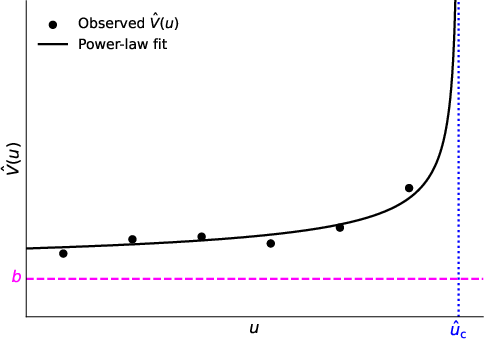
Figure 1: Schematic of TIPMOC's power-law fit, showing divergence of variance as the bifurcation is approached; u^c is the estimated critical point.
On detection, TIPMOC provides both (a) a statistical verdict on whether a bifurcation is imminent and (b) a prediction of its location u^c, using only the sample variance, with quantified uncertainty. TIPMOC is entirely parametric, does not require explicit modeling of the underlying stochastic dynamics, and functions efficiently with modest sample sizes (e.g., L=100 per control parameter value).
Numerical Results: Detection, Forecasting, and Evaluation
The efficacy of TIPMOC is demonstrated via numerical experiments across a suite of canonical nonlinear dynamical systems: stochastic double-well potential (saddle-node bifurcation), over-harvesting models (saddle-node and transcritical bifurcations), Rosenzweig-MacArthur model (Hopf bifurcation), and mutualistic-interaction networks.
For the double-well system, TIPMOC accurately detects bifurcation points in all 100 simulation runs, outperforming Kendall's τ in specificity and providing robust predictions despite variance in detection timing and u^c accuracy. Detection occurs before the deterministic bifurcation, and forecasted u^c clusters closely around the true critical point, though with notable dispersion, particularly for early detections.
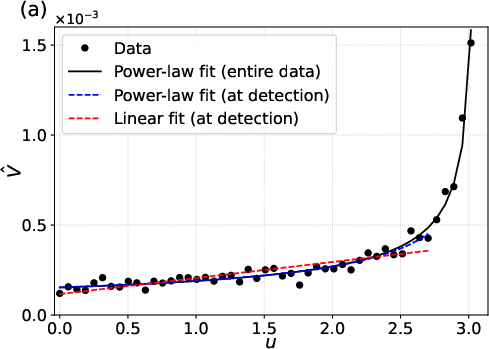
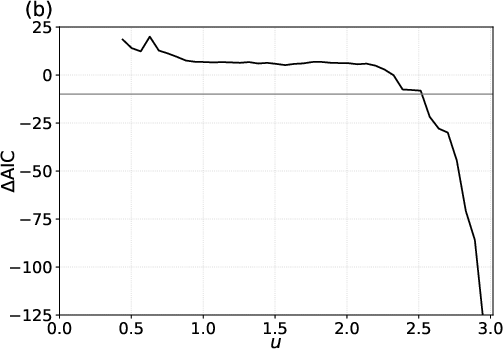
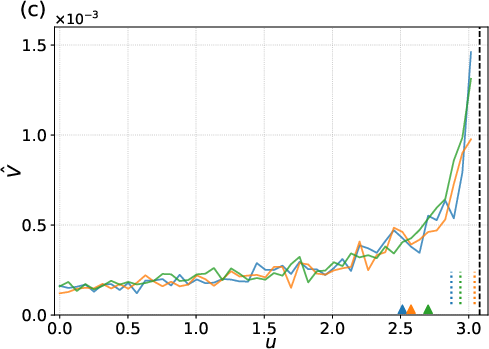
Figure 2: Demonstration of TIPMOC's detection in the stochastic double-well system; increasing variance precedes imminent bifurcation, with detected udet and forecasted u^c.
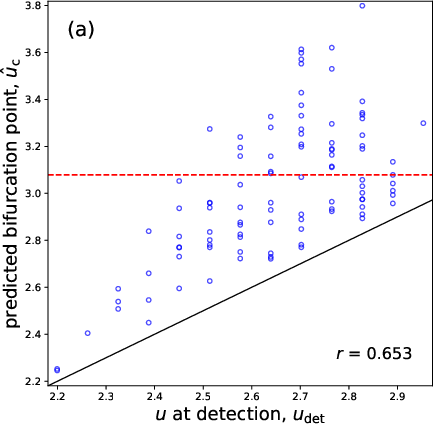
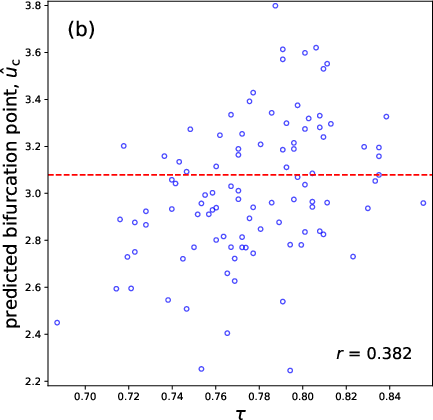
Figure 3: Distribution of udet and u^c across 100 runs; early detection trades off prediction accuracy.
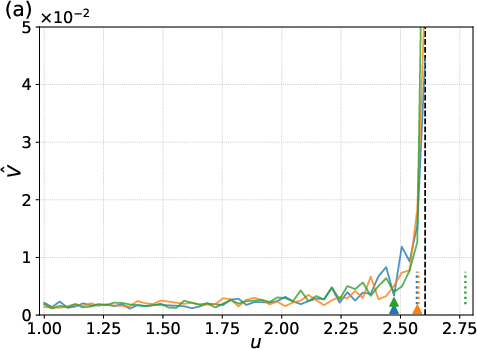
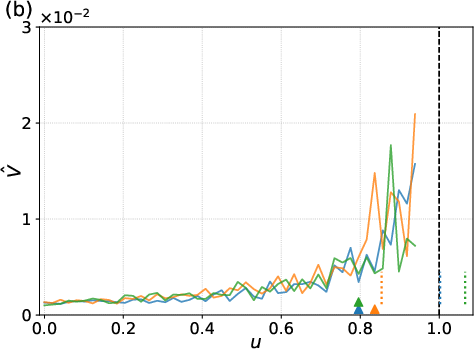
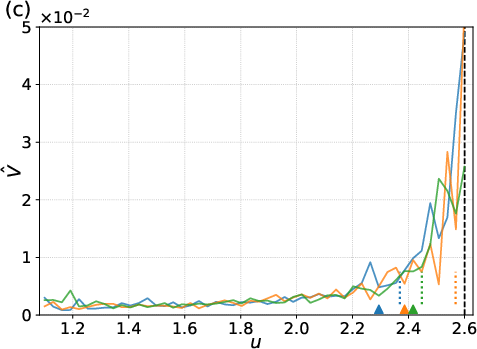
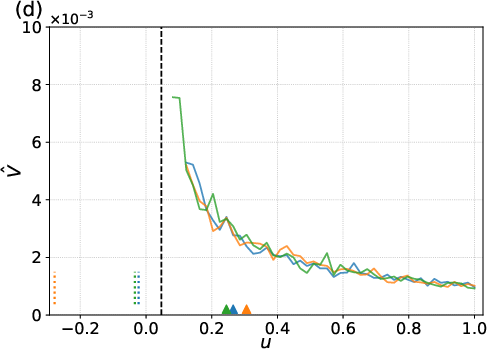
Figure 4: TIPMOC's variance dynamics across systems with various bifurcation types and detection outcomes.
Robustness is evaluated against (i) uneven spacing of the control parameter (TIPMOC remains functional by presumptive equidistant sampling), (ii) colored noise (detection rate remains high but forecast accuracy degrades), and (iii) non-bifurcating systems (TIPMOC exhibits zero false positives, contrasting with high τ rates). Across all systems, TIPMOC achieves high detection rates, low false positives, and moderate spatial accuracy in forecasting u^c.
Scope, Implications, and Integration with Modern AI
TIPMOC's domain of applicability is variance-based EWSs by design; lagged autocorrelation, bounded by [-1,1], lacks the divergence property required for power-law fitting. The theoretical underpinning relates to the scaling of variance with the leading eigenvalue of the system's Jacobian, applicable to saddle-node, transcritical, pitchfork, and Hopf bifurcations in both standard and networked dynamical systems.
TIPMOC offers a transparent, interpretable statistical tool that can be layered onto conventional scalar EWS pipelines, facilitating deployment in practical forecasting scenarios. Its parametric design is complementary to machine learning-based early warning methods: TIPMOC could provide lightweight, sequential input features or serve as a statistical baseline in hybrid frameworks. The prospect of training neural architectures on TIPMOC sequences (rather than raw time series) opens avenues for developing ML variants that directly leverage summary statistic dynamics.
Practically, TIPMOC is suitable for high-frequency monitoring (e.g., remote sensing in ecology, time-resolved network data in epidemiology). Theoretically, its statistical rigor offers an advance over heuristic EWSs, enabling principled adjudication and forecast of regime shifts, although forecast accuracy in estimating u^c is limited by data density and noise characteristics.
Future Directions
Several extensions merit exploration: (i) systematic evaluation of TIPMOC's data-efficiency relative to dynamical or ML-based EWSs; (ii) refinement of power-law fitting optimization and noise-smoothing; (iii) adaptation for spatial and multivariate EWSs; (iv) empirical validation on real-world datasets as dense measurement techniques mature; (v) incorporation into automated, real-time early warning and intervention systems.
The estimation of bifurcation types via the power-law exponent (γ) remains challenging due to variability and data limitations; future work could investigate classification algorithms that exploit TIPMOC's fitted parameters in bifurcation taxonomy.
Conclusion
TIPMOC constitutes a statistically grounded framework for the detection and forecasting of tipping points in complex dynamical systems based solely on sample variance. It overcomes limitations of traditional scalar EWS performance metrics, provides robust detection across bifurcation types and challenging noise regimes, and produces interpretable forecasts with low false positives. As both a standalone and complementary method to model-based and machine learning early warning schemes, TIPMOC enhances the practical and theoretical toolkit for anticipating critical transitions. Applications and further methodological development will depend on advancements in data acquisition and integration with AI-based forecasting infrastructures.
(2602.10817)