- The paper introduces a quantum token model that leverages quantum no-cloning and measurement disturbance to provide unforgeable, information-theoretic authentication.
- It compares various physical platforms, including REI-doped crystals, diamond color centers, and superconducting systems, highlighting key metrics like coherence times and state fidelity.
- The review analyzes discrete and continuous encoding schemes and advocates hybrid integration with post-quantum cryptography to overcome practical scalability challenges.
Practical Quantum Tokens: Physical Layer Challenges and Architectures
Introduction and Motivation
The concept of quantum tokens, originating from proposals on unforgeable quantum banknotes, leverages no-cloning and measurement-disturbance to provide information-theoretic authentication and anti-forgery guarantees. The paper "Practical quantum tokens: challenges and perspectives" (2602.10621) presents a multi-system, physical-layer view on quantum token architectures, surveying the state of the art in device realization, memory technologies, encoding protocols, and security primitives. Unlike post-quantum cryptographic approaches based on computational hardness, quantum tokens—tied intrinsically to the laws of quantum mechanics—promise fundamentally stronger protection against duplication and eavesdropping. The review is highly technical, addresses the interplay of quantum memory, photonic interface, and encoding protocols, and assesses both the progress and constraints in practical realizations.
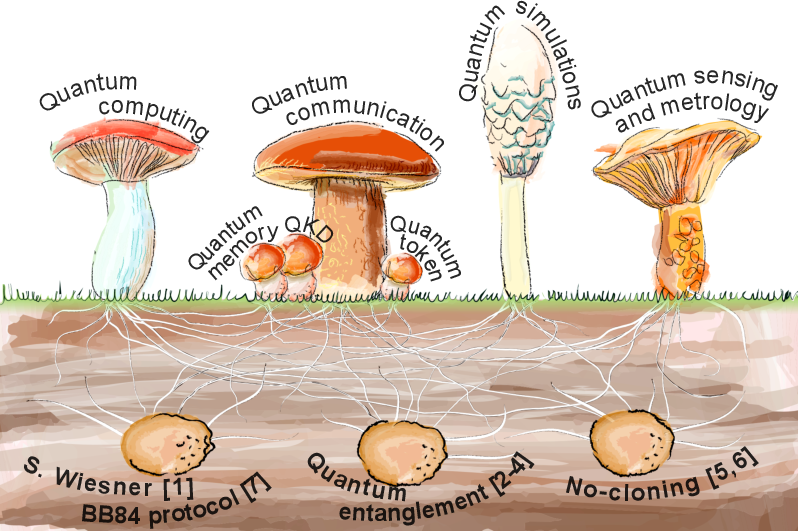
Figure 1: The structure of quantum information fields and their technological/cryptographic subfields as related to quantum tokens.
Core Architecture and Token Model
The quantum token model is defined as a device containing a quantum memory that stores a codebook of selected quantum states. Three essential elements are delineated: (i) the storage unit (quantum memory), (ii) a transmission channel, and (iii) an encoding/verification protocol, supporting flexible composition based on use case.
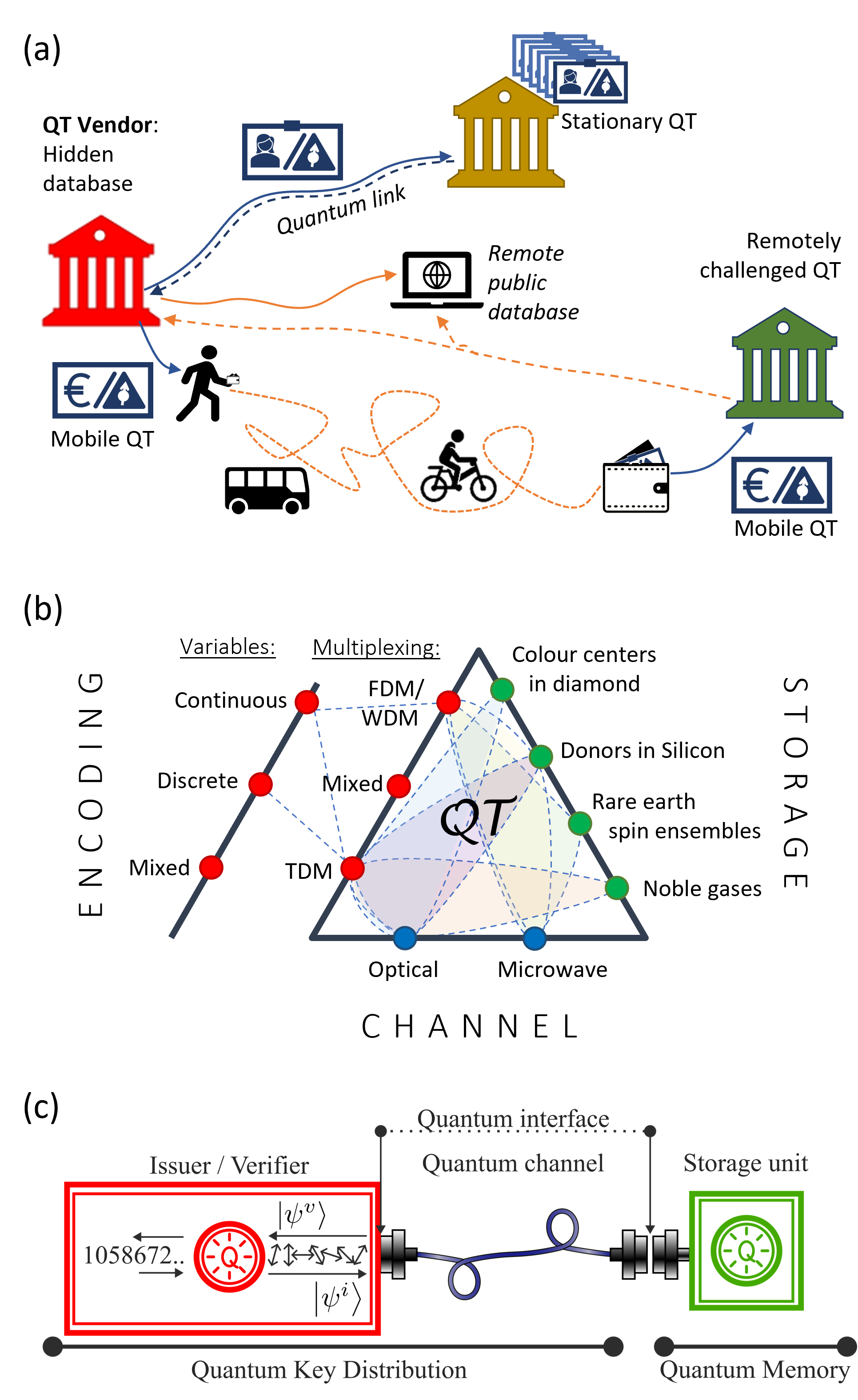
Figure 2: (a) Implementation scenarios for quantum tokens (flying or stored); (b) taxonomy of system-level encoding/channel/memory design; (c) physical realization including issuer, verifier, and the transmission/storage stack.
The central performance metrics are quantum state fidelity (defined via trace overlap of density matrices), write-read efficiency, the memory register “qubit count” parameter, and effective bit-rate—each constraining practical implementations due to memory decoherence, loss, and imperfect control.
Long-Lived Quantum Memories in the Optical and Microwave Domains
The review systematically compares candidate quantum memories for token storage:
- Rare-earth-ion (REI) doped crystals: Multi-hour spin coherence (Eu3+:YSO achieves >18-hour coherence under ZEFOZ and dynamical decoupling), cavity-enhanced single-ion detection, and massively multiplexed AFC/EIT storage. Bulk and integrated photonic structures, including waveguides, microcavities, and nanobeams, offer scalable, efficient interfaces.
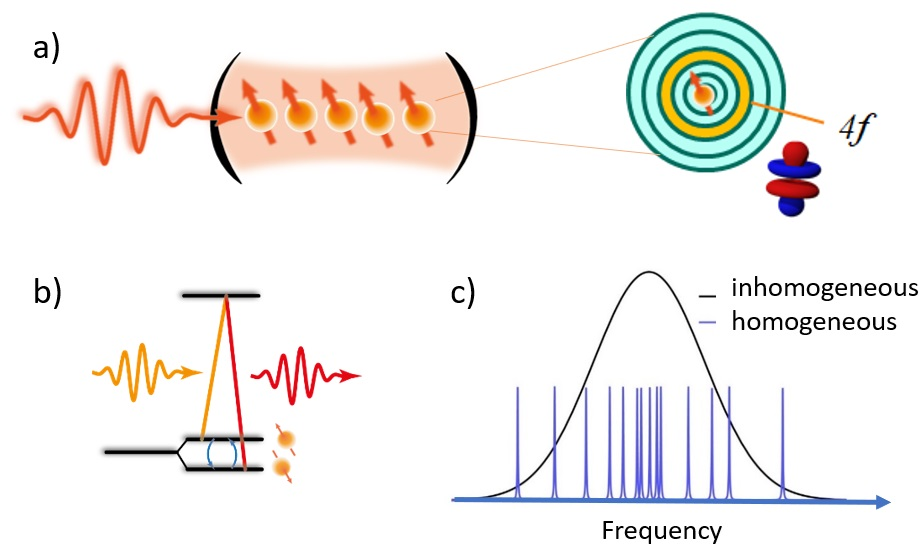
Figure 3: (a) Single-ion storage in an REI cavity; (b) spin-photon interface Λ-system; (c) homogeneous and inhomogeneous broadening for dense addressing.
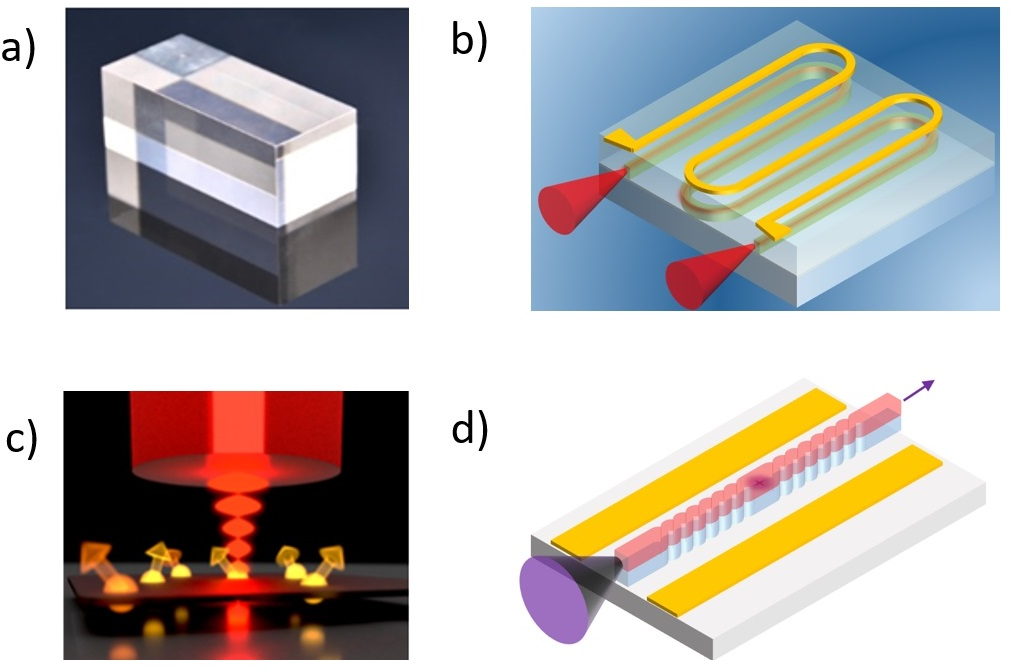
Figure 4: Realizations: (a) bulk crystals (multiplexing/long-lived); (b) photonic chips with integrated RF; (c) fiber-cavity/membrane; (d) LiNbO3 nanobeam cavity.
- Diamond color centers (NV, SiV, SnV, GeV, PbV): Diamond color centers with coupled nuclear spins enable robust electron-to-nuclear coherence transfer. Near-surface nanostructures (nanopillars, waveguides) enable efficient initialization/readout. For ensembles-per-token, copy attacks can be detected via elevated quantum projection noise. Protocol-level security is experimentally confirmed, with error rates below 10−22 for false acceptance and >0.999 for authentic tokens.
- Superconducting/microwave systems: Squeezed-state microwave encodings offer efficient local networking for quantum-LAN architectures using GHz quantum links. Solid-state electron/nuclear spin memories (e.g., donors in 28Si) achieve up to seconds-scale coherence and can employ either time- or frequency-multiplexing.
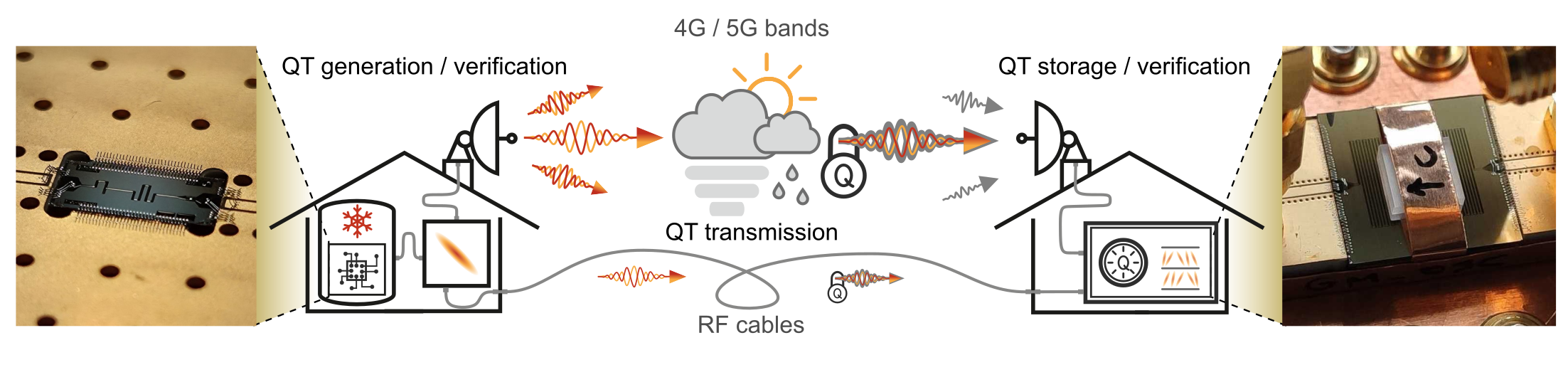
Figure 5: Applicability of microwave quantum tokens for secure short-range communication over classical or free-space GHz links.
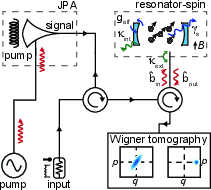
Figure 6: Experimental scheme: JPA-based generation of propagating squeezed/displaced microwaves, transfer to spin-resonator memory, and Wigner function tomography.
Room-Temperature and Mobile Tokens
Atomic vapor cell architectures (alkali–noble gas) circumvent cryogenic constraints, achieving up to hour-scale nuclear spin coherence through spin-exchange optical pumping and hybrid alkali/noble-gas ensembles. This direction supports truly mobile or consumer-grade quantum tokens in principle.
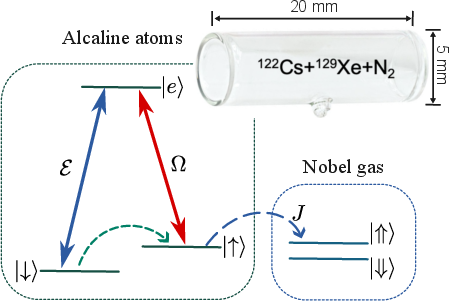
Figure 7: Spin-exchange protocol: optical photon stored in alkali ensemble, coherently mapped to noble gas nuclear spin for long-lived, room-temperature operation.
Token Encoding and Security Analysis
Encoding is bifurcated into discrete-variable (DV) and continuous-variable (CV) schemes. The BB84 protocol for DV encoding and squeezed-state-based CV encodings are both utilized, with corresponding strengths and weaknesses regarding loss tolerance and hardware overhead.
Security is grounded in quantum no-cloning and unambiguous state discrimination bounds; the review highlights that in ensemble- or multi-use tokens, sophisticated analysis allows for recycling or partial verification via non-demolition measurements, as in the shadow tomography framework [Aaronson, STOC 2018].
Public/private token models and their relationships to classical PUFs, QR-PUFs, and fully quantum physical unclonable functions (qPUFs) are examined in detail. qPUFs aim for challenge–response authentication with formal security models, but realistic physical instantiations remain to be proven.
(Figures 14, 15)
Figure 8/15: Schematic authentication flow for qPUF and conjugate-coding QR-PUF paradigms.
Engineering Constraints and Hybridization with Post-Quantum Cryptography
A major focus is the gap between laboratory demonstrations (often requiring dilution refrigeration, high-vacuum cryostats, or strong fields) and practical scalability. Bulk/cryogenic systems offer best lifetimes, while photonic integration and atomic vapor approaches trade lifetime for deployability.
Hybrid cryptography incorporating quantum tokens with PQC is advocated for high-security environments, especially where the cost and infrastructural overhead of quantum hardware is justified by the need for unforgeable hardware tokens and long-term data security. The analysis notes that PQC migration is easier for classical hardware, but tokens offer authentication/anti-repudiation capabilities not achievable via computational complexity.
Strategic Assessment and Future Perspectives
The aggregation of architectures and protocols—optical, microwave, atomic, solid-state/diamond, hybrid photonic—demonstrates that quantum tokens are theoretically and experimentally versatile but face device-level scaling and environmental robustness challenges. Integration with nanophotonics, progress toward long-lived room-temperature registers, and co-design with PQC/post-quantum authentication schemes are identified as the key directions.
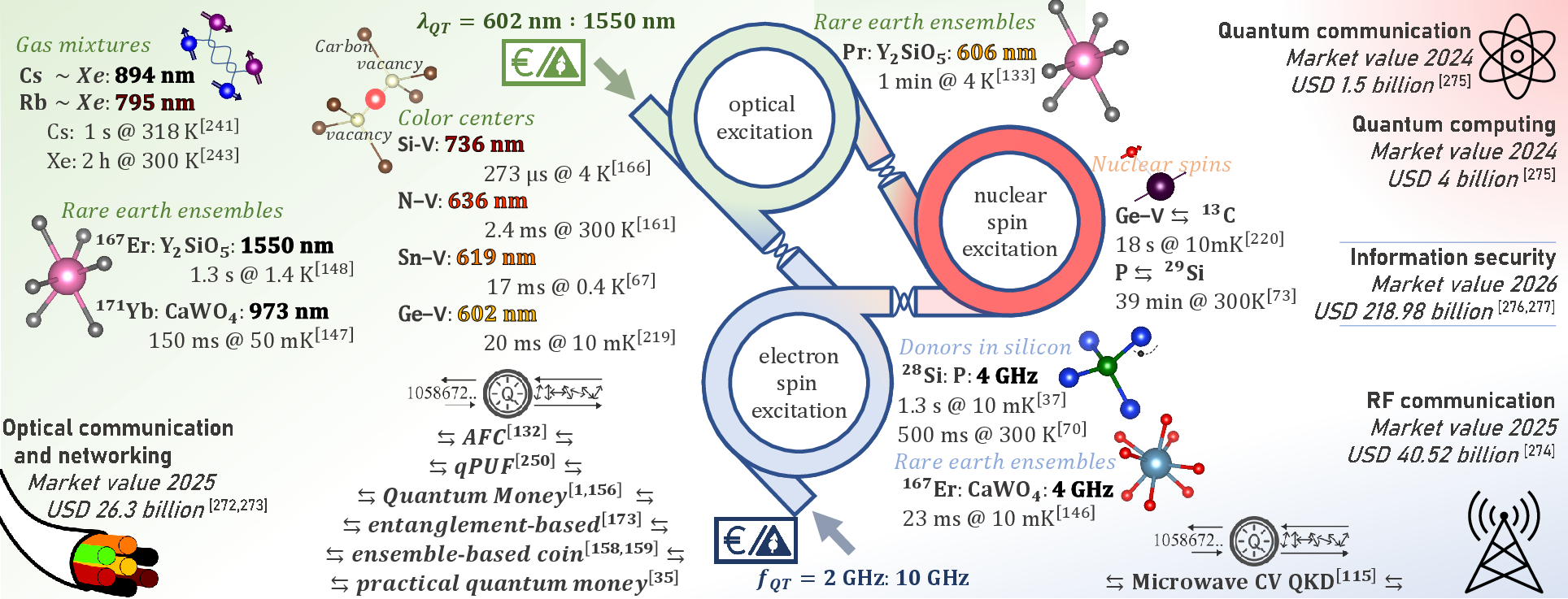
Figure 9: Comprehensive overview of quantum token realizations—their encoding domains, quantum memory substrates (optical/microwave, nuclei/electron spins), storage benchmarks, and technological maturity.
Conclusion
Quantum tokens present a distinct physical-layer primitive that fundamentally alters the trust and security landscape for cryptographic authentication. The paper systematically establishes a reference architecture, compares competing memory/encoding stacks, quantifies practical storage/transfer/performance bottlenecks, and establishes the operational requirements for scalable deployments (2602.10621). As quantum network infrastructure matures and device engineering advances, practical quantum tokens are poised to become essential for high-assurance authentication, hardware-based anti-counterfeiting, and irreproducible identity verification—likely operating in parallel with PQC for layered, future-proof information security architectures. The ongoing challenge is to optimize coherence, efficiency, and manufacturability while retaining the unique information-theoretic security benefits intrinsic to quantum hardware tokens.

