Disturbing news about the $d=2+ε$ expansion II. Assessing the recombination scenario
Abstract: In [De Cesare, Rychkov (2025)], we revisited the $d=2+ε$ expansion in the $O(N)$ Non-Linear Sigma Model (NLSM), emphasizing the existence of a protected operator which is a closed form with $N-1$ indices. The scaling dimension of this operator stays exactly equal to $N-1$, independently of $ε$. Its existence is problematic for the identification of the NLSM fixed point in $d=2+ε$ with the Wilson-Fisher fixed point family obtained by analytically continuing from near $d=4$, which does not possess such a protected operator. Multiplet recombination is one scenario discussed in [De Cesare, Rychkov (2025)], which could allow to connect the two families continuously (although not analytically). In this scenario, the protected dimension is lifted at some critical value of $ε$, thanks to the short conformal multiplet of scaling dimension $N-1$ eating a long conformal multiplet of higher scaling dimension. In this followup work, we assess this scenario for the cases $N=3$ and $N=4$. We identify the lowest candidates for the long multiplet which could be eaten, and compute their one-loop anomalous dimensions. We find that at one loop, scaling dimensions of these candidates grow with $ε$, while it should decrease down to $N$ for the recombination to occur. We conclude that multiplet recombination is unlikely.
Paper Prompts
Sign up for free to create and run prompts on this paper using GPT-5.
Top Community Prompts
Explain it Like I'm 14
What this paper is about
This paper studies two famous families of physics theories that describe how systems behave when you zoom in very close (like looking at a magnet or a fluid near a critical point):
- The O(N) Non-Linear Sigma Model (NLSM) in a world with a little more than 2 dimensions, written as d = 2 + ε.
- The Wilson–Fisher (WF) theory in a world with a little less than 4 dimensions, written as d = 4 − ε.
For a long time, many scientists thought these two families were really the same theories, just seen from different “sides.” The authors argue that, at least for N = 3 and N = 4, they are probably not the same.
The big questions the authors ask
In simple terms, the authors ask:
- The NLSM (near 2 dimensions) has a special “pattern” (called a protected operator) whose “size under zooming” (its scaling dimension) always stays exactly N − 1, no matter how close we are to 2 dimensions. The WF theory (near 4 dimensions) doesn’t have such a permanently protected pattern.
- Could a special event called “multiplet recombination” make the NLSM’s special pattern lose its protection as we move away from 2 dimensions, so the two theory families could still connect smoothly?
Put even more simply: Is there a believable way for the NLSM’s special feature to disappear as we change dimension, so it can match the WF theory?
How they investigated it (methods in everyday language)
Think of these theories as collections of “patterns” built from basic building blocks, like LEGO pieces (fields and their derivatives). Each pattern has a scaling dimension telling you how it looks when you zoom in or out. A “protected” pattern is like a LEGO model whose size doesn’t change, no matter how you tweak a certain knob (ε).
The recombination idea says: maybe the protected pattern stops being special when it “merges” with another larger collection of patterns. To test this, the authors:
- Wrote down all possible candidate patterns that could merge with the protected one. These candidates must have very specific features (like being a kind of N-index “shape” and having the right symmetries).
- Carefully sorted out which candidates are truly independent “primary” patterns (originals) and which are “descendants” (patterns that are just total derivatives, like copies made by taking a simple pattern and adding an overall extra operation).
- Computed how the sizes of these primary candidates change when you turn the ε knob a little. This change is called the anomalous dimension and is calculated at “one loop,” which you can think of as the first meaningful correction beyond the simplest picture.
- Used standard tools (like expanding the theory in simpler unconstrained fields, tracking how operators mix, and evaluating the leading corrections) to get precise answers.
Analogy: Imagine you’re testing whether a special song in a playlist loses its “protected” volume level by blending into a bigger mashup. You first find the most likely song it could blend with, and then you measure whether its volume goes up or down when you slowly turn a global knob. If it needs to go down to match another playlist but instead goes up, the mashup story doesn’t work.
What they found and why it matters
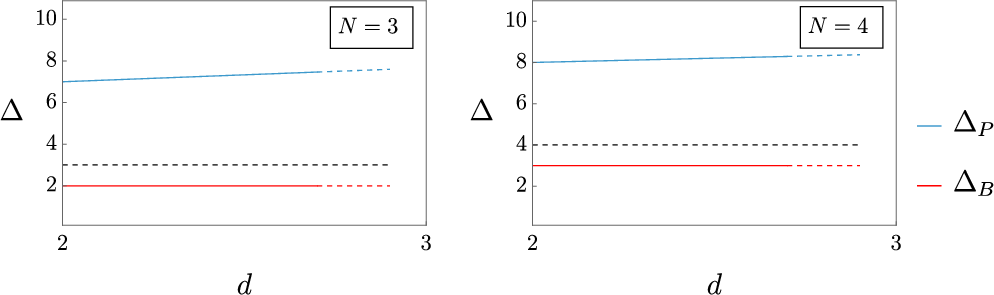
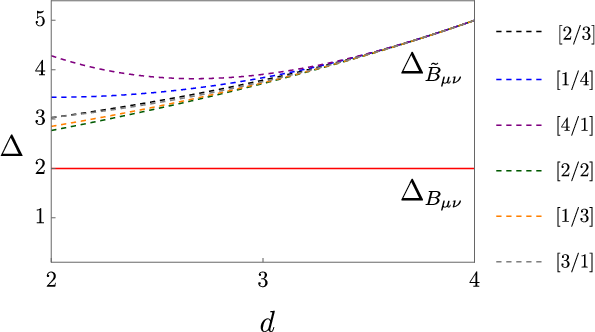
The authors focused on N = 3 and N = 4, the two simplest interesting cases. For recombination to work, the “partner” pattern’s scaling dimension needs to decrease down to Δ = N at some point between 2 and 3 dimensions. Instead, they found the opposite: the dimensions go up as ε increases.
Here is a short summary of the key numbers they found at one loop:
- For N = 3:
- The lightest candidate primary has classical dimension 7 + 2ε.
- Its one-loop correction makes its total dimension: Δ = 7 + (2/3)ε.
- This increases with ε, and never drops near Δ = 3 as recombination would require.
- For N = 4:
- The lightest candidate primary has classical dimension 8 + (5/2)ε.
- Its one-loop correction makes its total dimension: Δ = 8 + (5/12)ε.
- Again, this increases with ε, and doesn’t approach Δ = 4 as needed.
Why this matters: If recombination were going to rescue the “same-theory” idea, these candidate dimensions would need to go down to N. They don’t—at least not at one loop—so recombination looks unlikely.
To make the case even stronger for N = 3, the authors point to other recent, independent calculations done from the WF side (near 4 dimensions) up to five loops. Those results also suggest that the matching operator stays above the protected value and doesn’t meet it in the middle. That’s more evidence against the two families being the same.
What this means going forward
- The simplest way to connect the NLSM (near 2D) to the WF theory (near 4D) by “recombination” seems not to work for N = 3 and N = 4.
- This strongly suggests that, in the range 2 < d < 4, these are actually different theories—not two views of the same thing.
- For N = 3 and N = 4, even the “maybe they only match exactly at d = 3” idea doesn’t hold, because the protected operator is still present at d = 3 on the NLSM side but absent on the WF side.
- Future work could:
- Check higher-loop corrections (to see if a surprise reversal happens—unlikely but not impossible).
- Use non-perturbative tools like the conformal bootstrap to look for a distinct NLSM-type theory in three dimensions.
- Extend the analysis to larger N, though that gets more technically challenging.
Simple takeaway
The authors looked for a believable way for the special NLSM pattern to lose its protection so the NLSM and WF theories could still be the same. Their careful calculations for N = 3 and 4 say: that probably doesn’t happen. So these two famous theory families are most likely different in 2 < d < 4.
Knowledge Gaps
Knowledge gaps, limitations, and open questions
Below is a focused list of what remains unresolved or insufficiently explored in the paper, framed to guide concrete future work:
- Limited N coverage:
- Only N=3 and N=4 are analyzed. No general argument or computation exists for arbitrary N, especially for N≥5 where the protected operator becomes evanescent at d=3 and the “coincide only at d=3” scenario remains conceivable.
- Lack of a scalable method to construct and classify all independent primaries with the required quantum numbers for generic N.
- Perturbative truncation:
- Anomalous dimensions are computed only at one loop. It is unknown whether two- or higher-loop corrections could qualitatively change the trend (e.g., reverse the sign or cause accelerated decrease) for the candidate long multiplets.
- No resummation or error analysis (e.g., Padé–Borel, scheme variation) is performed to control finite-ε extrapolations (ε≈1).
- Completeness of recombination candidates:
- Only the “lightest” N-form primaries with N+4 derivatives are considered. It is not proven that no heavier primary (or linear combination thereof) with the same quantum numbers could decrease fast enough with ε to enable recombination at finite ε.
- No systematic scan of the full space of primaries in the N-form, O(N) pseudoscalar sector at p=N+4 and beyond to exclude unexpected crossings with Δ=N at some ε∈(0,1).
- Operator mixing and basis construction:
- The assumption r_P=1 (only one primary in the relevant sector) holds for N=3,4 but is untested for larger N.
- The matrices A and B in the mixing (which govern descendants and the mixing between primaries and total derivatives) are not computed; the explicit form of the primaries (beyond their anomalous dimensions) is unavailable, limiting cross-checks (e.g., two-point normalizations, OPE coefficients).
- The assumption M(Dj) ≥ M(O) and the non-degeneracy of the leading component of O compared to Dj are used but not proven generically; criteria ensuring these assumptions for other N or operator families are lacking.
- Evanescent operators and dimensional continuation:
- While evanescent operators are kept at generic d, their quantitative impact on mixing and anomalous dimensions near integer d (especially d=3) is not fully analyzed.
- Potential subtleties in how evanescent sectors influence finite-ε flows and recombination conditions are not explored.
- Methodological cross-checks and reproducibility:
- The OPE-based computation is only partially cross-checked with momentum-space Feynman diagrams; a complete independent verification is not provided.
- The explicit operator bases, linear-algebra reduction data, and intermediate coefficients (beyond final anomalous dimensions) are not made available, making replication or extension challenging.
- Wilson–Fisher side constraints:
- The five-loop WF results used to constrain N=3 rely on Padé approximants; uncertainty quantification and sensitivity to approximant choice is not systematically assessed.
- For N=4, analogous WF data for the three-index operator are currently unavailable; computing these (e.g., at multi-loop order) remains an open task to test continuity from the 4−ε side.
- Non-perturbative and bootstrap tests:
- No non-perturbative constraints (e.g., numerical bootstrap bounds with the protected operator as external, or mixed-correlator analyses distinguishing WF vs NLSM) are presented for d=3; such tests could confirm or refute the existence of a distinct 3d CFT for N=3,4.
- The authors’ proposed “merger and annihilation” scenario (disappearance of the NLSM CFT at d=d_) remains unquantified; higher-order computations or bootstrap bounds on candidate marginal singlets are needed to determine whether d_ < 3 or d_* > 3.
- Representation-theoretic no-go:
- There is no general, representation-theoretic proof (independent of perturbation theory) that multiplet recombination cannot occur for N=3,4 at any ε∈(0,1). A no-go theorem using conformal shortening conditions, unitarity bounds, and selection rules would close this loophole.
- Alternative recombination pathways:
- The analysis assumes recombination of the closed (N−1)-form occurs only via an N-form primary of dimension Δ=N. Other nonstandard routes (e.g., multi-operator or evanescent-mediated recombinations, or recombination involving operators outside the minimally constructed sector) are not systematically excluded.
- Additional physical ingredients:
- Possible effects of topological terms (e.g., θ-terms for O(3)) or other deformations on operator spectra and recombination are not discussed.
- The role of global subtleties (e.g., cohomological constraints on forms, Hodge dualization effects across d) in constraining or enabling recombination is not fully exploited.
- Roadmap to generalization:
- No automated or algebraic framework (e.g., conformal harmonic analysis, group-theoretic operator counting, or Hilbert series for constrained fields) is provided to streamline operator-basis construction and mixing computations for higher N or higher-derivative sectors.
Practical Applications
Immediate Applications
The following actionable applications can be deployed now, leveraging the paper’s findings, methods, and computational workflows:
- Operator-basis construction and pruning for constrained field theories
- Sector: Academia (high-energy and condensed matter theory), Software (symbolic computation for EFT/CFT)
- Application: Implement the paper’s rank-based linear-algebra procedure to construct independent operator bases in non-linear sigma models and other constrained EFTs (e.g., SMEFT, chiral EFT), including elimination via equations of motion and symmetry identities.
- Tools/products/workflows:
- A software module that translates constrained fields into unconstrained variables (e.g., sphere constraint via π-fields), normalizes denominators, and computes ranks to produce a minimal independent basis.
- Integration with symbolic packages (Mathematica/SymPy) and EFT operator-basis libraries to automate basis reduction with anti-symmetrized indices and evanescent operators.
- Assumptions/dependencies: Valid for generic non-integer d; relies on correctness of constraint resolution and linear independence in the π-expansion; evanescent operators must be handled consistently.
- Block-diagonal mixing-matrix workflow for primary/descendant separation
- Sector: Academia, Software
- Application: Use the paper’s structured basis that separates total derivatives from non-total-derivative operators to compute one-loop mixing matrices in a block form, enabling fast identification of primaries.
- Tools/products/workflows:
- A library routine that constructs the basis B_N, computes the A/B/C blocks, and extracts anomalous dimensions from C, ensuring total derivatives renormalize autonomously.
- Assumptions/dependencies: Minimal subtraction and dimensional regularization; basis completeness within the chosen operator class; reliable differentiation between total derivatives and non-derivatives.
- Position-space OPE method for one-loop anomalous dimensions
- Sector: Academia, Software
- Application: Adopt the OPE-based position-space technique to compute one-loop counterterms for composite operators, reducing diagrammatic overhead for complicated tensor structures.
- Tools/products/workflows:
- An OPE engine that automates the three-step procedure: Wick contractions with derivative counting, targeted Taylor expansion to match classical dimensions, and rotationally invariant integrals (e.g., ∫dd y |y|{-d}).
- Benchmarks for operators with anti-symmetric indices and Levi-Civita structures, cross-checking against momentum-space Feynman diagrams.
- Assumptions/dependencies: Valid in perturbation theory at one loop; correctness of OPE truncation to terms producing ε-poles; requires careful handling of tensorial combinatorics.
- Universality-class auditing for 3D O(N) systems using protected-operator diagnostics
- Sector: Academia (condensed matter, statistical physics), Education
- Application: Reassess mappings of 3D spin systems (e.g., Heisenberg magnets) to O(N) CFTs, using the presence/absence of protected operators and their dimensions to distinguish NLSM O(N) CFTs from WF O(N) CFTs for N=3,4.
- Tools/products/workflows:
- A “universality audit” checklist: examine whether experimental/numerical correlators admit a short multiplet protected operator (closed (N−1)-form; for N=3 its Hodge dual is a conserved current; for N=4 a pseudoscalar), and compare against WF expectations.
- Assumptions/dependencies: Paper’s one-loop conclusion of “no multiplet recombination” for N=3,4; requires careful interpretation of experimental/numerical data and finite-size/lattice artifacts.
- Benchmarking and calibration for multiloop/EFT renormalization tools
- Sector: Software (EFT/CFT codebases), Academia
- Application: Use the paper’s N=3,4 anomalous dimensions and “no-recombination” result as benchmarks to validate multiloop renormalization frameworks (e.g., those following Henriksson et al.), including Padé-based extrapolations across dimensions.
- Tools/products/workflows:
- Test suites comparing OPE-based one-loop outputs with momentum-space computations and with WF-side multiloop results for analogous operator representations.
- Assumptions/dependencies: Reliability of Padé approximants and scheme choices; consistency of operator matching across different CFT families.
Long-Term Applications
The following applications require additional research, scaling, or development before deployment:
- Discovery and characterization of a distinct O(N) CFT in 3D via bootstrap
- Sector: Academia (conformal bootstrap, high-energy/condensed matter theory)
- Application: Non-perturbative bootstrap searches for O(N) CFTs distinct from WF, using correlators with the protected operator as an external operator to impose sharp constraints and identify or exclude candidate CFTs in d=3.
- Tools/products/workflows:
- Bootstrap pipelines incorporating protected-operator correlators (N=3: conserved current after Hodge dualization; N=4: pseudoscalar), crossing equations, and unitarity bounds tailored to the operator’s short-multiplet structure.
- Assumptions/dependencies: Existence of consistent solutions to crossing with protected operators; computational scalability of high-precision bootstrap with mixed correlators.
- Mapping critical phenomena in materials to non-WF universality classes
- Sector: Materials science/condensed matter
- Application: Identify materials or lattice models whose critical behavior aligns with NLSM O(N) CFT features (protected operators, distinct spectra), refining theory-to-experiment matching beyond WF universality.
- Tools/products/workflows:
- Joint experimental-theory workflows to measure correlators sensitive to the protected operator; lattice Monte Carlo or tensor-network studies targeting operator spectra and conserved quantities implied by protected multiplets.
- Assumptions/dependencies: Accessibility of clean critical regimes; ability to measure operator-sensitive observables; robustness against disorder and anisotropies.
- Automated operator-basis generation for general N and higher-derivative sectors
- Sector: Software (symbolic/HPC), Academia
- Application: Generalize the paper’s operator-basis counting to larger N and operators with more derivatives, enabling automated enumeration and pruning in broad EFT/CFT settings (including evanescent operators).
- Tools/products/workflows:
- Scalable symbolic/HPC software that handles large tensor spaces, anti-symmetrizations, identities, and rank computations after constraint resolution; APIs to EFT packages.
- Assumptions/dependencies: Efficiency of symbolic linear algebra at scale; correctness of handling evanescent operators and dimension-dependent identities; careful design to avoid combinatorial explosion.
- Higher-loop and non-perturbative tests of recombination and merger/annihilation scenarios
- Sector: Academia
- Application: Extend anomalous-dimension computations beyond one loop; study candidate marginal operators driving CFT disappearance via merger/annihilation at d=d*, clarifying whether the NLSM O(N) CFT survives to d=3.
- Tools/products/workflows:
- Multiloop perturbative pipelines; functional RG; lattice and bootstrap studies of near-marginal operators; comparative analyses across dimensions.
- Assumptions/dependencies: Convergence and scheme stability of higher-loop series; control of non-perturbative effects; accurate operator identification across dimensions.
- Curriculum and training modules on advanced operator-mixing/OPE techniques
- Sector: Education
- Application: Develop graduate-level materials and computational labs that teach operator-basis construction, block-diagonal mixing, and position-space OPE methods with realistic, high-complexity examples (NLSM, EFTs).
- Tools/products/workflows:
- Open-source notebooks and problem sets; integration with symbolic computation libraries; comparative exercises (position-space OPE vs momentum-space diagrams).
- Assumptions/dependencies: Availability of robust teaching software and datasets; alignment with evolving theory curricula.
- Cross-verification pipelines between WF and NLSM families across dimensions
- Sector: Academia, Software
- Application: Systematically compare operator spectra and dimensions via Padé-improved multiloop results on the WF side and OPE/mixing computations on the NLSM side to assess (non-)continuity between families for various N and operator representations.
- Tools/products/workflows:
- A “CFT family comparator” toolkit that ingests operator data, performs analytic continuation checks, and flags protected-operator conflicts or recombination requirements.
- Assumptions/dependencies: Accurate operator matching rules; reliability of continuation methods; standardized conventions across codebases and papers.
Glossary
- 1-particle irreducible (1PI): A Feynman diagram that remains connected after cutting any single internal line, representing genuinely interacting contributions. "The second contribution comes instead from the one-particle irreducible (1PI) diagrams and reads"
- 1-particle reducible (1PR): A Feynman diagram that becomes disconnected when a single internal line is cut, often removed by field renormalization. "The first arises from one-particle reducible (1PR) diagrams and is canceled by the wave-function renormalization of the elementary fields"
- anomalous dimension: The quantum correction to an operator’s scaling dimension due to interactions. "We identify the lowest candidates for the long multiplet which could be eaten, and compute their one-loop anomalous dimensions."
- antisymmetrization: The process of antisymmetrically summing over index permutations (e.g., for differential forms). "operators with derivatives, antisymmetrized and 4 contracted."
- beta function (β-function): The function describing how a coupling varies with energy scale under renormalization. "and the -function reads"
- closed form: A differential form whose exterior derivative vanishes. "a protected operator---a closed form with indices"
- conformal bootstrap: A nonperturbative method that constrains CFT data using consistency of operator product expansions and crossing symmetry. "by using the conformal bootstrap"
- conformal field theory (CFT): A quantum field theory invariant under the conformal group, with scale and angle-preserving symmetries. "In conformal field theory, the dimension of a protected operator which is a primary of a short multiplet of the conformal group can only be lifted if this multiplet recombines with extra states"
- conformal multiplet: A set of operators related by the action of conformal generators, organized into primaries and descendants. "the short conformal multiplet of scaling dimension eating a long conformal multiplet of higher scaling dimension"
- descendant (operator): An operator obtained by acting with spacetime derivatives on a primary within the same multiplet. "But this operator is a descendant \cite{paper1}."
- dimensional regularization: A technique to regulate divergences by continuing spacetime dimension to non-integer values. "In dimension regularization and minimal subtraction, the counterterm will take the form"
- evanescent operator: An operator that vanishes in specific integer dimensions but is nontrivial for generic non-integer d. "it will be an evanescent operator."
- exterior derivative: The differential operator on forms that generalizes the curl and divergence, mapping p-forms to (p+1)-forms. "The operator is the exterior derivative."
- fixed point: A point in coupling space where beta functions vanish and the theory is scale-invariant. "evaluate it at the fixed point \eqref{eq:FP}"
- Hodge dualization: The mapping between p-forms and (d−p)-forms via the Hodge star operator. "after Hodge dualization, the protected operator becomes a conserved current"
- Kronecker delta: The identity tensor δ that contracts indices and enforces equality, used in O(N) index contractions. "contracting indices either with the Kronecker delta or with the Levi-Civita epsilon:"
- Levi-Civita tensor: The totally antisymmetric tensor used to define pseudoscalars and forms. "contracted using a number of Kronecker tensors and exactly one Levi-Civita tensor."
- long multiplet: A generic (unshortened) conformal multiplet without shortening conditions, whose primary’s dimension is unprotected. "turning into a long multiplet ."
- minimal subtraction: A renormalization scheme that removes only the divergent parts (poles in ε) of loop integrals. "In dimension regularization and minimal subtraction, the counterterm will take the form"
- mixing matrix: The matrix relating bare and renormalized composite operators that mix under the RG flow. "This mixing can be encoded by the mixing matrix, which relates renormalized and bare operators."
- multiplet recombination: A phenomenon where a short multiplet becomes long by absorbing additional states as parameters change. "Multiplet recombination is one scenario discussed in \cite{paper1}, which could allow to connect the two families continuously"
- Non-Linear Sigma Model (NLSM): A field theory describing maps into a curved target manifold with constraints, here with O(N) symmetry. "the Non-Linear Sigma Model (NLSM), emphasizing the existence of a protected operator"
- N-form Lorentz representation: The Lorentz representation carried by an antisymmetric tensor with N indices (an N-form). "the lightest primary operator () in the -form Lorentz representation"
- O(N) symmetry: An orthogonal global symmetry acting on N-component fields. "the symmetric sigma-model with the target space "
- operator product expansion (OPE): The short-distance expansion expressing products of local operators as sums over local operators. "position-space operator product expansion (OPE)"
- Padé approximation: A rational-function approximation used to resum series and improve convergence. "obtained via a Padé approximation"
- primary operator: An operator annihilated by special conformal generators; the highest-weight state of a conformal multiplet. "which should also be a primary."
- pseudoscalar: A scalar under rotations that flips sign under improper transformations (like reflections), often built with Levi-Civita tensors. "Under the global rotation it is a pseudoscalar."
- pullback: The operation of transporting a differential form from the target manifold to spacetime via the field map. "constructed as a pullback of the volume form on the target manifold."
- renormalization group (RG) flow: The change of theory parameters and operators with energy scale, described by beta functions. "A generic set of operators ... mix under the RG flow."
- scaling dimension: The exponent characterizing how an operator scales under dilations; equals classical plus anomalous dimensions. "The scaling dimension of this operator stays exactly equal to , independently of ."
- short multiplet: A conformal multiplet obeying a shortening condition that protects the primary’s dimension. "a primary of a short multiplet of the conformal group"
- tadpole: A loop diagram consisting of a single propagator attached to a vertex, often arising from contracting fields within the same operator. "giving rise to a tadpole, which can be evaluated straightforwardly."
- target manifold: The curved space into which sigma model fields map; here e.g., the sphere S{N−1}. "constructed as a pullback of the volume form on the target manifold."
- ultraviolet (UV) fixed point: A scale-invariant point governing the high-energy behavior of the theory. "constructing perturbative conformal theories as UV fixed points of Non-Linear Sigma Models"
- wave-function renormalization: The rescaling of fields to absorb divergences in their two-point functions. "wave-function renormalization of the elementary fields"
- Wilson–Fisher (WF) fixed point: The interacting fixed point of scalar theories near four dimensions obtained in the 4−ε expansion. "Wilson-Fisher (WF) fixed point analytically continued from "
Collections
Sign up for free to add this paper to one or more collections.

